
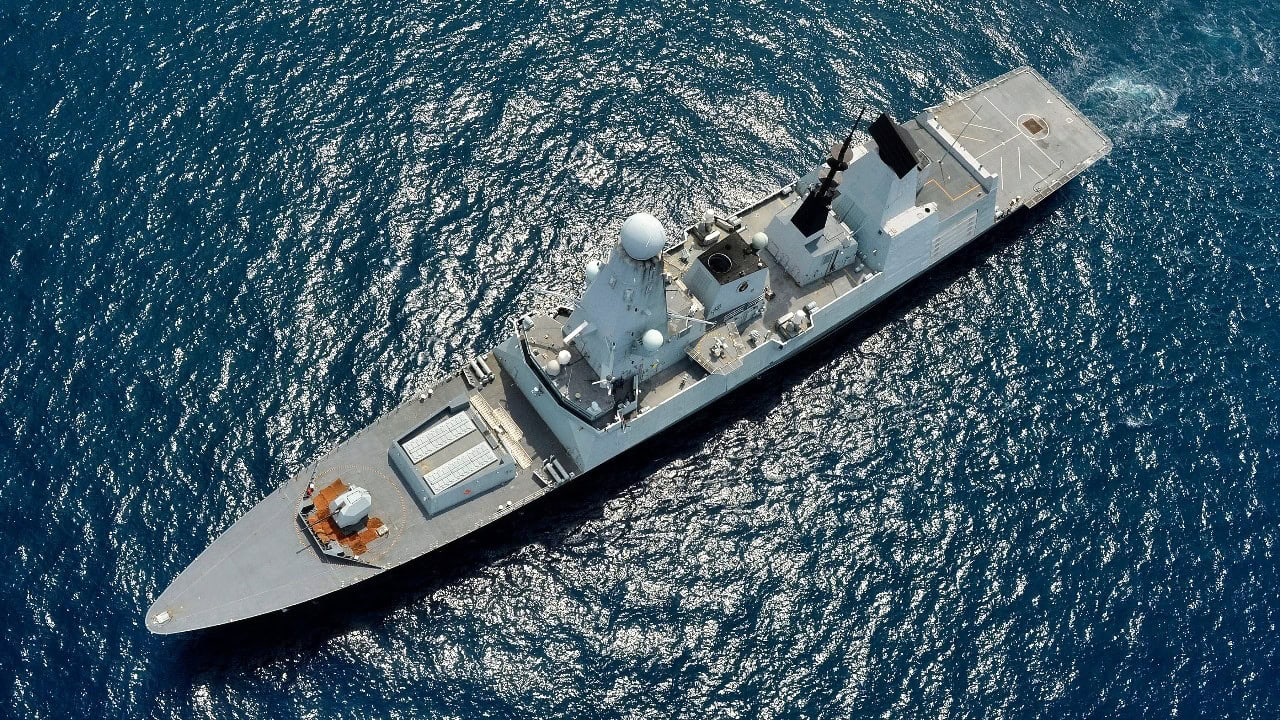
The HMS Daring (Type 45 lead ship) entered service in 2009 as one of the world’s most advanced air defense destroyers.
The vessel was designed to protect carrier strike groups from mass missile and aircraft attacks, but instead has become synonymous with years in dry dock, propulsion failures, and chronic delays.
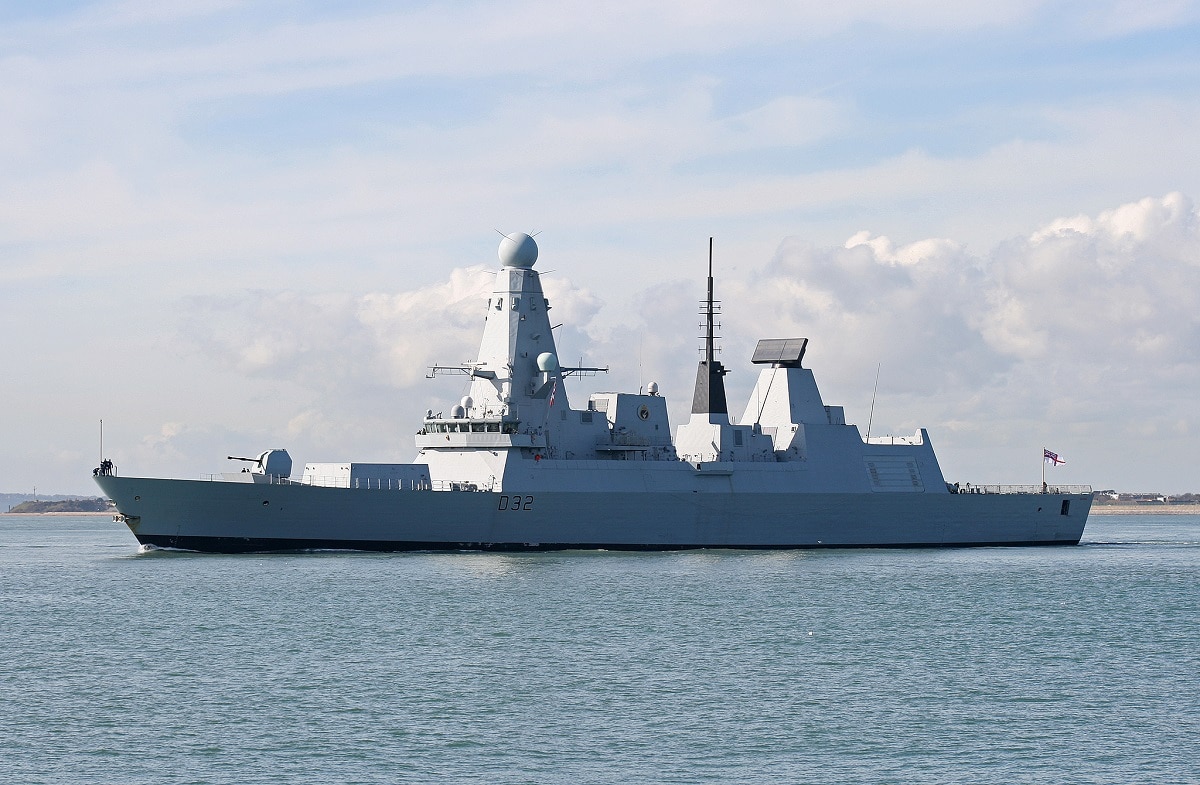
HMS Daring (D32), a stealth design of area defence anti-aircraft destroyer of the Royal Navy, outward bound from Portsmouth Naval Base, UK.
This decades-long saga speaks to deeper problems with Britain’s defense industrial base, procurement system, and shrinking naval workforce—further proof that Britain’s Navy has long since been displaced as the world’s finest.
Built to Defend the Fleet
The Type 45’s mission was to replace the aging Type 42 destroyers after lessons learned during the Falklands War.
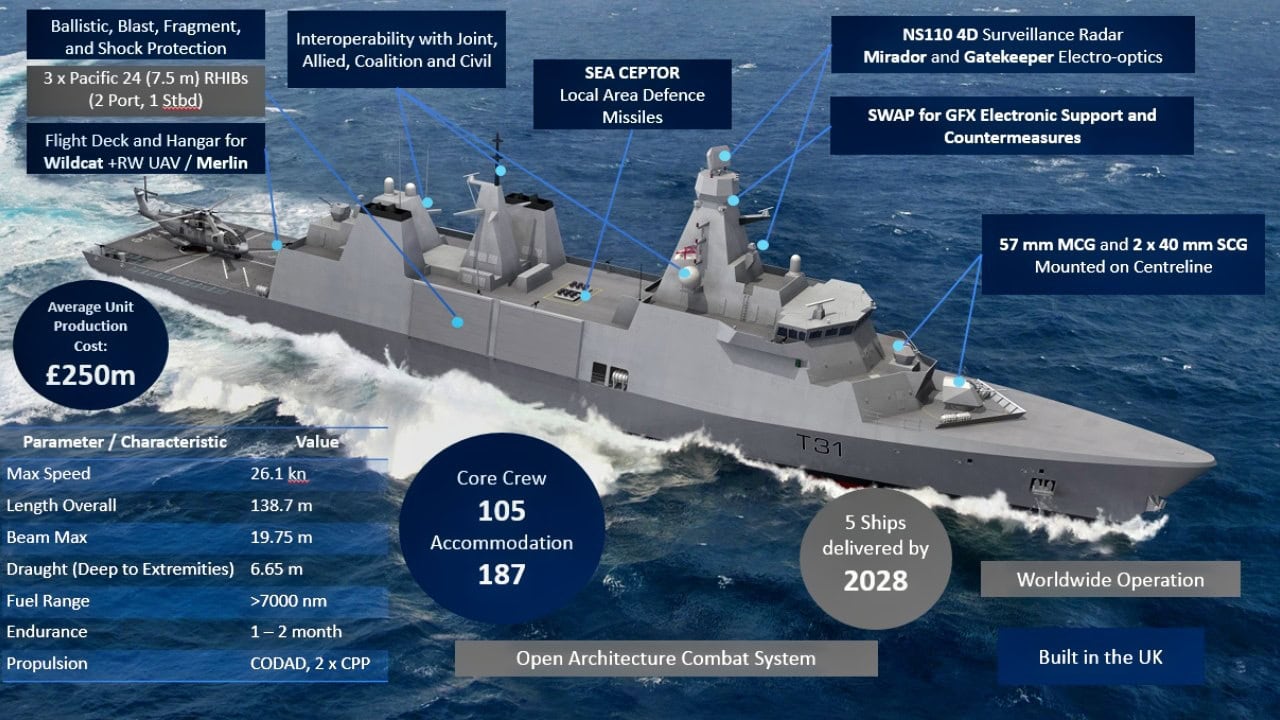
Type 31 Frigate. Image Credit: Royal Navy.
The primary mission of the Type 45 is to provide fleet air defense, ballistic and cruise missile defense, and escort aircraft carriers.
Indeed, the Type 45 is among the most sophisticated air defense ships ever built, featuring advanced combat systems like the SAMPSON multifunction radar capable of tracking hundreds of targets and the Sea Viper missile system.
Additionally, the PAAMS combat architecture integrates radar, missiles, and fire control.
In sum, the vessel is intended to counter saturation missile attacks from modern adversaries.
The British took a gamble with the Type 45 propulsion system, however.
The integrated electric propulsion (IEP) features gas turbines and diesel generators to create electricity, while electric motors drive the propeller shafts.
The benefits promised from the IEP were fuel efficiency, quieter operations, simplified power distribution, and future growth for sensors and directed-energy weapons.
But the WR-21 gas turbine had a flaw.
Featuring a revolutionary Rolls-Royce intercooler/recuperator design, the WR-21 was efficient on paper—but vulnerable in sustained hot-weather operations. Obviously, this sensitivity to hot weather placed a massive handicap on the entire system.
Persian Gulf deployments placed heavy thermal loads on air coolers, reducing their cooling efficiency and causing turbines to experience thermal spikes.
Then, the automated protection system shut engines down to prevent catastrophic damage, making it hard for the entire vessel to operate properly, as ships could lose propulsion and electrical power simultaneously, causing radar, sensors, and combat systems to become temporarily unavailable.
Remarkably, the quirk meant that a premier air-defense destroyer constantly ran the risk of becoming a powerless “dark ship”—all because it was hot outside.
Addressing the Problems
The defect could not simply be fixed through software updates.
Instead, engineers literally had to cut open each destroyer’s hull and install three additional diesel generators.
This Power Improvement Project (PIP) represented one of the largest warship engineering retrofits undertaken in decades. This forced years in dry dock. The HMS Daring entered extended maintenance in 2017.
Roughly eight years passed without operational deployment, meaning the vessel spent more time undergoing reconstruction than serving at sea.
This demonstrates how costly design mistakes can be, rippling throughout the entire fleet.
But the problem wasn’t confined only to engineering; there was a procurement problem, too.
In the case of the HMS Daring, the Ministry of Defense embraced ambitious, relatively unproven propulsion technology.
Naturally, the pursuit of cutting-edge capability increased the program’s technical risk, and once the flaw emerged, it was already baked into the entire program.
Fixing the problem placed significant pressures on the British industrial base.
Complex naval repairs require specialized shipyards, and long maintenance queues reduce fleet availability. As the incident demonstrated, high-end warships become strategically irrelevant when unavailable for deployment.
A Ship Without a Fleet
The completion of the refit did not immediately return the Daring to service—because she still needed roughly 190 trained sailors.
This need was complicated by the Royal Navy’s recruitment and retention problems. The solution lay in part in cannibalizing the rest of the fleet.
Sailors were reassigned from other ships while the training pipeline was extended before sea trials.
Obviously, having a seaworthy vessel is only one requirement for fielding it.
Operational strength depends not just on ships but on trained sailors, maintenance capacity, and industrial support. Weakness in any one area can drastically inhibit combat power.
The saga speaks to a more general institutional weakness.
While the HMS Daring remains among the world’s most capable air-defense destroyers on paper, that capability simply doesn’t matter if the ship is confined to dry dock.
MORE – Japan Took a Battleship and Rebuilt It Into an Aircraft Carrier
About the Author: Harrison Kass
Harrison Kass is a writer and attorney focused on national security, technology, and political culture. His work has appeared in Tablet, City Journal, The Hill, The Spectator, and The Cipher Brief. He holds a JD from the University of Oregon and a master’s in Global & Joint Program Studies from NYU. More at harrisonkass.com.