
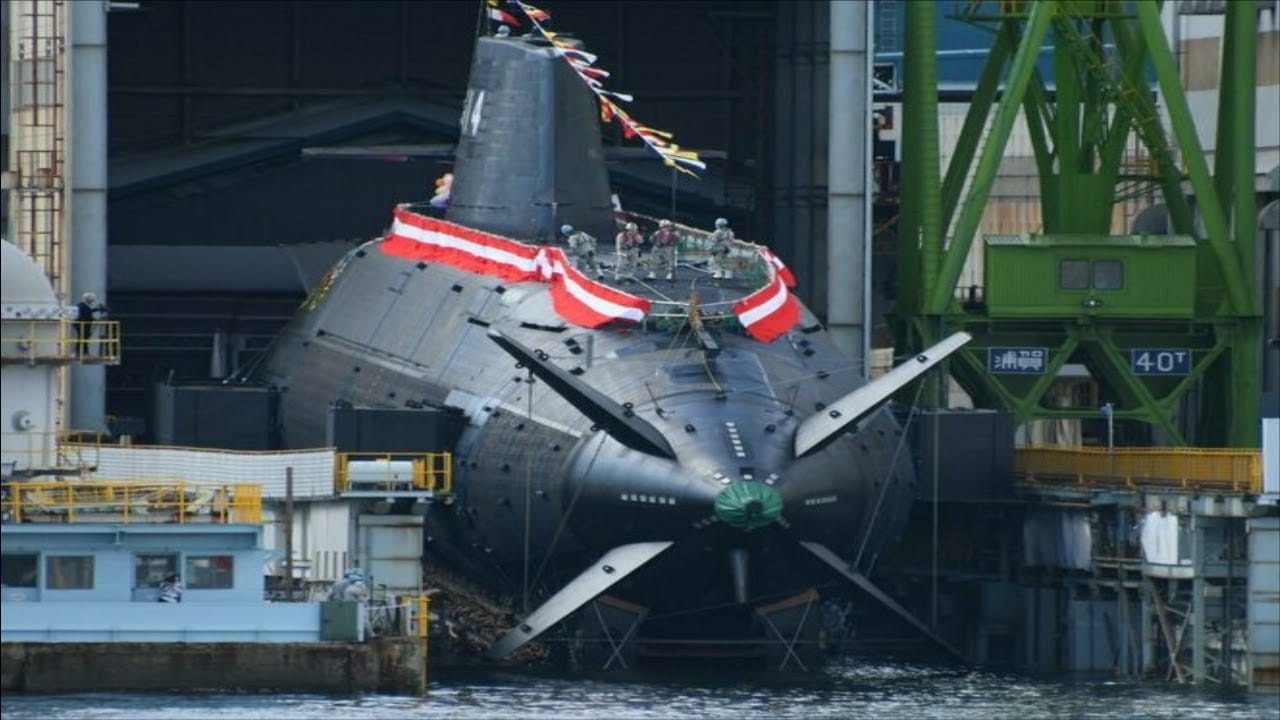
Japan’s Taigei-class diesel-electric attack submarine represents the latest stage of Japanese specialization in conventional undersea warfare.
Measuring roughly 84 meters long and displacing about 3,000 tons surfaced and 4,200 tons submerged, the Taigei is optimized for quiet operations in the narrow seas, straits, and chokepoints of the First Island Chain.

Taigei-Class. Image Credit – Creative Commons.
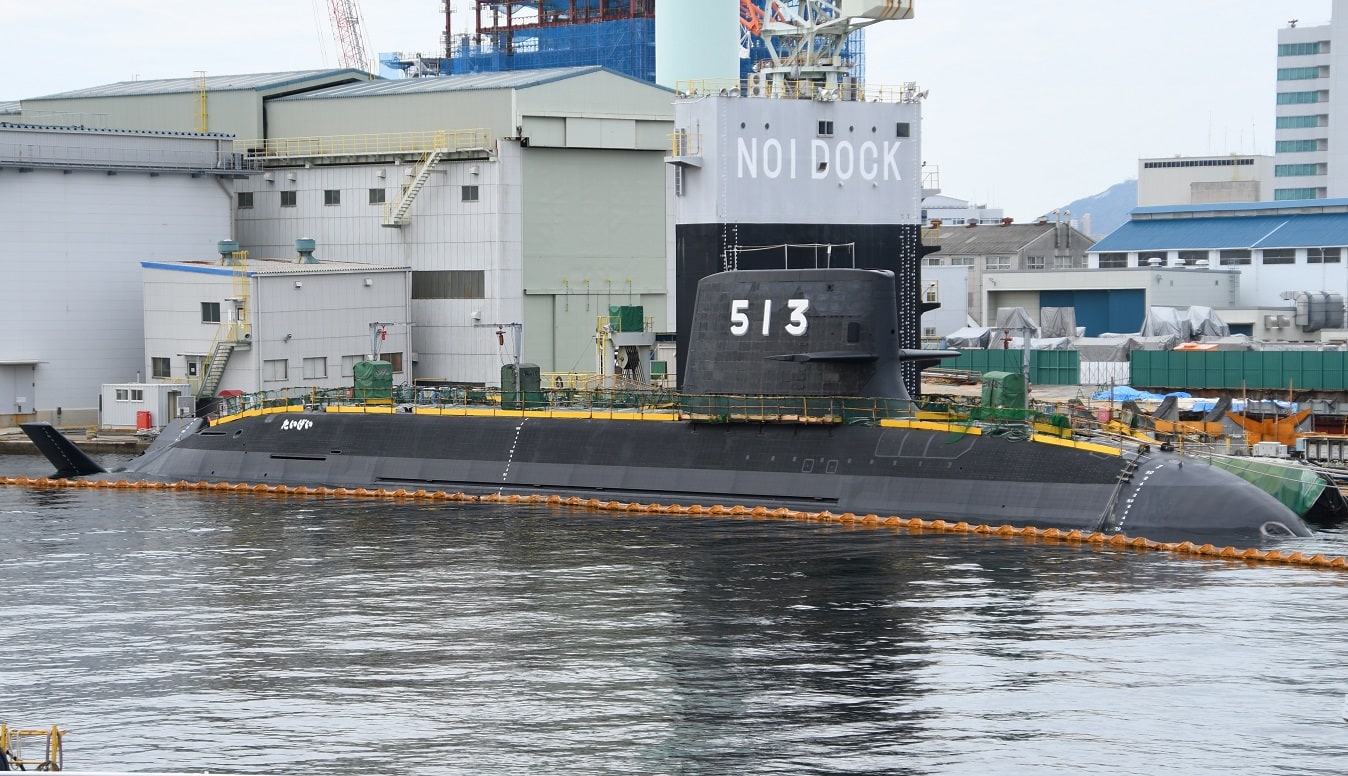
Taigei-class. Image Credit: Creative Commons.
The class’s defining technological feature is its reliance on lithium-ion batteries rather than the Stirling air-independent propulsion system used earlier Soryu-class subs.
While the Taigei lacks the endurance of nuclear-propelled boats, it offers exceptional stealth and underwater performance.
Lithium-Ion Revolution
Japan began its lithium-ion transition with the final Soryu-class submarines Oryu and Toryu, marking a shift away from traditional diesel-electric submarines, which run submerged on batteries and periodically have to snorkel to recharge their diesel engines.
Snorkeling creates opportunities for detection by radar, infrared, and electronic sensors.
While Japan could have elected air-independent propulsion for the Taigei, which uses Stirling engines to generate power underwater without atmospheric oxygen, Japan instead opted for lithium-ion batteries.

Image: Creative Commons.
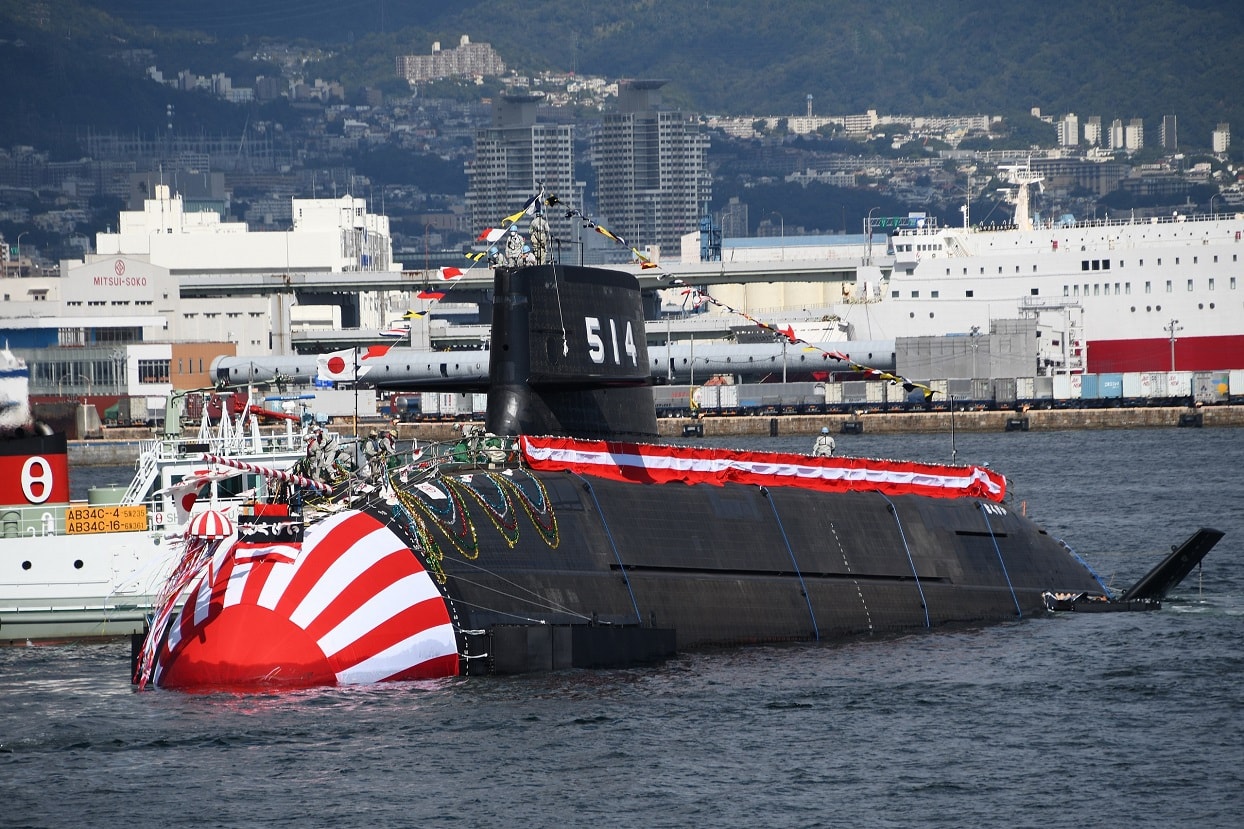
Taigei-Class Submarine. Image: Creative Commons.
Compared with conventional lead-acid batteries, lithium-ion offers greater usable energy density, faster charging, and stronger high-output performance.
This confers tactical advantages—a submarine may need to accelerate rapidly to attack, evade a torpedo, or reposition without exhausting its available battery power.
Therefore, lithium-ion provides Taigei with greater flexibility between recharge cycles.
Eliminating the Stirling AIP system also removes machinery and associated systems from the submarine, reducing weight and complexity.
But the Taigei is still diesel-electric, meaning it must recharge, and while lithium-ion does not eliminate the vulnerability associated with snorkeling, it does reduce it.
Stealth in the Water
Taigei’s effectiveness isn’t about speed but about stealth.
Diesel-electric submarines have a natural advantage: while operating on batteries, they do not require the continuously running reactor-related machinery associated with nuclear propulsion.
Japan has compounded this advantage by paying close attention to machinery isolation and acoustic reduction, which enhances the boat’s stealth performance.
The class reportedly incorporates a floating floor structure that helps isolate machinery vibrations before they propagate to the pressure hull and into the surrounding water, where other vessels can detect them.
Acoustic absorbing materials further reduce the Taigei’s detectability and reduce the effectiveness of hostile active sonar.
Taigei also uses a C-shaped stern control arrangement, which gives the sub strong maneuverability and control—useful in confined or comparatively shallow waters, the type of waters the Taigei was designed to operate in.
Of course, the Taigei is not undetectable, but it was designed to detect before it was detected, thereby giving the Japanese an important advantage in undersea warfare engagements.
Finding the Enemy
To detect the enemy before being detected, the Taigei carries Japan’s ZQQ-8 sonar suite, which combines multiple acoustic sensors rather than relying upon a single bow array.
The broader sensor architecture includes bow, flank, and towed-array elements that allow the submarine to listen across different frequencies and directions.
A towed array is particularly valuable because it places sensitive hydrophones away from much of the submarine’s own machinery and hydrodynamic noise.
Taigei also incorporates modern optronic mast technology, which replaces the classic requirement that the commanding officer physically peer through an optical periscope.
Cameras and electronic sensors let the Taigei gather imagery and other information, which can be displayed throughout the sub’s combat-information spaces.
Against China
Geography makes the Taigei’s capabilities valuable. Japan sits astride China’s maritime approaches to the Pacific, where the Ryukyu Island chain creates natural chokepoints.
So instead of creating subs that could chase Chinese fleets across the open Pacific, Japan crafted a sub that could operate effectively in these shallow, narrow chokepoints.
The Taigei is, in effect, an underwater ambush platform.
The Taigei also shows why Japanese rearmament matters strategically to the United States. Japan provides a complementary capability to US Virginia-class SSNs—conventional submarines optimized for home-region chokepoint defense.
This is a form of allied burden-sharing: Japan will supply local sea denial while the US’s nuclear-propelled boats supply long-range power projection.
Indeed, the Taigei is a platform specifically calibrated for assistance in great power conflict.
About the Author: Harrison Kass
Harrison Kass is a writer and attorney focused on national security, technology, and political culture. His work has appeared in Tablet, City Journal, The Hill, The Spectator, and The Cipher Brief. He holds a JD from the University of Oregon and a master’s in Global & Joint Program Studies from NYU. More at harrisonkass.com.