
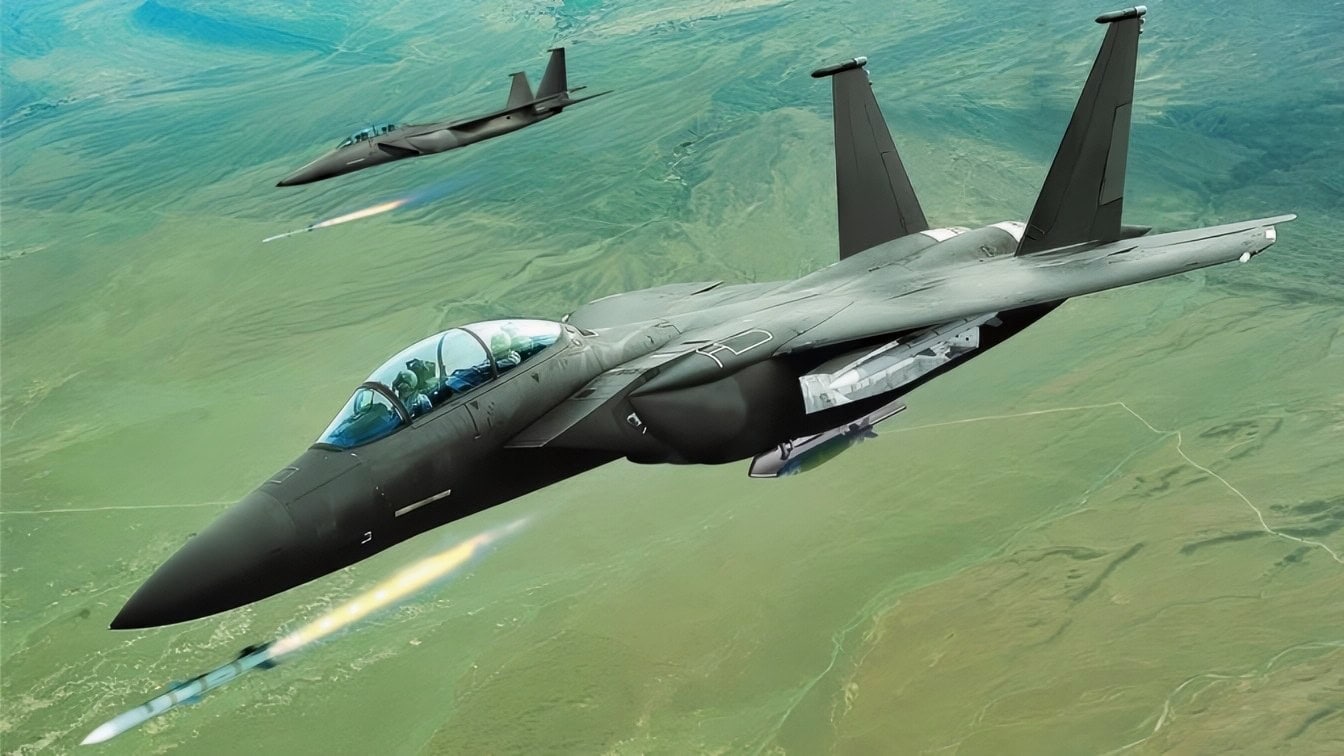
For nearly 50 years, the F-15 Eagle has had one of the most impressive combat records in military aviation, credited with a spotless kill ratio in air-to-air engagements, and it remains in front-line service with the US Air Force.
So when Boeing decided to give its aging warhorse a facelift for the stealth era, expectations were high.
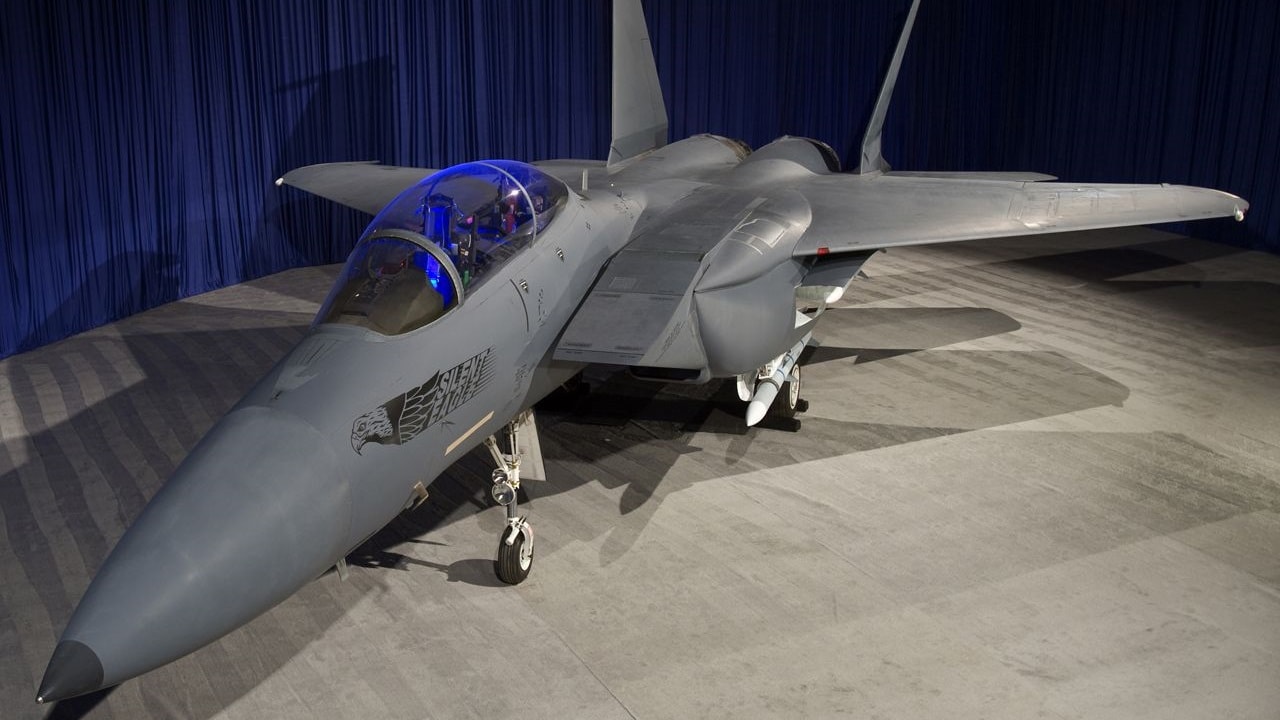
F-15SE Silent Eagle. Image Credit: Creative Commons.
The result was the F-15SE Silent Eagle, an impressive piece of engineering that featured conformal weapons bays, radar-absorbent materials, and outward-canted vertical stabilizers to reduce its radar cross-section.
And yet, it still walked away from every competition it entered without a single order.
The Silent Eagle remains one of modern military aviation’s stranger footnotes: an enhanced, already excellent fighter, but built for a market that had already moved on.
The F-15SE: A 4th-Generation Answer to a 5th-Generation Problem
Boeing unveiled the Silent Eagle publicly in March 2009, pitching it explicitly as an export-oriented alternative for countries that either couldn’t buy the F-22 Raptor (which was banned by the U.S. from foreign sale) didn’t want to pay, or couldn’t afford, the high cost of the F-35.
The idea was simple: take the combat-proven F-15E Strike Eagle airframe and give it enough low-observable characteristics to survive in contested airspace, without the cost, schedule risk, or program complexity of a clean-sheet stealth design.
The engineering approach consisted of three main modifications.
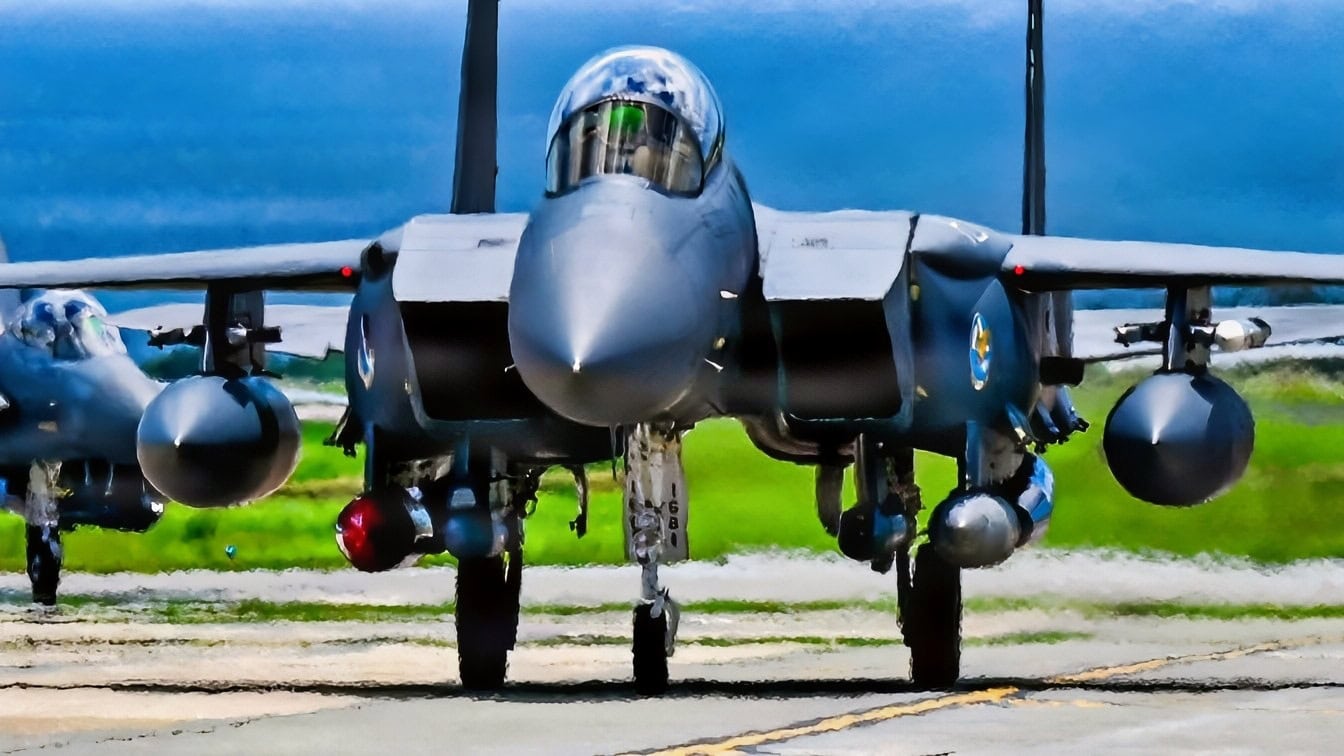
A U.S. Air Force F-15EX Eagle II and F-15E Strike Eagles assigned to 85th Test and Evaluation Squadron, Eglin Air Force Base, Florida, land at Kadena Air Base, Japan, June 29, 2026. The test aircraft arrival supported the Department of War’s effort to modernize U.S. airpower in the Indo-Pacific and prepared Kadena personnel and the local community for the F-15EX’s arrival. (U.S. Air Force photo by Airman 1st Class Gracelyn Hess)
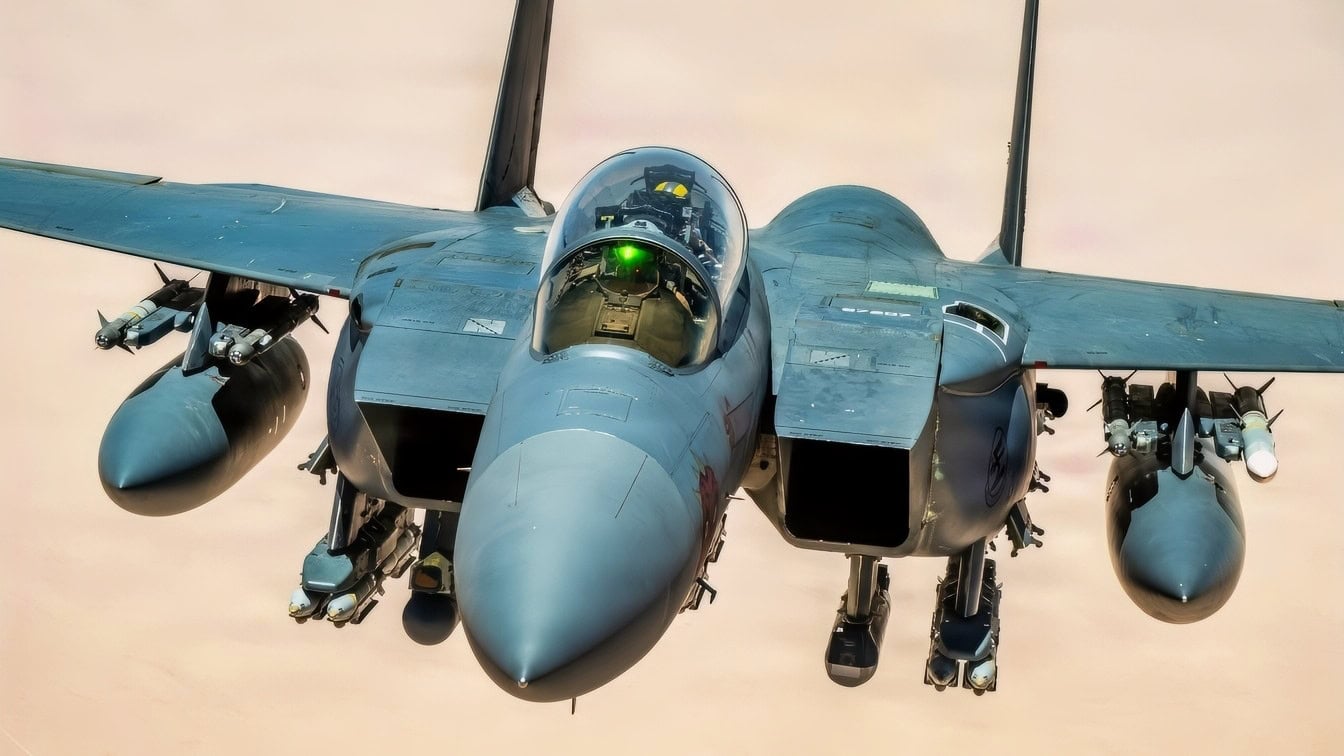
A U.S. Air Force F-15E Strike Eagle aircraft flies in the U.S. Central Command area of responsibility July 15, 2026. (U.S. Air Force photo by Tech. Sgt. Tiffany A. Emery)
First, conformal weapons bays replaced the Strike Eagle’s familiar conformal fuel tanks along the fuselage sides, allowing missiles to be carried internally rather than on external pylons, the internal carriage being one of the simplest ways to cut radar cross-section, since exposed missiles and pylons are some of the biggest radar reflectors on a modern aircraft.
Second, the aircraft’s twin vertical tails were canted outward by 15 degrees, angling flat surfaces away from a head-on radar return.
This increased the Silent Eagle’s range by 75 to 100 nautical miles.
And finally, Boeing applied radar-absorbent material across key sections of the airframe to further suppress the aircraft’s signature.
Boeing also planned an active electronically scanned array radar and an updated electronic warfare suite from BAE Systems, along with fly-by-wire flight controls and lighter, more fuel-efficient construction on new-build airframes.
None of this was meant to make the Silent Eagle invisible to radar the way the F-22 or F-35 were. Boeing was clear that the aircraft’s stealth was a frontal-aspect improvement only, not an all-aspect one.
This reduced detection range to about one-fifth of a traditional F-15, especially in a head-on engagement, but not a true low-observable platform.
The sales pitch was less “we built an F-22 competitor” and more “we built something significantly harder to see, at a fraction of the price and risk.”
Flight Testing and the Push for Sales
Boeing moved reasonably fast. The company filed for a U.S. export license in early 2010, received it that July, and flew its demonstrator aircraft, a modified two-seat F-15E redesignated F-15E1, on its first flight the same month.
Powered by 2 × Pratt & Whitney F100-PW-220 afterburning turbofans, 58,000 pounds of thrust with afterburner, the Silent Eagle would fly at Mach 2.45 (1,650 mph) at altitude or Mach 1.2 (921 mph) at sea level.
That November, the demonstrator successfully launched an inert AIM-120 AMRAAM from its internal weapons bay, proving the concept could actually deploy weapons rather than just carry them.
Boeing also signed a memorandum of understanding with Korea Aerospace Industries that same month to continue developing the weapons bays, a sign of how central the South Korean market was to the whole program. Wind tunnel testing on the bay design wrapped up in mid-2012.
Boeing shopped the Silent Eagle to a short list of traditional F-15 operators and potential new customers: South Korea, Japan, Saudi Arabia, Israel, and Singapore.
The estimated unit cost was around $100 million, and Boeing hoped for a total export market approaching 190 aircraft if even a few of those countries signed on.
South Korea Considers It, But Passes On The F-15SE
The closest the Silent Eagle ever came to an actual order was South Korea’s F-X Phase III competition, a roughly $7.3 billion program launched in 2012 to buy 60 new fighters to replace aging F-4 and F-5 fleets.
The Silent Eagle competed against the Eurofighter Typhoon and the Lockheed Martin F-35A.
Formal bids were submitted in June 2012, and by August 2013 the field had narrowed dramatically: the F-35A was judged too expensive for the program’s budget, and the Typhoon was disqualified over bidding issues, leaving the F-15SE as the sole remaining candidate.
For a brief window, a Boeing win looked like a foregone conclusion. South Korea’s Yonhap News Agency reported the deal had gone through, and at least one industry publication ran a headline announcing Korea had selected the F-15SE.
Then, on September 24, 2013, South Korea’s Defense Acquisition Program Administration announced it was rejecting the sole-bidder outcome entirely and would reopen the competition rather than proceed with an uncontested award.
Two months later, in November 2013, South Korea confirmed it would instead purchase the F-35A, a decision widely attributed to Seoul’s interest in the industrial and technology-transfer benefits of the F-35 program, including support for its indigenous KF-X fighter effort (which eventually became the KF-21).
Why The F-15SE Failed To Find A Buyer
South Korea’s reversal effectively ended the program’s best chance at a foundational order, and the dominoes fell. Japan, Saudi Arabia, Israel, and Singapore all eventually chose the F-35 as well, drawn by its genuine all-aspect stealth, sensor fusion, and the strategic value of being inside the F-35’s growing international partnership network rather than operating a one-off variant with a market of, at best, a handful of countries.
While it aimed to offer a more affordable, multi-role stealth capability than fifth-generation fighters like the F-22 or F-35, it was too expensive for its limited stealth. Potential buyers, including South Korea and Saudi Arabia, passed it over, preferring either cheaper traditional jets or fully stealthy platforms.
A fourth-generation-plus fighter with only partial stealth was a hard sell once air forces saw that a genuine fifth-generation option was within reach, even at a higher price.
Boeing formally shelved the Silent Eagle program around 2015, without ever building a production airframe beyond the single F-15E1 demonstrator.
Boeing Rolled Its Work Into The F-15 EX
The company didn’t abandon the underlying F-15 upgrade work, though.
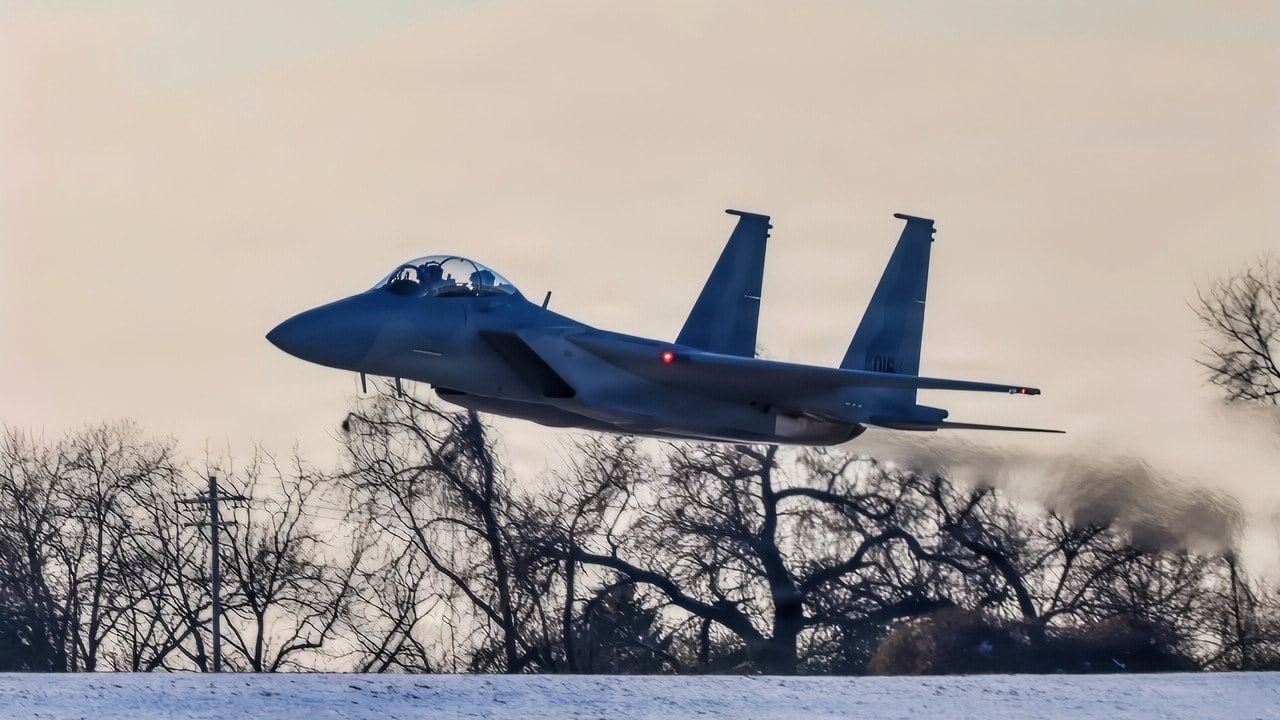
An F-15EX departs for Portland Air National Guard Base. The U.S. Air Force, in partnership with Boeing and the Defense Contract Management Agency, has resumed F-15EX Eagle II deliveries to the Portland Air National Guard Base, overcoming recent production delays. (Courtesy photo)
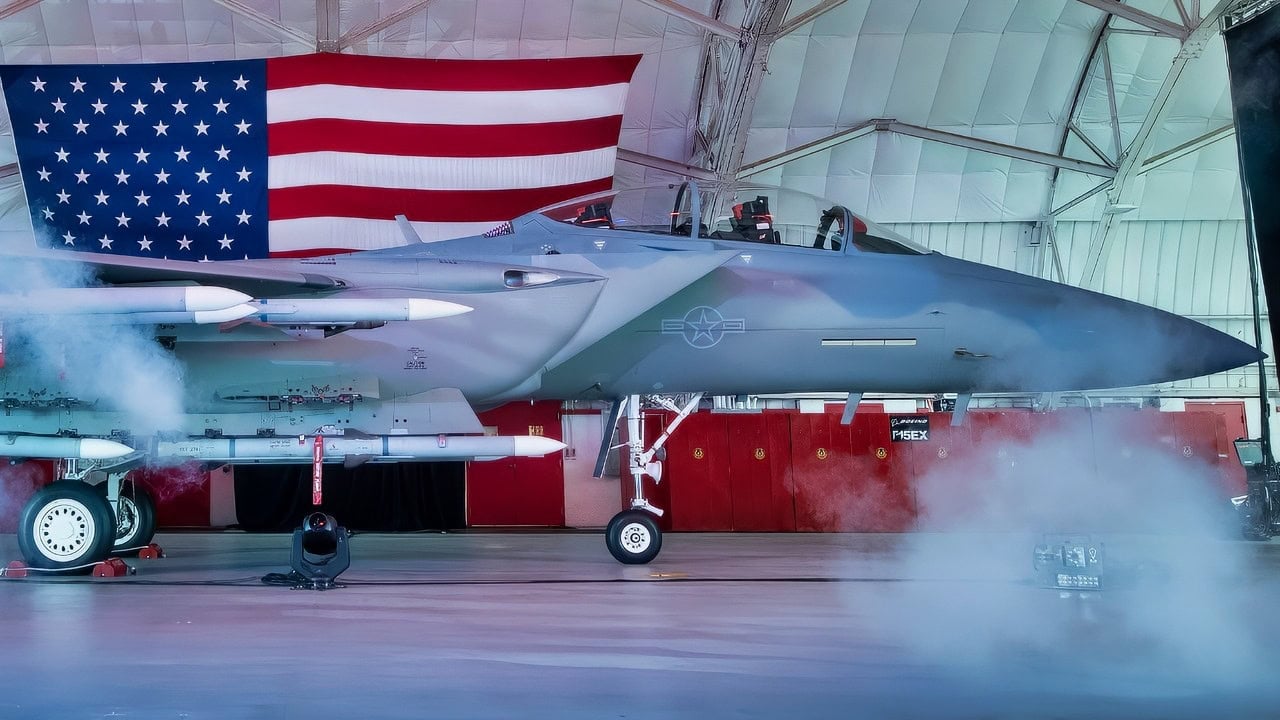
The Air Force’s newest fighter, the F-15EX Eagle II, was revealed and named during a ceremony April 7 at Eglin Air Force Base, Fla. The aircraft will be the first Air Force aircraft to be tested and fielded from beginning to end, through combined developmental and operational tests. (U.S. Air Force photo/Samuel King Jr.)
It rolled many of the airframe, avionics, and structural improvements developed for the Silent Eagle into what eventually became the F-15EX Eagle II, a non-stealthy but heavily modernized F-15 that the U.S. Air Force began procuring in the early 2020s at the same St. Louis plant.
That proved that the engineering wasn’t wasted, even if the stealthy version of the Eagle never found a single customer willing to write a check. And the Eagle still shows no sign of retirement just yet.
MORE – The F-117 Nearly Flew from Aircraft Carriers
About the Author: Steve Balestrieri
Steve Balestrieri is a National Security Columnist. He served as a US Army Special Forces NCO and Warrant Officer. In addition to writing on defense, he covers the NFL for PatsFans.com and is a member of the Pro Football Writers of America (PFWA). His work was regularly featured in many military publications