
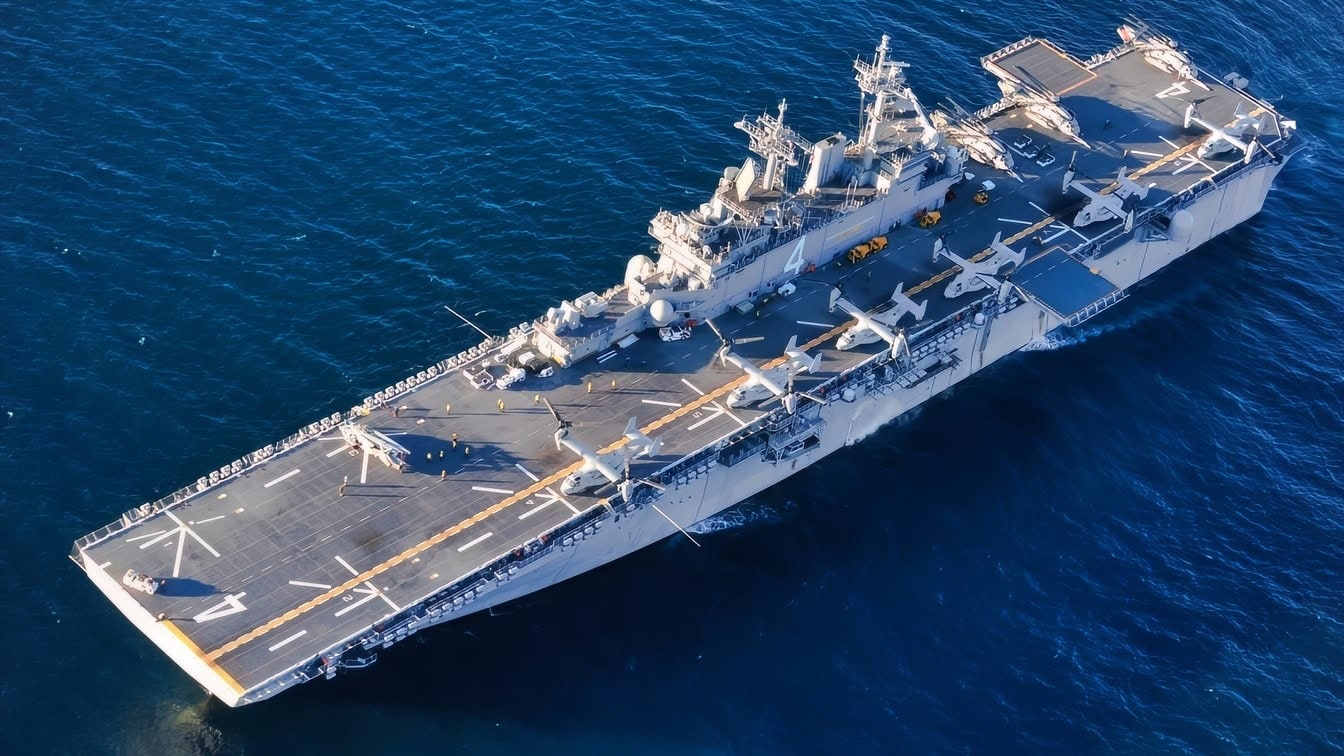
Summary and Key Points: The last time USS Boxer went in for maintenance, she came out four years late. The Wasp-class amphibious assault ship returned to San Diego in 2020, was back with the fleet in late 2021, did not sail until June 2022, broke down again, and did not properly rejoin until 2024. In April of that year, she came home after ten days at sea. BAE Systems has now been awarded $149.8 million to do it again.
The USS Wasp Is Like a Mini Aircraft Carrier
The Wasp-class amphibious assault ship, the USS Boxer (LHD-4), is set to receive some upgrades as soon as she returns to her home port in San Diego.
BAE Systems recently announced that it had received a $149.8 million contract to conduct the ship’s Selected Restricted Availability (SRA) maintenance, which will reportedly modernize her onboard systems while providing routine maintenance.
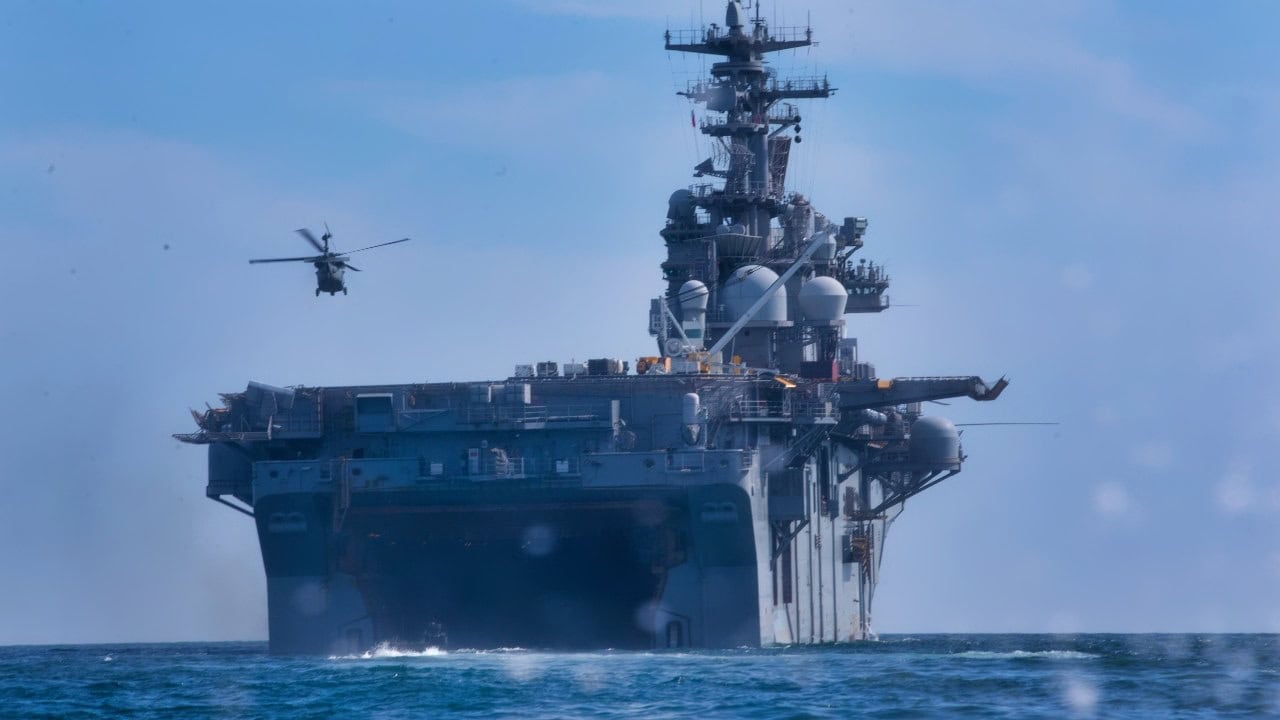
U.S. Marines with Bravo Company, 2d Assault Amphibious Battalion, 2d Marine Division approach the USS Wasp (LHD 1) in assault amphibious vehicles off of Onslow Beach during a three-day ship-to-shore exercise on Camp Lejeune, N.C., June 27, 2020. During the exercise, the Marines conducted amphibious maneuvers and dynamic ship-to-shore operations with the USS Wasp (LHD 1). (U.S. Marine Corps photo by Lance Cpl. Jacqueline Parsons)
Currently, Boxer is in the Singapore Strait near Singapore after she was temporarily relocated to the Middle East to support the Navy’s force buildup near Iran.
Many suspected that Boxer, supported by her Amphibious Ready Group (ARG) and the USS Tripoli, would stage a landing on Iranian territory. Thankfully for Iran, this did not happen.
Keeping the Boxer Mission Ready
On August 26, BAE Systems announced it had received a contract from the Navy to modernize the USS Boxer.
The SRA will take place at her homeport at the naval base in San Diego, CA. “Critical maintenance of the USS Boxer will support the U.S. Navy’s vital mission to continue defending our nation,” said Eric Icke, vice president and general manager of BAE Systems Maritime Solutions San Diego. “I look forward to our highly skilled team delivering unmatched capacity, precision, and performance for our customer.” BAE has not shared details as to what this modernization entails beyond “critical modernization.”
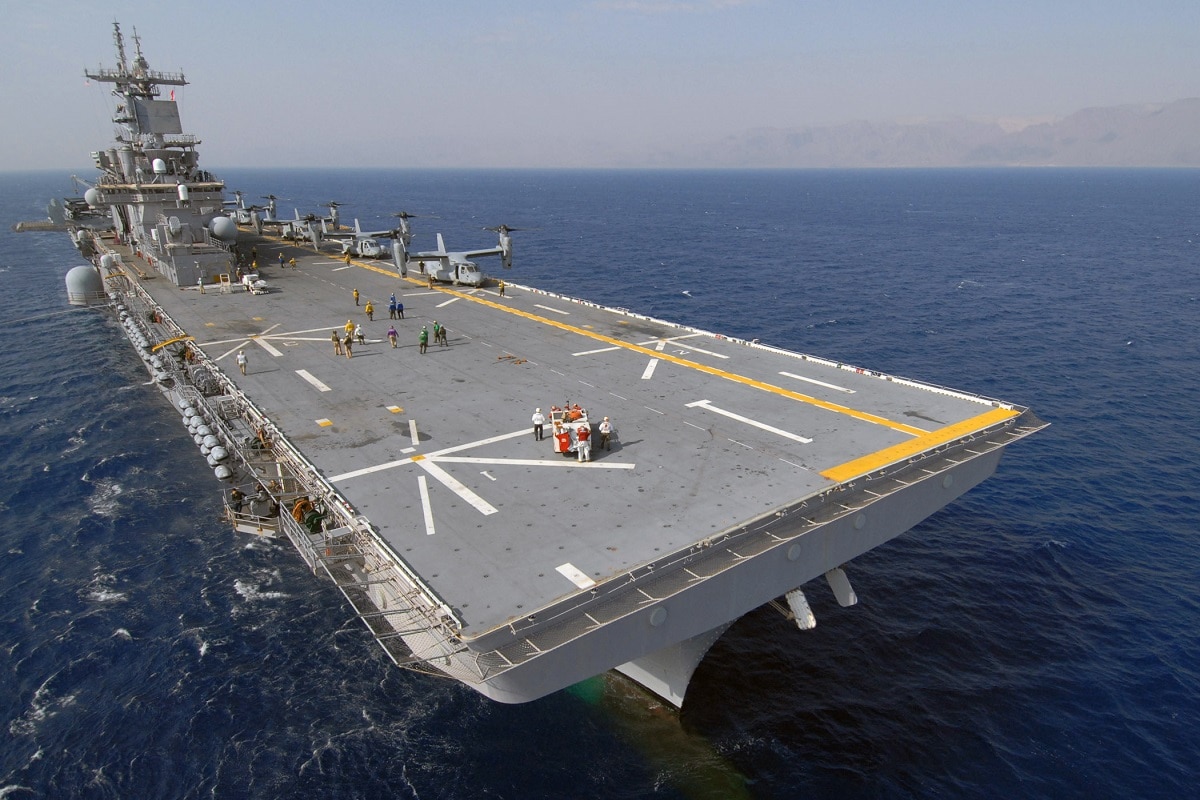
GULF OF AQABA (Oct. 4, 2007) – U.S. Marine Corps MV-22 Ospreys, assigned to Marine Medium Tiltrotor Squadron (VMM) 263, Marine Aircraft Group 29, prepare for flight on the deck of the multipurpose amphibious assault ship USS Wasp (LHD 1). Wasp is on surge deployment to the Middle East carrying the Osprey to its first combat deployment. U.S. Navy photo by Mass Communication Specialist 2nd Class Zachary L. Borden (RELEASED)
An SRA, for those who don’t know, is a period of usually short but intense maintenance and modernization. Unlike other Availability periods, an SRA is scheduled specifically by the Chief of Naval Operations (CNO) and is required to maintain a ship’s physical condition until its next major overhaul.
Boxer underwent a drydock Availability period, provided by BAE Systems, which repaired her hull structure, propulsion, electrical plant, auxiliary systems, and many more, while also making her compatible with the F-35 Lightning II.
However, her last maintenance period involved several delays and technical difficulties. After she returned to San Diego in 2020, she was originally scheduled to return to the fleet in late 2021.
Due to delays, however, she would not leave until June 2022, when she experienced further technical difficulties that prevented her from rejoining the fleet until 2024.
Recent Deployment to the Middle East
In 2026, following her troubled maintenance period, Boxer and her ARG were deployed to the Middle East to support Operation Epic Fury.
She was joined by the San Antonio-class amphibious dock ship USS Portland and the Whidbey Island-class landing ship USS Comstock.
The ARG was slated to join the America-class USS Tripoli, marking a significant buildup of amphibious landing capabilities in the U.S. Some suspected that the U.S. would attempt a landing, possibly on Kharg Island or Qeshim Island.
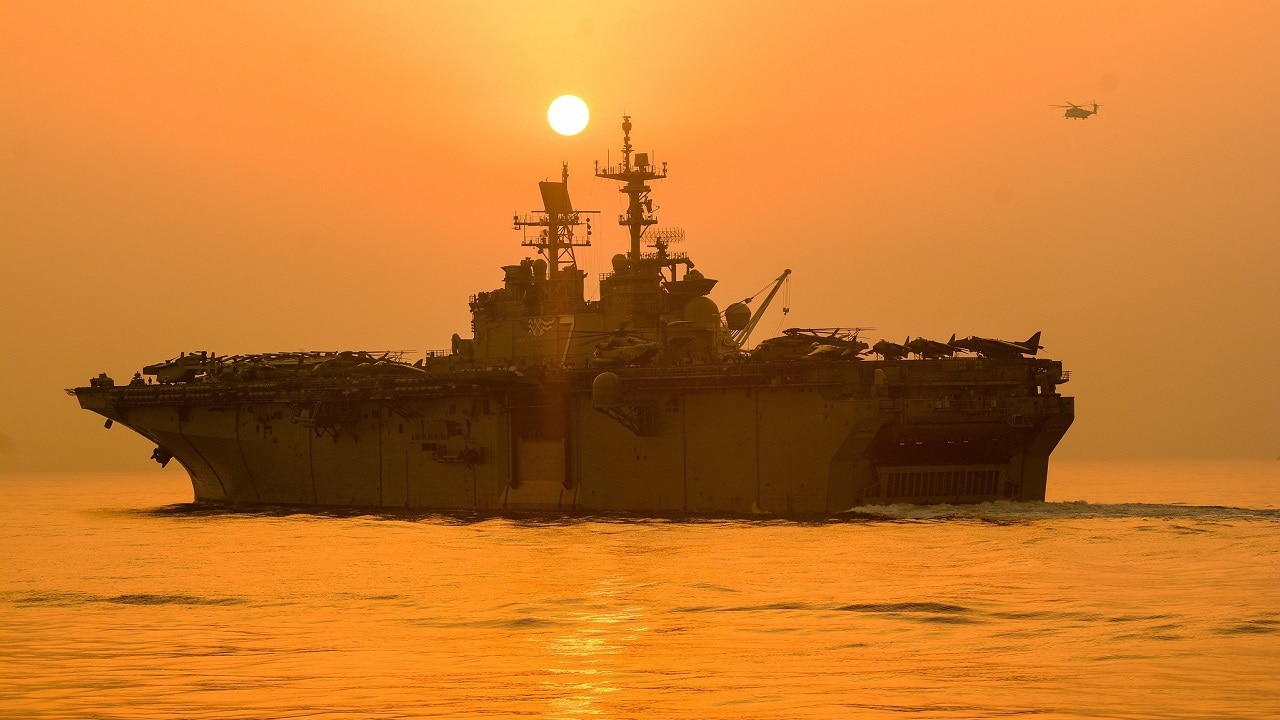
(Aug. 4, 2021) The Wasp-class amphibious assault ship USS Iwo Jima (LHD 7) transits the Strait of Hormuz, Aug. 4, 2021. Iwo Jima is deployed to the U.S. 5th Fleet area of operations to ensure maritime stability and security in the Central Region, connecting the Mediterranean and the Pacific through the western Indian Ocean and three strategic choke points. (U.S. Navy photo by Seaman Logan Kaczmarek)
However, Boxer and her ARG headed East towards the South China Sea. Currently, she is operating near Singapore, with no indication given of when she will finish her deployment.
Recently, Boxer has been making headlines after a series of reports surfaced suggesting the ship was experiencing a shortage of women’s hygiene products.
These reports followed similar rumors aboard the aircraft carrier Abraham Lincoln, which claimed it was running low on food and medical supplies.
The U.S. Navy denied both claims and said Boxer was fully supplied after making four separate port stops since leaving San Diego earlier this year. “The crew has been at sea for less than two months since the last port call, and they are stocked with feminine products, including at the ship store and in medical offices on board,” the Navy wrote on social media.
What to Know About the Wasp-class Assault Ships
The Wasp-class amphibious assault ships were first built in the 1980s. As the name suggests, the ships were designed to support amphibious landing operations.
Each ship can carry an array of landing craft, totaling up to 12 Landing Craft Mechanized (LCMs). The ships also incorporate a flat-top airstrip for launching helicopters or V/STOL aircraft like the AV-8B Harrier II or, more recently, the F-35B Lightning II.
Unlike the larger Nimitz/Ford-class aircraft carriers, these ships are conventionally powered by two steam turbines. Each ship has a full load displacement of 40,500 tons, a top speed of 22 knots, and a combat range of 9,500 nautical miles.
First commissioned in 1995, Boxer can accommodate a crew of 1,070 officers and enlisted personnel, as well as a detachment of more than 1,600 Marines, nearly a full-strength Marine Expeditionary Unit (MEU).
With maintenance on the horizon, her onboard sensors are expected to receive an update while any structural fatigue is identified and addressed.
Boxer and the Wasp-class ships fill an important niche in the U.S. Navy.
They enable landing operations and can provide limited air support for offensive operations.
Although they are being replaced by the newer America-class ships, maintaining the Wasp-class is of utmost importance to the Navy until their replacements arrive.
About the Author: Isaac Seitz
Isaac Seitz, a Defense Columnist, graduated from Patrick Henry College’s Strategic Intelligence and National Security program. He has also studied Russian at Middlebury Language Schools and has worked as an intelligence Analyst in the private sector.