
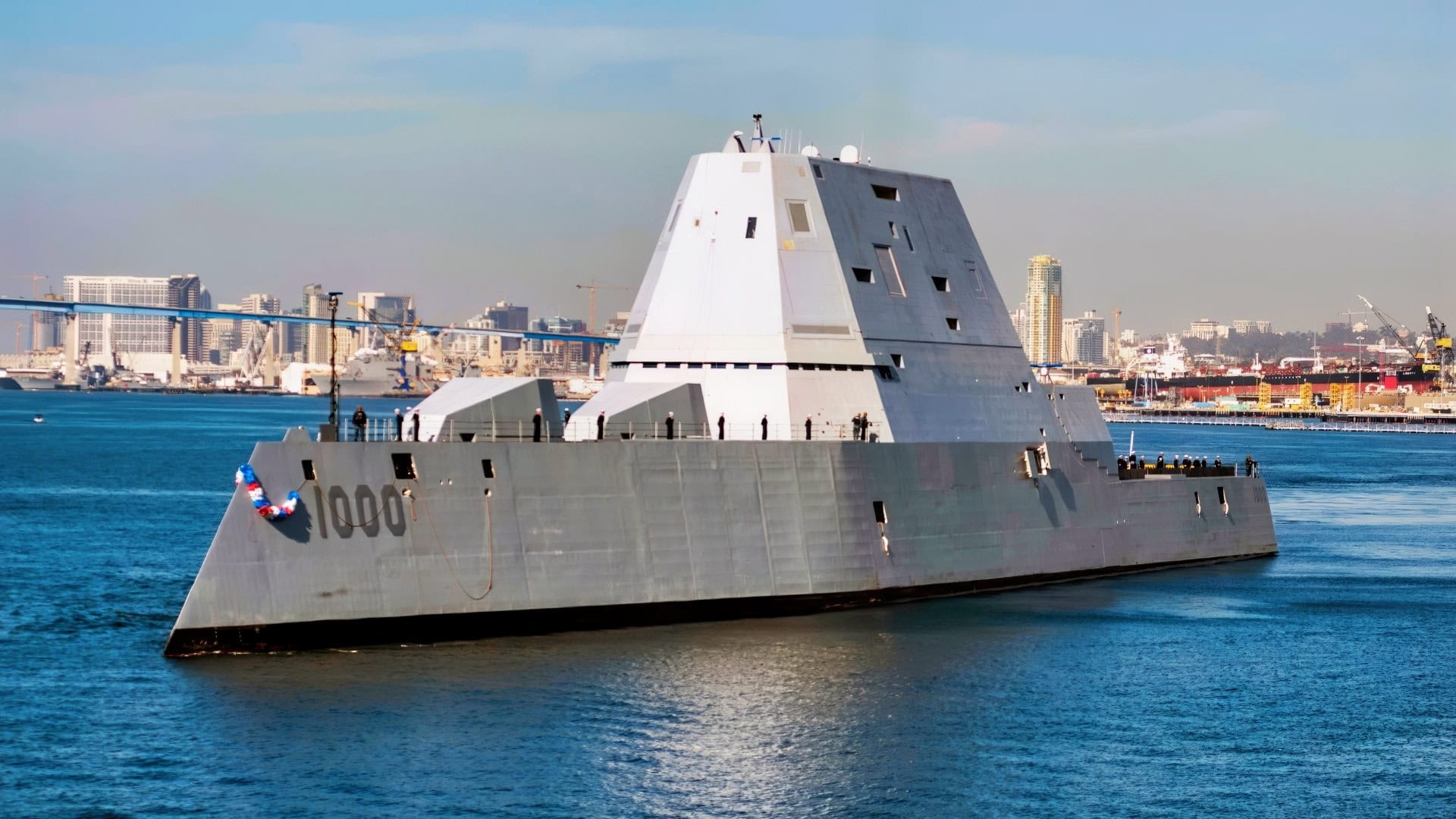
The US Navy Planned 32 Zumwalt Destroyers. Three Ships Cost $31.8 Billion – The U.S. Navy once planned to buy 32 Zumwalt-class destroyers. It built three. The Government Accountability Office now places the acquisition cost at $10.6 billion per ship, more than seven times the original unit estimate. That figure includes research and development spread across only three hulls, rather than representing the shipyard price of each vessel.
The class was supposed to restore heavy naval gunfire after the Iowa-class battleships left service. Each 610-foot ship was built around two 155mm Advanced Gun Systems, a 600-round magazine, and 80 peripheral vertical-launch cells for Tomahawk, Evolved SeaSparrow, Standard, and anti-submarine missiles. Stealth shaping, electric propulsion, automation, and a reduced crew were meant to make the Zumwalt the model for a new generation of surface combatants.
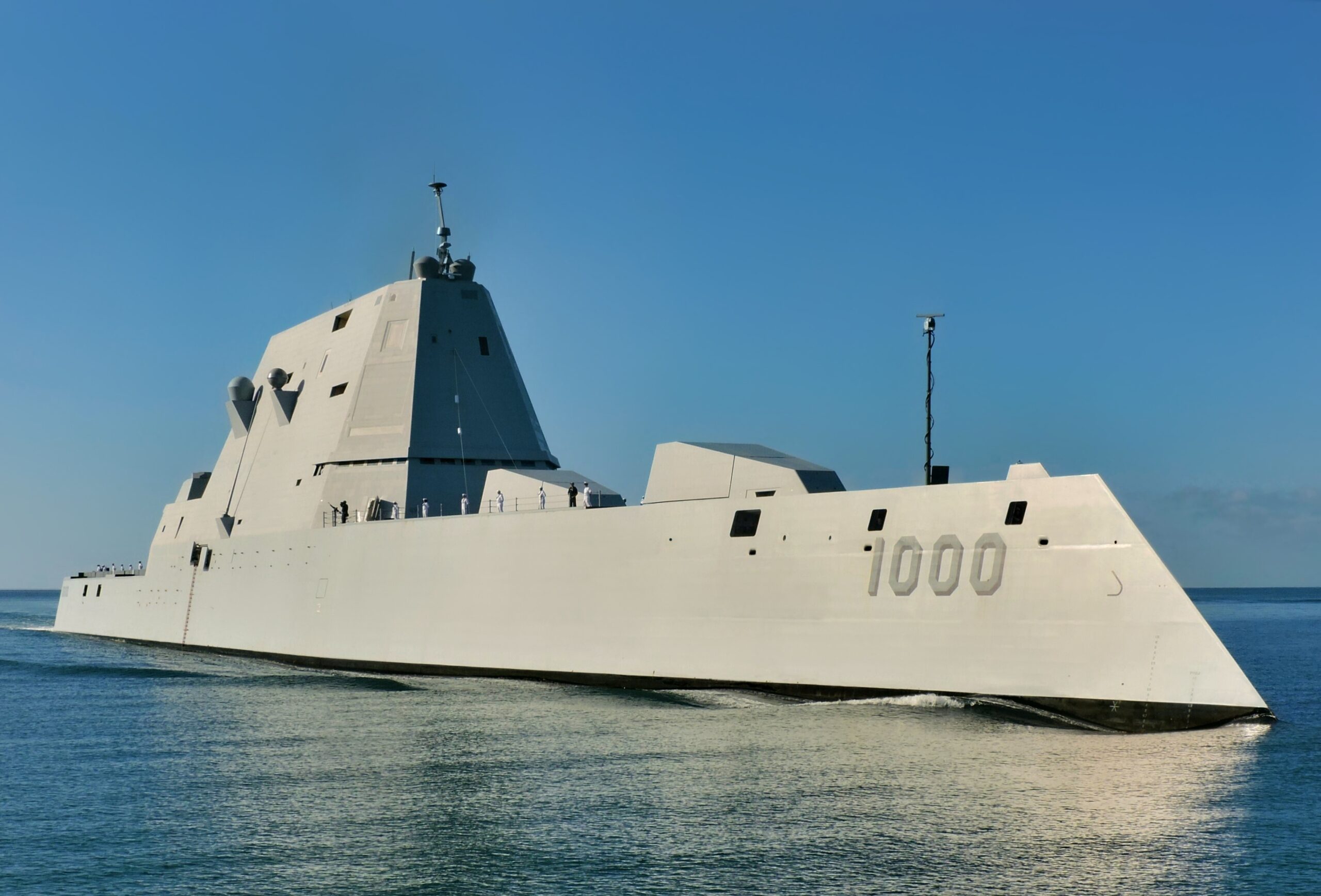
Zumwalt-Class Destroyer U.S. Navy. Image Credit: Creative Commons.
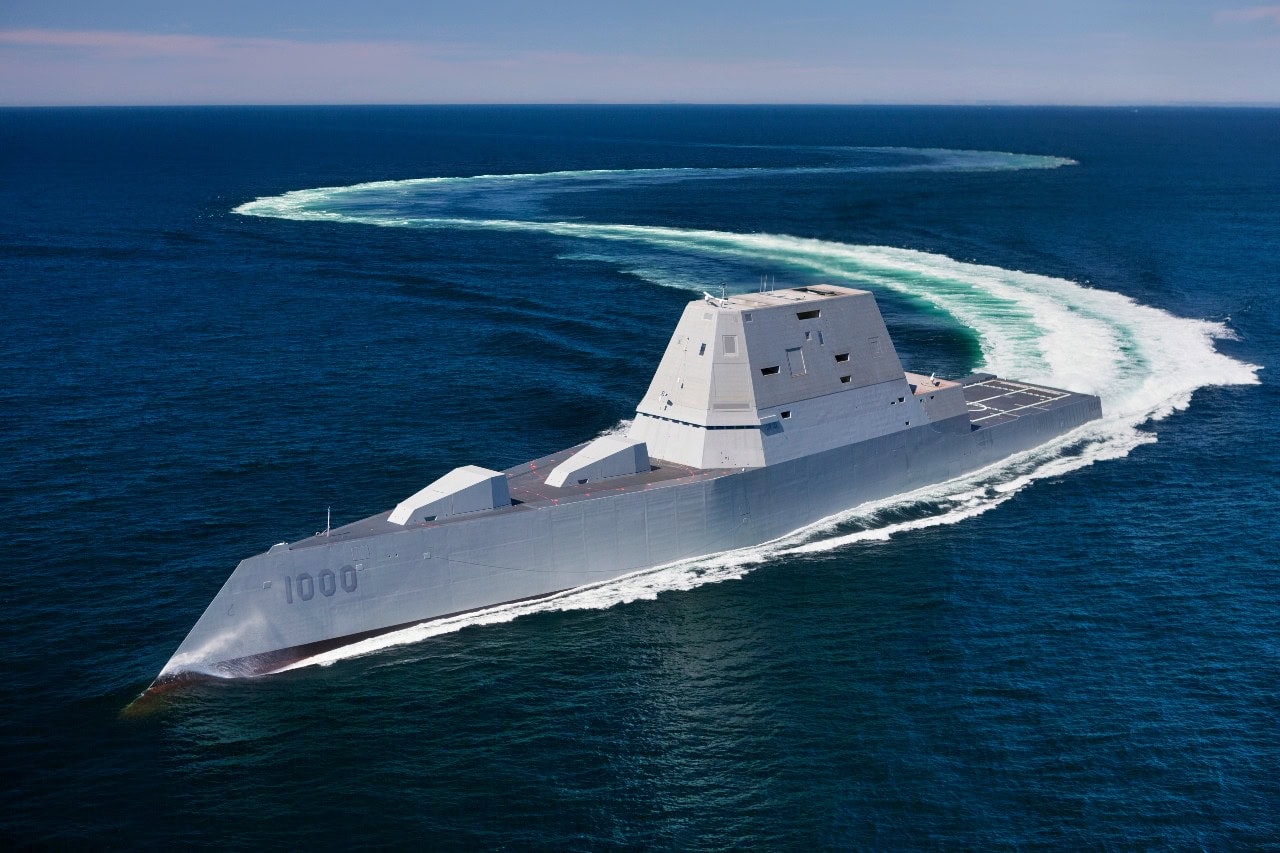
Zumwalt-Class Destroyer U.S. Navy.
The central weapon never entered operational service. The Long Range Land Attack Projectile, or LRLAP, rose to an estimated $800,000 to $1 million per round after the fleet collapsed to three ships. The Navy stopped buying the ammunition, leaving six large guns across the class without a practical combat round.
The replacement mission is also expensive and late. A July 2026 GAO review said the Navy is spending at least $2 billion to convert all three ships for Conventional Prompt Strike hypersonic missiles. Each destroyer is expected to carry 12 rounds, with an estimated average cost of about $67 million apiece. As of August 14, 2026, no Zumwalt had fired one from sea, and the first shipboard test had moved from 2025 to 2027.
DD-21 Was Designed for the Littoral War of the 1990s
The program began with a 1994 requirement for a new surface combatant capable of supporting Marines and other forces ashore. The Soviet fleet had disappeared, the United States expected to operate close to hostile coastlines, and the Navy had retired the battleships that once delivered sustained large-caliber fire.
The early DD-21 design reflected that mission. In 1997, the Navy approved plans for 32 ships carrying two advanced guns, 1,200 long-range projectiles, and 128 missile cells. The initial average unit-cost ceiling was $921 million in fiscal 1996 dollars. Those ships were supposed to arrive beginning in 2008.
The requirements quickly outran the cost target. The design combined a low radar signature, a new hull form, an integrated electric plant, advanced radar, automated damage control, a new computing architecture, new launch cells, and a new gun with a new guided projectile. In 2001, the Navy restructured DD-21 into DD(X), placing it inside a planned family that also included the CG(X) cruiser and Littoral Combat Ship.
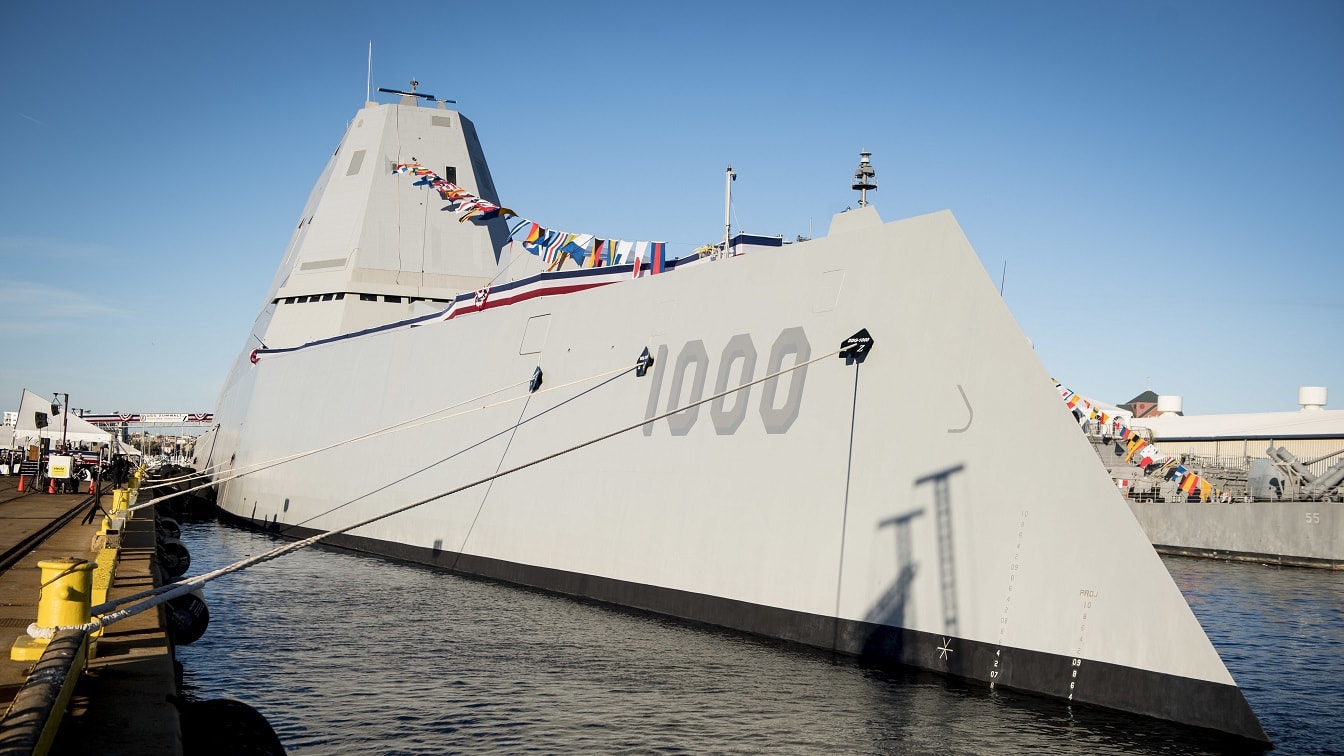
(Oct. 15, 2016) The Navy’s newest and most technologically advanced warship, USS Zumwalt (DDG 1000), is moored to the pier during a commissioning ceremony at North Locust Point in Baltimore. (U.S. Navy photo by Petty Officer 1st Class Nathan Laird/Released)
The program eventually settled on a much larger vessel than the word destroyer suggests. The current Navy fact file lists a displacement of 15,995 metric tons, a length of 610 feet, and a speed above 30 knots. Its electric plant generates roughly 78 megawatts, enough to drive the ship and support power-intensive systems that older destroyers could not readily absorb.
The wave-piercing tumblehome hull reduced radar reflections, while the Total Ship Computing Environment linked combat, engineering, and administrative functions through a common architecture. The original threshold crew was 147 sailors plus a 28-person aviation detachment, far below the complement of an Arleigh Burke-class destroyer. The current Navy figure is 197.
Those features explain why the collapse from 32 hulls to three was more than a routine procurement cut. The Navy had developed an entire operating, training and support system around a class expected to become a substantial part of the fleet.
The Fleet Shrunk as the Technology Bill Grew
GAO says the restructured program attempted to mature 12 developmental technologies through 10 engineering development models. The Navy reduced the planned buy from 32 ships to 16, then to 8, and finally to 3 as technology development costs increased.
The cuts did not remove the fixed cost of designing the hull, software, power system, radar, guns, and launch cells. They divided that bill among fewer ships. The smaller fleet also reduced orders for spare parts, training equipment, and unique ammunition, driving recurring costs higher.
The mission changed while the ship was still under development. GAO counted 15 years between the identification of the need and the construction of the lead vessel. During that period, the Navy moved away from a nearshore focus and returned to open-ocean competition involving submarines, anti-ship cruise missiles, and ballistic-missile defense.
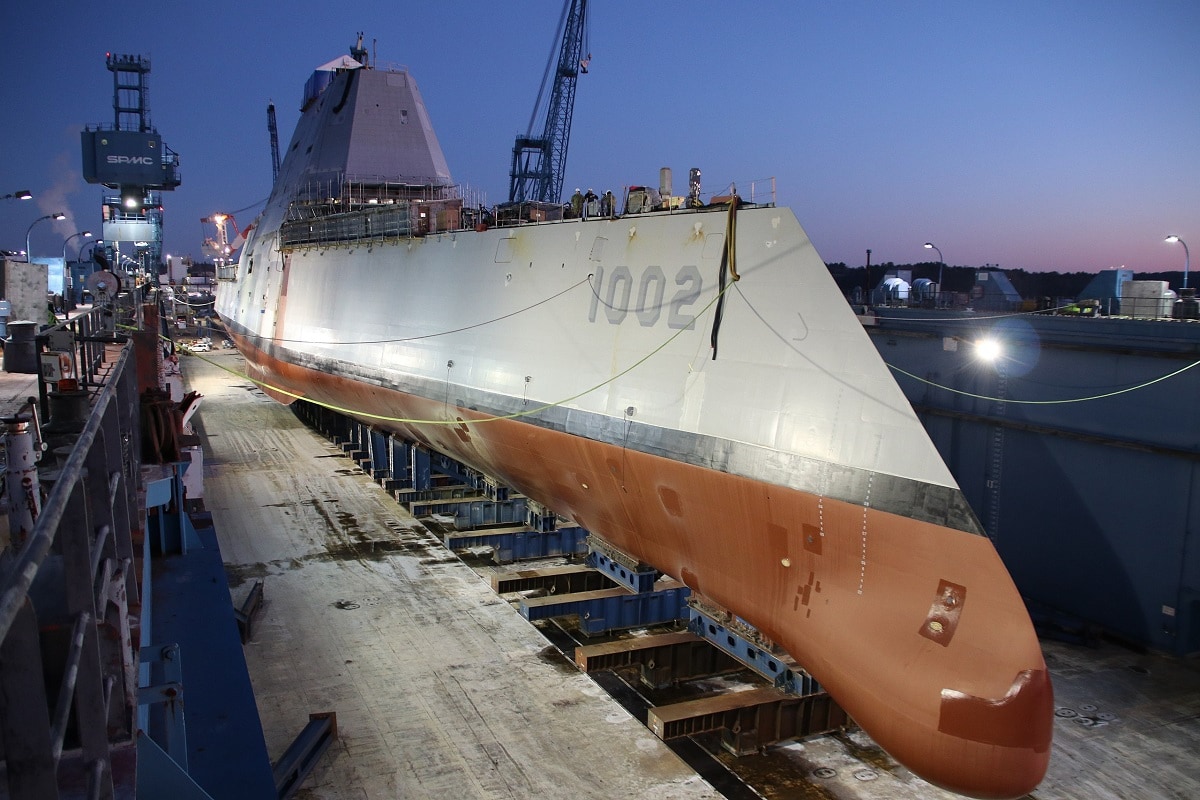
(Dec. 9, 2018) Following a multi-day process that includes moving the ship from the land level facility to the dry dock, the future USS Lyndon B. Johnson (DDG 1002) is made ready before flooding of the dry dock at General Dynamic-Bath Iron Works shipyard, and subsequent launching of the third Zumwalt-class destroyer. (U.S. Navy photo courtesy of General Dynamics-Bath Iron Works/Released)
In 2008, the service proposed ending the Zumwalt buy at three and restarting Arleigh Burke production. The mature DDG-51 design already carried the Aegis combat system, had an established supply chain, and supported missions the Navy considered more urgent. The latest Flight III Burkes now cost about $2.7 billion each when purchased in pairs annually, according to the Congressional Research Service.
The Zumwalt procurement cost alone is lower than the $10.6 billion acquisition figure. Current budget data place the combined ship-construction bill for the three hulls near $13.9 billion, or roughly $4.6 billion per ship. Research, development, testing, and other acquisition costs raise the full program to $31.8 billion. Both numbers are useful, but they answer different questions.
By the standard set at the beginning, the program failed. It did not deliver 32 ships, affordable naval gunfire, or the planned fleet-wide foundation for a future cruiser. It produced three highly advanced hulls whose original mission had weakened before the lead ship completed combat-system work.
The Navy Built the Ship Before Its Key Weapons Were Ready
The Zumwalt program illustrates the risk of designing a warship around technology still under development. The Navy proceeded with ship design and lead-ship construction before every critical system had demonstrated that it could meet cost and performance goals.
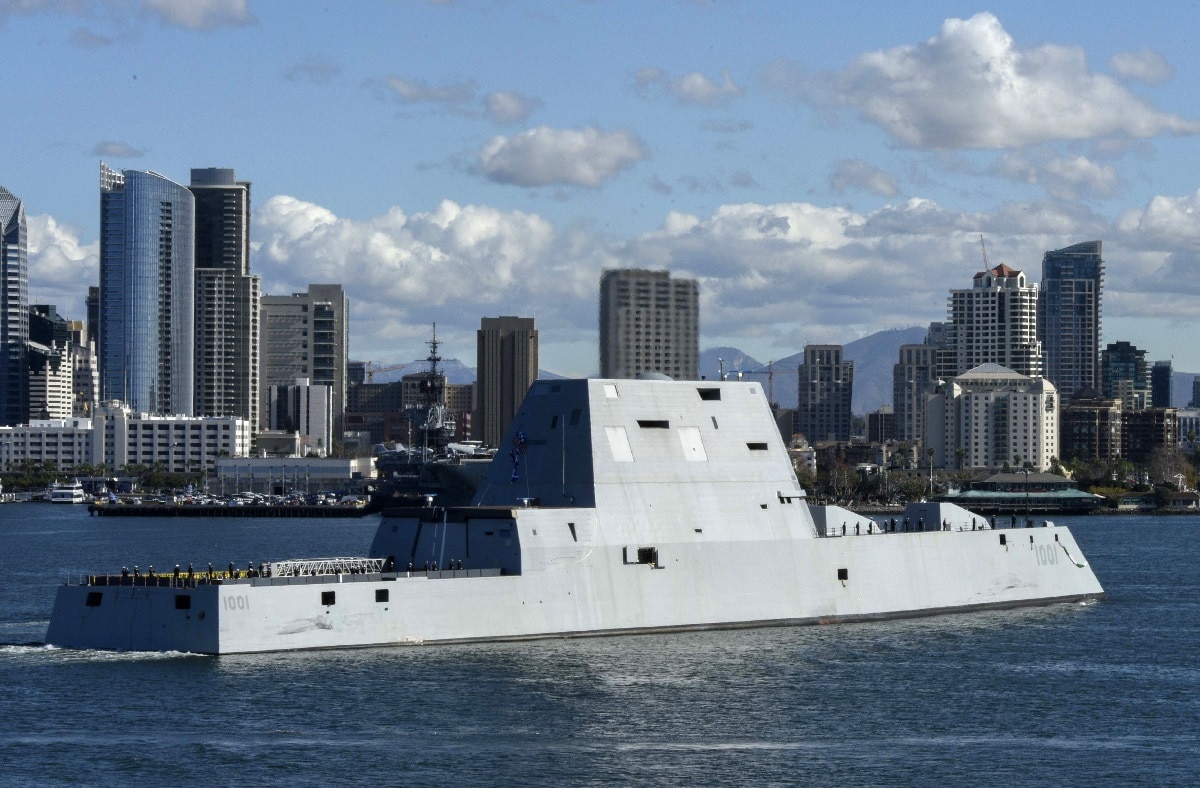
SAN DIEGO (Dec. 7, 2018) The Pre-Commissioning Unit (PCU) Michael Monsoor (DDG 1001) arrives in homeport of San Diego. The future USS Michael Monsoor is the second ship in the Zumwalt-class of guided- missile destroyers and will undergo a combat availability and test period. The ship is scheduled to be commissioned into the U.S. Navy Jan 26, 2019 in Coronado, Cailf. (U.S. Navy photo by Mass Communication Specialist Seaman Apprentice Nicholas Huynh/Released)
Some of the technology worked. The integrated power system created electrical capacity with value for future weapons and sensors. The peripheral Mk 57 launch system separated missile cells along the ship’s sides rather than concentrating them in one central block. The computing environment, automation, and signature reduction gave the Navy experience that continues to influence future designs.
Other choices were scaled back. The planned dual-band radar lost its S-band volume-search component as the Navy reduced costs. The surviving SPY-3 radar and class-specific combat system remained capable, but they lacked the broad commonality of Aegis ships. That decision would later add to the sustainment burden of a three-vessel class.
The most damaging failure involved the Advanced Gun System. The Navy did not buy a standard naval gun with several existing ammunition options. The barrel, magazine, cooling system, and combat-system software were designed around one specialized projectile. When LRLAP became unaffordable, finding another shell required significant modification rather than a simple ammunition substitution.
The Advanced Gun System Lost Its Only Ammunition
Each Zumwalt carried two automated 155mm guns with 300 rounds apiece. The weapons were designed to fire as many as 10 rounds per minute per barrel and strike fixed land targets more than 60 miles away. A full class of 32 ships, each holding 600 rounds, would have supported a theoretical magazine requirement of 19,200 projectiles before training stocks and war reserves were counted.
Three ships required only 1,800 rounds to fill their magazines. The Navy planned to buy about 2,000 LRLAPs for the remaining class, but the smaller production run destroyed the expected economies of scale. USNI News reported in 2016 that each round had climbed to $800,000 to $1 million, placing the complete buy between $1.8 billion and $2 billion.
A Tomahawk cruise missile then cost roughly $1 million and reached targets about 1,000 nautical miles away. LRLAP offered sustained gunfire, a larger magazine, and the possibility of replenishment at sea, but its price no longer resembled inexpensive artillery. Buying the ammunition would have cost roughly as much as an Arleigh Burke destroyer.
The Navy had obtained about 90 test rounds. It studied alternatives, including guided artillery projectiles, but none became an operational replacement compatible with the complete AGS installation. The guns had not suffered a basic mechanical collapse. The business case for their sole ammunition had disappeared.
That distinction matters when describing the ship built around a weapon it could not use operationally. The ships were built with two enormous gun houses, extensive magazines, and no affordable means of carrying out the shore-fire mission that had justified much of the design.
Hypersonic Missiles Use the Space and Power the Guns Left Behind
In 2017, the Navy changed the class’s primary mission from land attack to offensive surface strike. In 2021 and 2022, it selected the three ships as the first surface platforms for Conventional Prompt Strike. Their size, electrical capacity, and unused gun volume offered space unavailable aboard standard destroyers.
CPS is a boost-glide weapon. A two-stage rocket accelerates a Common Hypersonic Glide Body toward the edge of space. The glide body separates, maneuvers through the atmosphere, and approaches the target along a less predictable path than a traditional ballistic missile. The conventional weapon is intended to hit valuable, heavily defended targets at long range.
The missile is nearly four stories tall and cannot fit inside the Zumwalt’s existing Mk 57 cells. The conversion removed the Advanced Gun Systems and installed four large launch tubes in the bow. Each tube holds an Advanced Payload Module containing three missiles, giving one ship a maximum CPS battery of 12 while retaining the original 80 peripheral missile cells.
The result is that the class becomes a specialized strike platform rather than restoring its original naval gunfire role. Twelve hypersonic weapons cannot provide repeated artillery support for troops ashore. They offer a small number of exceptionally fast attacks against targets important enough to justify an expensive round.
GAO estimated the April 2026 unit cost to be between $63 million and $71 million, with an average of $67 million. At that average, a complete 12-missile load represents about $804 million in weapons. The calculation is illustrative because actual procurement prices will depend on production efficiency, support equipment, upgrades and the year of purchase.
The small magazine has become central to the debate over what the conversion buys. A Zumwalt still carries 80 other missile cells, but its dedicated hypersonic load is 12. Once fired, those large weapons would need to be replaced in port.
The Hypersonic Production Line Cannot Fill the Fleet Quickly
The missile is not yet being produced at the rate the Army and Navy need. GAO found that Lockheed Martin’s facility could build a maximum of six to seven rounds per year, compared with 12 needed to stabilize production. If every missile went to one Zumwalt, filling a 12-round magazine would take close to two years at the current maximum rate.
Production problems include labor-intensive assembly, difficult thermal-protection coatings, incomplete parts kits, complicated work instructions and workforce turnover. Some employees need about a year before they can work independently. A 2023 Navy audit also found expired materials, weak inspection practices and quality-control steps that were not consistently followed.
The Navy’s total life-cycle estimate for CPS rose from $31 billion for 262 missiles in 2020 to $41 billion for 224 missiles in 2024. That total covers development, procurement, ship and submarine integration, operations, and support rather than the Zumwalt conversion alone. The Army plans another large investment in the shared weapon.
The hypersonic move is technically credible and strategically useful if the weapon works. It is also another case in which the Navy is modifying a rare platform around an expensive missile with a constrained production line. The new launch tubes give the ships a mission; they do not guarantee enough missiles for repeated operations.
The Three Zumwalts Are at Three Different Stages
USS Zumwalt arrived at HII’s Ingalls Shipbuilding yard in Pascagoula in August 2023. Workers placed the ship on land, removed the gun systems, installed the large missile tubes, and completed other modernization work. HII completed builder’s sea trials in January 2026.
The conversion remained behind schedule. GAO said it was 94 percent complete in January and now expected to finish during the fourth quarter of fiscal 2026, 10 months later than the September 2025 plan. The Navy added 230,000 labor hours and $20 million in August 2025 after workers found additional cabling and other unplanned tasks.
USS Michael Monsoor completed its first deployment in 2025. It is scheduled to enter its Build Yard Modernization Period in February 2027. The Navy sequenced that work so one operational ship would remain available while the others were in the yard.
The future USS Lyndon B. Johnson has not yet entered commissioned service. It is undergoing combat-system activation and CPS integration at Ingalls, with delivery now expected in 2028. The Navy has used parts from that ship to sustain the first two vessels, which has contributed to delays because the components must eventually be replaced.
Across the class, the estimated modernization bill increased from $1.8 billion to at least $2 billion. GAO measured the overall effort at 24 months behind the original schedule. The reboot is substantial engineering work, not a quick weapon swap.
A Three-Ship Class Carries a Permanent Sustainment Tax
The Navy must maintain systems found on almost no other ship. The Zumwalt uses the SPY-3 radar, Total Ship Computing Environment, and Zumwalt Operating Environment rather than the standard Aegis, SPY-6, and fleet-network combinations spreading across other surface combatants.
GAO reported repeated serious casualty reports involving the integrated power system since the Navy accepted the lead ship in 2020. Some failures degraded capability; others prevented the ship from performing missions. Certain power-system parts require three months from order to delivery, creating the prospect of extended downtime when no spare is available.
Suppliers have less incentive to continue producing components for three ships. Training pipelines, software support, technical documentation, and contractor field teams must be maintained for a tiny fleet. The Navy estimates that replacing the unique radar, networks, and other systems with standard equipment would cost another $1 billion to $2 billion across the class. No decision had been made by August 14.
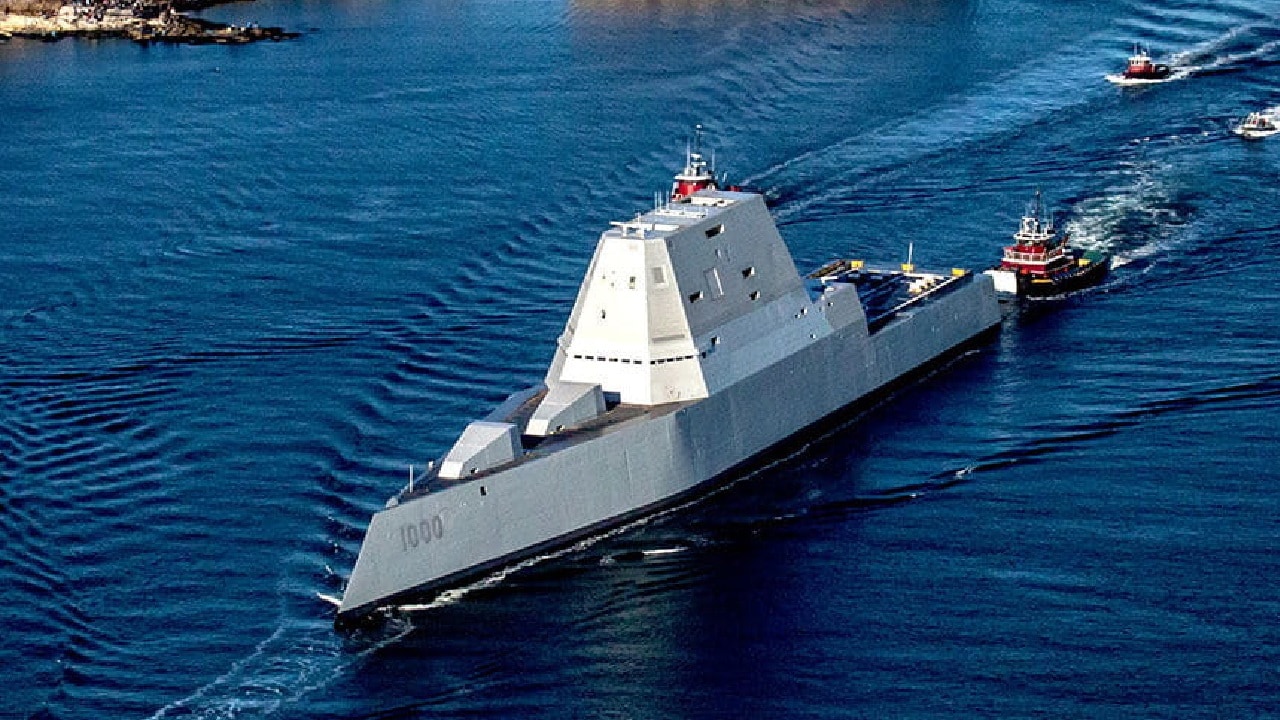
Zumwalt-class destroyer. Image Credit: Raytheon.
The Navy intends to operate the ships through 35-year service lives extending into the 2050s. That makes the unresolved sustainment plan more than a temporary problem. Hypersonic weapons will not remove the class-specific costs that began when 29 planned hulls disappeared.
The surviving ships still have strengths. Their low signatures complicate detection; the 78-megawatt plant provides unusual growth capacity, and the 80 Mk 57 cells support Tomahawk, Standard Missile, ESSM, and anti-submarine weapons. A successful CPS integration would create a combination no other American surface ship currently carries. That potential explains why the Navy chose conversion instead of early retirement.
The First Shipboard Hypersonic Test Is Scheduled for 2027
Calling the Zumwalt class a failure does not mean the three ships are worthless. It means the program did not deliver the quantity, price, or mission capability used to justify it. The Navy is now trying to recover value from hulls whose power, internal volume, and stealth still offer useful options.
The hypersonic mission could make each ship a potent strike asset in a high-end Pacific war. Three hulls and 36 total CPS rounds at maximum load will remain a specialized capability rather than the fleet of land-attack destroyers envisioned in the 1990s. The conversion also leaves the Marine Corps without the sustained 155mm naval gunfire the original program promised.
The decisive evidence will come from testing rather than plans. Navy officials moved the first CPS launch from USS Zumwalt to the third quarter of fiscal 2027. GAO described that schedule as optimistic and dependent on successful integration and test results. As of August 14, 2026, no Zumwalt-class destroyer had fired a Conventional Prompt Strike missile at sea.
About the Author: Harry J. Kazianis
Harry J. Kazianis (@Grecianformula) was the former Senior Director of National Security Affairs at the Center for the National Interest (CFTNI), a foreign policy think tank founded by Richard Nixon based in Washington, DC. Harry has over a decade of experience in think tanks and national security publishing. His ideas have been published in the NY Times, The Washington Post, The Wall Street Journal, CNN, and many other outlets worldwide. He has held positions at CSIS, the Heritage Foundation, the University of Nottingham, and several other institutions related to national security research and studies. He is the former Executive Editor of the National Interest and the Diplomat. He holds a Master’s degree focusing on international affairs from Harvard University.

