
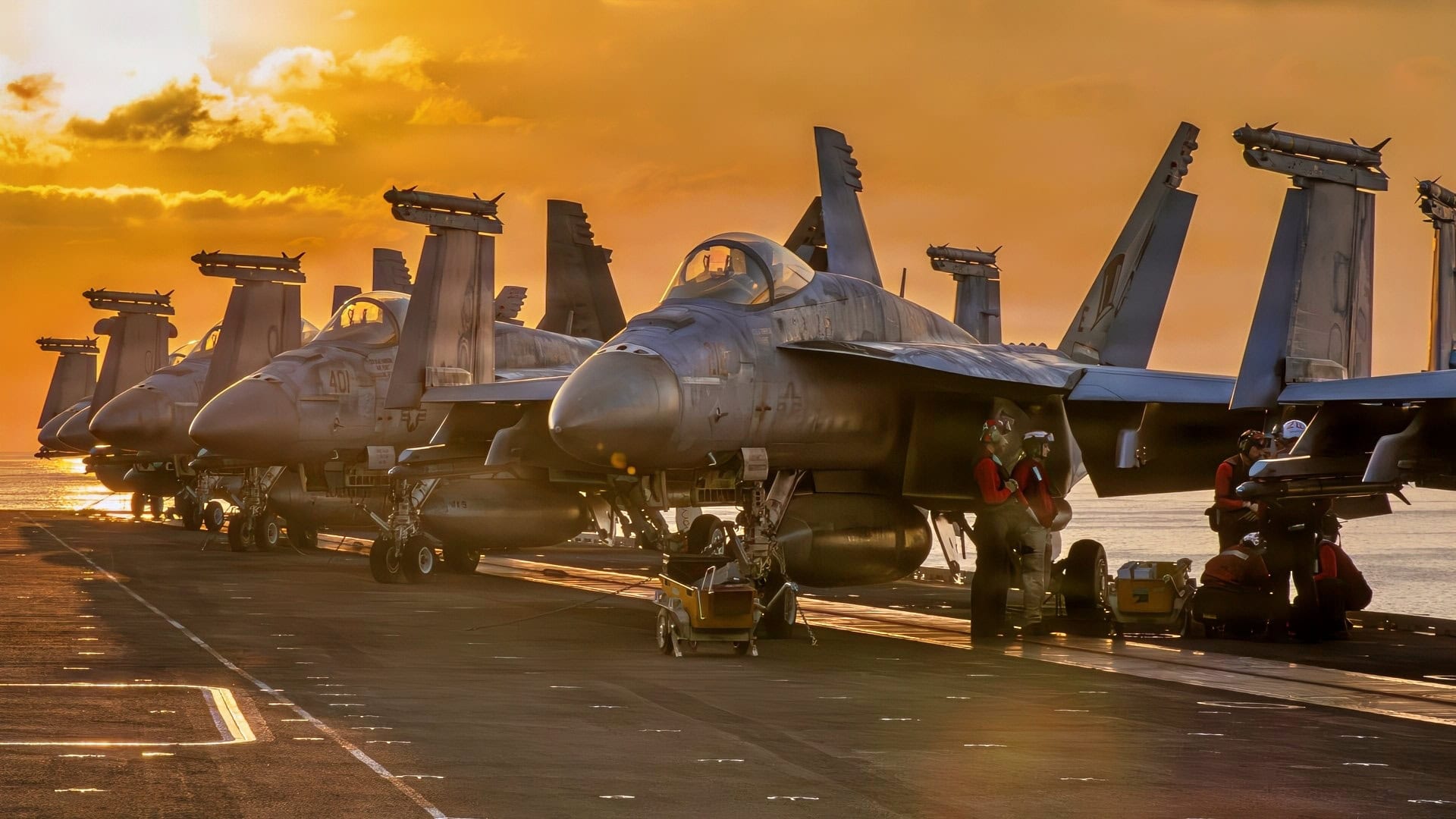
The story about to dominate defense coverage this week already has its argument backward. USS Abraham Lincoln is heading home after nearly nine months deployed, and most of the coverage will treat that endurance as proof that the aircraft carrier still matters against a country mostly hit by other things this war.
The real proof of what a carrier is for showed up quietly a few weeks in, when the mission stopped being about dropping ordnance and became about simply refusing to leave.
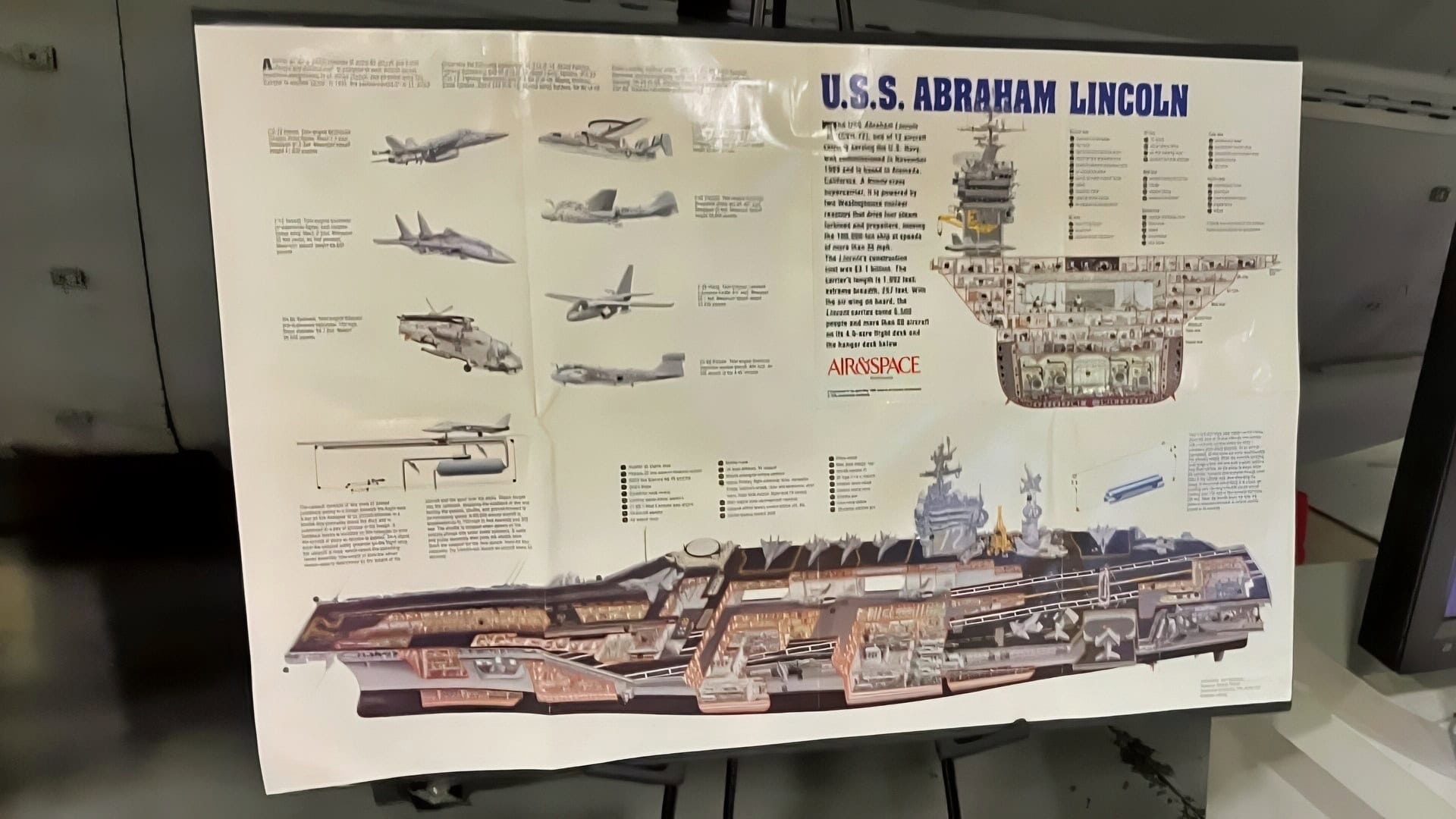
Aviation Museum of Kentucky USS Abraham Lincoln Carrier Photo. 19FortyFive.com Image.

ATLANTIC OCEAN (Aug. 30, 2018) An MH-60S Sea Hawk helicopter assigned to Carrier Air Wing (CVW) 7 flies by the Nimitz-class aircraft carrier USS Abraham Lincoln (CVN 72) during dual-carrier sustainment operations with the Nimitz-class aircraft carrier USS Harry S. Truman (CVN 75). In addition to demonstrating the Navy’s inherent flexibility and scalability, this evolution provides the opportunity to conduct complex, multi-unit training to enhance maritime interoperability and combat readiness; prepare the Navy to protect our homeland; and preserve and promote peace anywhere around the world. (U.S. Navy photo by Mass Communication Specialist 3rd Class Juan Sotolongo/Released)
Lincoln left San Diego in November.
The strikes that opened this war in late February pulled in B-2s, Tomahawks, F-35s, and a swarm of cheap one-way attack drones alongside her air wing, and there was nothing uniquely carrier-shaped about that phase of the fight.
Washington then imposed a naval blockade on Iranian ports in April. It lifted the blockade in June under a short-lived understanding with Tehran, then put it back in place on July 14 when that understanding collapsed.
It has been running since, with no talks scheduled and, according to Defense Secretary Pete Hegseth, no fixed end date.
Add the two stretches together, and the blockade comes to a little over three months, well short of Lincoln’s nine months.
The real question is what Lincoln was actually asked to do in each stretch, and which one needed a carrier.
Two Different Wars, One Flight Deck
The strikes are the easy part of this. A B-2 flying from Missouri and a Tomahawk launched from a destroyer two hundred miles offshore can both hit a target that once required a carrier.
So can an F-35C off a carrier deck, doing roughly the same job as an F-35A out of a Gulf air base. Once that’s true, the carrier stops being special for that mission.
It becomes one more way of putting a weapon on a coordinate, competing with several cheaper alternatives.
A war that opened with more than a hundred aircraft launching from land and sea didn’t need Lincoln specifically. It needed ordnance on target, and American power has plenty of ways to supply it.
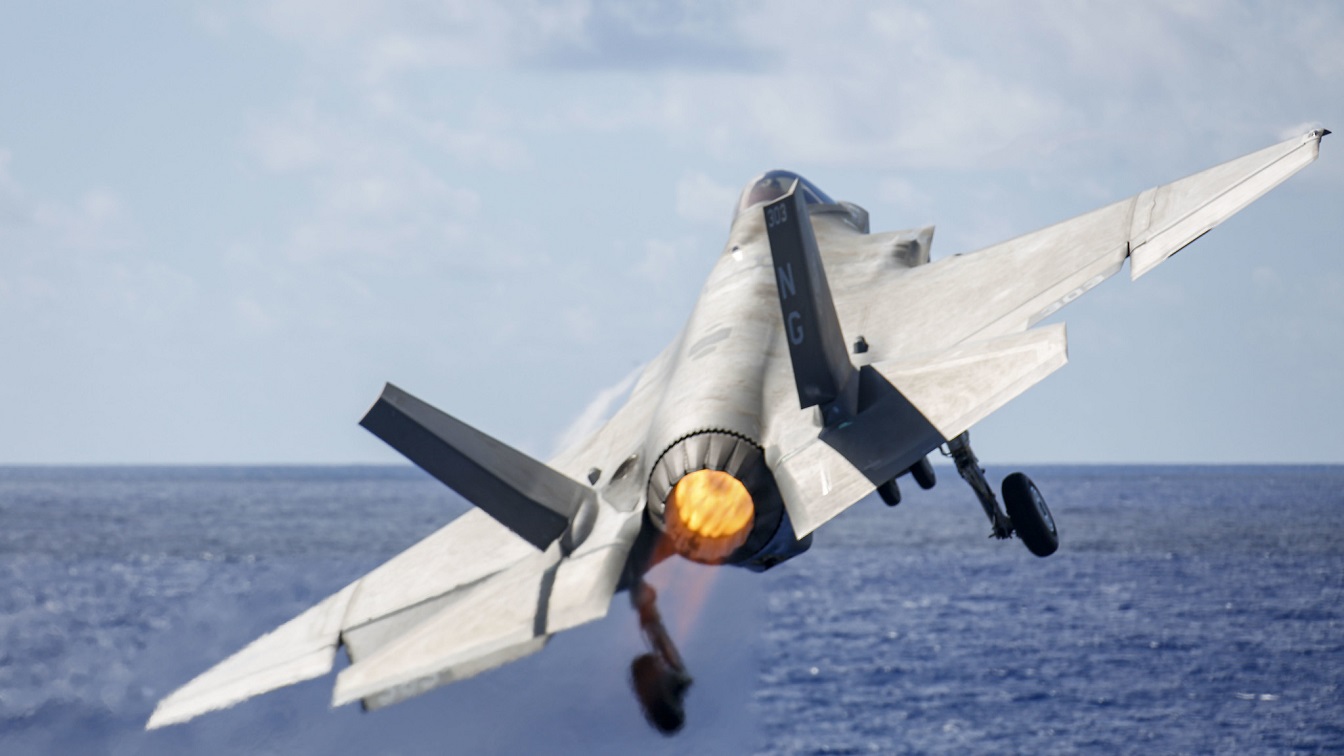
PHILIPPINE SEA (May. 13, 2022) An F-35C Lightning II assigned to the “Black Knights” of Marine Fighter Attack Squadron (VMFA) 314 launches from the Nimitz-class aircraft carrier USS Abraham Lincoln (CVN 72). The Abraham Lincoln Carrier Strike Group is on a scheduled deployment in the U.S. 7th Fleet area of operations to enhance interoperability through alliances and partnerships while serving as a ready-response force in support of a free and open Indo-Pacific region. (U.S. Navy photo by Mass Communication Specialist 3rd Class Michael Singley) 220513-N-MM912-1002
The blockade is a different animal, and this is the part the ship-tracker coverage keeps missing. An interdiction campaign doesn’t have a target list you can exhaust.
It has a duration, and the duration is set by Tehran’s stamina, not by anything the Pentagon controls.
That changes what the mission needs from a platform: less a single large payload delivered once, more a presence that can sit offshore for months, watch hundreds of vessels a week, decide which ones to let pass, and escalate against the ones that don’t comply, without asking a foreign government’s permission to keep doing it tomorrow.
What a Blockade Actually Requires
Lincoln’s air wing earned its keep on persistence, and it’s worth being specific about why.
The EA-18Gs and E-2Ds aboard her added a surveillance and control picture over the strait, and the F-35Cs and Super Hornets added a strike option that could scale with how a given ship behaved, all of it without waiting on a host nation’s permission each time the picture changed.
None of it required Lincoln alone.
Two carriers held that line together for weeks, backed by destroyers and Marine boarding teams, inside a regional American naval presence that runs past twenty warships. But it did draw on exactly the capabilities a carrier air wing is built to provide.
That’s a real distinction, and it cuts against the two lazy takes this deployment will generate. The carrier is not obsolete.
The mission that kept Lincoln at sea past its original return date is one ordnance-delivery platforms can’t easily replicate.
But calling it indispensable overstates things, since the opening weeks showed how replaceable carrier-based strike aviation has become.
Both things are true of the same ship in the same war, an uncomfortable pairing for a headline. The more useful question isn’t which claim wins.
It’s which of Lincoln’s two jobs the Navy should keep asking carriers to do, and which ones it should quietly hand off to something cheaper.
The Pacific Challenge
Relieving Lincoln required pulling George Washington off her own Pacific patrol, which had made a port call in Vietnam weeks earlier, and sending her west through the Singapore Strait.
Behind her there is no immediate reliever: Carl Vinson is still working up out of San Diego, and Theodore Roosevelt hasn’t announced a deployment date either. Gerald Ford ran past 300 days earlier this year, so this isn’t a one-ship anomaly. As of this week, the United States has no carrier operating in the western Pacific.
The Navy has eleven carriers on paper. At any moment, a meaningful share of them are tied up in maintenance or workups rather than available for tasking.
Asking that fleet to run an open-ended blockade on carrier-dependent terms in one theater while holding deterrent presence in a second theater that hasn’t gotten less urgent is the kind of strain eleven hulls were never built to absorb twice over, and it has been building quietly for months while everyone argued about whether carriers are still relevant.
A Fleet Managed One Crisis at a Time
Does any of this mean the blockade was a mistake? No, and it shouldn’t be read that way.
The mission’s persistence was the Navy’s comparative advantage, and abandoning it now would hand Tehran the outcome it has been fishing for since April.
This calls for honesty about the trade being made. Push more of the routine interdiction load onto surface ships and allied navies, and shift the surveillance work to land-based patrol aircraft where a flight deck isn’t necessary.
Save carrier aviation for the piece that actually needs it: the escalation reserve and control function; nothing else replicates as well.
That’s a resourcing decision.
It has little to do with whether the ship itself is worth keeping.
A carrier on station also signals commitment to voters and to Tehran alike, and that instinct is real. It doesn’t explain the blockade tasking.
That needed the persistence, not the optics.
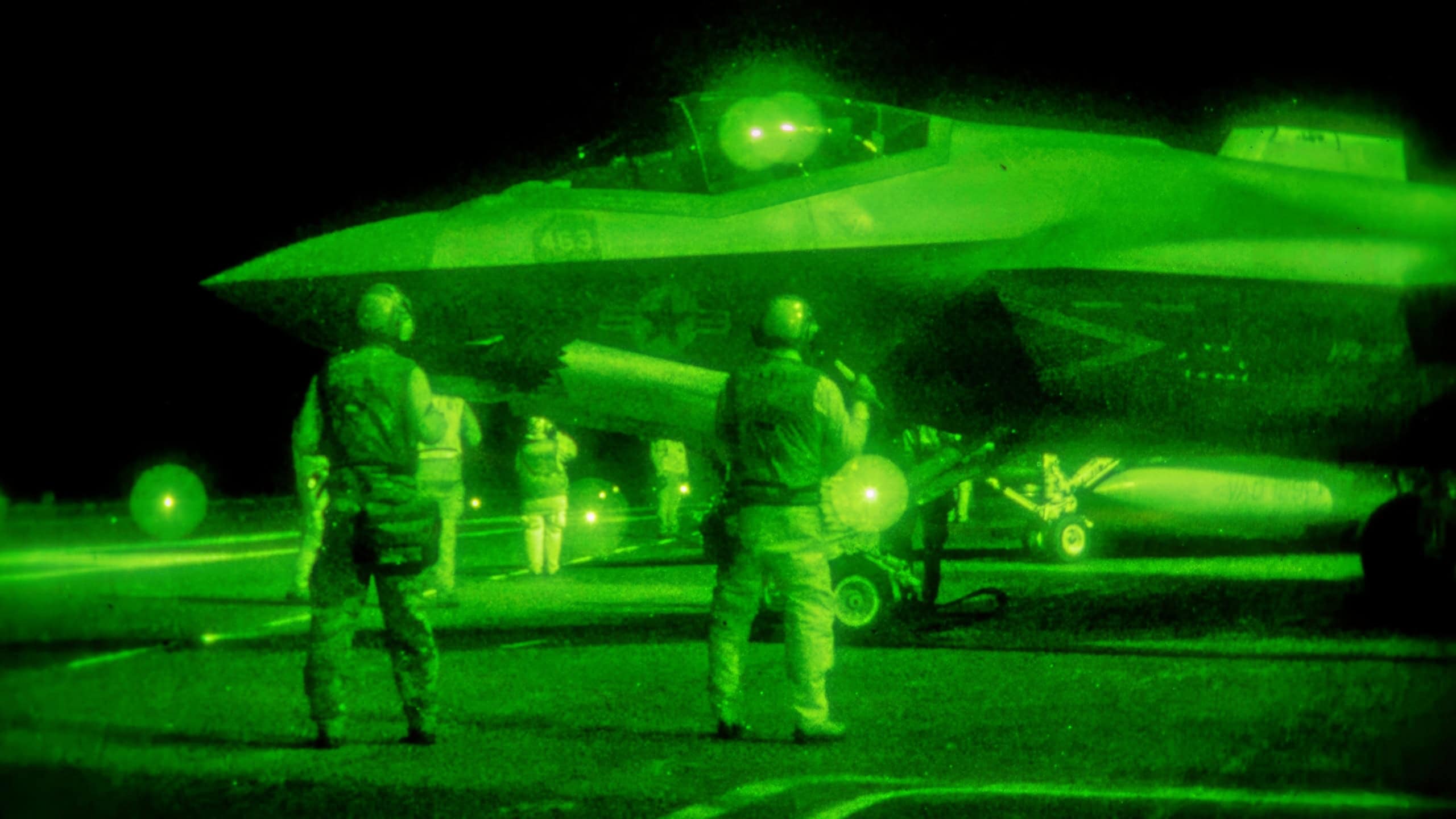
PACIFIC OCEAN (Jan. 23, 2026) –U.S. Navy Sailors conduct routine flight operations on the flight deck of the Nimitz-class aircraft carrier USS Theodore Roosevelt (CVN 71) Jan. 23, 2026. Theodore Roosevelt, flagship of Carrier Strike Group (CSG) 9, is underway conducting exercises to bolster strike group readiness and capability in the U.S. 3rd Fleet area of operations. (U.S. Navy photo by Mass Communication Specialist 2nd Class Ryan Holloway)
It may explain some of the strike tasking instead, where cheaper platforms could plainly have done the job. The harder problem is a Navy that doesn’t reliably tell the two apart.
Nobody in Washington has made that decision, at least not out loud.
Hegseth’s answer, when asked how long this would go on, was that the Navy could maintain the blockade indefinitely by rotating ships in and out.
That’s the same model that just sent Washington to relieve Lincoln and left the Pacific empty behind her.
Trump said much the same thing this morning, insisting no talks are underway or scheduled and that the blockade keeps running at full strength for as long as it takes, even as Tehran disputes his claim that the strait he calls open is anything of the sort.
Both men describe a policy with a stated method but no stated limit.
Somebody in this administration needs to say out loud how many months of an empty Pacific that policy is worth.
Right now, the fleet answers that question by default every time a relief carrier makes the trip, and nobody in Washington has had to explain why.
About the Author: Dr. Andrew Latham
Andrew Latham is a professor of international relations and political theory at Macalester College in Saint Paul, MN. You can follow him on X: @aakatham.