As the Iran War continues, with demand intensifying for US systems in both the Middle East and Ukraine, and with American arsenals running dry, Washington is having to make some hard choices.
One of the hardest choices was pulling the last US aircraft carrier from the Indo-Pacific.
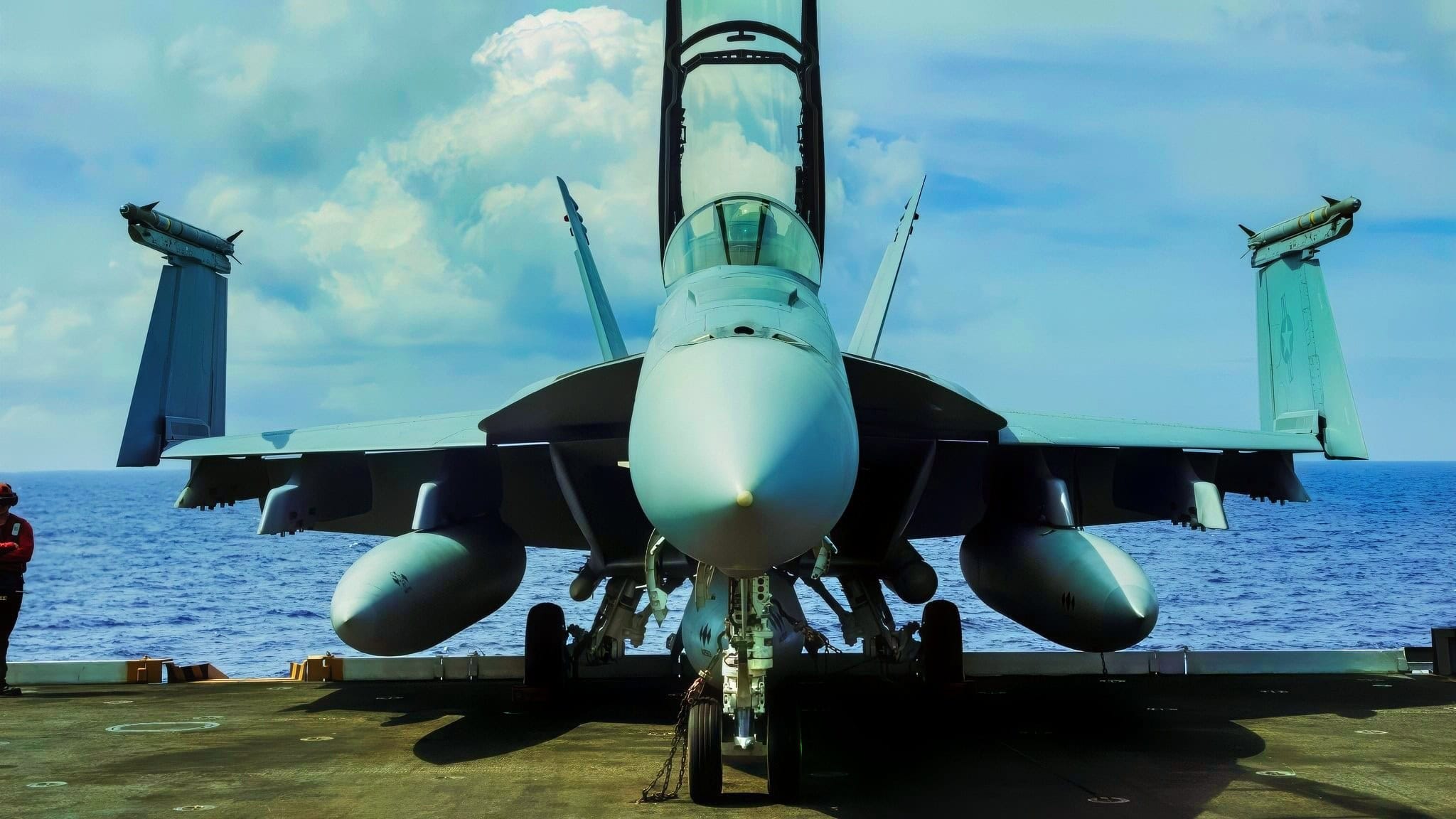
Capt. Tim Waits, commanding officer of Nimitz-class aircraft carrier USS George Washington (CVN 73), climbs into an F/A-18F Super Hornet, attached to Strike Fighter Squadron (VFA) 102, while underway in the South China Sea, Nov. 24, 2025. George Washington is the U.S. Navy’s premier forward-deployed aircraft carrier, a long-standing symbol of the United States’ commitment to maintaining a free and open Indo-Pacific region, while operating alongside allies and partners across the U.S. Navy’s largest numbered fleet. (U.S. Navy photo by Mass Communication Specialist 2nd Class Geoffrey L. Ottinger)
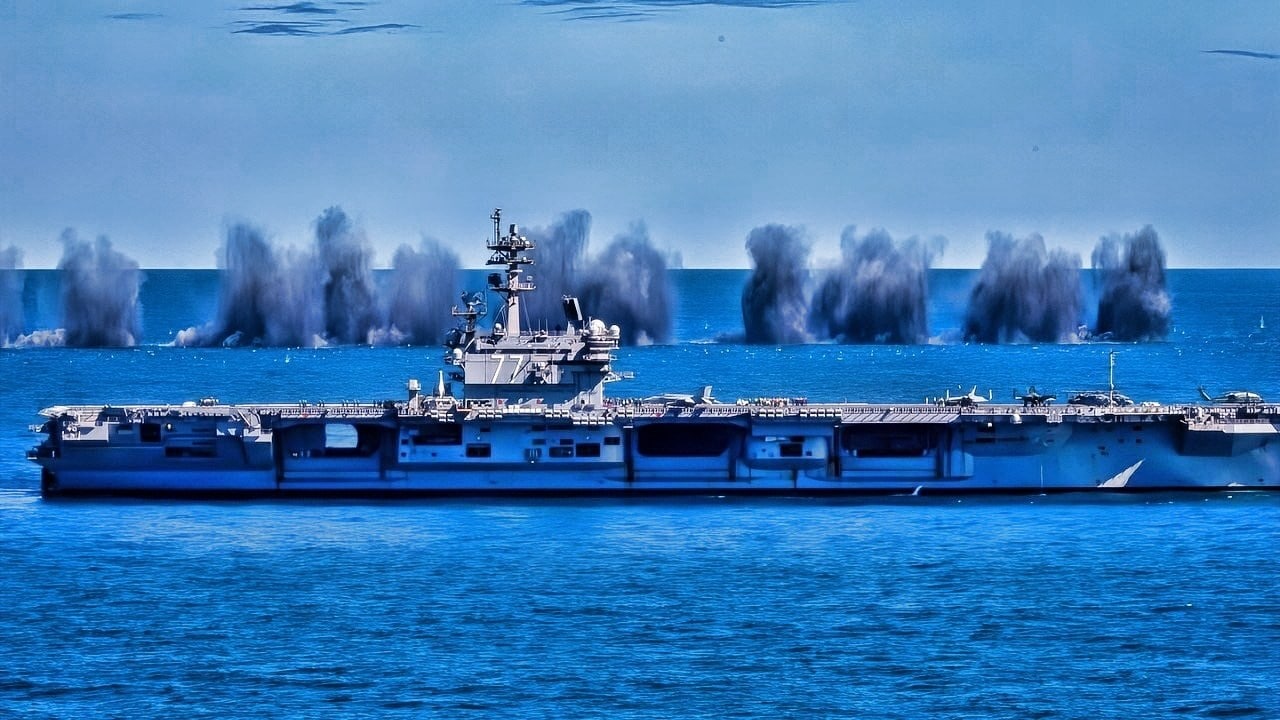
Nimitz-Class Aircraft Carrier at Sea. Image Credit: Creative Commons.
The USS George Washington has been deployed from Asia to the Middle East to relieve the ailing USS Abraham Lincoln.
No Replacement Coming
No replacement for George Washington is coming to the Indo-Pacific anytime soon.
George Washington leaves Asia, where the Chinese coast guard is engaged in intense standoffs with the Philippine coast guard over contested parts of the South China Sea.
It leaves an Asia that is witnessing the rapid modernization and expansion of the North Korean military (thanks to North Korea’s close ties with both Russia and China).
The lack of an aircraft carrier means the United States’ primary power-projection platform is absent.
Both Japan and Taiwan also appear jittery about this prospect.
Recently, Taiwan announced plans to surge production of cheap drones as part of the proposed “Hellscape” strategy to make the island an impenetrable fortress.
Earlier this year, Japan’s prime minister publicly reaffirmed the country’s commitment to Taiwan’s defense, stating that Taiwan’s security is inextricably linked to Japan’s.
Of course, these events are part of longer-running trends that transcend the lack of American aircraft carriers in the region.
But they do underscore a real strategic crisis that has been coming–and for which American strategists have been unprepared–for some time.
Everything regarding Asia–Taiwan’s announcements, Japan’s fears, concerns over the South China Sea, or tensions on the Korean Peninsula links back, either directly or indirectly, to fears about China.
And those fears are not only that the People’s Republic of China (PRC) is expanding in every direction and becoming more militarily capable.
China is doing those things.
The great fear is that the United States is unavailable because of its commitments elsewhere and the severe strain on its forces.
Therefore, the fear is that the deterrent effect, notably upon China, that the US military once had in the region is gone.
Not the First Time
This isn’t the first time in recent years that American carriers have been completely out of the Indo-Pacific. During the pandemic, Americans also had no carriers operating in the region.
During that time, the Chinese People’s Liberation Army Navy (PLAN) chose to send its carrier beyond Okinawa. Chinese PLAN elements began operating as though they had unchallenged access to every facet of the region.
Without US carriers available, those Chinese ships had free rein.
At the same time, nothing happened. China didn’t invade Taiwan. Japan didn’t really worry about being attacked.
The Korean Peninsula remained calm.
So, what’s the big deal? Each time US carriers leave the region unattended for protracted periods, it sets a precedent.
It tells American allies that they can no longer fully trust the deterrent effect of the US military (because there is no guarantee it will be available).
Given that China isn’t sitting still militarily, it stands to reason that during one of these strategic gap periods in the US Navy’s presence in the Indo-Pacific, China might decide to muscle its way through that gap.
Are We In Store for More War In 2027?
The Pentagon fears that 2027 could be the year that the Chinese military makes a move on Taiwan. That’s a possibility.
However, multiple experts on China I’ve spoken to over the last few weeks insist the Pentagon has made up the 2027 deadline.
According to these sources, including Peter Alexander, a Shanghai-based investor, China’s leaders truly believe that the United States is in terminal decline, and that all they must do is wait the Americans out; Beijing will get everything it wants without ever firing a shot.
Indeed, President Xi Jinping has made such pronouncements in recent years. And we know that China intends to have nine aircraft carriers by 2035.
The Chinese military has certainly grown in size and capability.
But to engage in the kind of revanchism that many fear Beijing desires in the region, they’d need significantly more capabilities in their arsenal.
Here’s what the current moment tells us, though. The military balance of power has already shifted in China’s favor (at least within the First Island Chain).
The Americans are more strained and stretched than ever. Washington cannot maintain its deterrence against the Chinese the way it used to. At some point, that weakness might become too tempting for China to pass up.
Over the years, it will become increasingly difficult for the US to maintain even the current levels of force it has arrayed in the Indo-Pacific.
Should China opt to blockade Taiwan, or engage in a “war of the cities” approach to conflict with Japan, or escalate its fight with the Philippines over control of the South China Sea, at some point it will simply be impossible for the US military to be there for these countries reliably.
The fear of losing deterrence alone is driving decisions in the capitals of these Asian states.
Game Over for America in the Indo-Pacific
So the United States is losing the Indo-Pacific one way or another.
And if China did opt to initiate hostilities in some form while American forces were distracted elsewhere, the likelihood that the Chinese would achieve their goals is higher now than ever before.
And those chances go up every year between now and 2035.
The whole point of deterrence is to make one’s rival behave better with your strategic goals. Carriers, for better or worse, have long been the symbol of that deterrence in the Indo-Pacific.
The more they’re absent, the greater the apparent strain on the carrier force is, the less likely that the US-led order will remain as it is in the Indo-Pacific.
MORE – The K3 Tank Looks Like a B-21 Raider Bomber
About the Author: Brandon J. Weichert
Brandon J. Weichert is the Senior National Security Editor at 19FortyFive.com. He also manages The Weichert Brief on Substack. Weichert also hosts “National Security Talk” on Rumble. He is the author of four bestselling national security books, the most recent of which is A Disaster of Our Own Making: How the West Lost Ukraine (Encounter Books). Follow him via Twitter/X @WeTheBrandon.