
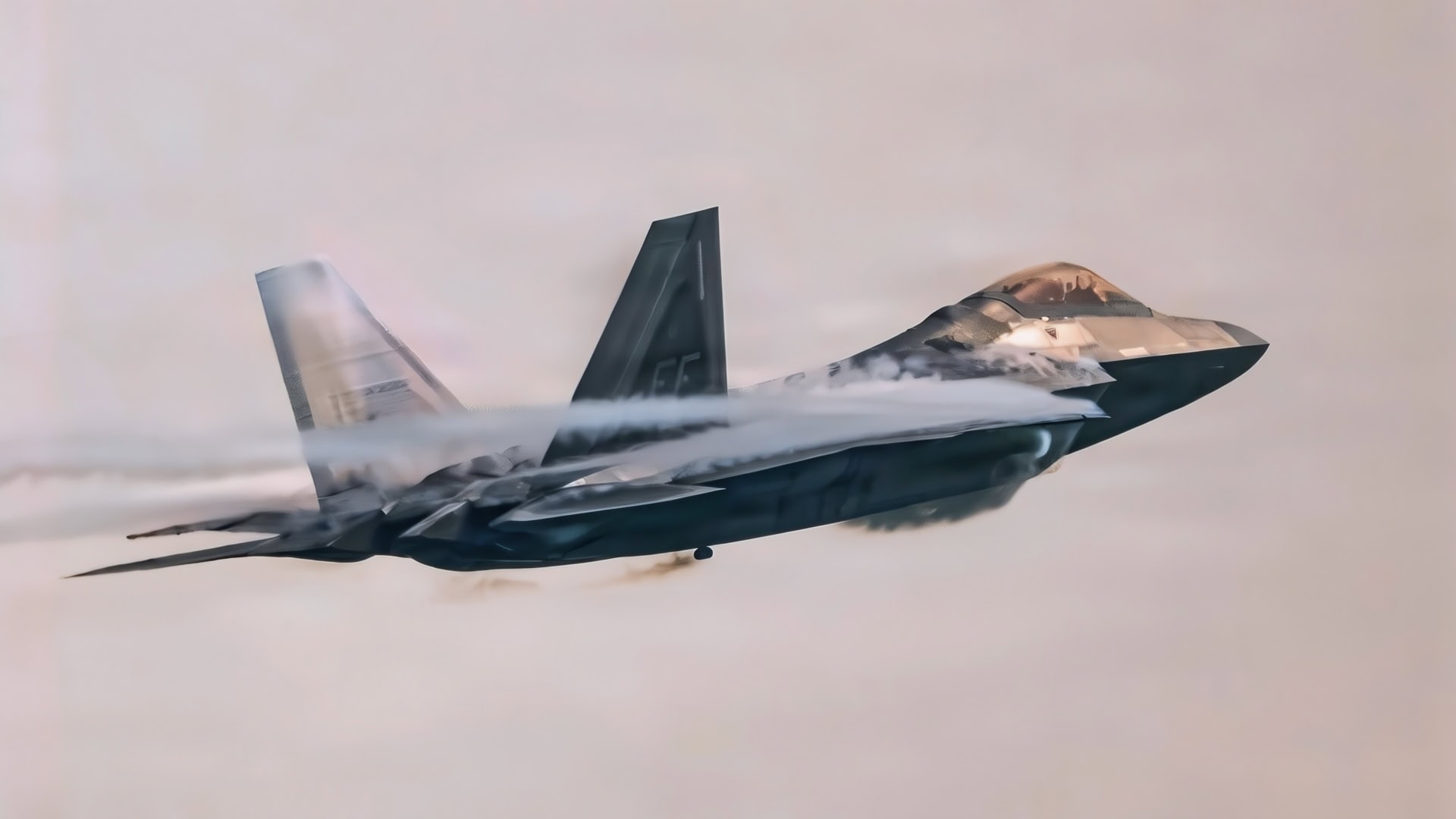
Summary and Key Points: The most advanced air superiority fighter ever built has three confirmed kills, all of which are balloons. The F-22 Raptor was designed to hunt Soviet fighters over Europe. Instead, it has spent its entire career as the best aircraft in the world with nothing to fight, because the war it was built for ended before it ever entered service. In February 2023, more than three decades after the program began, a Raptor finally fired a missile in anger — at a Chinese surveillance balloon drifting off the coast of South Carolina.
The F-22 Raptor: A History
The F-22 Raptor was the first true fifth-generation stealth fighter in the world to enter service.
Developed under the Advanced Tactical Fighter (ATF) program, the aircraft was designed to fight and defeat the Soviet Union’s most advanced aircraft of the time.
It was intended to bypass enemy air defenses and secure air dominance, thereby enabling other aircraft to conduct SEAD/DEAD missions while ground forces operate without fear of enemy air strikes.
Accept, in 1991, while the Raptor was still in development, the Soviet Union collapsed, meaning that the war the F-22 was designed to fight was destined never to occur.
Since then, the F-22 has been relegated to the proverbial sidelines.
The Fighter Built to Win the Cold War
The ATF program officially began in 1981, after the U.S. Air Force issued a Request for Information (RFI) to the aerospace industry.
Multiple companies answered the call, including Lockheed Martin, which, partnering with Boeing and General Dynamics, responded with the YF-22.
The YF-22 was an impressive, conventional-looking aircraft that blended low-observable technologies with raw speed and maneuverability.

YF-22. Image Credit: Creative Commons.
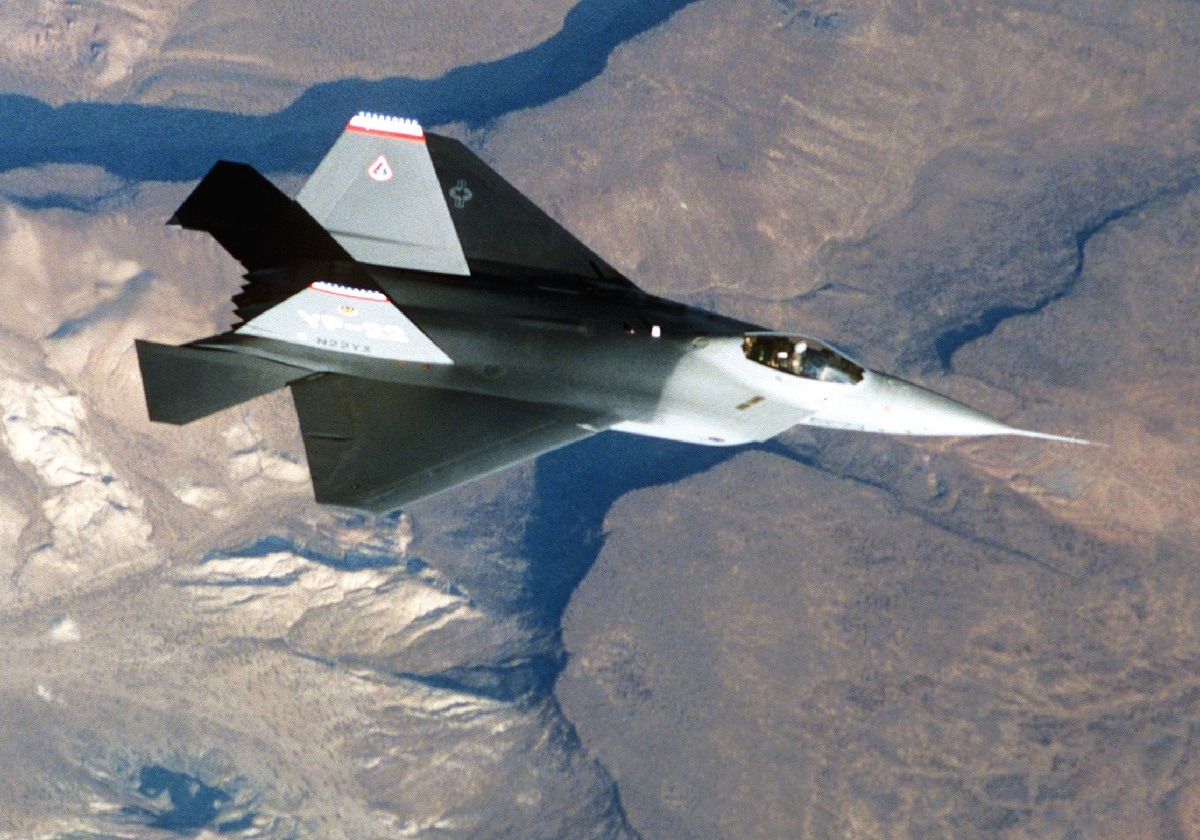
An air-to-air overhead view of the YF-22 advanced tactical fighter aircraft during a test flight. Creative Commons Image.
Although the Northrop/McDonnell Douglas YF-23 is generally considered to have better speed and stealth capabilities, the USAF selected the YF-22 as a safer, more cost-effective alternative.
The now-christened F-22 was selected for further development, with hopes of replacing the Air Force’s fleet of F-15 and F-16 fighters.
The F-22 was designed from the ground up for stealth, speed, and sensor fusion.
Built with deliberate shaping techniques and RAM coatings, the F-22’s radar cross-section, according to some estimates, is as low as 0.0001 square meters from certain angles.
Although maneuverability was not part of the ATF requirements, the designers included two-dimensional thrust-vectoring nozzles to enhance the aircraft’s maneuverability.
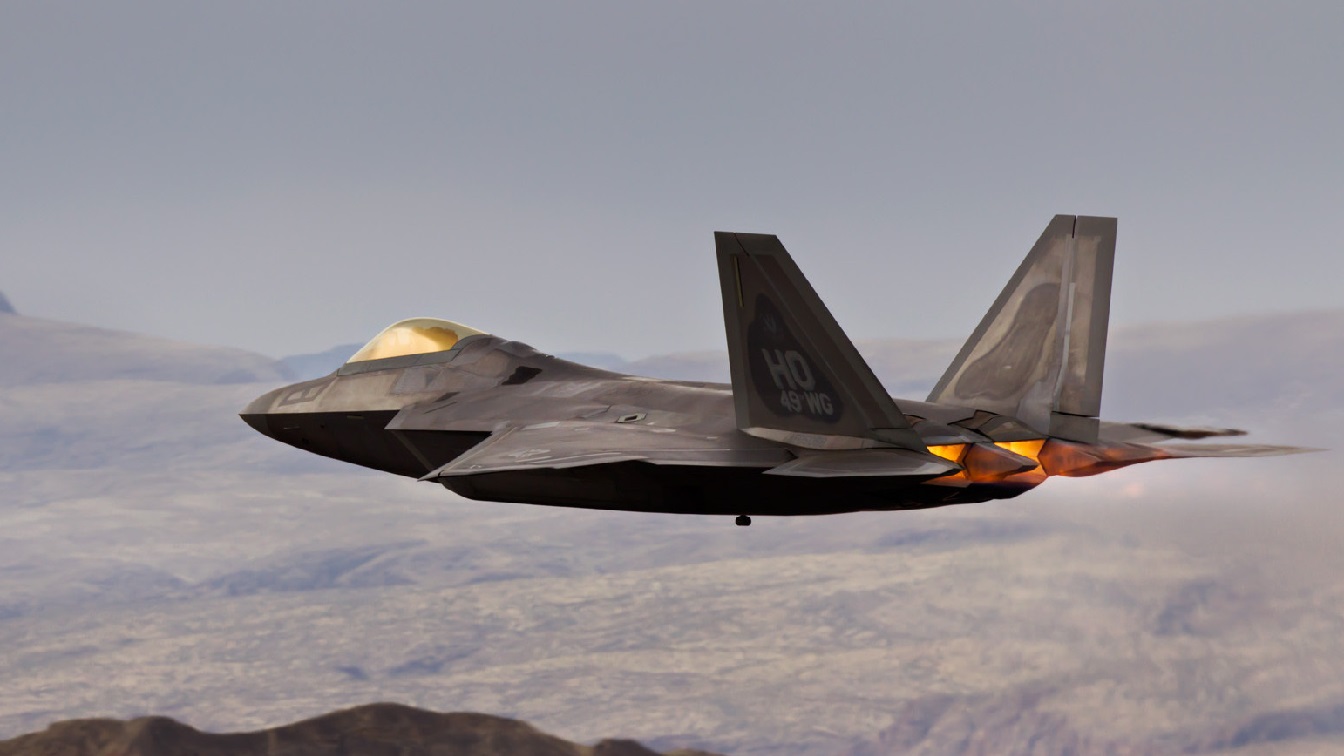
F-22 Raptor. Image Credit: Creative Commons.
Although it was designed to defeat aircraft at long range before detection, no stealth system is absolute.
If the aircraft ever got into a fight with Soviet aircraft, it had to outmaneuver aircraft like the Su-27 Flanker, which is no small task.
Per USAF requirements, the F-22’s engines also enable it to fly at supersonic speeds without engaging its afterburners at speeds of Mach 1.76.
The Perfect Air Superiority Aircraft With No Enemy Fight
With the development of the F-22, the USAF finally had the air dominance fighter that it had been looking for—a fighter that could easily beat the most advanced Soviet aircraft of the time.
Accept that the F-22 would never get the chance to prove itself.
Months after the conclusion of the ATF competition, the Soviet Union collapsed, and the Cold War ended suddenly and abruptly.
Suddenly, the adversary that the Raptor had been purpose-built to fight had simply disappeared.
The USAF now had a $350,000,000 fighter jet with no enemy to fight. Initially, the military insisted that it still needed the F-22’s advanced capabilities.
Originally intended to procure 750 ATFs, the number was gradually reduced to 600, then 400, then 300, and finally to fewer than 200 aircraft, which were ultimately delivered.
In the early 2000s, opinions on the F-22 began to sour in the government. With the newly formed Russian Federation a shadow of its former self, and China not yet on everyone’s radar, the Raptor appeared to offer too much bang for too much buck.
After the 9/11 attacks, the U.S. was now locked in the Global War on Terror (GWOT), which was focused on counterinsurgency warfare against adversaries with little to no air defenses.
Because of the Raptor’s limited multi-role capability, the aircraft’s use in the post-Cold War era came under serious question.
Furthermore, because the aircraft was so technologically sophisticated, it was prohibited from export, meaning U.S. allies could not cover any of its development/procurement costs.
Closing Down Production and the Balloon Incident
In 2012, the F-22’s production lines were officially closed after the 195th aircraft was delivered.
The Raptor was expensive to procure and operate in large numbers, and given its lack of multi-role capability, the investment wasn’t deemed worth the cost.
Over time, however, the F-22 received several upgrades to enhance its air-to-ground capabilities, which it used in Syria and Afghanistan.
More recently, however, with the resurgence of China and Russia as capable threats, the F-22 has received new life.
Following numerous upgrades, the F-22’s multi-role capabilities have also increased over the years, which has come in handy in the current war with Iran.
Despite being built as the ultimate air dominance fighter, the F-22 would not receive any air-to-air kills for multiple decades.
Its first air kill was scored not against an enemy fighter, or even an enemy missile, but a balloon.
In 2023, a suspected Chinese spy balloon was spotted in the skies above the U.S. at an altitude of around 60,000 meters.
The USAF dispatched an F-22 to intercept the balloon with a short-range anti-air missile.
Soon after, F-22s shot down two more unknown objects, likely other spy balloons over the skies of Alaska. With these events, the F-22’s total confirmed air kill count is at a solid three, all of them balloons.
There is a certain degree of irony to the fact that the most sophisticated air dominance aircraft to date has only shot down a couple of balloons.
This is not necessarily the Raptor’s fault. The collapse of the USSR caught everyone by surprise, and as a result, the Cold War ended right as the F-22 program gained traction.
About the Author: Isaac Seitz
Isaac Seitz, a Defense Columnist, graduated from Patrick Henry College’s Strategic Intelligence and National Security program. He has also studied Russian at Middlebury Language Schools and has worked as an intelligence Analyst in the private sector.