At first glance, you wouldn’t think the Lockheed Martin S-3 Viking lived up to its warlike barbarian namesake. Its stout, guppy-like appearance and odd-sounding turbofan engines led pilots to call it the “War Hoover.” The vacuum cleaner you took to war. But for nearly fifty years, the “War Hoover” served the US Navy in various roles, beginning with its introduction to Carrier Air Wings in 1974 and ending in 2021, when NASA flew the last Vikings to test communications systems for drones.
The “Hoover” was a “Mover”
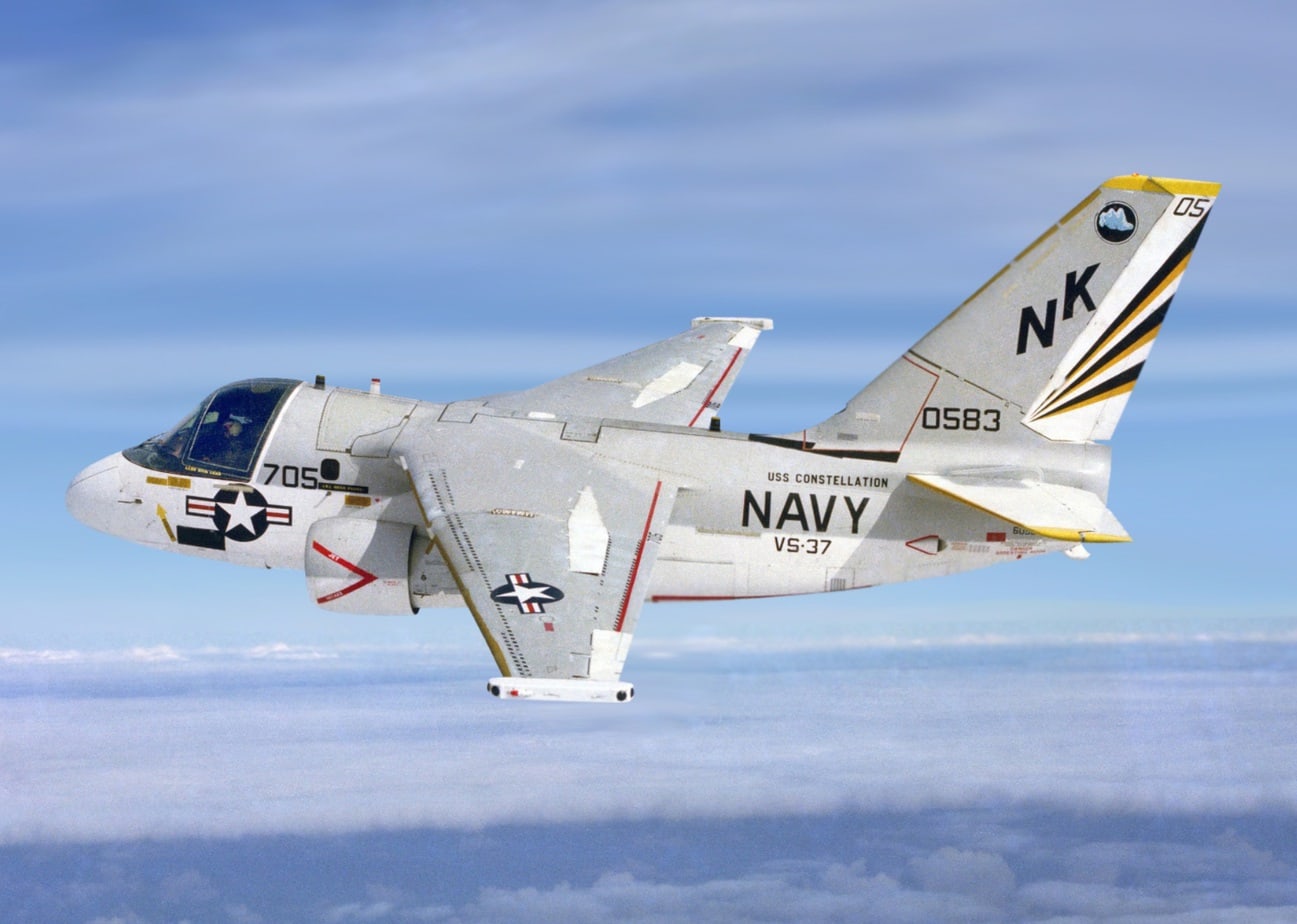
A Lockheed S-3A Viking aircraft from the anti-submarine squadron VS-37 Sawbucks on 11 Dec 1986, assigned to Carrier Air Wing Fourteen (CVW-14) aboard the aircraft carrier USS Constellation (CV-64).
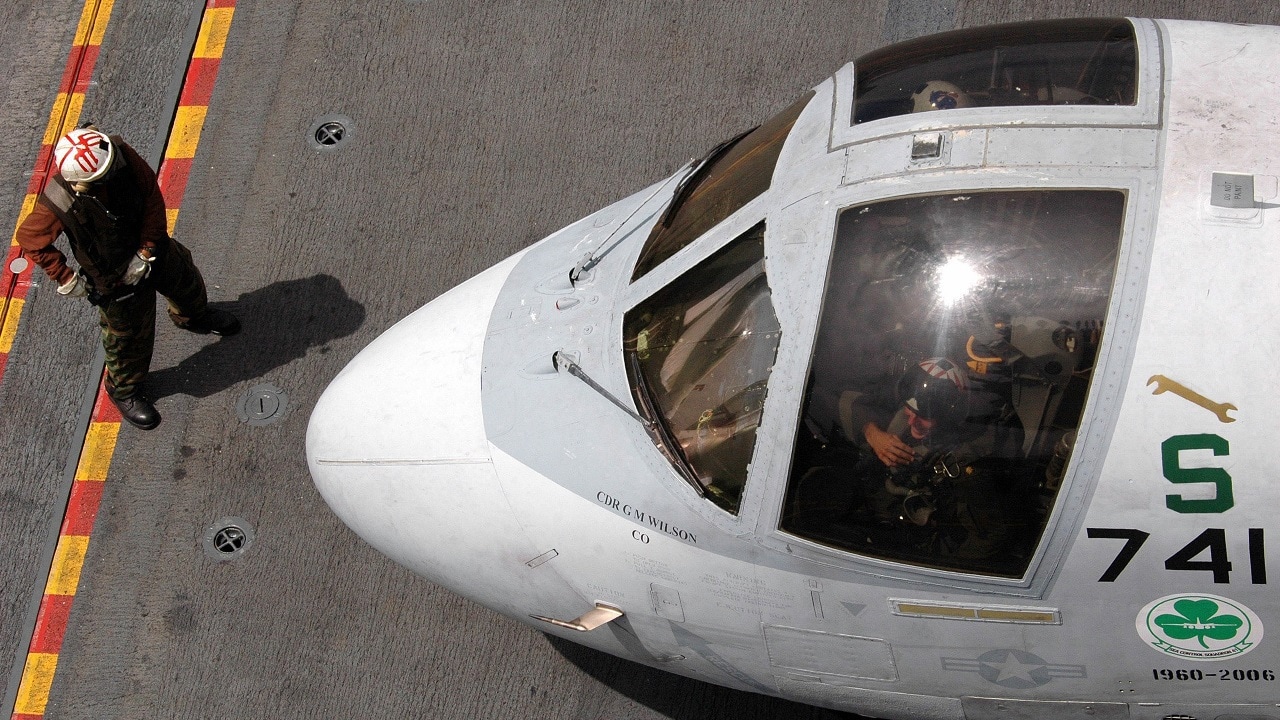
A U.S. Navy S-3B Viking aircraft assigned to the”Shamrocks”of Sea Control Squadron 41 prepares for launch from the U.S. Navy Aircraft Carrier USS NIMITZ (CVN 68).
In the 1960s, the US Navy sought to replace its propeller-driven Grumman S-2F Tracker, dating back to the 1950s, with a larger, more up-to-date aircraft in terms of engines and sensors.
Lockheed Martin offered the YS-3A as an all-weather, subsonic, multi-mission, long-range replacement.
One thing the “Hoover” could do was move.
It could fly past 500mph at 25,000 feet, which is important when scrambling to investigate a submarine contact.
Once there, its ten-hour endurance meant it could stay on the hunt.
With its internal bomb bay, sonobuoys, and four-man flight crew, it was a single-airframe hunter-killer of submarines.
An aircraft carrier could embark a full squadron of S-3As that could range far and wide from the carrier, operating in a continuous relay to ensure medium- to long-range, 24-hour coverage in contested waters.
The S-3A Viking Was Just Good To Just Stick To One Job
The Navy delivered almost 200 Vikings, intended to serve in the Anti-Submarine Warfare role, but their performance was so good and reliable that the Navy soon assigned them to other missions as well.
They turned the Viking into a ship hunter capable of launching the Harpoon Missile in the S-3B version.
Its speed, radar, and data links enabled it to skim over the waves without emitting electronic energy, receive targeting data from another ship or plane, and then launch two Harpoon missiles.
The S-3A Viking Became “The Ears Of The Fleet”
With the end of the Cold War and the collapse of the Soviet Union, the S-3A and B models found themselves out of a job.
The Soviet Navy, with its hundreds of ships and subs, was now mostly pier-side without the rubles needed to crew them and put them to sea.
The Navy still wasn’t ready to give up its “War Hoovers,” and the aircraft adopted a new role as an Electronic Surveillance and Warfare platform: the ES-3A Shadow.
Replacing its sonobuoy launcher, magnetic anomaly detection gear, and weapons loadout, the Shadow was crammed with sensors and communications gear and bristled with some sixty antennas.
Serving as the “Ears” of the Carrier Strike Group Commander, the Shadow was a signals intelligence gathering platform now, “Hoovering” up radio and radar frequencies that would identify specific ships, planes, and submarines beyond the detection range of the ships of the strike group to help the admiral form the tactical picture of the threats in the area.
Various other variants were experimented with, including the “Beartrap” and “Gray Wolf” Vikings whose missions and full equipment loadouts are still classified some thirty years after they were made.
A Bittersweet Good-Bye To The S-3A Viking
By 2009, the Vikings were at the end of their service life as multi-mission Anti-Sub, Anti-Ship, and Electronic Surveillance platforms, as the last carrier-based squadron was decommissioned and its Vikings put out to pasture.
A few remaining Vikings hung on in support roles ashore until the Navy finally let them go in what it called “A bittersweet good-bye” in mid 2016.
NASA acquired four S-3B models as communications test aircraft and kept them flying until their collective age and lack of spare parts led to their “Research Workhorse” retiring in 2021.
Proposals to keep the versatile and reliable Viking in the air never quite worked out.
China’s emergence as a new naval threat, armed with long-range cruise missiles, almost led to the Viking’s return to service.
The idea was to convert them into aerial tankers to free up more F/A-18s used in that role.
South Korea considered refurbishing S-3As as anti-submarine warfare aircraft for its own coastal waters, but that deal fell through.
In 2014, Lockheed Martin proposed retiring 35 Vikings and using them to replace the aging C-2 Greyhound, which the fleet uses as a cargo and passenger shuttle.
The Navy decided on the V-22 Osprey instead.
Today, what remains of the S-3A and B model Vikings are in the boneyards of Nevada and Arizona and on display in museums.
A curious-looking, chubby little plane that punched well above its weight in every task it was given as the “War Hoover.”
Manufacturer: Lockheed-Martin Aeronautics
-Type: anti-submarine warfare (ASW)
-Crew: Pilot, COTAC (Naval Flight Officer), Acoustic Sensor Operator (AW), Non-Acoustic Sensor Operator (AW)
-Powerplant: Two 9,275 lb. static thrust General Electric TF-34-GE-400B turbofans
Dimensions:
-Length: 53 ft., 4 in.
-Height: 22 ft., 9 in.
-Wingspan: 68 ft., 8 in.
Weight:
-Empty: 26,650 lb.
-Gross: 52,539 lb.
Performance:
-Max Speed: 518 mph at 25,000 ft.
-Ceiling: 40,900 ft.
-Range: 2,645 miles
Armament:
-Up to 3,958 lb. of ordnance, including AGM-84 Harpoon, AGM-65 Maverick, and AGM-84 SLAM and SLAM(ER) missiles, torpedoes, rockets, and bombs.
About the Author: Sean Spoonts
Sean Spoonts is the former Editor-In-Chief of SOFREP.com. He is a military analyst, writer, and commentator whose work has appeared in Newsweek, CNS News, Ukrinform, and various military/veteran media networks and professional publications, including the Military Intelligence Professional Bulletin. He is a U.S. Navy veteran, having served as an Aviation Anti-Submarine Warfare Operator and Search and Rescue Helicopter Aircrewman