
Elbridge Colby, President Donald Trump’s nominee for undersecretary of Defense for Policy, made a career arguing that the United States must maintain laser focus on a future conflict with China, one likely precipitated by a Chinese invasion of Taiwan. It was against this backdrop that Colby’s statement at his March 4, 2025, confirmation hearing that defense of Taiwan may no longer be a vital U.S. interest raised eyebrows. “Taiwan is very important to the United States but as you said it’s not an existential interest,” Colby explained, arguing the military imbalance in the Strait of Taiwan changed calculations.
The China Invasion Threat on Taiwan
Such an adjustment in his policy may convince authorities in Beijing that they face less chance of meaningful U.S. pushback should the People’s Republic of China seek to forcibly unify China and Taiwan; the U.S. intelligence community previously suggested that Chinese President Xi Jinping wanted the People’s Liberation Army to be capable of invading Taiwan by 2027.
Too often, U.S. attention toward a potential Chinese invasion of Taiwan focuses on the run-up to such an invasion and the military dynamics of the invasion itself: Will China test the waters by first conquering Taiwan’s outlying islands like Taipeng (Itu Aba), Pratas (Dong-sha), and Quemoy (Kinmen)? Or will they go in big, as Colby suggests? Conversely, could China simply blockade and embargo Taiwan into submission?
What happens next is seldom discussed? After all, Beijing’s “one China” rhetoric aside, China has never convincingly controlled Taiwan; the United States occupied Afghanistan longer than China ever occupied Taiwan, especially as the Qing Dynasty was Manchu and not ethnically Chinese.
What History Teaches on What Taiwan Could Experience
Here, events 3,500 miles away from Beijing in Baku may give a hint. In September 2023, Azerbaijani forces invaded and ethnically cleansed Nagorno-Karabakh. While Azerbaijan claimed Nagorno-Karabakh as its sovereign territory, the Azerbaijani government’s narrative elided history: Baku never possessed Nagorno-Karabakh until a young Josef Stalin shuffled the Caucasus but, even then, Nagorno-Karabakh was constitutionally autonomous.
Upon the fall of the Soviet Union, the first Nagorno-Karabakh War erupted as it sought to secede from Azerbaijan while Azerbaijan sought to slaughter or expel its population. Azerbaijan failed in its objectives and Nagorno-Karabakh established its own republic. Like Taiwan, the Republic of Artsakh was democratic, hosting real, contested elections leading to transfers of power.
Five days prior to Azerbaijan’s invasion of Artsakh, Acting Assistant Secretary of State Yuri Kim told the Senate Foreign Relations Committee, “We will not tolerate any military action. We will not tolerate any attack on the people of Nagorno-Karabakh. That is very clear.” When Azerbaijani troops swarmed over the region the following week, she did nothing. Azerbaijani troops expelled the region’s Christian population, defaced churches and bulldozed ancient graves, and dynamited the parliament.
Their war on democracy and freedom did not end there: Azerbaijani security forces arrested more than a dozen former elected officials, including three former presidents and Ruben Vardanyan, a billionaire who left his business career in Russia to dedicate himself to the Artsakh cause. They charged each with a number of offenses and have begun show trials to humiliate Artsakh leaders. Vardanyan is now on a hunger strike. Azerbaijan, meanwhile, has expelled the International Committee of the Red Cross.
Mark Libby, the U.S. ambassador to Azerbaijan, meanwhile participates in and praises Azerbaijani propaganda tours to see the reworking of destroyed Armenian towns and cities. While the ambassadorship in Beijing is now vacant pending ambassador-designate David Purdue’s confirmation, the willingness of previous U.S. ambassadors to ignore China’s colonization and destruction of East Turkestan (Xinjiang) and Tibet give little hope that the State Department would take a firmer line on Taiwan. Will the State Department approve a future U.S. ambassador to China to visit and praise the stewardship of the People’s Republic of China after any Taiwan occupation? Will he or she ignore the destruction of churches and temples?
It may be theoretical now, but still relevant. With isolationists ascendant in the Washington policy battle, it is easy to ignore what happens in the South Caucasus. The Baku show trials provide a window into how China might treat Taiwan post-invasion. Will Beijing raze the Cihu Mausoleum, the finally resting place of President Chiang Kai-shek? Will they symbolically dominate the Taiwan’s parliament and the Presidential Building in Taipei’s Zhongzheng District?
Will Communist agents who follow the People’s Liberation Army into Taiwan spread across the occupied country to hunt down and then stage show trials for former Taiwanese presidents, ministers in the Executive Yuan, and other prominent Taiwanese leaders in the same way that Azerbaijani brownshirts hunted down Artsakh democrats?
If Beijing, like Baku, does not have truth on its side, why not craft a false narrative for a captive audience accustomed to swallowing and regurgitating propaganda? The average Chinese citizen is as brainwashed toward Taiwan as the average Azerbaijani is toward Armenians. They may believe any false admissions of terror and foreign taint that torture compels. Here, Kari Lake faces a test in her stewardship of Voice of America: Will she broadcast truth into Azerbaijan and China?
To date, the United States has defended Taiwan with weapons and reinforced the notion that the Strait of Taiwan is international waters with frequent Freedom of Navigation Operations. Both are important, but they are not enough.
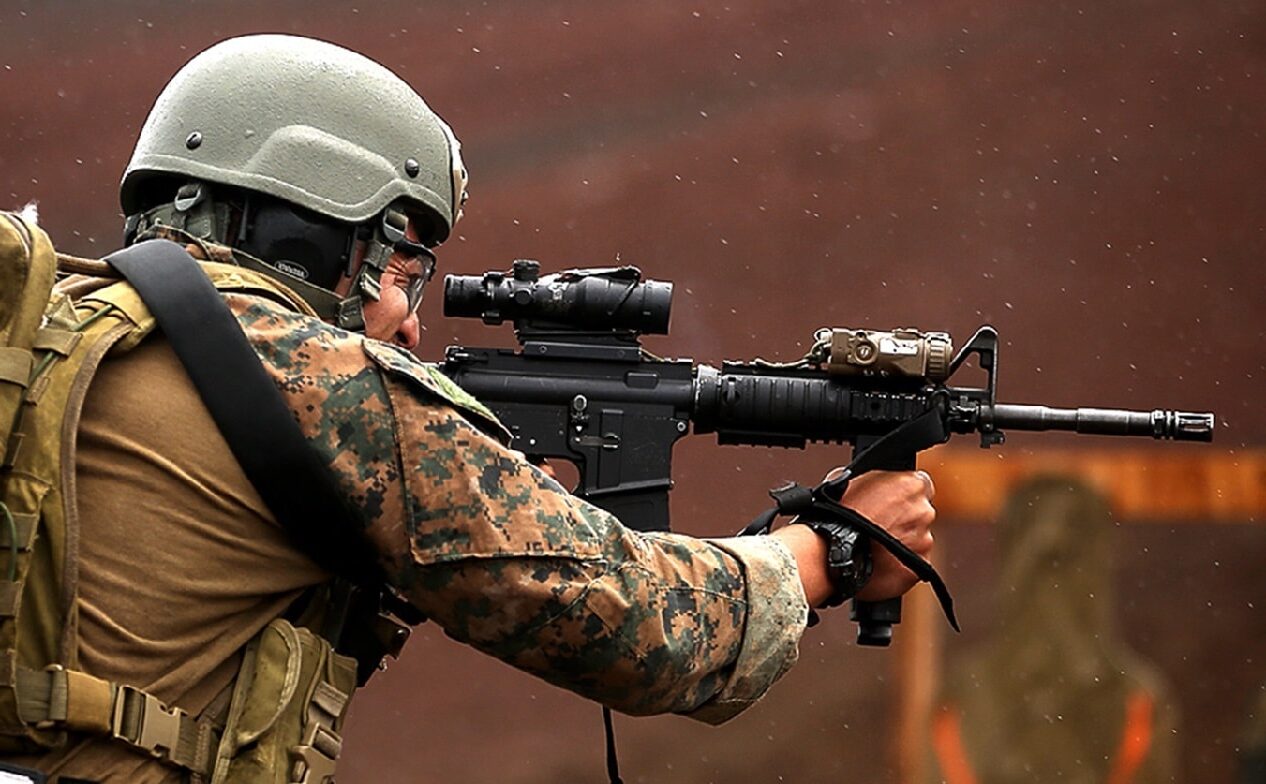
ROC/Taiwan Soldier. Image Credit: Creative Commons.
Baku is not Beijing but by publicly mocking Azerbaijan’s show trials rather than simply ignoring them; by slapping Magnitsky Act sanctions on the judges presiding over such mockeries of justice; by publicly standing by those persecuted; and by forcing compliance with the Foreign Agents Registration Act for those in think tanks and universities who take direction from Baku, the United States might signal to those in Beijing who watch and assess U.S. reactions and behavior that even after any invasion of Taiwan, the United States will not forget Taiwan’s freedom, ignore China’s illegal agents of influence, or condemn Taiwan’s legitimacy to history’s dustbin.
About the Author: Dr. Michael Rubin
Dr. Michael Rubin is a senior fellow at the American Enterprise Institute and director of policy analysis at the Middle East Forum. He is also a 19FortyFive Contributing Editor. The views expressed in this opinion piece are the author’s own.