
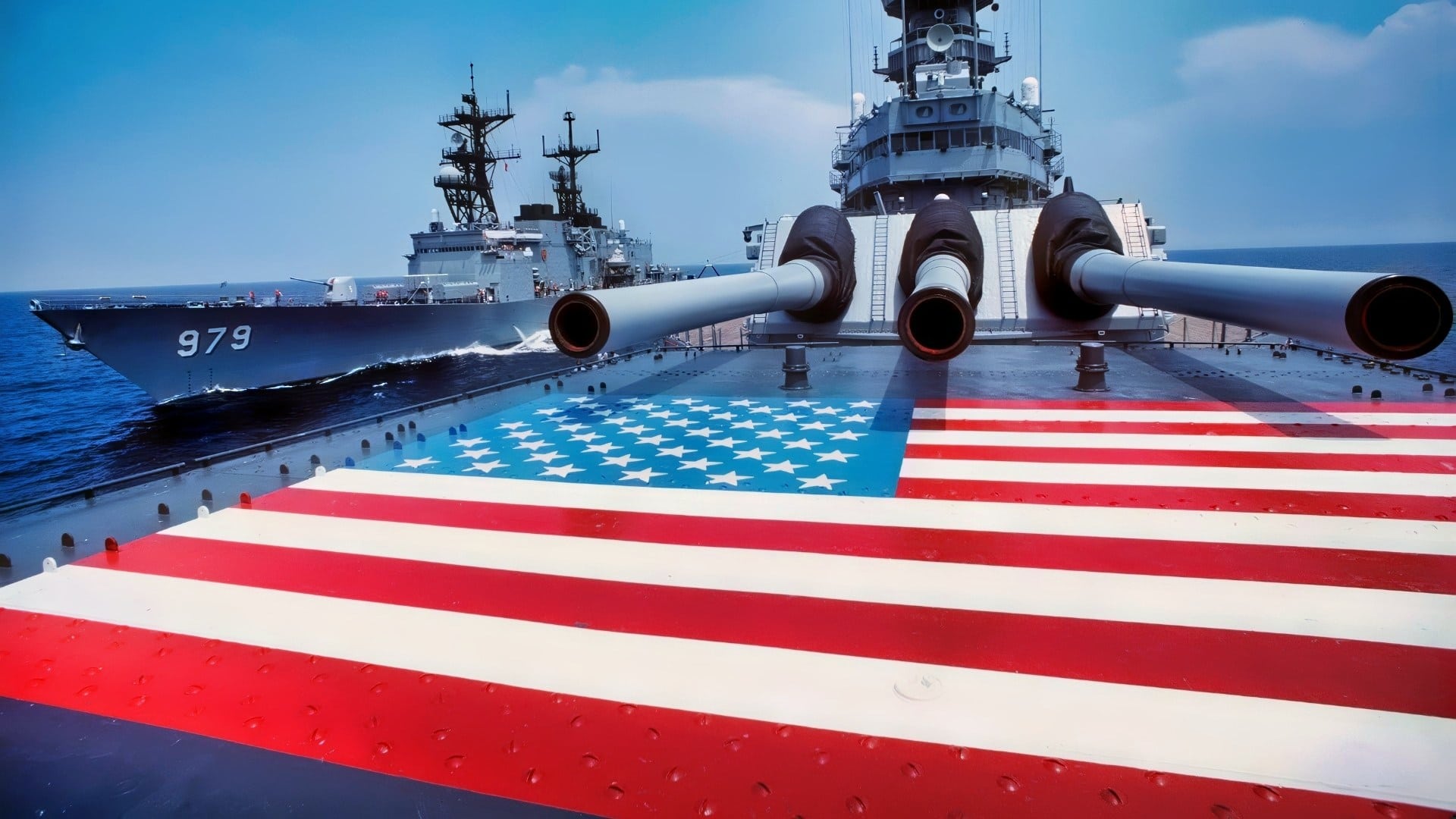
Summary and Key Points: The proposed Trump-class battleship—designated BBG(X) and led by the USS Defiant—aims to become the Navy’s largest surface combatant since World War II, with a projected displacement of around 39,000 tons and a length between 840 and 880 feet.
-Supporters frame it as a transformative guided-missile capital ship, but the central obstacle is cost.
-Estimates range from $10 billion to $15 billion for the lead vessel, while a Congressional Budget Office projection cited in reporting suggests the first ship could approach $21 billion to $22 billion if ordered in 2030.
-A key technical and budget risk is the electromagnetic railgun, a headline feature after past Navy railgun efforts ended without operational results.
What the Trump-Class Battleship Might Look Like
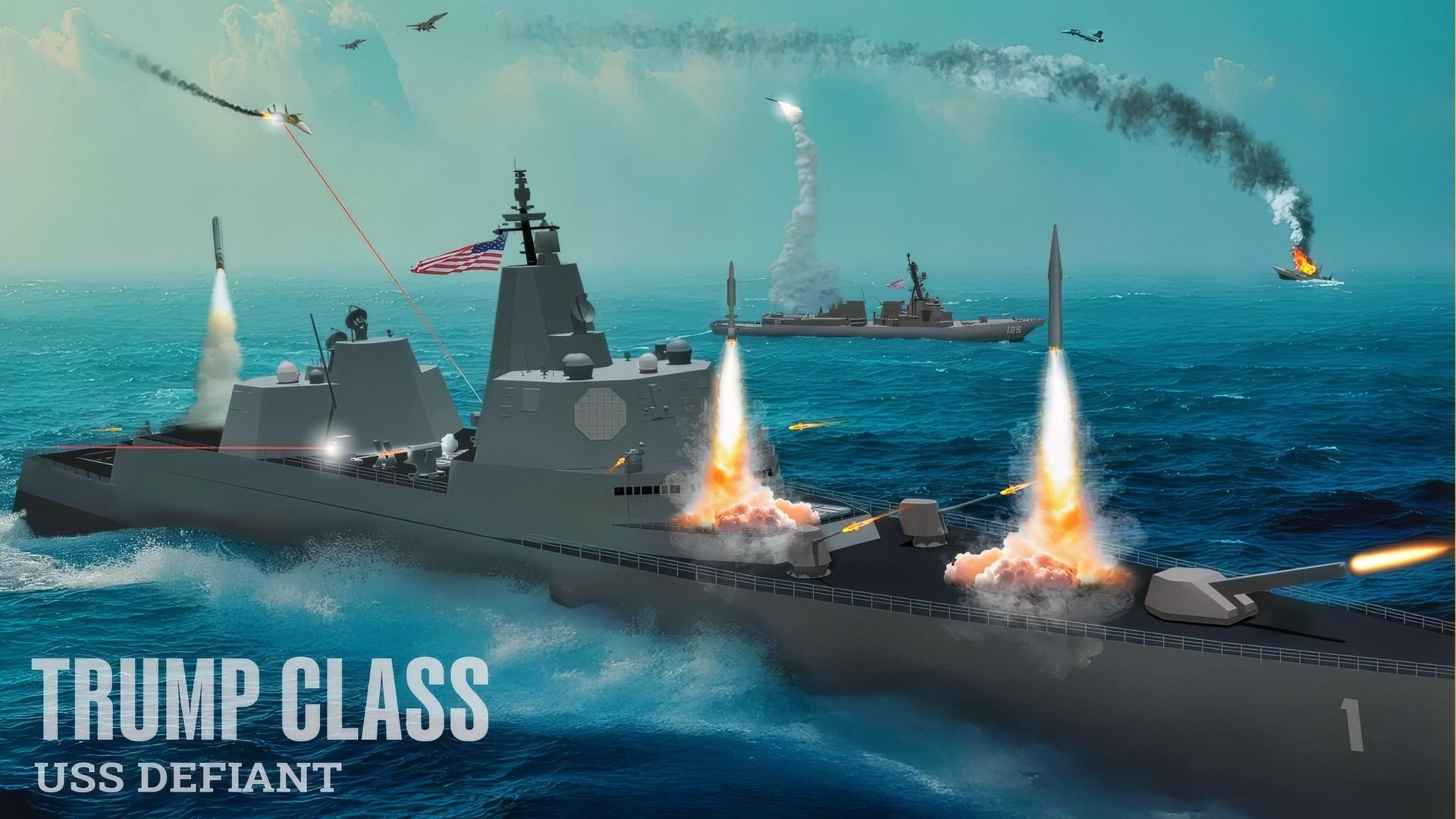
Trump-Class Battleship USS Defiant. Image Credit: Creative Commons.
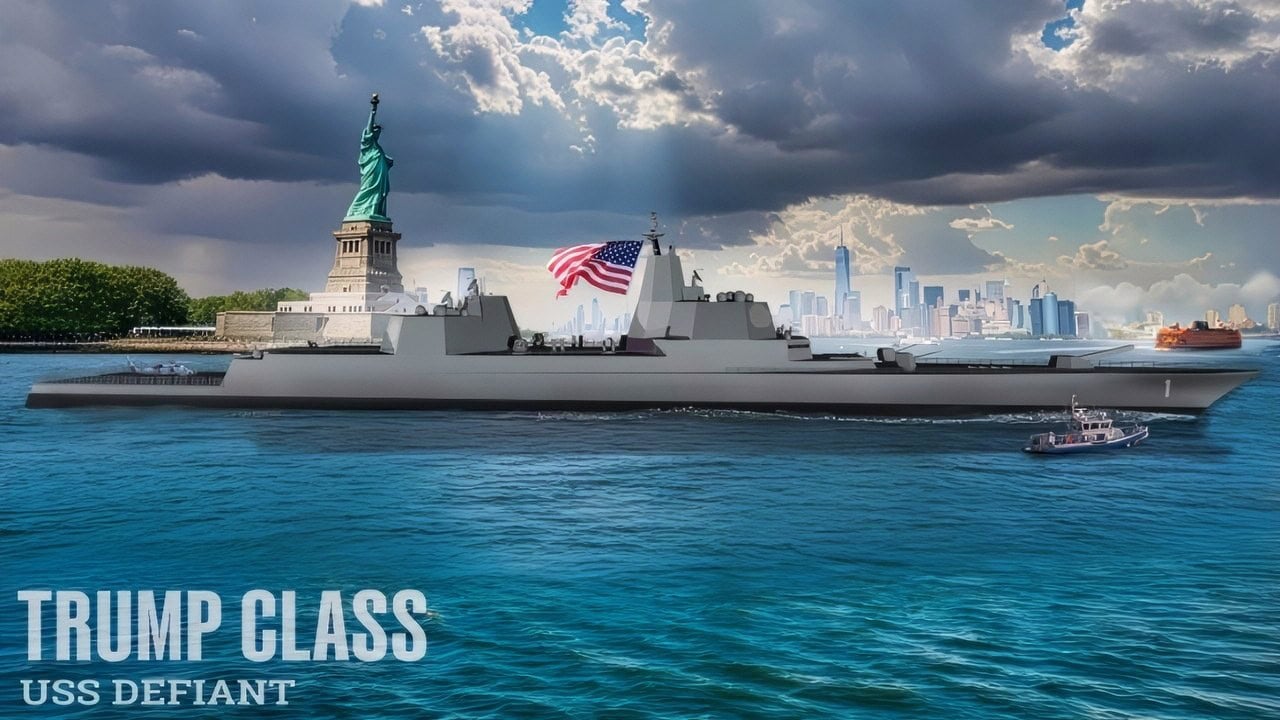
Trump-Class Battleship. Image Credit: Creative Commons/White House.
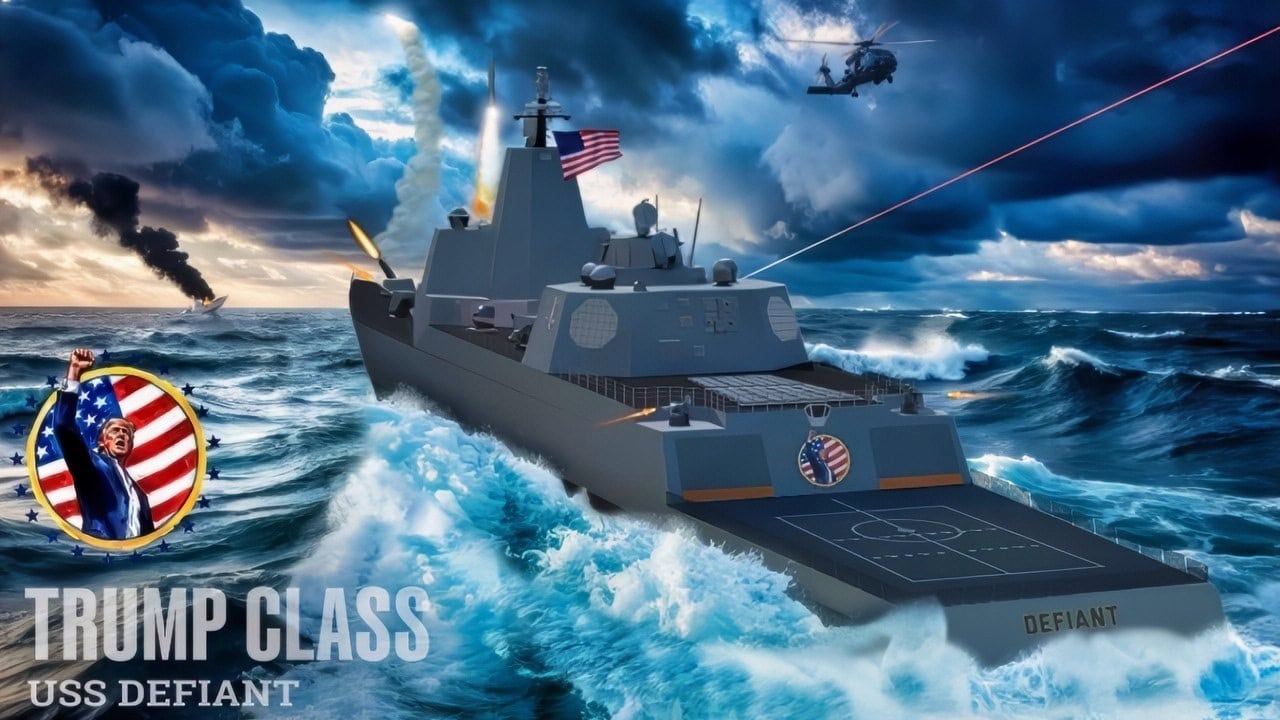
Trump-Class Battleship. Image Credit: Creative Commons/White House Photo.
Trump-Class “BBG(X)” Battleship: The $22 Billion Question Facing the Navy
“Size does matter,” as the old cliché goes.
As much as that saying is overused and abused, there is a lot of truth to it in military matters, whether we’re talking about the size of the military machines themselves or the astronomical budgets necessary to fund them.
Which brings us to the topic of the prospective—and already highly controversial—Trump-class battleships, officially labeled the BBG(X). (“BB” as in battleship, “G” as in guided missile platform, and “(X)” as in design yet to be determined). If and when these next-generation behemoths are built, they will be the largest U.S. Navy surface combatants since World War II—though with a displacement of 39,000 tons, they would still be smaller than the 54,000-ton Iowa-class of that era (or, for that matter, the 72,000-ton Yamato and Musashi of the long-defunct Imperial Japanese Navy).
The question is, will the Trump-class battleships be too big to fail? Or will the big budget battles sink them before they’re ever even floated?
The Basics
A major source of inspiration for this article is a December USNI News piece by Mallory Shelbourne and Sam Lagrone.
To wit: “Trump said the Navy will start by purchasing two ships and eventually purchase 10, with a goal of 20 to 25 in total for the class with the start of construction planned for 2030…’The U.S. Navy will lead the design, along with me, because I’m a very aesthetic person,’ Trump said.
“Images of a future USS Defiant (BBG-1) were featured alongside Trump, [U.S. Secretary of War Pete] Hegseth and [U.S. Navy Secretary John] Phelan, as well as a ship logo based on the July 13, 2024, Evan Vucci photo taken shortly after Trump was shot in the ear during an assassination attempt amid his presidential campaign.”
The authors go on to quote this confident statement from Phelan:
“‘The future Trump-class battleship—the USS Defiant—will be the largest, deadliest and most versatile and best-looking warship anywhere on the world’s oceans. Now there will be work for shipyards everywhere from Philadelphia to San Diego, from Maine to Mississippi, from the Great Lakes to the Gulf Coast, and for manufacturers that will build components for this battleship in every state.’”
For comparison, the Zumwalt-class destroyers, at 15,000 tons, are the largest surface combatants currently in the fleet.
As for hull length, the Trump-class is projected to measure from 840–880 feet. The low end of that scale would make it shorter than both the Iowas (887 feet) and the Yamato/Musashi (862 feet).
Semantic Sidenote
By naming the lead ship of the Trump class the USS Defiant instead of the “USS Trump,” the Navy would be departing from an old naming convention of christening the lead ship of a multi-vessel class with the same name as the overall class.
The Problem with the Trump-Class
As we said at the beginning, “size does matter” applies to expenditures as well as physical dimensions.
Shelbourne and Lagrone guesstimate that the USS Defiant could cost “from $10 to $15 billion, based on the size and the systems that are included.”
However, in a January article, Valerie Insinna of Breaking Defense cites a Congressional Budget Office (CBO) estimate that projects a significantly higher cost for the lead ship of the class:
“The first Trump-class battleship could cost up to about $21 billion if ordered today, with the price inching toward $22 billion if ordered in 2030, according to an estimate put forward by the Congressional Budget Office.
“‘If the BBG-1 has more survivability features—greater compartmentalization or internal structure, for example—than the Navy’s current surface combatants, costs could increase,’ according to the CBO.’”
For follow-on ships, the CBO projects costs of $9 billion to $13 billion per vessel if orders begin today, or $10 billion to $15 billion if the first ship order is deferred until 2030.
Though not specified by Ms. Insinna, my prior research on the Trump-class battleships indicates the potential likeliest factor to delay construction—and thus drive up the price tag—is also the potentially most physically impressive feature: the electromagnetic railgun.
Expected to fire tungsten projectiles at a hypersonic velocity of Mach 6, the gun, if it works as advertised, will compensate in sheer kinetic energy (32 megajoules) what it lacks in bore size relative to the 16-inch guns of its Iowa-class predecessors.
However, the U.S. Navy has a less than stellar record of experimenting with railguns. The Navy’s railgun experiments were declared dead in July 2021 after 15 years and $500 million expended on research that yielded no positive results.
This does not necessarily mean the railgun is a lost cause. Just ask one of America’s key allies in “the Quad,” namely Japan. Back in October 2023, the Japan Maritime Self-Defense Force (JMSDF) successfully test-fired a railgun from one of their warships, and amazingly, they spent a measly $6.5 million—roughly 1.3 percent of what the Navy spent.
Perhaps Navy R&D teams would do well to consider brainstorming with their JMSDF counterparts to make the BBG(X) a reality sooner rather than later.
About the Author: Christian D. Orr, Defense Expert
Christian D. Orr is a Senior Defense Editor. He is a former Air Force Security Forces officer, Federal law enforcement officer, and private military contractor (with assignments worked in Iraq, the United Arab Emirates, Kosovo, Japan, Germany, and the Pentagon). Chris holds a B.A. in International Relations from the University of Southern California (USC) and an M.A. in Intelligence Studies (concentration in Terrorism Studies) from American Military University (AMU). He is also the author of the newly published book “Five Decades of a Fabulous Firearm: Celebrating the 50th Anniversary of the Beretta 92 Pistol Series.”
More From 19FortyFive
USS Nimitz Could Become a Drone Supercarrier