Summary and Key Points: Isaac Seitz, an intelligence analyst and defense columnist, evaluates the five strategic pillars of Napoleon Bonaparte’s European hegemony.
-From the “battle without a battle” at Ulm to the masterclass of deception at Austerlitz, this 19FortyFive report analyzes how the Grande Armée utilized the Corps System to outmaneuver the Third Coalition.
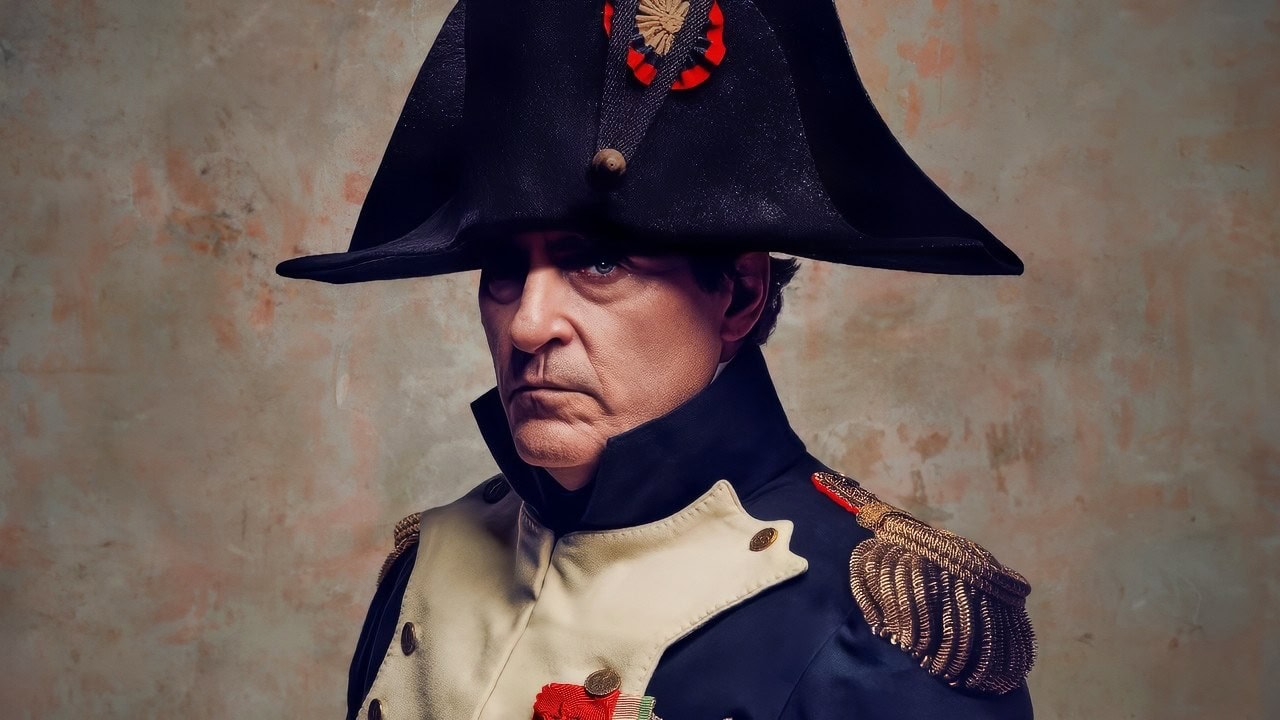
Napoleon Bonaparte. Image Credit: Creative Commons.
-The analysis details the dual victories at Jena-Auerstedt, the crushing of Russian forces at Friedland, and the brutal use of the Grand Battery at Wagram, highlighting how Napoleon translated tactical success into the geopolitical remaking of the Holy Roman Empire.
Quote of the Day: How Napoleon Won a War Without Firing a Single Major Shot
“If you wage war, do it energetically and with severity. This is the only way to make it shorter and consequently less inhuman.” -Napoleon
Napoleon Bonaparte is arguably one of the greatest generals of the last two hundred years.
His tactical prowess, understanding of battlefield movements, and his higher-than-heaven ambitions made him a fearsome opponent on the battlefield.
On many occasions, the nations of Europe banded together to stop Napoleon, but they were unsuccessful until the Battle of Waterloo.
Because of France’s precarious geopolitical position (and because of his own ego), Napoleon had to wage multiple wars in order to secure France’s position in Europe. As a result, Napoleon won many great victories over the combined forces of Europe.
Below is a list of what I believe to be five of Napoleon’s most important victories.
The Battle of Ulm
The 1805 campaign that culminated at Ulm remains a model of victory achieved through maneuver rather than annihilation.
At the time, the Third Coalition had formed to challenge France’s rising power. Napoleon’s Grande Armée, freshly transformed from an invasion force poised against Britain on the Channel coast, wheeled eastward with remarkable speed and cohesion.
The Austrians, under General Karl Mack, gathered around the city of Ulm on the Danube, expecting to coordinate with Russian forces moving westward. Napoleon saw an opportunity not to defeat Mack in a single climactic battle, but to strangle his army’s strategic position through encirclement. Over several weeks in September and October of 1805, the French corps advanced along parallel routes, crossing the Rhine at multiple points and converging behind Ulm.
The French Army maneuvered in a way that allowed each corps to maintain enough autonomy to fight if needed, while the whole network closed a tightening ring around the Austrians. Once Napoleon had severed their lines of communication and blocked retreat routes, the Austrians faced a dismal calculus.
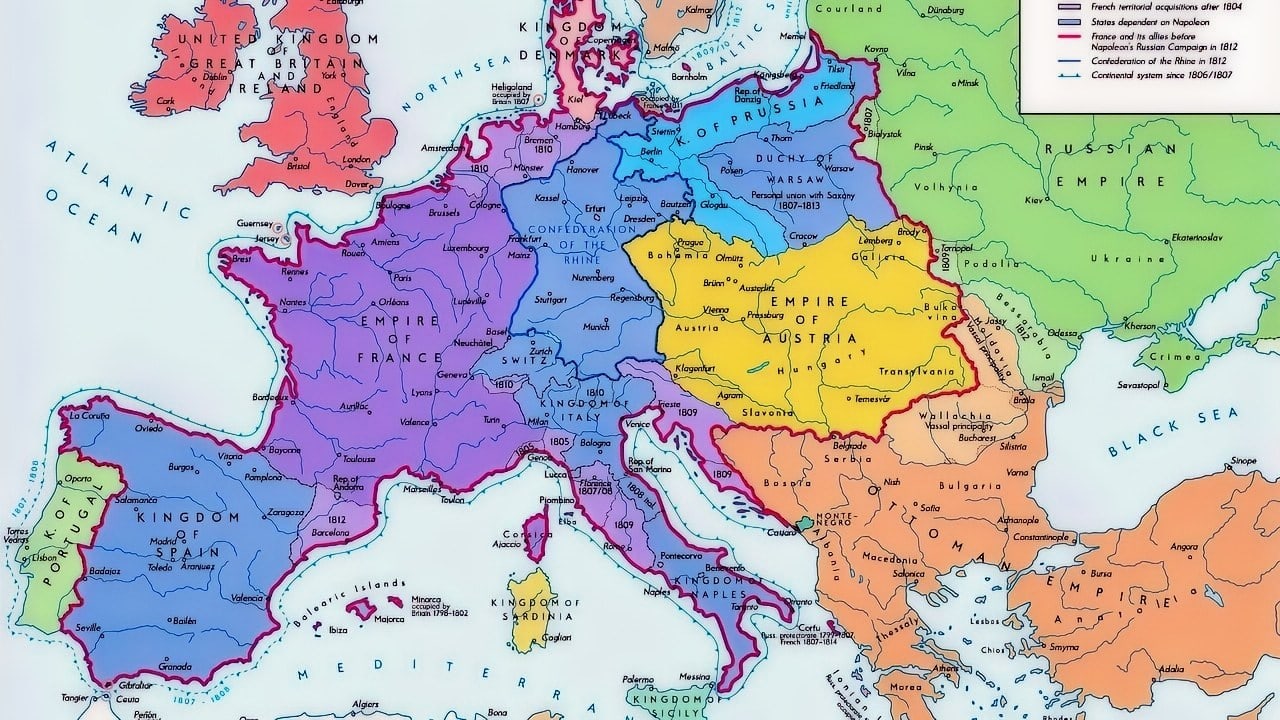
Map of Napoleon’s Empire. Image Credit: Creative Commons.
They could fight a desperate breakout against better-postured opponents or surrender.
On October 20, 1805, Mack capitulated with more than thirty thousand men.
The French casualties in the campaign were comparatively light for an operation at that scale. AS a result, Austrian morale was crushed, and the road to Vienna was left wide open.
Ulm has been called a “battle without a battle,” but that description understates the intellectual daring of the operation. Napoleon converted mobility and corps-level independence into a strategic checkmate.
The Battle of Austerlitz
The battle of Austerlitz, on December 2, 1805, is widely considered by many historians to be one of Napoleon’s greatest triumphs.
The Russian and Austrian armies, now operating together, sought to recover from the humiliation of Ulm and regain the initiative. Napoleon, having occupied Vienna, was willing and eager to fight, but only on his own terms. He set those terms by feigning weakness. The high ground known as the Pratzen Heights dominated the Austerlitz battlefield were deliberately vacated by the French, inviting the Allies to believe they could turn the French right and collapse his line. The trick worked. In the cold, misty morning,
Allied forces committed heavily to enveloping the French right flank near the villages of Telnitz and Sokolnitz. At precisely the moment when the Allied center was extended and under-defended, Napoleon unleashed Marshal Soult’s corps to assault the Pratzen Heights. As the mist lifted, the French climbed and seized the high ground, splitting the Allied army in two. The northern sector, where Marshal Lannes and cavalry under Murat were engaged, pinned the Allied left and prevented reinforcement. On the threatened French right, Marshal Davout’s troops arrived after long forced marches to stabilize the situation.
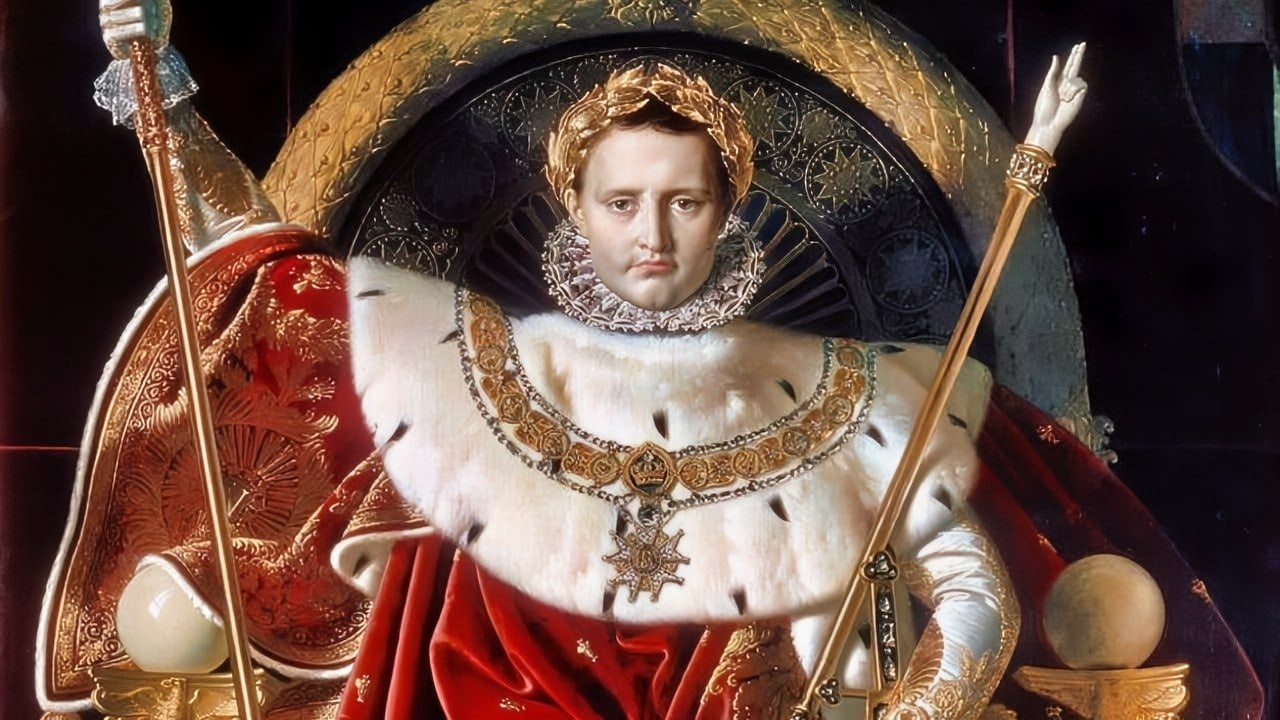
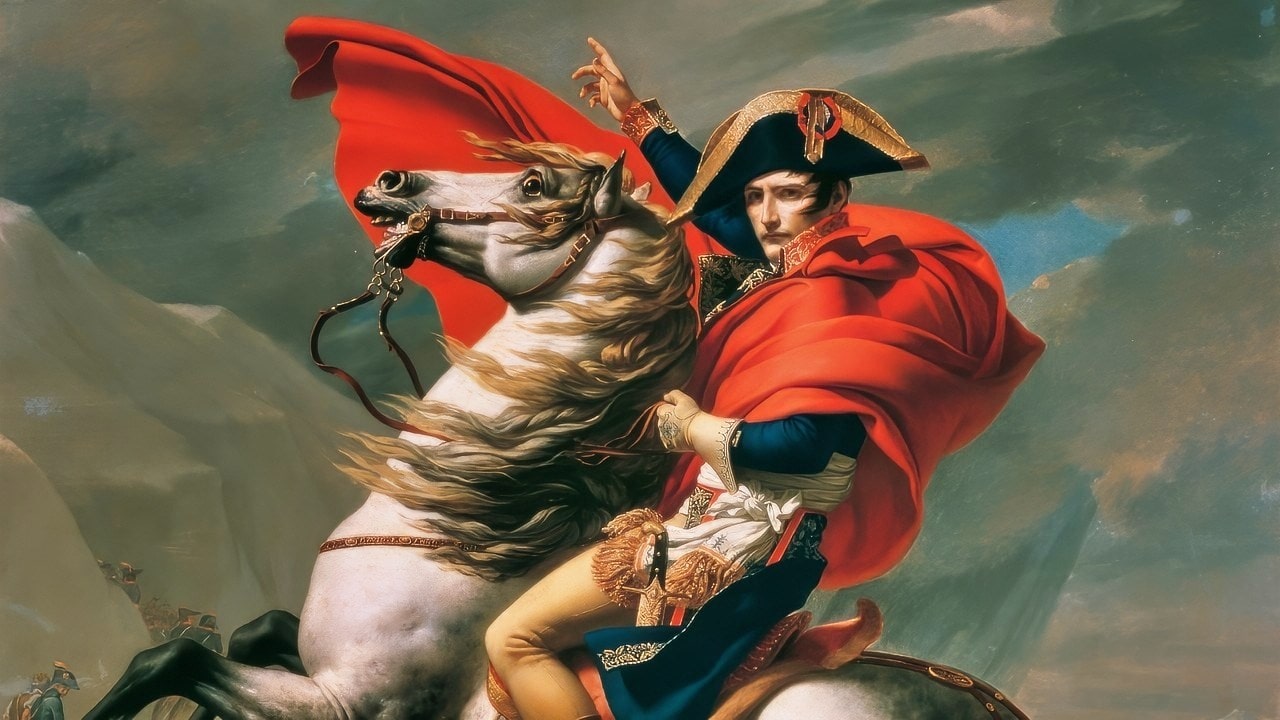
Napoleon the Emperor. Image Credit: Creative Commons.
The decisive fracture occurred in the Allied center. Once the French held the heights, they were able to roll up one wing while containing the other. Parts of the Allied army, trying to withdraw across ponds and marshy terrain, were caught in disarray.
Later retellings of the battle embellished the story with dramatic accounts of cannons crashing through ice, but the reality was that allied cohesion was completely shattered. Casualties fell disproportionately upon the Allies, and the political consequences were immediate and far-reaching. Austria was compelled to sue for peace, resulting in the Treaty of Pressburg, territorial concessions, and withdrawal from the coalition.
The Holy Roman Empire, already exhausted as a political structure, soon disappeared to be replaced by the Confederation of the Rhine under French influence.
Austerlitz is still studied as a paradigm of luring the enemy to overextend, then counterstriking through the center with decisive timing. Napoleon controlled not only movement and fire, but also perception; he convinced the enemy to see what he wanted them to see.
The Battles of Jena/Auerstedt
The next year brought a different kind of victory when Napoleon broke Prussia’s military power in a single day through the twin battles of Jena and Auerstedt, fought on October 14, 1806. Prussia, stung by the reorganization of Germany after Austerlitz and anxious about French dominance, mobilized late and unwisely.
Napoleon moved swiftly into central Germany, aiming to split the Prussians from any possible Russian support and to exploit the flexibility of his corps system.
At Jena, Napoleon believed he was facing the main Prussian army and pressed hard on rolling high ground that favored his use of skirmishers and flexible attack columns. French light infantry screens, supported by artillery and corps arriving in echelon, gradually pushed back Prince Hohenlohe’s forces. The Prussians, wedded to rigid linear tactics and hampered by command confusion, gave ground and eventually broke when French cavalry exploitation under Murat turned retreat into rout.
Meanwhile, in a separate but simultaneous battle at Auerstedt to the north, Marshal Davout found himself confronting the actual main Prussian army under the Duke of Brunswick with barely a single corps.
This meant that the French fielded perhaps 26,000 to 28,000 men against more than 60,000. Despite insurmountable odds, Davout showed skill comparable to Napoleon. Employing interior lines, concentrated artillery, and disciplined counterattacks, he held off repeated Prussian assaults.
The Duke of Brunswick was mortally wounded and command coherence dissolved. By day’s end, Davout had not only survived but defeated the larger force. The combination of Napoleon’s victory at Jena and Davout’s at Auerstedt shattered Prussian power. In the pursuit that followed, fortress after fortress capitulated, and Berlin fell.
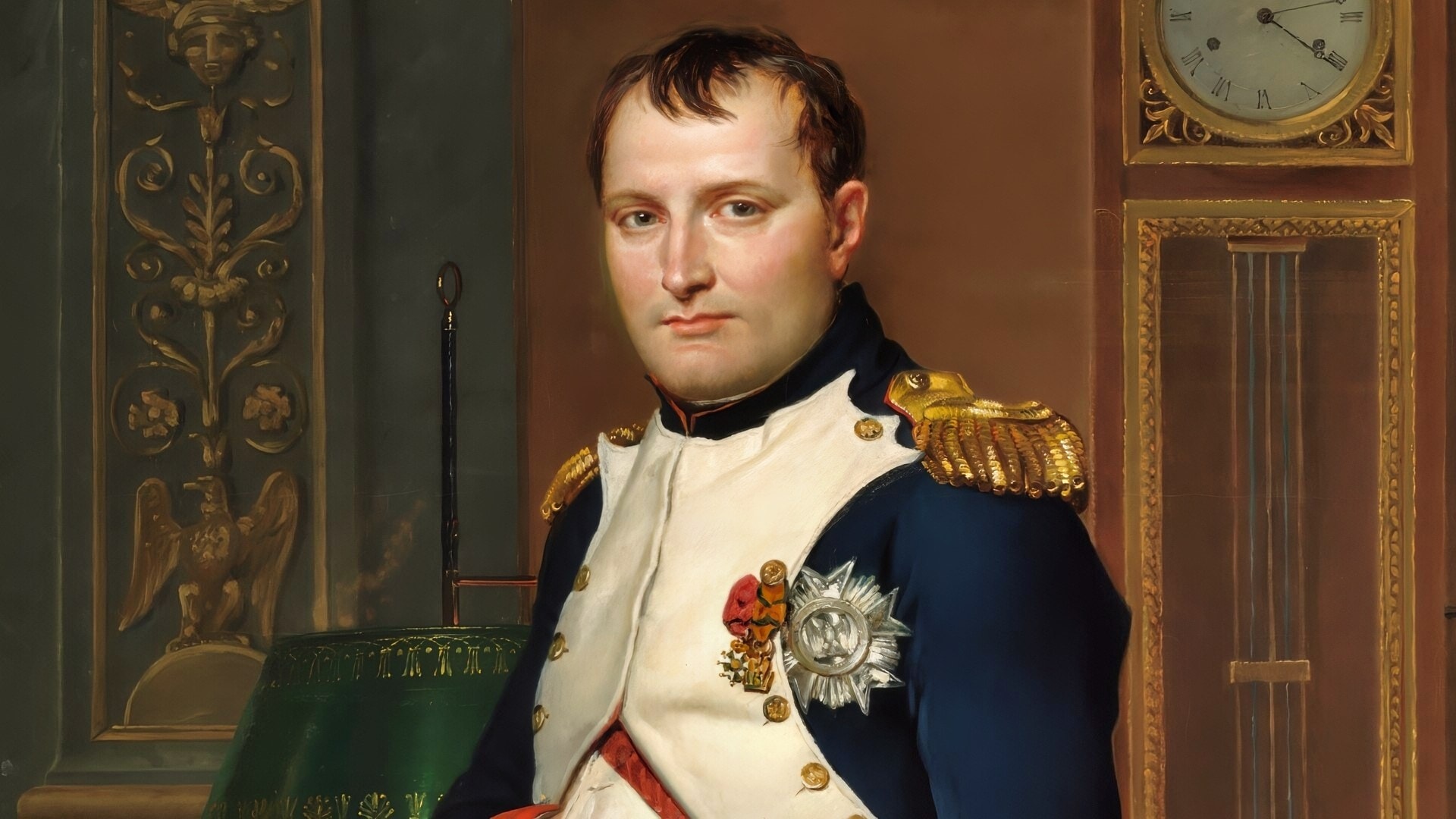
Napoleon Painting Creative Commons Image
The swiftness with which the Prussian military edifice collapsed owed much to the French pursuit, which transformed operational success into a strategic victory. Jena–Auerstedt illustrates another facet of Napoleonic excellence: the system can win in aggregate even when intelligence is imperfect, because independent excellence at the corps level, like Davout’s, can redeem uncertainty with discipline and aggression.
The Battle of Friedland
French fortunes then turned toward Poland, where Napoleon encountered Russian armies in a brutal winter campaign. The Battle of Eylau in February 1807 was one of the bloodiest and most indecisive clashes of the era, fighting in snow and misery that achieved little more than mutual exhaustion.
But by June, the campaign had resumed, and Napoleon sought a decisive engagement that would force Russia to negotiate. He found his chance at Friedland on June 14, 1807. The Russians under General Bennigsen deployed near the town of Friedland, with the Alle River constraining their position.
What began as a localized encounter expanded as Lannes skillfully held the Russians in place long enough for Napoleon to bring up major forces. The Russians, increasingly compressed against the river and the town’s bottlenecks, faced a growing storm. Napoleon massed artillery and infantry for a major blow against the Russian left, where the ground favored a concentrated attack.
Marshal Ney led an assault that initially met with some repulse, but, reinforced and coordinated with devastating artillery fire, surged forward. French grand batteries inflicted punishing casualties on Russian formations packed into tight spaces, and attempts to withdraw across limited bridges created chaos.
As the French pressure mounted, parts of the Russian line crumbled and soldiers drowned or were cut down as they tried to recross the river.
The result was decisive enough to compel Tsar Alexander I to negotiate, leading to the famous meeting on the raft at the Niemen and the Treaties of Tilsit in July 1807. AS a result of the battle, Prussia was carved up and humiliated, Russia made a formal if uneasy alignment with Napoleon’s Continental System, and France stood at its geopolitical high point. Friedland thus exemplifies Napoleon’s ideal of tactical concentration producing political transformation. He created conditions for the enemy to make a positional mistake, punished that mistake with overwhelming fire and force against one flank, and translated the battlefield’s outcome into a remaking of the continental order.
The Battle of Wagram
With Napoleon focusing his efforts in Spain, the Austrian’s sought to exploit France’s weakened position in central Europe and launched an offensive.
Having received word of this, Napoleon rushed back into central Europe and met the Austrians at Wagram, northeast of Vienna. On the first day, both sides clashed in fierce engagements that yielded no immediate decision.
The ground was open and punishing, and artillery duels became a dominant feature of the battle. The Austrian army under Archduke Charles had learned from earlier defeats and had become more resilient to Napoleon’s attacks. On the second day, Archduke Charles attempted to seize the initiative with a strong dawn attack against the French left, aiming to rupture Napoleon’s line and roll up his position.
The French bent but did not break. Through stubborn defense, local counterattacks, and rapid reinforcement, Napoleon stabilized the threatened sector. He then orchestrated a decisive response in the center. General Macdonald, commanding elements of the Army of Italy incorporated into the larger force, was directed to mass an enormous infantry formation and drive into the Austrian center under the cover of an immense artillery concentration.
This was one of the earliest and clearest expressions of a true grand battery used not simply to support a general attack, but to serve as the spearpoint of decision. As Macdonald advanced through sheets of shot and shell, French artillery battered the opposing line, while Davout’s pressure on the Austrian left and continuous cavalry action complicated Archduke Charles’s ability to shift reserves.
The French push did not produce a clean, theatrical collapse; instead, it inflicted cumulative damage, sapped Austrian cohesion, and eventually forced a general withdrawal. The Austrians retreated in relatively good order, denying the French the kind of rout that might have yielded massive captures.
Nevertheless, the field belonged to Napoleon. Both sides suffered heavy casualties, a testament to the battle’s brutal character. The battle of Wagram did what Napoleon needed it to do: it knocked Austria out of the war and led to the Treaty of Schönbrunn in October 1809, which imposed territorial losses on Austria and helped stabilize Napoleon’s continental position.
The marriage to Archduchess Marie-Louise, orchestrated soon after, was both a diplomatic move and a symbol of France’s ascendancy.
What Made These Victories So Significant?
Each of these battles enabled Napoleon to pursue his larger strategic goals. Ulm and Austerlitz removed Austria as an immediate threat and precipitated the reorganization of Central Europe under French auspices.
Jena–Auerstedt obliterated Prussia’s armies, leading to sweeping reforms in that kingdom that would, ironically, help power Prussia’s resurgence years later. Friedland’s decisive character forced Russia into an accommodation at Tilsit that secured Napoleon’s strategic rear and freed him to pursue continental designs, even as the seeds of future conflict were sown in the uneasy alliance and the economic strain of the Continental System.
Wagram suppressed a renewed Austrian challenge during a period when Napoleon could not afford to fight on too many fronts at once. In each case, victory was not an end but a lever, prying open diplomatic doors or slamming shut regional resistance.
These five battles also perfectly exemplify Napoleon’s strengths. He was a commander who could convince his enemies to step into traps of their own making, who could win campaigns without fighting decisive battles when maneuver would do, and who could rely on subordinates empowered to act decisively when the fog of war thickened.
He understood that timing is not a number on a clock but a felt sense of when the enemy has already moved past the point of balance.
He knew that battlefields are not only about killing and surviving but about shaping perception and constraining choices.
And when the occasion demanded it, he could abandon elegance for force, marshal guns and men in overwhelming quantity, and grind his way to a result that preserved his strategic position.
About the Author: Isaac Seitz
Isaac Seitz, a Defense Columnist, graduated from Patrick Henry College’s Strategic Intelligence and National Security program. He has also studied Russian at Middlebury Language Schools and has worked as an intelligence Analyst in the private sector.