
Summary and Key Points: Defense analyst Isaac Seitz evaluates the pivotal diplomatic career of Benjamin Franklin, focusing on his mission to France during the Revolutionary War.
-This report analyzes how Franklin utilized his international renown as a scientist to persuade King Louis XVI and Foreign Minister Vergennes to support the American cause following the Battle of Saratoga.
-Seitz explores the signing of the 1778 Treaty of Alliance and the subsequent 1783 Treaty of Paris, noting how Franklin’s calm pragmatism mediated conflicts between John Adams and John Jay.
-He concludes that Franklin’s ability to project strength prevented the fledgling United States from being “eaten” by European powers.
The Franklin Doctrine: Why Benjamin Franklin’s “Sheep and Wolves” Warning Still Governs 2026 Diplomacy
“Make yourself sheep and the wolves will eat you.” – Benjamin Franklin
Benjamin Franklin was an accomplished man who was well-versed in science, religion, philosophy, and many other topics.
He was a brilliant man whose wit made him a favored individual in elite society.
When the Revolutionary War broke out, Franklin’s skills were needed in France, where his high status made him especially important.
As a diplomat, he was tasked with convincing the French to support the newly formed United States both militarily and financially. His efforts proved successful, ultimately securing America’s independence.

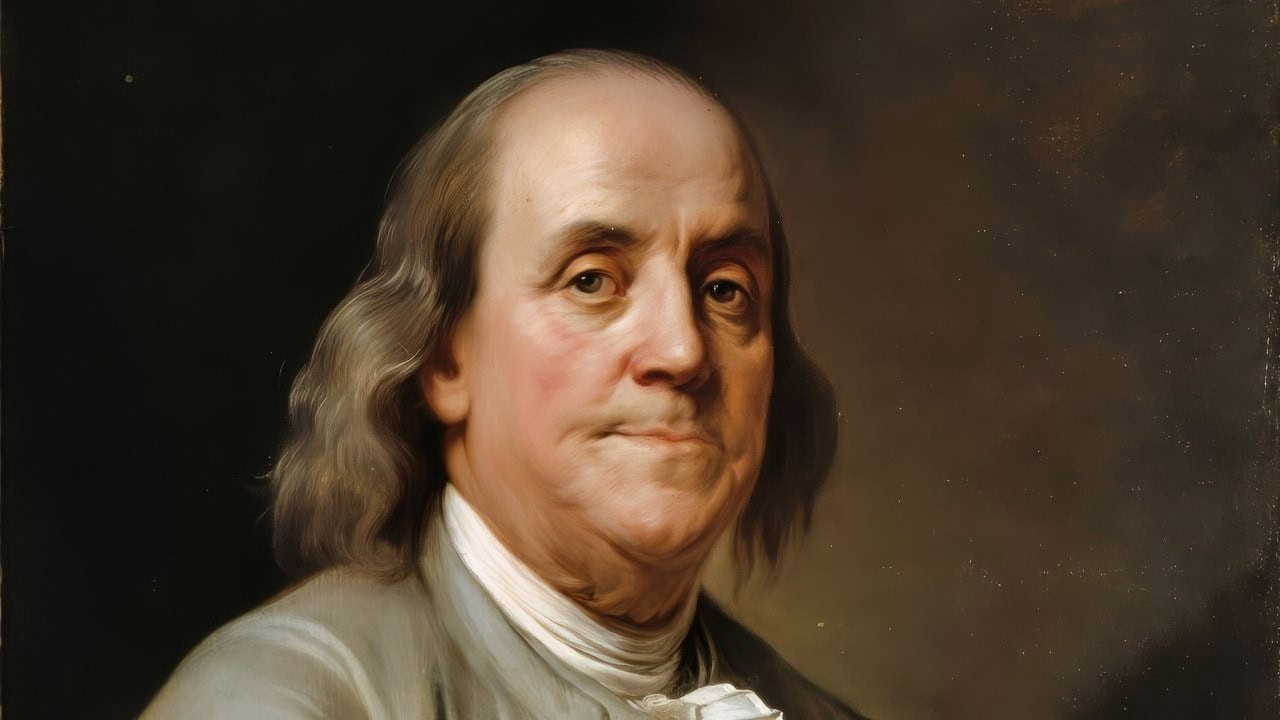
Benjamin Franklin. Image Credit: Creative Commons.
Political Involvement
By midlife, Franklin had established himself not only as a writer and publisher but also as a civic innovator and scientist. He helped found the Library Company of Philadelphia, the American Philosophical Society, and the city’s first volunteer fire brigades.
His experiments with electricity in the 1740s and 1750s, particularly the famous kite experiment and the invention of the lightning rod, were widely praised in Europe. This scientific renown gave Franklin an international celebrity that would later open doors in Parisian salons and allow him to operate in diplomatic circles with a legitimacy few other Americans possessed.
Franklin’s political awakening evolved during his long stays in London, where he represented various American colonies.
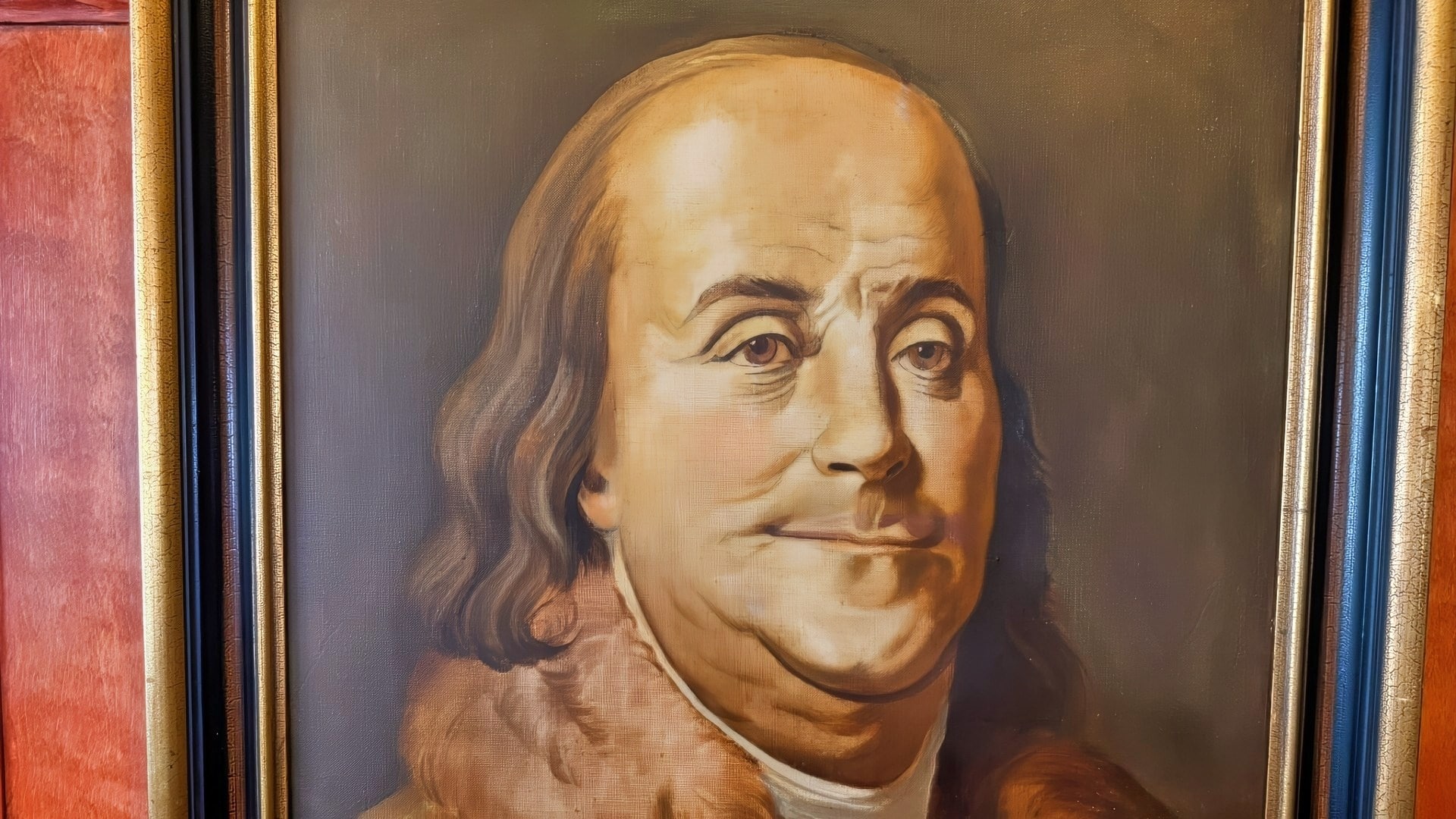
Benjamin Franklin 19FortyFive Image. Taken by Harry J. Kazianis at the Hall of Presidents at Walt Disney World, Florida.
He initially believed deeply in an imperial partnership between Britain and America. Yet the Stamp Act crisis, new taxes imposed by Parliament, and finally the humiliating episode in which he was berated before the Privy Council for exposing Governor Hutchinson’s letters pushed him firmly into the camp of colonial resistance. By the time he returned to Philadelphia in 1775, Franklin was prepared to pursue independence if Britain refused to reform its policies. He helped draft the Declaration of Independence the following year and soon afterward accepted the most precarious and important diplomatic assignment the Continental Congress could give him: securing France as an ally.
Arrival in France
At the time of Franklin’s arrival, France was ruled by, who, along with his foreign minister, Charles Gravier, comte de Vergennes, was eager to weaken Britain who was France’s longstanding rival.
Yet France was also cautious; the American rebellion might fail, and an early alliance could draw France into a disastrous war. Franklin’s task, therefore, was to persuade the French that the American cause was viable and worthy of investment. This required more than charm. It required careful negotiation, credible military news from America, and constant reassurance that the Americans would not rashly abandon the alliance if the tides of war shifted.
Franklin’s residency in Passy, a village outside Paris, became the nerve center of American diplomacy. He handled correspondence, arranged for arms and supplies, navigated complex financial arrangements, oversaw privateers, and mediated constant quarrels within the American delegation.
His colleagues Silas Deane and Arthur Lee frequently clashed, and later John Adams joined the mission with a temperament that often contrasted sharply with Franklin’s calm pragmatism. Franklin, older than all of them, absorbed these tensions with patience and often acted as the steadying influence that kept the mission from collapsing under the weight of personal conflict.
George Washington Bust at Mount Vernon. Image taken by Harry J. Kazianis for 19FortyFive back in 2022.
Advocating for America
The turning point in Franklin’s diplomatic efforts came with the American victory at Saratoga in late 1777.
The news convinced Vergennes that the United States might indeed prevail. After months of negotiation, France and the United States signed the Treaty of Amity and Commerce and the Treaty of Alliance in February 1778.
These agreements recognized the United States as an independent nation, established formal diplomatic relations, and committed France to military support against Britain. It was the diplomatic triumph that Franklin had been sent to achieve, and it fundamentally altered the course of the war.
Franklin’s role did not end with the alliance. In many ways, the next several years were even more challenging. He had to maintain French confidence in the American cause, secure additional loans, and work through the logistical challenges of supplying a distant rebel army across the Atlantic.
France’s assistance, especially its financial assistance, kept the war effort alive. Franklin’s steady relations with Vergennes were essential in sustaining this support. Although he sometimes struggled with Congress’s slow responses, inflated requests, or internal divisions, he succeeded in preserving French goodwill even when American politics threatened to undermine it.
France Agrees to Support the Revolution
As the war progressed and the prospects for peace grew stronger, Franklin found himself at the center of another crucial diplomatic moment. In 1782, he joined John Adams and John Jay in negotiating peace with Britain.
Although Congress had instructed the American commissioners to consult with France on all major decisions, Jay and Adams both grew suspicious of French motives regarding territorial claims. Ultimately, the American peace delegation negotiated directly with Britain without seeking Vergennes’s input, a move that strained but did not break the Franco-American partnership.
The resulting Treaty of Paris, signed in 1783, secured American independence and generous territorial boundaries extending to the Mississippi River.
Franklin remained in France for two more years, continuing to manage financial matters and representing the United States in a period of uncertain transition. His health declined, but his reputation only grew. When he returned to America in 1785, he was welcomed as a national hero.
Even in old age, he continued to serve the public, attending the Constitutional Convention of 1787 and advocating for the eventual abolition of slavery.
About the Author: Isaac Seitz
Isaac Seitz, a Defense Columnist, graduated from Patrick Henry College’s Strategic Intelligence and National Security program. He has also studied Russian at Middlebury Language Schools and has worked as an intelligence Analyst in the private sector.

