
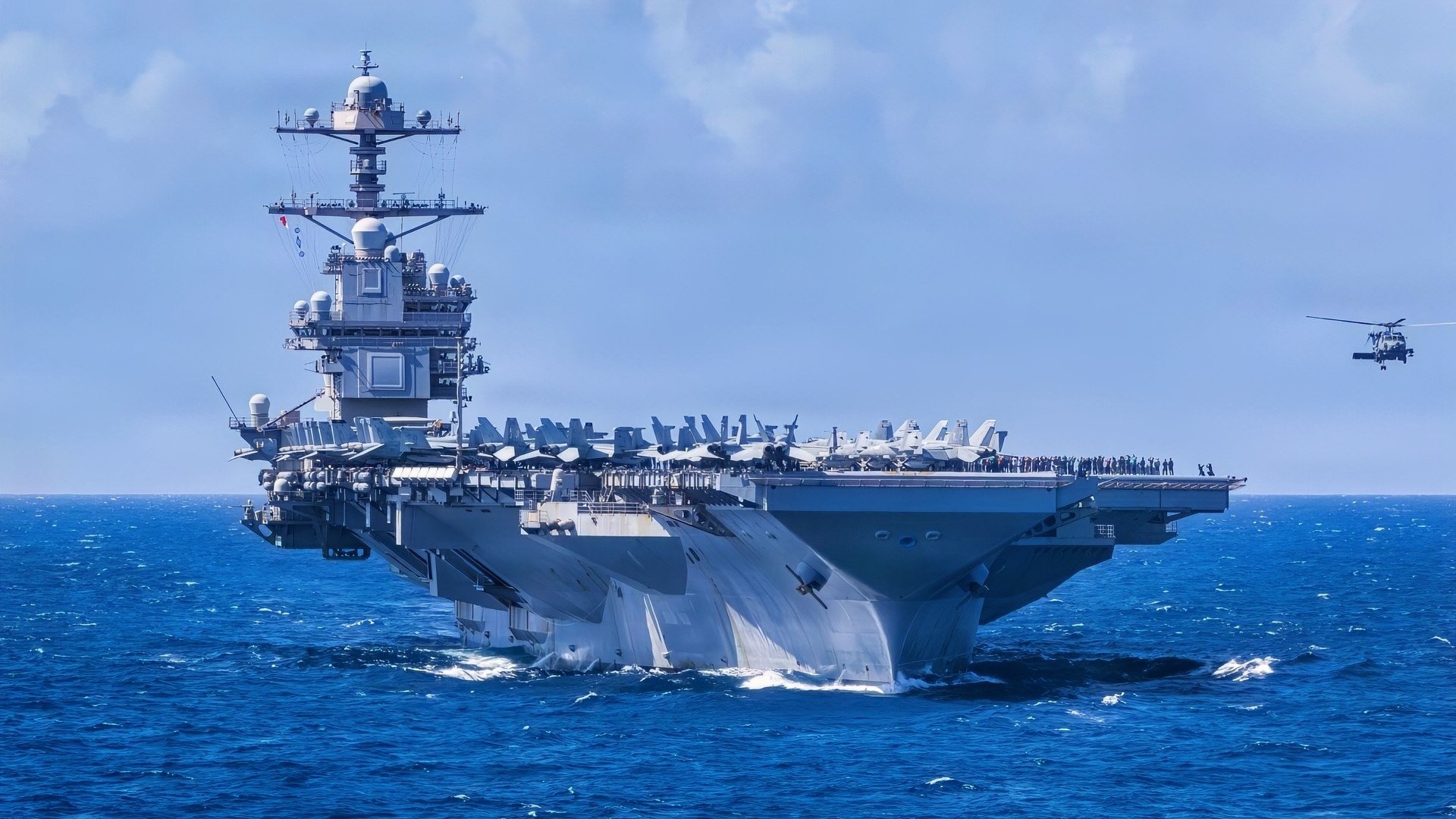
Summary and Key Points: Award-winning journalist Stephen Silver examines the massive 30-hour fire aboard the USS Gerald R. Ford and the dangerous media speculation surrounding it.
-Following a March 12, 2026, blaze in the carrier’s laundry facilities that displaced 600 sailors and forced the warship to retreat to Souda Bay, Crete, British and Greek outlets have heavily speculated about deliberate crew sabotage.
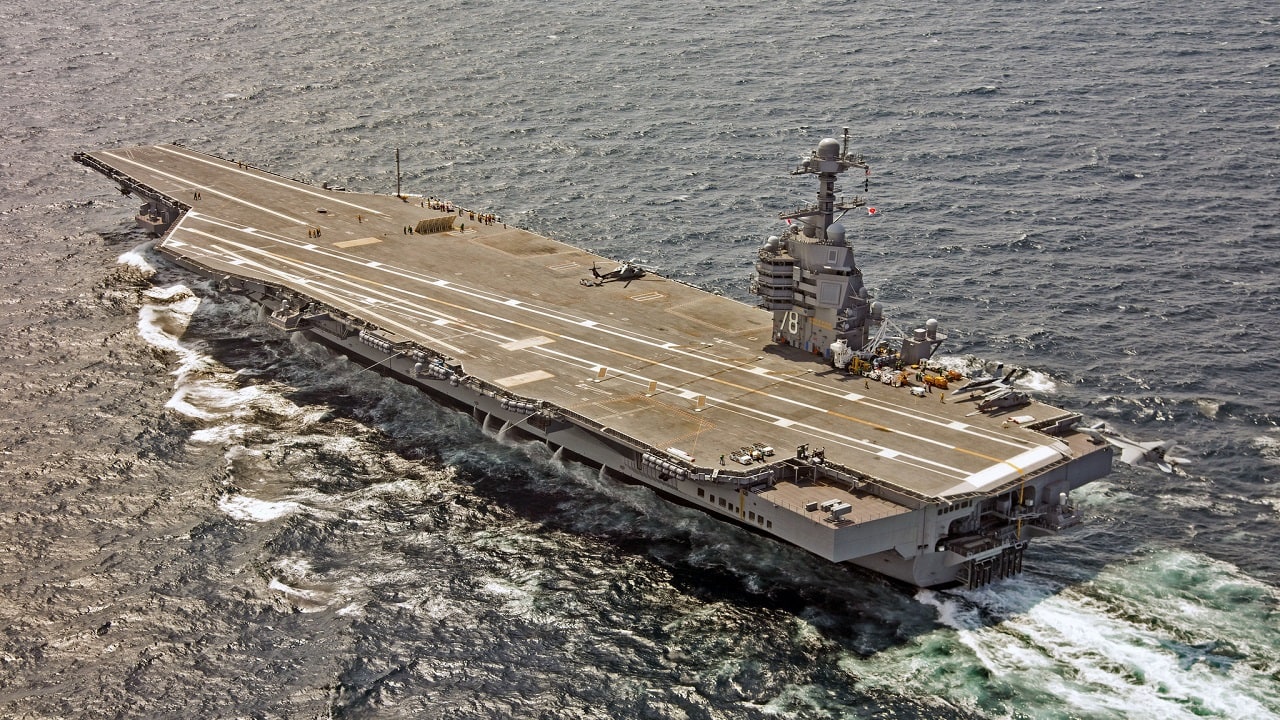
Ford-Class Aircraft Carrier Artist Rendering. Image Credit: Creative Commons.
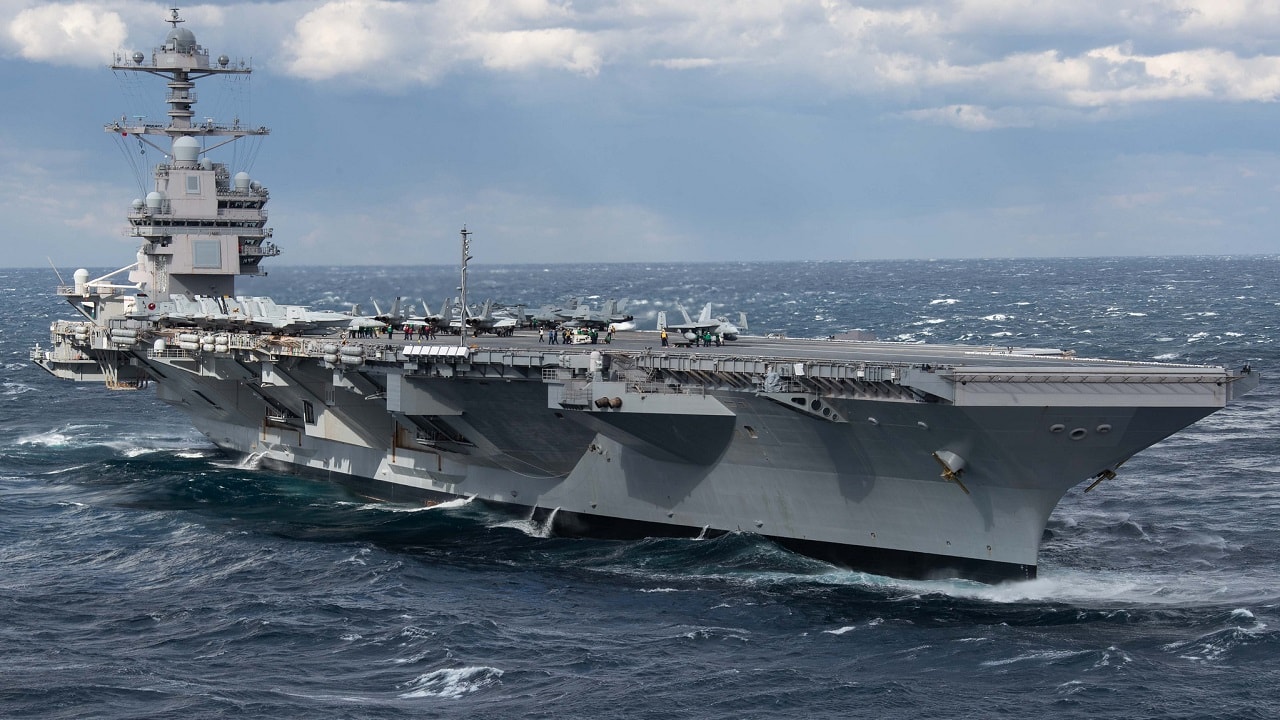
The aircraft carrier USS Gerald R. Ford (CVN 78) transits the Atlantic Ocean, March 26, 2022. Gerald R. Ford is underway in the Atlantic Ocean, conducting flight deck certification and air wing carrier qualifications during the ship’s tailored basic phase before operational deployment.
-Silver unpacks how an exhausted crew—pushed past a 10-month deployment for Operation Epic Fury—has become the center of unverified arson theories, highlighting the modern information warfare surrounding the U.S. Navy.
Beyond the Sabotage Rumors: The Exhaustion of the Aircraft Carrier USS Gerald R. Ford’s Crew
On March 12, a fire broke out in the laundry facilities of the Navy’s aircraft carrier USS Gerald R. Ford. According to the New York Times, putting out the fire on the carrier took more than 30 hours.
“The fire started in the ship’s main laundry area last Thursday. By the time it was over, more than 600 sailors and crew members had lost their beds and have since been bunking down on floors and tables,” the Times said of the fire, citing officials.
“The cause of the fire was not combat-related and is contained,” Central Command said in a statement on the day of the fire. “There is no damage to the ship’s propulsion plant, and the aircraft carrier remains fully operational.”
No one was killed. Two sailors were treated for “non-life-threatening injuries,” the report said. Among other things, the fire has left the carrier’s laundry facilities inoperable for the 4,500 people aboard.
The carrier, as a result, departed the theater of war near Iran, where it was based in the northern Red Sea, and headed for Crete for repairs. Per AFP, which produced a photograph, the USS Gerald R. Ford arrived at the Souda Bay naval base in Crete.
The USS Gerald R. Ford, which was previously in the Caribbean before and after the Venezuela operation in January, is nearing a record-long deployment of nearly ten months. The Times reported that the deployment will likely extend into May, putting it past the one-year mark. The sailors aboard the ship have also been dealing with malfunctioning toilets, with NPR reporting on that going back to January.
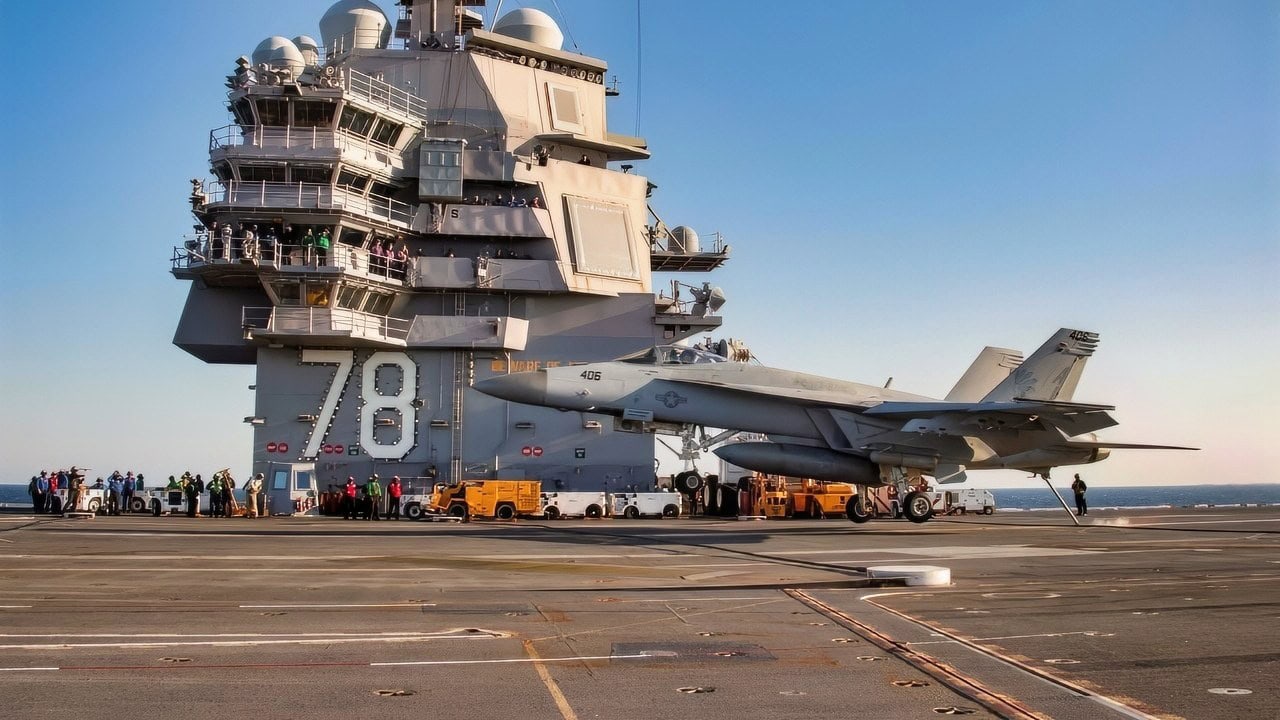
USS Gerald R. Ford Supercarrier Flight Deck. Image Credit: Creative Commons.
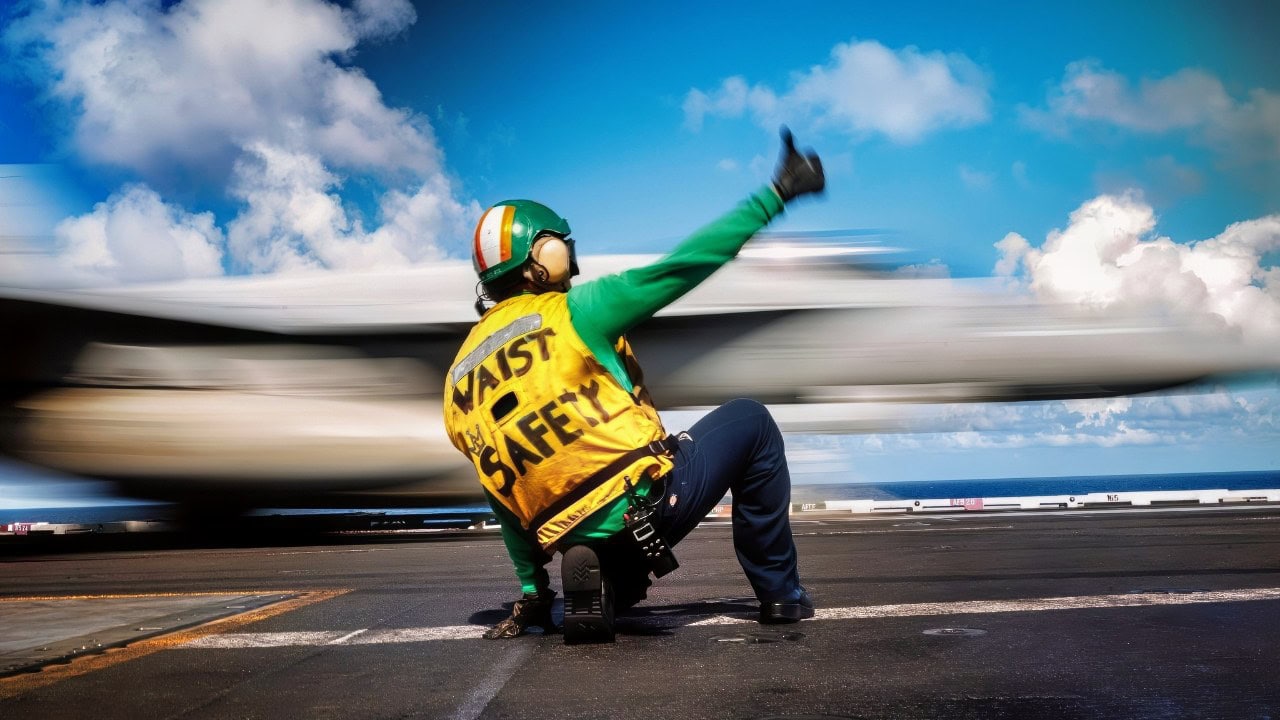
USS Gerald R. Ford Aircraft Carrier or Supercarrier

Oct. 9, 2022 – The first-in-class aircraft carrier USS Gerald R. Ford (CVN 78) steams the Atlantic Ocean during a simulated straits transit with the Gerald R. Ford Carrier Strike Group (GRFCSG) in the Atlantic Ocean, Oct. 9, 2022. The Gerald R. Ford Carrier Strike Group is deployed in the Atlantic Ocean, conducting training and operations alongside NATO Allies and partners to enhance integration for future operations and demonstrate the U.S. Navy’s commitment to a peaceful, stable and conflict-free Atlantic region. (U.S. Navy photo by Mass Communication Specialist 2nd Class Jackson Adkins)
What Caused the Fire?
“The fire, according to two officials, began in the vent of a dryer in the ship’s laundry facilities and quickly spread,” the Times reported.
Stars and Stripes reported last week about a “smorgasbord” of dangers in the laundry facility, which may have led to the fire. The outlet reported that “a potent mixture of flammable materials, equipment pushed beyond its limits and human error could be behind” the causes of the fire.
“Equipment that normally would be serviced and taken down may be running at levels past when they need to run,” Sal Mercogliano, an adjunct professor at the U.S. Merchant Marine Academy, told Stars and Stripes. “Anytime you go past normal operating hours, the chances of mechanical and human error increase.”
However, some subsequent news reports had an alternative explanation.
Speculation of Sabotage on USS Gerald R. Ford
“Did exhausted sailors set fire to USS Gerald R. Ford?” was the headline of a story late last week by the British newspaper The Telegraph.
It’s an odd, and possibly irresponsible, piece because it seems entirely speculative and lacks any solid evidence that the sailors themselves were responsible, or even that such an investigation is underway.
All the Telegraph report does is speculate and quote various experts who speak in hypotheticals, while also noting the wide body of legitimate reporting that the crew of the Ford has been pushed to the brink amid this record-long deployment, as well as the issues with the toilets.
“There are also reports that sabotage may have been involved — not by Iranian undercover operatives, but by crew members disgruntled that their standard six-month tour of duty has been extended for the Gulf operation,” the Telegraph piece says. However, it links to or cites no such reports.
The Greek publication Kathimerini reported on March 17 that “Kathimerini understands that one scenario being examined is that the blaze may have been deliberately caused by crew members to terminate their extended mission.” But this, too, is rather thin, with no sourcing to back it up.
And perhaps even more strangely, the Telegraph piece, while claiming there are “reports” about sabotage, does not link to or cite the Kathimerini story, or any other source.
“You could easily get 20 years in jail for this, especially in a time of conflict,” Chris Parry, a retired Navy rear admiral, told the Telegraph.
Another British paper, the International Business Times, went a bit further, reporting that “the US Navy is investigating whether sailors aboard the USS Gerald R. Ford deliberately started the fire that tore through the aircraft carrier’s main laundry spaces on 12 March,” citing “sources with direct knowledge of the planned port call.”
The reported probe, per IBT, “explicitly includes the possibility of deliberate sabotage by crew members, with one theory suggesting the fire was intentionally set to interrupt the carrier’s lengthy and repeatedly extended mission.”
IBT also reported that Iran’s state broadcaster had pushed the theory that the fire was caused by internal sabotage, while making clear that “Iranian state media claims should be treated with caution.”
What’s Really Happening?
If such an investigation is underway, it remains unclear whether it is merely a routine examination of the cause of the fire or whether the Navy believes it has solid evidence of deliberate sabotage.
But the furthest any of the reporting so far has gone is to say that sabotage is a “possibility” and that it’s “one scenario” that’s been looked into.
There’s a possible lesson here about how stories spread in the modern media environment, as there have since been various social media and YouTube aggregations of these stories, many of which have grown much looser with “allegedly,” “investigating,” or other caveats.
“Everything is possible, and on a ship of nearly 5,000 people, there can always be some bad actors, especially when the crew has been ridden pretty hard,” Dr. John Cordle, a retired US Navy commander, told the Telegraph. “However, if I was a betting person, I’d say the fire was probably an accident. Laundries have lots of heat, electrics, and moving parts, and people may have just got so worn out on this tour that they’ve made mistakes.”
About the Author: Stephen Silver
Stephen Silver is an award-winning journalist, essayist, and film critic, and contributor to the Philadelphia Inquirer, the Jewish Telegraphic Agency, Broad Street Review, and Splice Today. The co-founder of the Philadelphia Film Critics Circle, Stephen lives in suburban Philadelphia with his wife and two sons. For over a decade, Stephen has authored thousands of articles that focus on politics, national security, technology, and the economy. Follow him on X (formerly Twitter) at @StephenSilver, and subscribe to his Substack newsletter.