
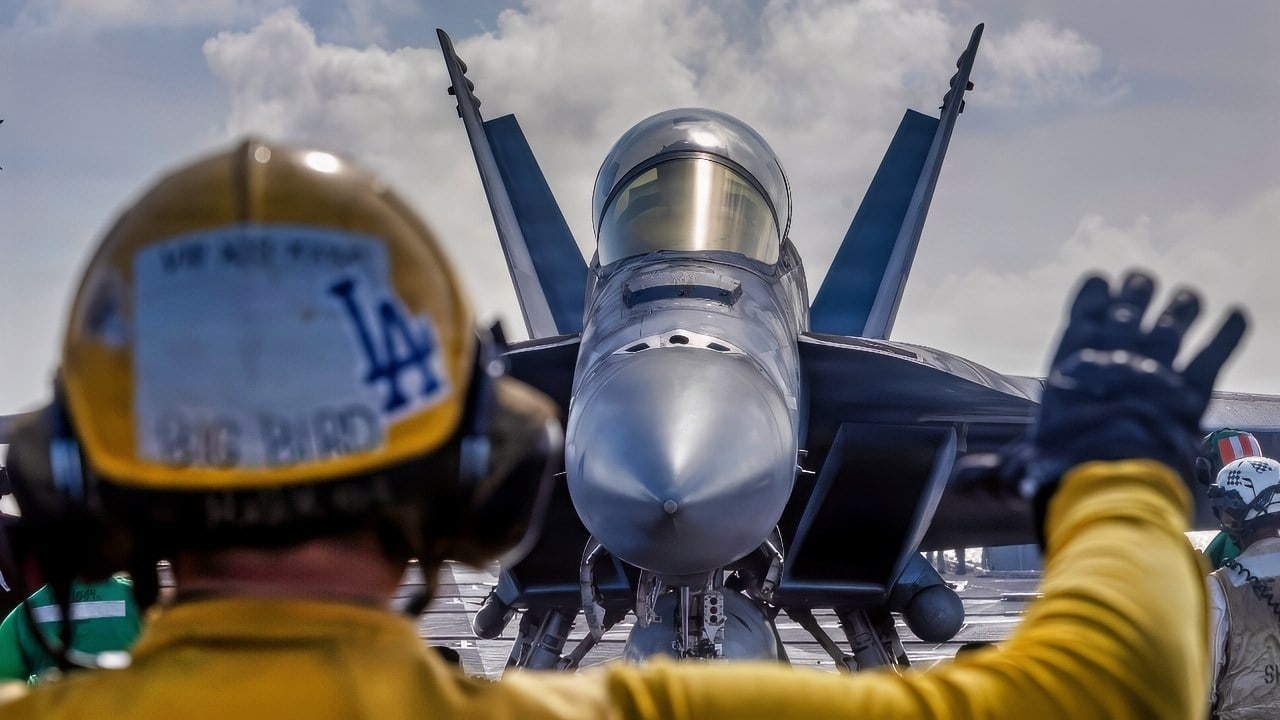
Video footage released on March 26 showed a very near miss by an Iranian man-portable air-defense system (MANPADS) on an F/A-18 Super Hornet.
The videos were geolocated to the port of Chabahar in Iran’s Sistan and Baluchestan Province. The F/A-18 pilot had been conducting low-level strafing runs against Iranian military positions with its M61A1 Vulcan rotary cannons. The Vulcan is a six-barrel 20-mm weapon capable of firing 6,000 rounds per minute.
The pilot, probably aware of the incoming missile, makes a hard left turn as the missile’s proximity fuze explodes the warhead just aft of the tail of the Super Hornet. TWZ posted, “There is no obvious sign of infrared countermeasures being deployed, although BOL IR-type countermeasures can be harder to see in daylight.”
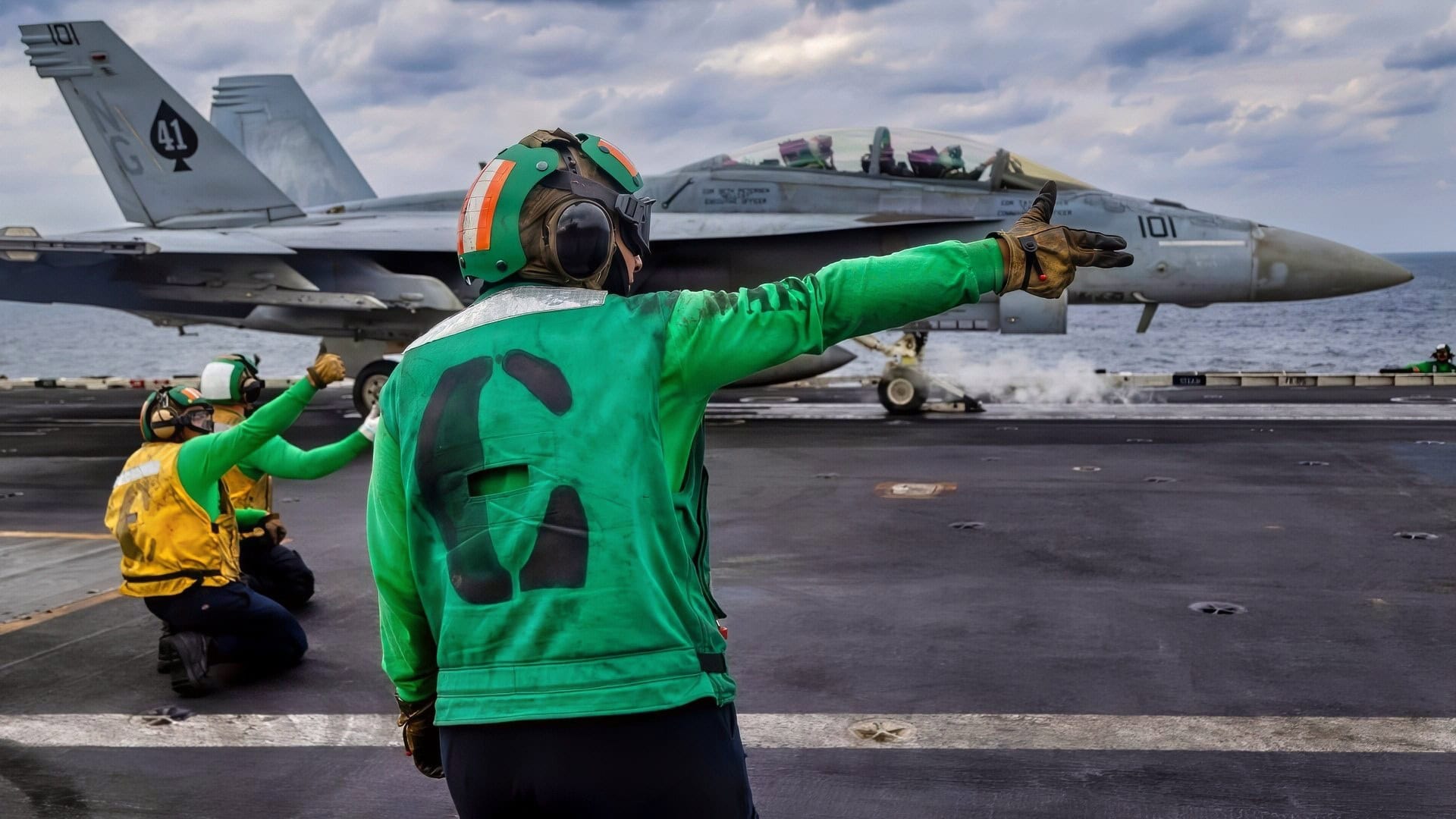
ARABIAN SEA (Jan. 28, 2026) An F/A-18F Super Hornet, attached to Strike Fighter Squadron (VFA) 41, prepares to launch from the flight deck of Nimitz-class aircraft carrier USS Abraham Lincoln (CVN 72) in the Arabian Sea, Jan. 28. Abraham Lincoln is deployed to the U.S. 5th Fleet area of operations to support maritime security and stability in the CENTCOM area of responsibility. (U.S. Navy photo by Mass Communication Specialist Seaman Zoe Simpson)
The aircraft flew on, apparently with little to no damage.
Super Hornets have been active over Chabahar since the air campaign began, firing standoff missiles and then making low-level strafing runs at Iranian positions.
The video shows the very real danger that U.S. pilots face when flying air strikes over Iran—especially the low-level missions during which MANPADS launchers can’t be seen until they activate their infrared target seekers.
But what also stands out is that Iran’s integrated surface-to-air missile defenses have been virtually eliminated, which is why low-and-slow, non-stealth aircraft such as the F/A-18 Super Hornet are flying low-level strafing runs in daylight.
Iran Makes Another False Claim
The Islamic Revolutionary Guard Corps (IRGC) immediately claimed that the aircraft was struck and later crashed in the Indian Ocean. Iran’s state-controlled Fars News Agency published the statement from the IRGC:
“The enemy F-18 fighter jet was accurately hit in the sky of Chabahar by missiles from the IRGC Navy’s advanced modern air defense system, under the command of the country’s integrated air defense network, and crashed in the Indian Ocean.”
U.S. Central Command (CENTCOM) issued a “Fake News” post on X, stating that no U.S. plane was shot down.
Iran has made several claims of shooting down U.S. aircraft. It even claimed it struck the aircraft carrier USS Abraham Lincoln (CVN-72) with ballistic missiles. CENTCOM reacted to that lie by stating that the only aircraft carrier struck and sunk was Iran’s, the Shahid Bagheri.
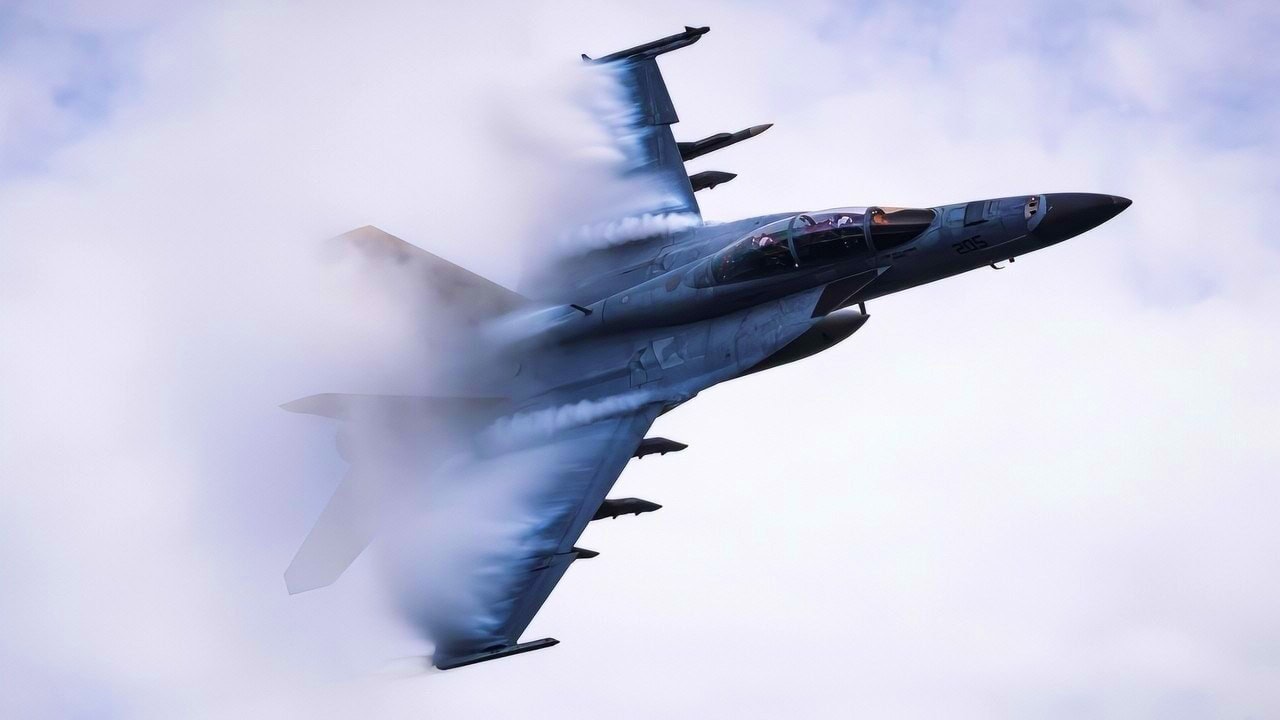
USS George Washington Aircraft Carrier Super Hornet. Image Credit: Creative Commons.
The only definite hit on a U.S. aircraft is seen in a video of an F-35 stealth fighter that was hit and damaged. Captain Tim Hawkins, a spokesperson for CENTCOM, told TWZ in that situation that the F-35 was “flying a combat mission over Iran” when it was forced to make an emergency landing.
“The aircraft landed safely, and the pilot is in stable condition,” he added. “This incident is under investigation.”
F/A-18 Super Hornets Are The Backbone Of US Air Strikes:
The F/A-18E/F Super Hornet serves as the primary U.S. Navy strike fighter in the Middle East, conducting precision ground strikes against Iranian-backed militias, targeting naval assets, and providing air defense for carrier strike groups.
During Operation Epic Fury, the F/A-18s, especially from the USS Abraham Lincoln, carry out the main thrust of strike operations against Iran, while specialized EA-18G Growlers provide critical electronic warfare support to disrupt Iranian defenses.
Key Roles And Operations During Operation Epic Fury
Precision Strike Operations
Super Hornets have been used to strike Iranian-backed militia targets and naval assets, with recent activity reported on social media.
Air Defense and Interception
F/A-18s are deployed for combat air patrols to intercept threats. In August 2024, Super Hornets arrived in Jordan with heavy loads of air-to-air missiles, including the AIM-120 and AIM-9X, to counter potential Iranian attacks.
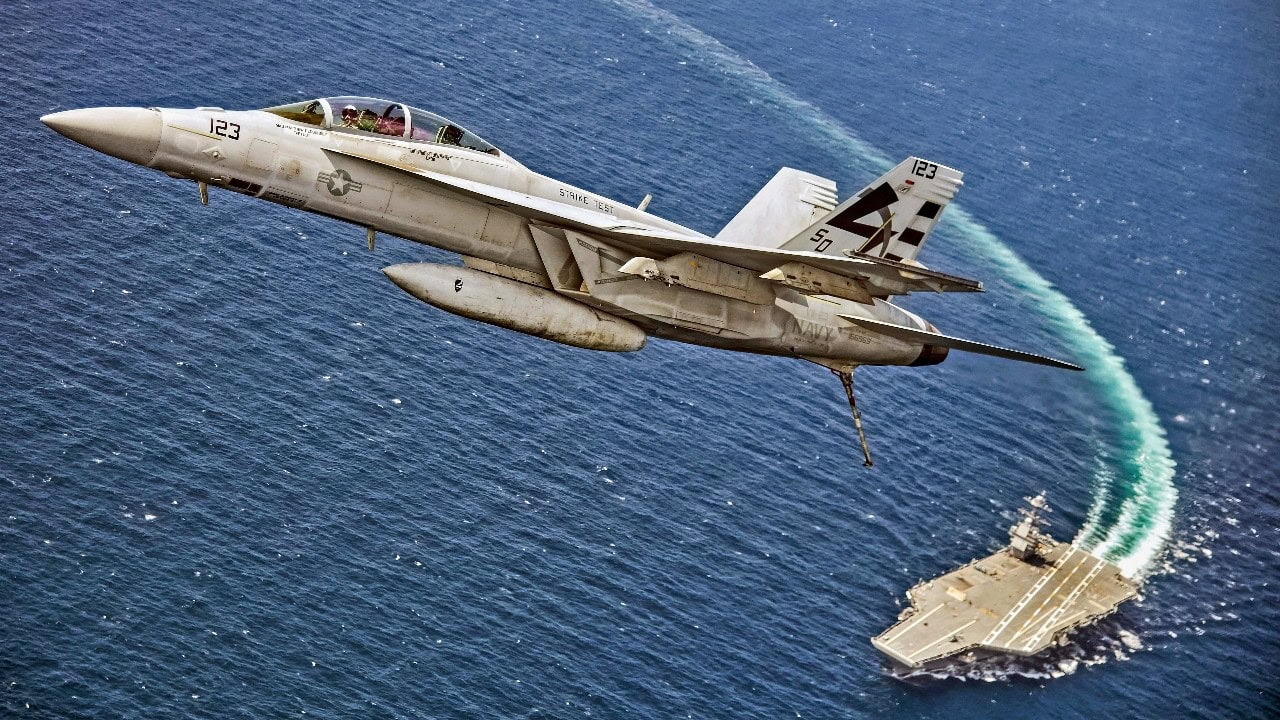
Super Hornet Navy Fighter. Image Credit: Creative Commons.
Electronic Warfare (EA-18G Growler)
The specialized EA-18G Growler is used for suppressing enemy air defenses by jamming radar systems. It is a critical asset in contested airspace.
The F/A-18 Super Hornet, Bigger, Better, Stronger:
The Super Hornet is a series of U.S. supersonic, twin-engine, carrier-capable, multirole fighter aircraft derived from the legacy McDonnell Douglas F/A-18 Hornet.
The F/A-18E/F is an evolutionary upgrade path from the original Hornet. It is 20 percent bigger, carries 33 percent more internal fuel, and has 25 percent more wing area.
The Super Hornet has integrated advanced technologies—such as active electronically scanned array (AESA) radar and improved avionics—along with superior carrier suitability and a lower cost per flight hour.
The F/A-18E single-seat and F tandem-seat variants are larger and more advanced versions of the F/A-18C and D Hornet, respectively.
The F/A-18E Super Hornet is considered an excellent fighter jet. It is recognized for its versatility, strong combat capabilities, and ability to perform multiple roles, including air-to-air combat and strike missions. This makes it a key component of the U.S. Navy’s carrier air wings.
Compared to newer stealth fighters such as the F-35, it may have limitations—certainly, it is not stealthy. However, many consider the Super Hornet to be the best fighter in Navy history.
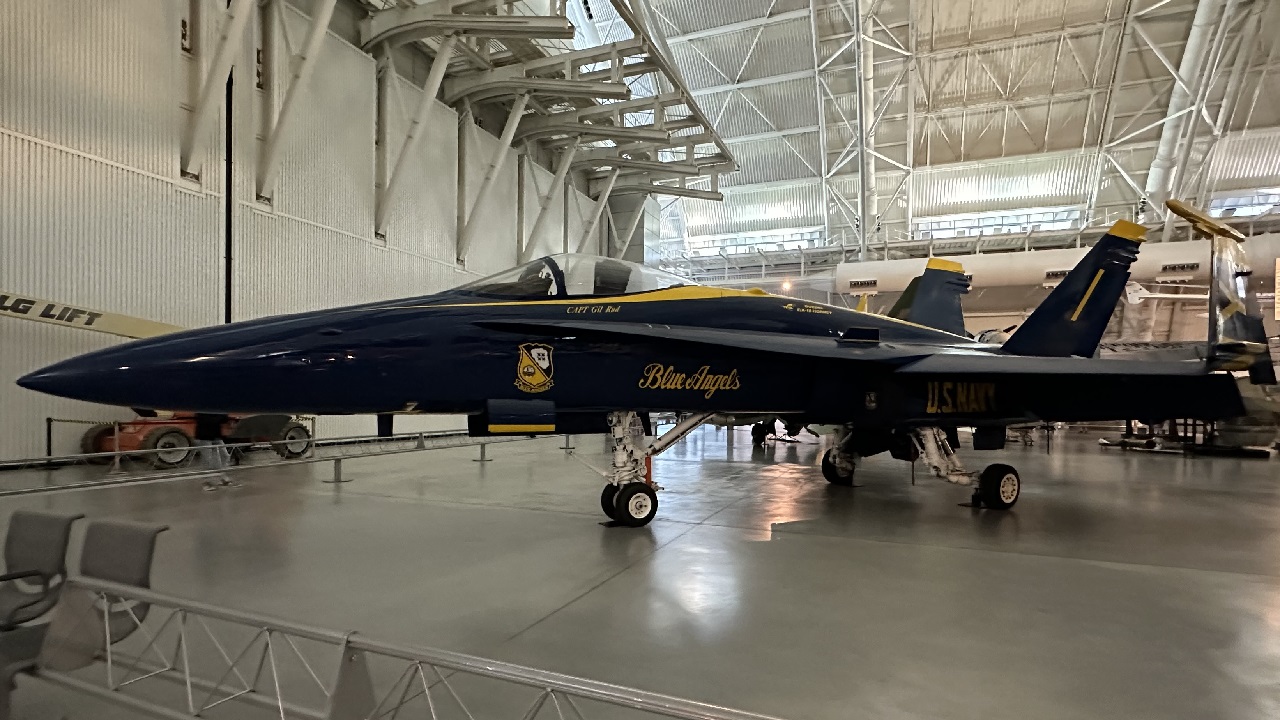
F/A-18 Hornet. Image taken at National Air and Space Museum on October 1, 2022. Image by 19FortyFive.
The Air Campaign of Operation Epic Fury Against Iranian Forces:
The air campaign of Operation Epic Fury, which began on February 28, comes after years of target development, force pre-positioning, and suppression-of-enemy-air-defense planning that CENTCOM and its subordinate air component accumulated against the Iranian regime since the early 1990s.
The campaign was planned, organized, and conducted around three prioritized objectives:
Suppress and eliminate Iran’s air defense systems to create safe conditions for subsequent airstrike operations.
Destroy Iran’s nuclear enrichment, reprocessing, and weaponization infrastructure.
Degrade the Islamic Revolutionary Guard Corps’ (IRGC’s) offensive military capability, including its ballistic and cruise missile launch infrastructure, naval forces, and proxy support networks.
“The mission of Operation Epic Fury is laser-focused: Destroy Iranian offensive missiles, destroy Iranian missile production, destroy their navy and other security infrastructure – and they will never have nuclear weapons,” Secretary of War Pete Hegseth has said.
A deluge of Tomahawk cruise missiles obliterated many targets in the opening days of the air campaign. There are limited stockpiles of those weapons, meaning the following strike packages would be carried out by Air Force and Navy aircraft.
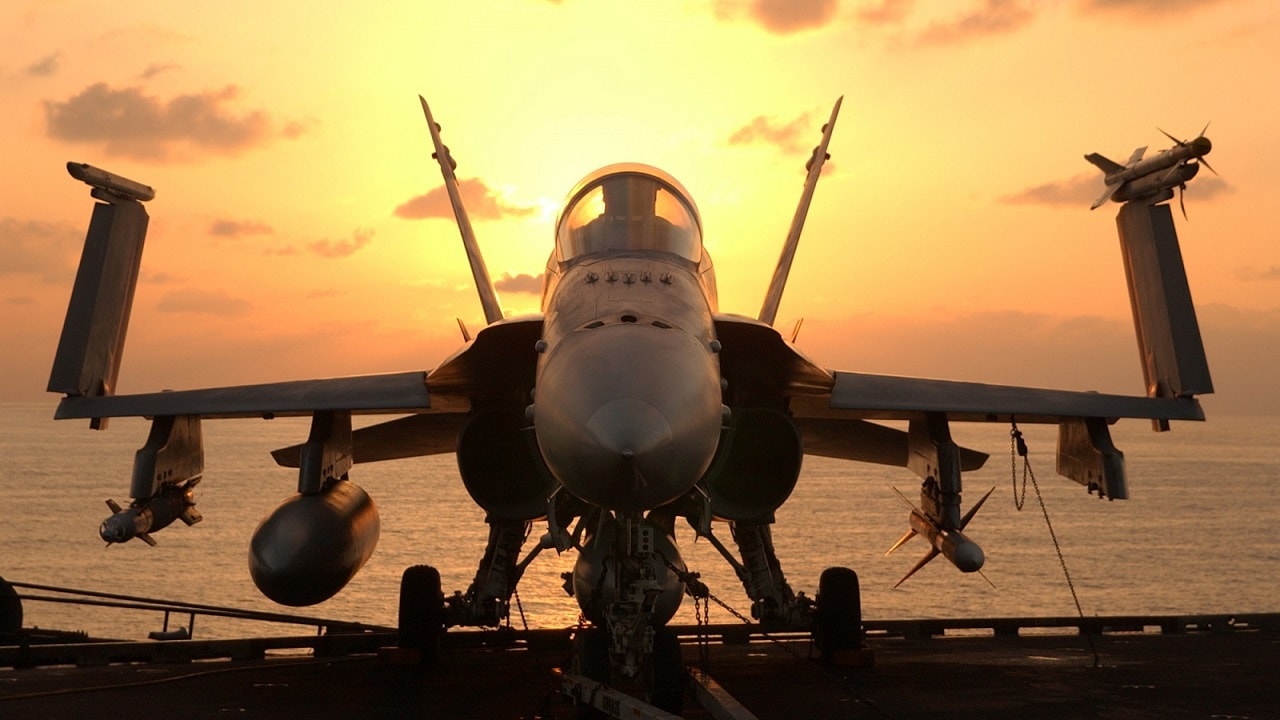
At sea aboard USS John C. Stennis, December 18, 2001 – After an early morning round of flight operations, an F/A-18 Hornet awaits the next round of combat flight operations aboard the USS John C. Stennis (CVN 74). Stennis and her embarked Carrier Air Wing Nine (CVW-9) are supporting Operation Enduring Freedom. U.S. Navy photo by Photographer’s Mate 3rd Class Jayme Pastoric
Since the air campaign over Iran began, the F/A-18s have been in constant operation as the Navy’s core strike package aircraft.
The Navy has three carrier strike groups operating in the region.
Each Air Wing is comprised of three squadrons of 12 F/A-18 Super Hornets, a squadron of F-35C stealth aircraft, and a squadron of E/A-18 Growler electronic attack aircraft. Thus far, several thousand targets have been struck.
F/A-18E Super Hornet Specs:
The Super Hornet was built to be easy to maintain, and it has certainly lived up to that. Maintenance of technology-heavy combat fighters is time-consuming. But maintaining carrier jets is even more work. Super Hornets require half the maintenance time of an F-14 or an A-6.
The General Electric F414 engines are also easy to maintain. They are connected to the aircraft at just ten points and can be removed by a four-man team in just 20 minutes. Because of this, the Super Hornet had an excellent readiness record of more than 80 percent.
- Length: 60.3 ft
- Height: 16 ft
- Wingspan: 44.9 ft
- Maximum take-off weight: 66,000 lbs
- Airspeed: Mach 1.8+
- Ceiling: 50,000+ ft
- Propulsion: Two F414-GE-400 turbofan engines
- Guns: 1× 20 mm (0.787 in) M61A2 Vulcan
- Missiles: AIM-7 Sparrow, AIM-9 Sidewinder, AIM-120 AMRAAM, AGM-65E/F Maverick, AGM-84H/K SLAM-ER, AGM-88 HARM, AGM-158 JASSM, AGM-154 Joint Standoff Weapon (JSOW)
- Bombs: JDAM bombs, Paveway series of laser-guided bombs, Mk 80 series unguided bombs
Service Life Extension and other programs ensure the airframes remain structurally sound for extended service, with the Super Hornet expected to operate into the 2040s.
“People from all walks of life and areas of Naval Aviation feel some tangible connection to this aircraft,” Captain Michael Burks, who has served as the F/A-18 and EA-18G Program Office program manager since 2023, said.
“Whether they’ve worked on the production line, whether they were engineers that did design work, whether they wore the uniform or are wearing it right now. The history of this aircraft—which is still being written—represents and honors the enduring impact of those who started and those who are sustaining what is probably one of the greatest runs in Naval Aviation for any platform out there.”
The Navy’s Nimitz- and Ford-class aircraft carriers are America’s power projection icons. And with flight decks crammed with F/A-18E Super Hornets and F-35C Lightning II stealth fighters, they are more packed with firepower than some entire nations can boast.
MORE – Iran Claims to Have Hit a U.S. Navy Aircraft Carrier
About the Author: Steve Balestrieri
Steve Balestrieri is a National Security Columnist. He served as a US Army Special Forces NCO and Warrant Officer. In addition to writing on defense, he covers the NFL for PatsFans.com and is a member of the Pro Football Writers of America (PFWA). His work was regularly featured in many military publications.