
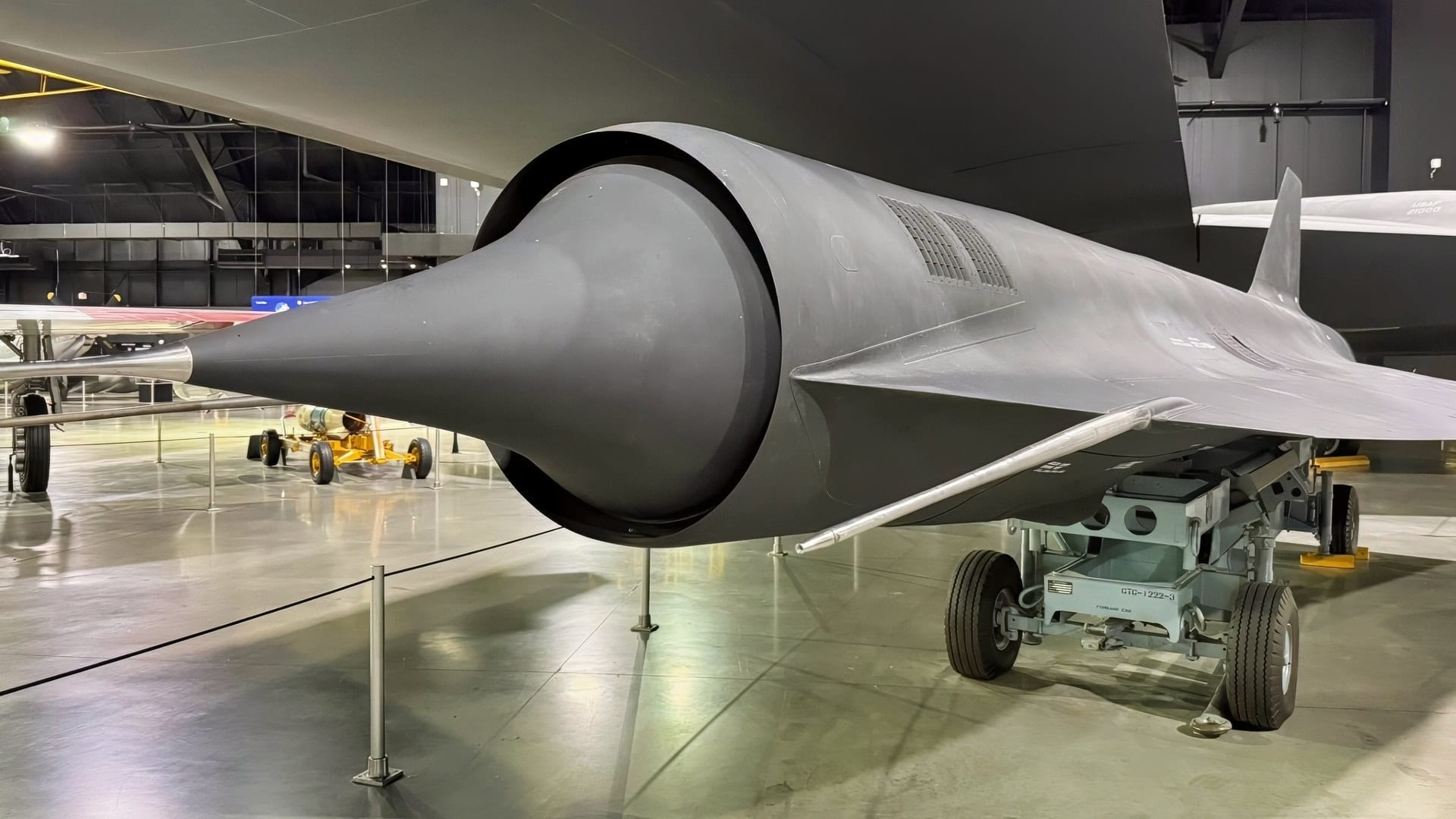
D-21B: The SR-71 Blackbird’s Little Brother Was a Mach 3 Spy Drone — It Made Its Maiden Flight on the Same Day as the Blackbird
Besides being the winning number in the game of blackjack and the legal drinking age in the United States, the number 21 also has significance in the world of aviation.
Right now, the B-21 Raider sixth-generation stealth bomber is nearing its entry into service. Going back to the Cold War, the Soviet-built MiG-21 “Fishbed” fighter was the most-produced jet aircraft in aviation history, with more than 11,000 built.
DF-21B Drone 19FortyFive.com Image Taken at the National Museum of the U.S. Air Force on July 19, 2025.
But the United States had its own “21” aircraft during the Cold War—the D-21B, which was a speed demon of a drone that had a brief but fascinating career spying on Communist China.
We now give the D-21B its moment in the spotlight.
D-21B Initial History, Premise, and Promise
The D-21 was categorized as a remotely piloted aircraft (RPA).
If the D-21B looks like a miniaturized robotic version of the SR-71 Blackbird (the fastest air-breathing manned aircraft ever produced), well, that’s no mere coincidence, nor is your imagination playing tricks on you.
After all, the D-21B was built by the same legendary Lockheed Skunk Works division that built the Blackbird.
It is one of the many testaments to the genius of its mastermind and head honcho, Clarence Leonard “Kelly” Johnson.
It was initially designed to be launched from the back of an M-21, a specially modified “mothership” edition of the SR-71. Two of these motherships were built.
Appropriately enough, the D-21 made its maiden flight on the same day as the Blackbird, December 22, 1964.
However, the D-21 was three years behind the SR-71 in attaining official operational status (1969 vs. 1966).
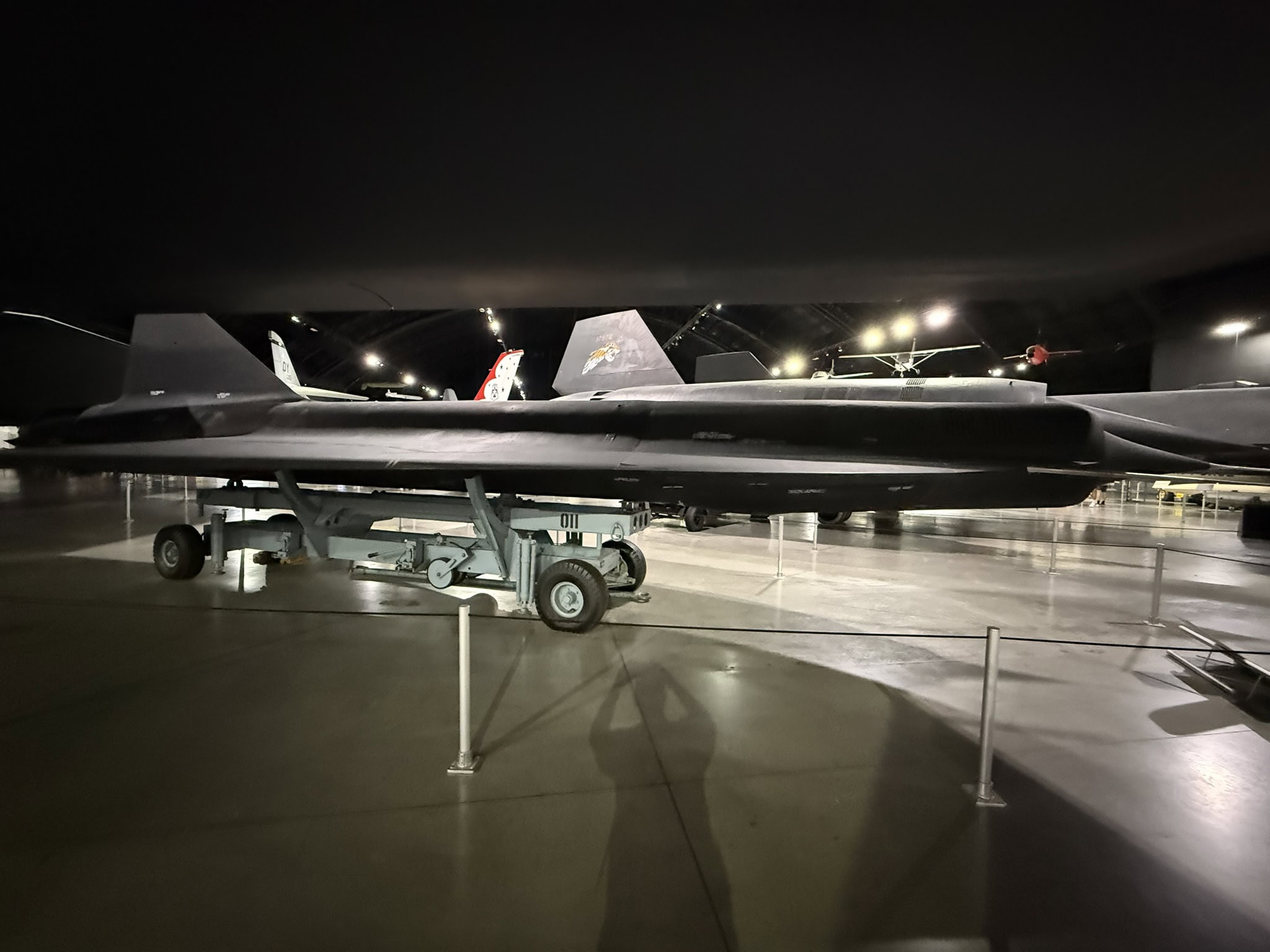
DF-21B Drone 19FortyFive.com Image Taken at the National Museum of the U.S. Air Force on July 19, 2026.
Part of the reason for the delay was a fatal accident in 1966 that led to the cancellation of the D-21/M-21 tandem.
The D-21 was further adapted in the late 1960s for launch from B-52H Stratofortress strategic bombers.
With its new lease on life, the RPA was redesignated the D-21B and mated with a large, solid-propellant rocket for launch.
A total of 38 D-21s were built.
D-21 Specs and Special Features
The D-21 used much of the same technology as the SR-71 (as well as the A-12 Oxcart spy plane and YF-12A interceptor from that same family of aircraft).
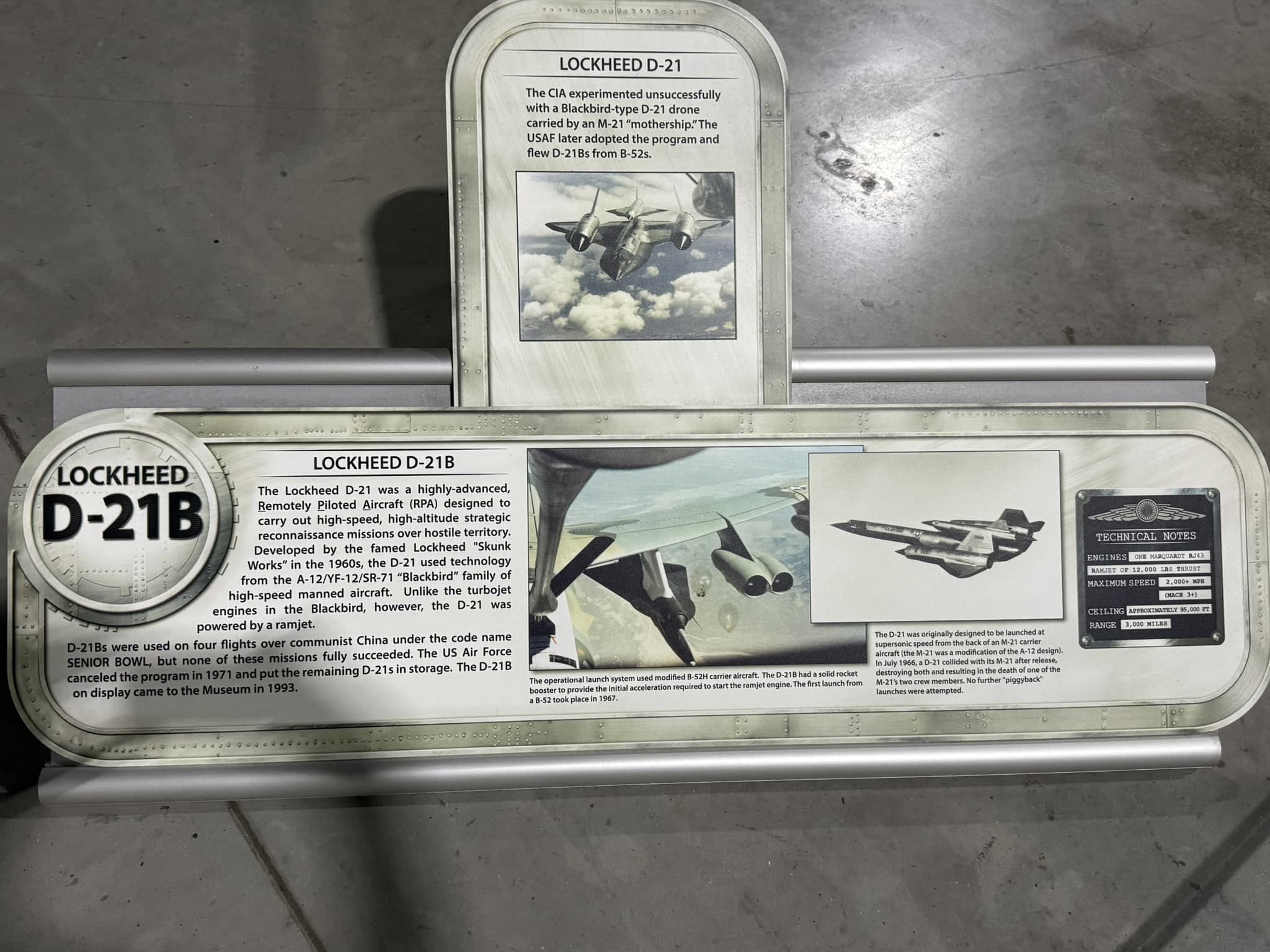
However, while the Blackbird used twin Pratt & Whitney J58 turbojet engines, the D-21 used a single ramjet—specifically a Marquardt RJ43—which could generate 12,000 lbs of thrust.
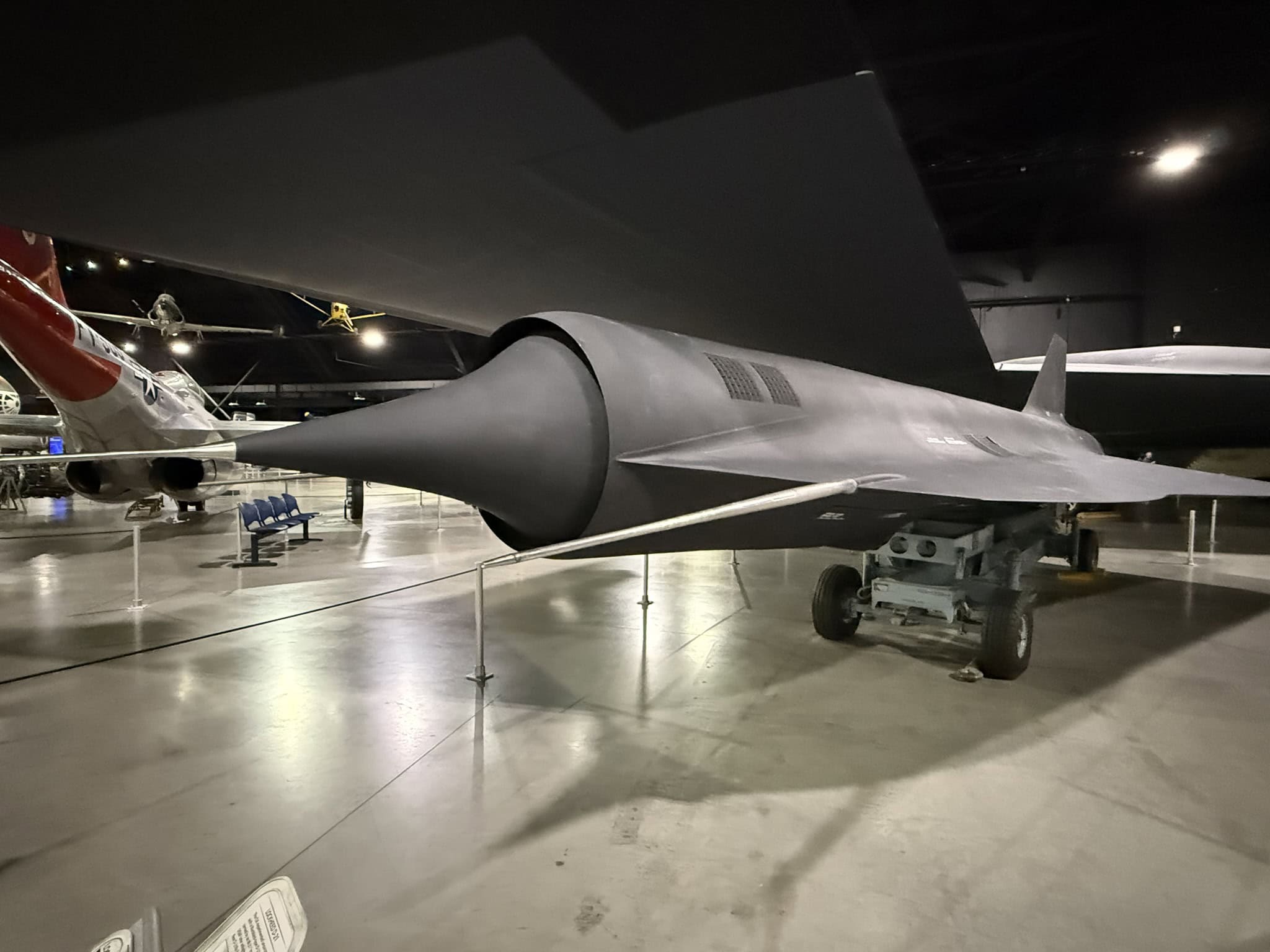
DF-21B Drone 19FortyFive.com Image Taken at the National Museum of the U.S. Air Force on July 19, 2025.
Though Marquardt (whose legacy partly survives in Aerojet Rocketdyne, an L3Harris company) was nowhere nearly as famous an engine maker as Pratt & Whitney, it was no slouch. Its engine enabled the D-21B to virtually match the Blackbird’s speed of Mach 3+. (The RJ43 also powered the Boeing CIM-10 Bomarc surface-to-air missile.)
To put that in perspective for you, the MQ-1 Predator drone plods along at a max speed of a mere 135 miles per hour; the RQ-4 Global Hawk at 391 mph; the X-45 at 224 mph; and even the much-feared Iranian-made Shahed 191 tops off at 220 mph.
The D-21B had a maximum range of 3,000 miles and a service ceiling of 95,000 feet.
Operational History
Ideally, during a reconnaissance mission, the D-21 drone would follow a pre-programmed flight path over areas of interest, then return to international airspace, whereupon the RPA would jettison the reconnaissance film package, equipped with its own parachute, and self-destruct.
The chute would then be recovered in mid-air by a specially equipped airplane or at sea by a ship.
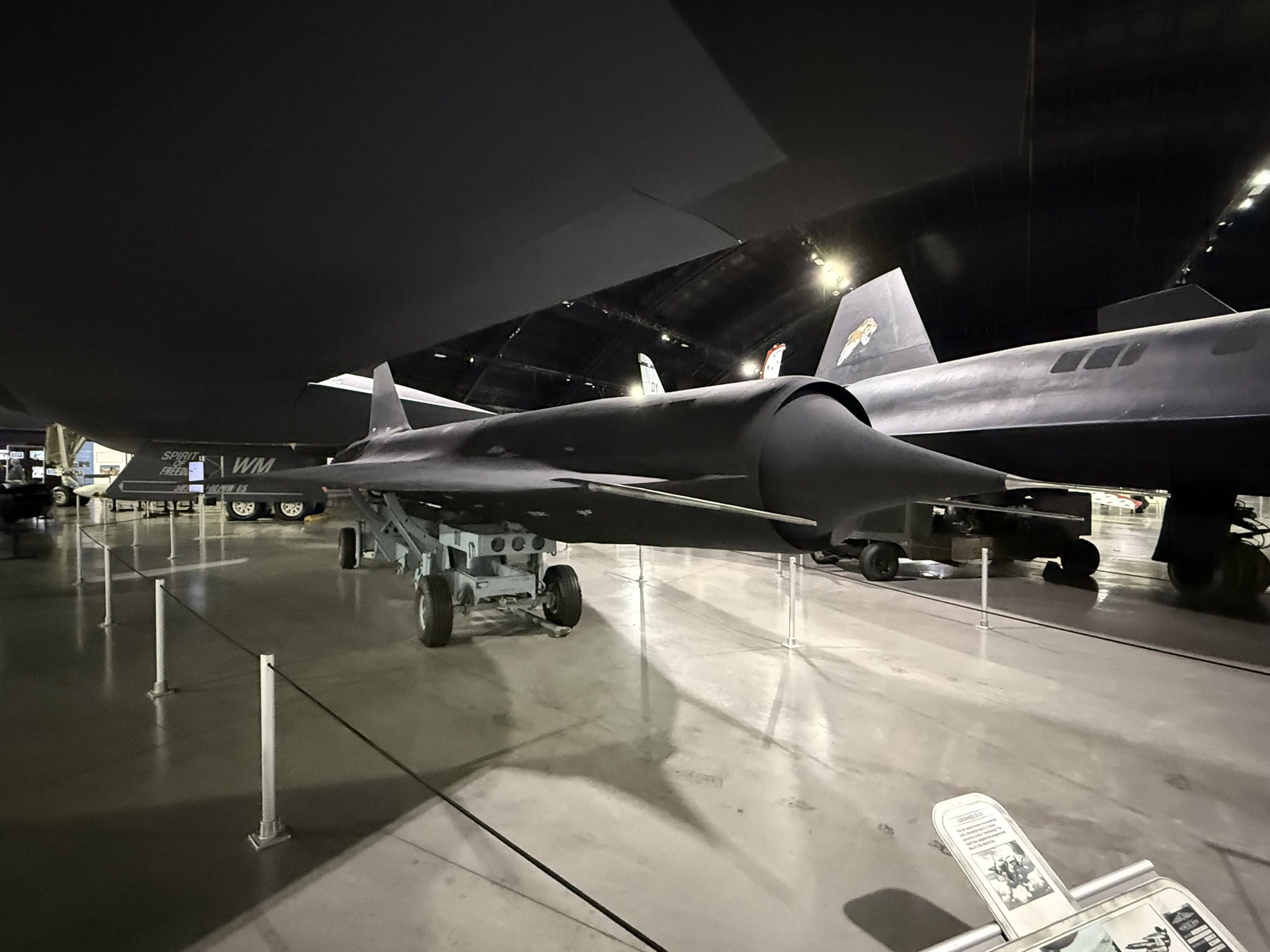
DF-21B Drone 19FortyFive.com Image Taken at the National Museum of the U.S. Air Force on July 19, 2025.
As to how well this worked in practice, the National Museum of the United States Air Force states that “D-21Bs were used on four flights over communist China under the code name Senior Bowl, but none of these missions fully succeeded. The U.S. Air Force canceled the program in 1971 and put the remaining D-21s in storage.”
(Presumably the “Senior Bowl” code name was inspired by the postseason college football all-star game played annually in late January or early February in Mobile, Alabama.)
Where Are They Now?
Roughly a dozen D-21 drones have been preserved for posterity.
In fact, the pictures in this article were taken during a visit to the D-21B at the National Museum of the U.S. Air Force last year.
And, in fact, the SR-71 Blackbird sits ten feet away. You can see it in the image below.
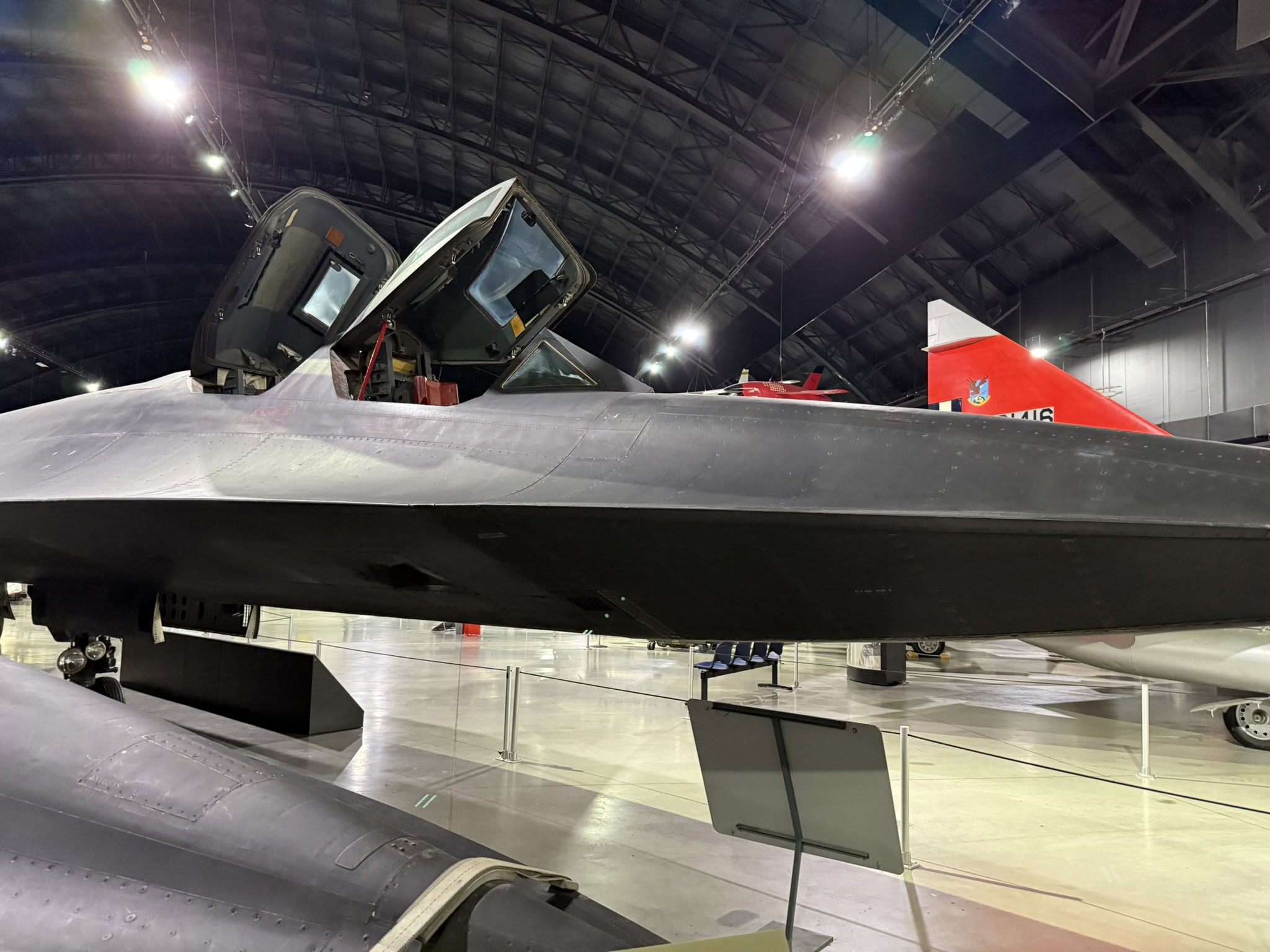
SR-71 at the National Museum of the Air Force.
Sadly, one of them, Serial No. 527, is in Chinese hands—though it is literally a wreck—and on display at the China Aviation Museum in Datangshan.
Meanwhile, the National Museum of the United States Air Force has one specimen (#524) on display—it arrived there in 1993—and has loaned #510 to the Museum of Flight in Seattle, Washington, where it is attached to the sole surviving M-21.
About the Author: Christian D. Orr, Defense Expert
Christian D. Orr is a Senior Defense Editor. He is a former Air Force Security Forces officer, Federal law enforcement officer, and private military contractor (with assignments worked in Iraq, the United Arab Emirates, Kosovo, Japan, Germany, and the Pentagon). Chris holds a B.A. in International Relations from the University of Southern California (USC) and an M.A. in Intelligence Studies (with a concentration in Terrorism Studies) from American Military University (AMU). He is also the author of the book “Five Decades of a Fabulous Firearm: Celebrating the 50th Anniversary of the Beretta 92 Pistol Series, the second edition of which was recently published.