

The B-2 Spirit was one of the most advanced aircraft ever built. Yet only 21 were ever produced. While over 100 B-2s were originally planned, the flying wing stealth bomber ultimately became a boutique strategic asset.
Why? The B-2 was designed in the 1980s for nuclear penetration of Soviet airspace, but when the Soviet Union collapsed, the B-2 was left without its primary mission or the motivation to fund such an expensive program, resulting in one of the most truncated programs in aviation history.
B-2 Spirit Bomber: Born of the Cold War and Why It Was Cut Back
In the late 1970s and early 1980s, the Soviets employed a dense IADS equipped with advanced SAMS, such as the SA-10 and SA-12.
At the time, US bombers, including the B-52 and B-1, were increasingly vulnerable, leaving the US without a viable penetrating stealth asset.
The solution wasn’t to beat the Soviet IADS with speed, as the B-1 proposed, but with invisibility—a low observable stealth penetrator.
The Advanced Technology Bomber (ATB) program was born, and was awarded to Northrop in 1981, who was tasked with building the most technologically advanced bomber ever fielded.
The Design Philosophy
Notably, the B-2 lacks a tail and has only minimal vertical surfaces.
The result was a reduced radar cross section (RCS), an aircraft with smooth, continuous surfaces, no right angles, and edge alignment—all calibrated towards remaining invisible on Soviet radar.
Lowering the RCS further was an internal weapons bay; whereas conventional bombers carried weapons externally, the Spirit carried weapons internally to avoid radar reflections. To reduce the infrared signature, the engine was buried and cooled to minimize engine exhaust.
In sum, every design choice prioritized stealth over conventional performance.
The Technical Build
The B-2 was built with extensive use of radar-absorbent material (RAM) and composite structures to reduce radar signature.
Because the flying wing design is aerodynamically unstable, the B-2 features a fly-by-wire system that the pilot must use to keep the aircraft airborne.
The Spirit also has terrain-following avionics. For radar, the Spirit uses the AN/APQ-181, which has a low probability of intercept.
The payload capacity is 40,000 pounds of either nuclear or conventional ordnance.
The B-2 is a true strategic bomber, with a 6,000-plus-mile nautical range, which can be extended with refueling.
The aircraft is difficult to build from a manufacturing perspective; the stealth performance requires tight tolerances, while the RAM maintenance is highly labor-intensive. Indeed, the B-2 pushed the limits of materials science, computing, and manufacturing possibilities for its day.
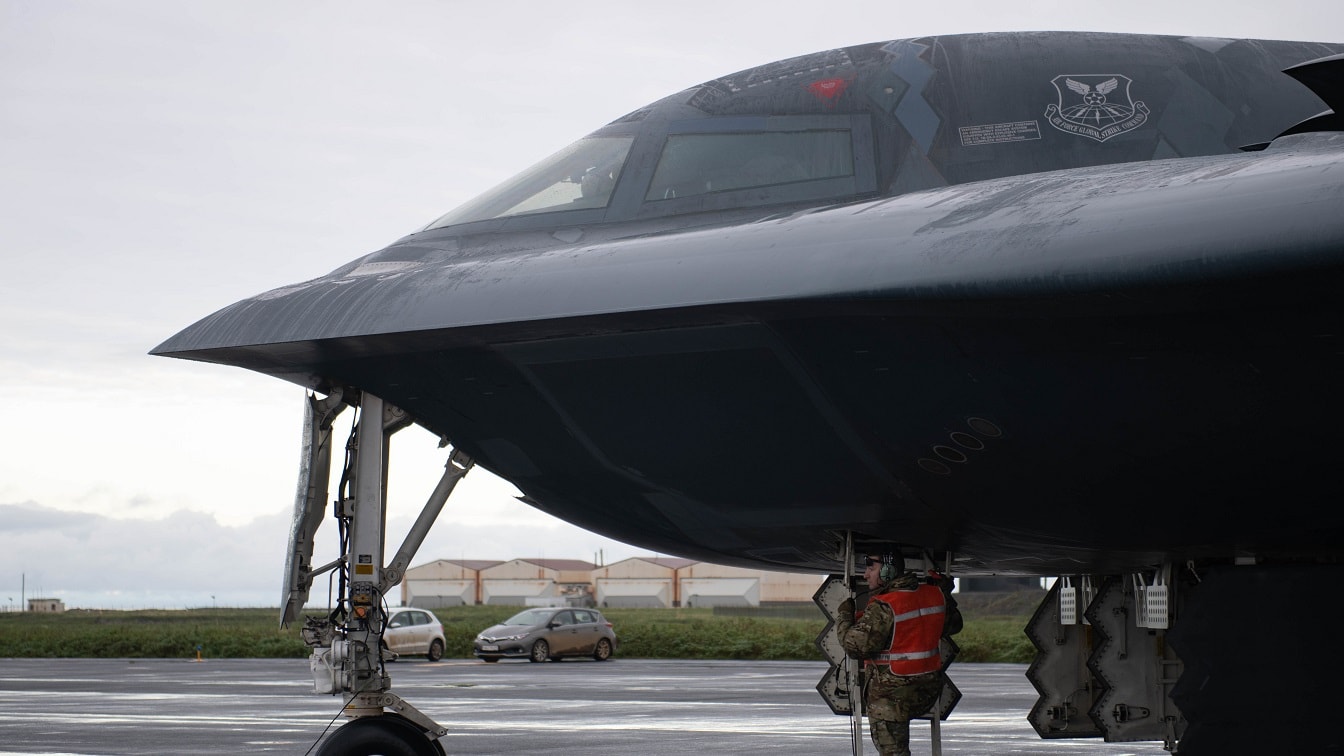
A crew chief assigned to the 110th Expeditionary Bomb Squadron, prepares a B-2 Spirit for departure from Keflavik Air Base, Iceland, Sept. 11, 2021. The stealth bomber provides unique capabilities to combatant commanders with their ability to strike targets without being detected. Operating out of Iceland allows Airmen and the B-2 to assure allies by contributing to security in the European theater. (U.S. Air Force photo by Airman 1st Class Victoria Hommel)
The Inevitable Controversy
The program was born of extreme secrecy, a black program with limited public visibility.
The program’s cost, which was easier to justify against the backdrop of the Cold War and the Soviet menace, was harder to justify after the Soviet Union collapsed. The cost per aircraft would eventually balloon to more than $2 billion per unit.
Congress grew increasingly skeptical, obviously, suggesting that the B-2 was too expensive and overbuilt for the nuclear mission. Eventually, the B-2, like the F-22 Raptor and the Seawolf-class submarine, would become a symbol of Cold War excess.
Massive Cutbacks
Originally, the Air Force planned to procure 132 aircraft. That number was cut to 75. And then to just 21, representing one of the most significant procurement cuts in aviation history.
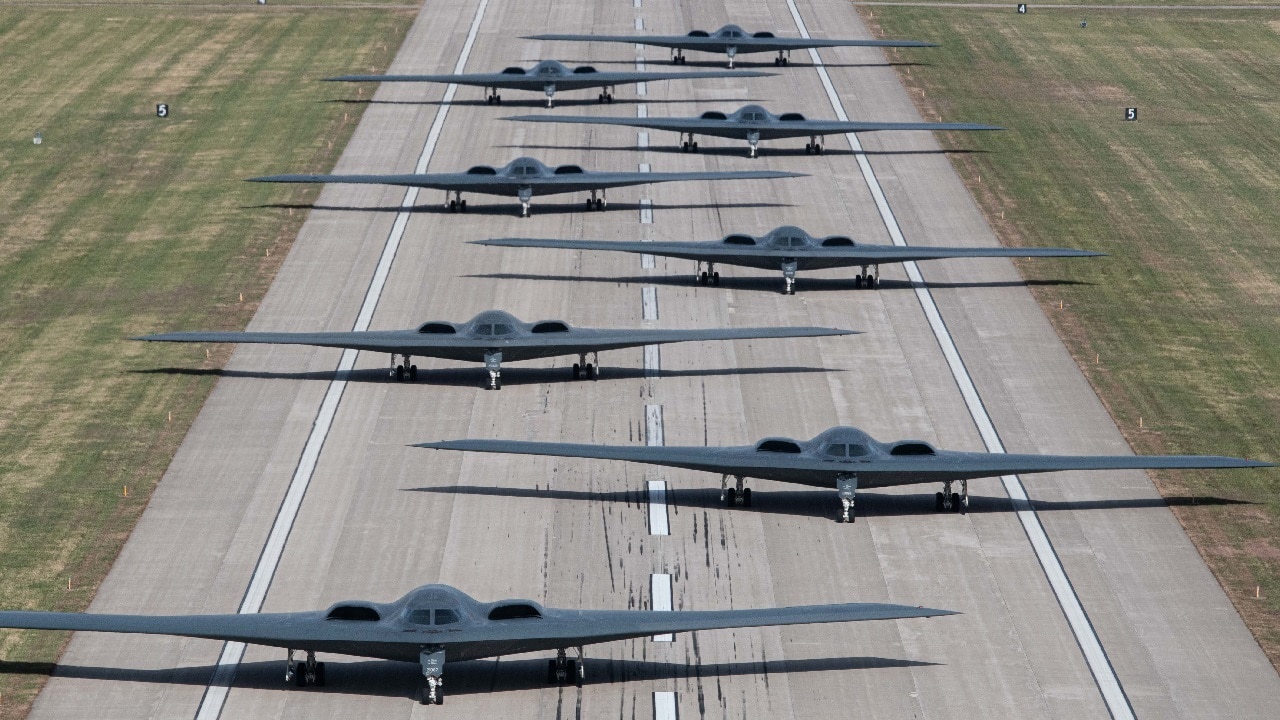
B-2 Spirit stealth bombers assigned to Whiteman Air Force Base taxi and take-off during exercise Spirit Vigilance on Whiteman Air Force Base on November 7th, 2022. Routine exercises like Spirit Vigilance assure our allies and partners that Whiteman Air Force Base is ready to execute nuclear operations and global strike anytime, anywhere. (U.S. Air Force photo by Airman 1st Class Bryson Britt)
The Soviet collapse and the end of the Cold War reduced nuclear urgency overnight, leaving the B-2 without the mission for which it was designed.
And after 1991, the defense budget constricted; Americans didn’t want to spend so much on weaponry if the world was unipolar. As a result, the B-2 program lost economies of scale, further spiking the cost per aircraft.
Strategic Consequences
The Spirit fleet reduction meant limited availability and a higher maintenance burden. But the platform retained its unique capability to execute penetration strikes.
The B-2 would see action in Kosovo, Iraq, Afghanistan, and, more recently, Iran, becoming a precise (and precious) strategic tool.
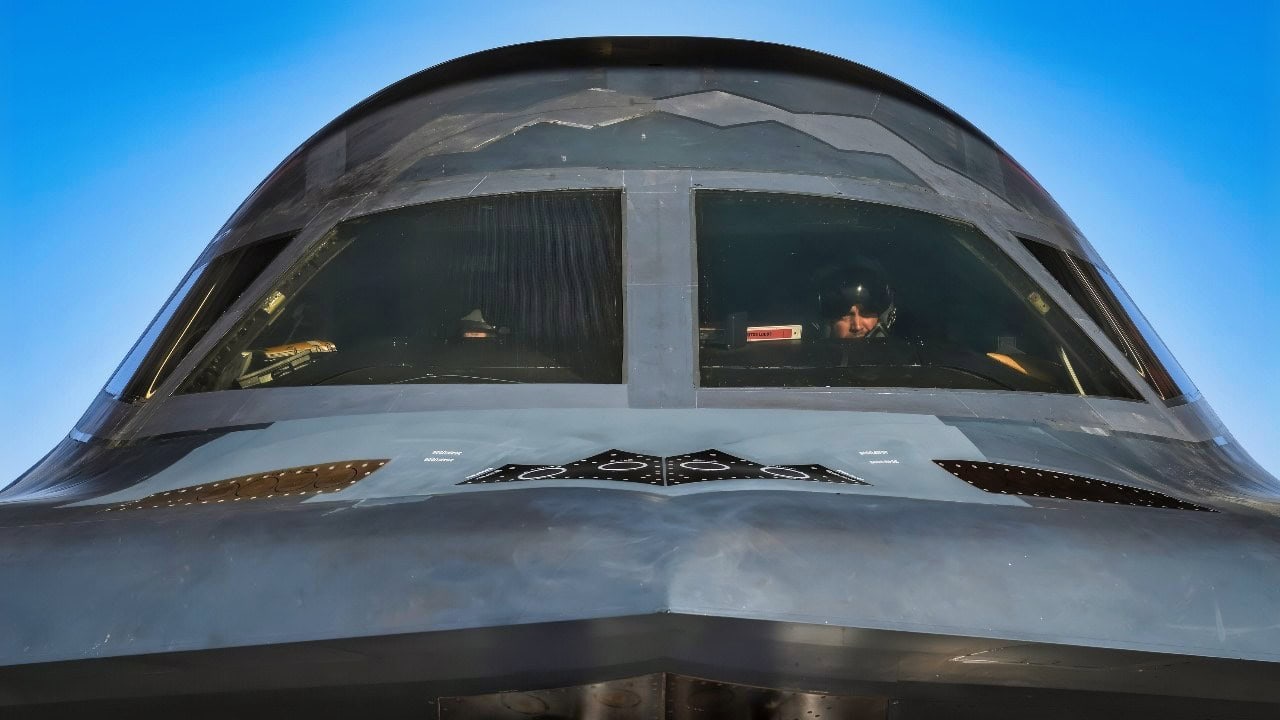
A U.S. Air Force B-2 Spirit aircrew performs pre-flight checks in the cockpit of their aircraft at Whiteman Air Force Base, Missouri, March 8, 2020. The B-2 took off from Whiteman AFB to support U.S. Strategic Command Bomber Task Force operations in Europe. The 131st Bomb Wing is the total-force partner unit to the 509th Bomb Wing. (U.S. Air Force photo by Tech. Sgt. Alexander W. Riedel)
The B-2’s days are numbered; the forthcoming B-21, built from the core premise of the B-2, will replace the B-2.
Designed to avoid the B-2’s cost pitfalls through scaled production, the B-21 is also a flying-wing stealth bomber—one that applies lessons learned from the B-2’s unique procurement story.

B-2 Spirit Stealth Bomber 19FortyFive Photo. Taken by Harry J. Kazianis back in July 2025.
About the Author: Harrison Kass
Harrison Kass is a writer and attorney focused on national security, technology, and political culture. He holds a JD from the University of Oregon and an MA in Global & Joint Program Studies from NYU. His work has appeared in City Journal, The Hill, Quillette, The Spectator, and The Cipher Brief. More at harrisonkass.com.