
The U.S.-Israeli campaign against Iran very quickly wiped out Iranian naval assets, striking early and taking out the country’s most valuable naval assets – including its Kilo-class submarines – within days. But while the strikes demonstrated American capability, the ease of the fight so far is not representative of what a future conflict with more powerful adversaries may look like. The campaign has shown what happens when American air and naval power confronts a much weaker maritime force that lacks the scale and technology to sustain high-end warfare – but what happens in a fight against China?
Iran and China are not remotely comparable. Iran could harass shipping and mine chokepoints, and in some instances launch missiles and strike some U.S. assets successfully. China, however, could do much more damage. Its strategy would be different, and its forces could attempt to kill aircraft carriers, destroy American bases, and even contest the Pacific with one of the world’s largest and most sophisticated navies.
And there’s another warning inside the Iran campaign: modern wars, even against weaker adversaries, can burn through missiles at an extraordinary rate.
Even against a far weaker opponent like Iran, the United States and Israel have had to expend large numbers of interceptors, cruise missiles, ship-fired missiles, air-launched stand-off weapons, and other precision munitions to strike targets and defend their assets.
Those same weapons would be necessary in a future war against China, and if stockpiles are reduced in one theater, America’s immediate readiness in another could suffer.
These are the clear lessons from the conflict so far, though Washington already knew them.
That’s precisely why the Trump administration recently announced its historic $1.5 trillion defense budget.
But how would a fight with China unfold, even with munitions, boats, fighters, and bombers that the FY2027 budget expects to pay for?
China Would Fight A Carrier War Differently
Unlike Iran, China has spent decades preparing specifically for a war against American naval power.
Beijing would not rely on speedboats or mines. It would likely attempt a coordinated campaign designed to keep U.S. carrier strike groups far from the fight and make intervention around Taiwan or the South China Sea costly from the opening hours of the war.
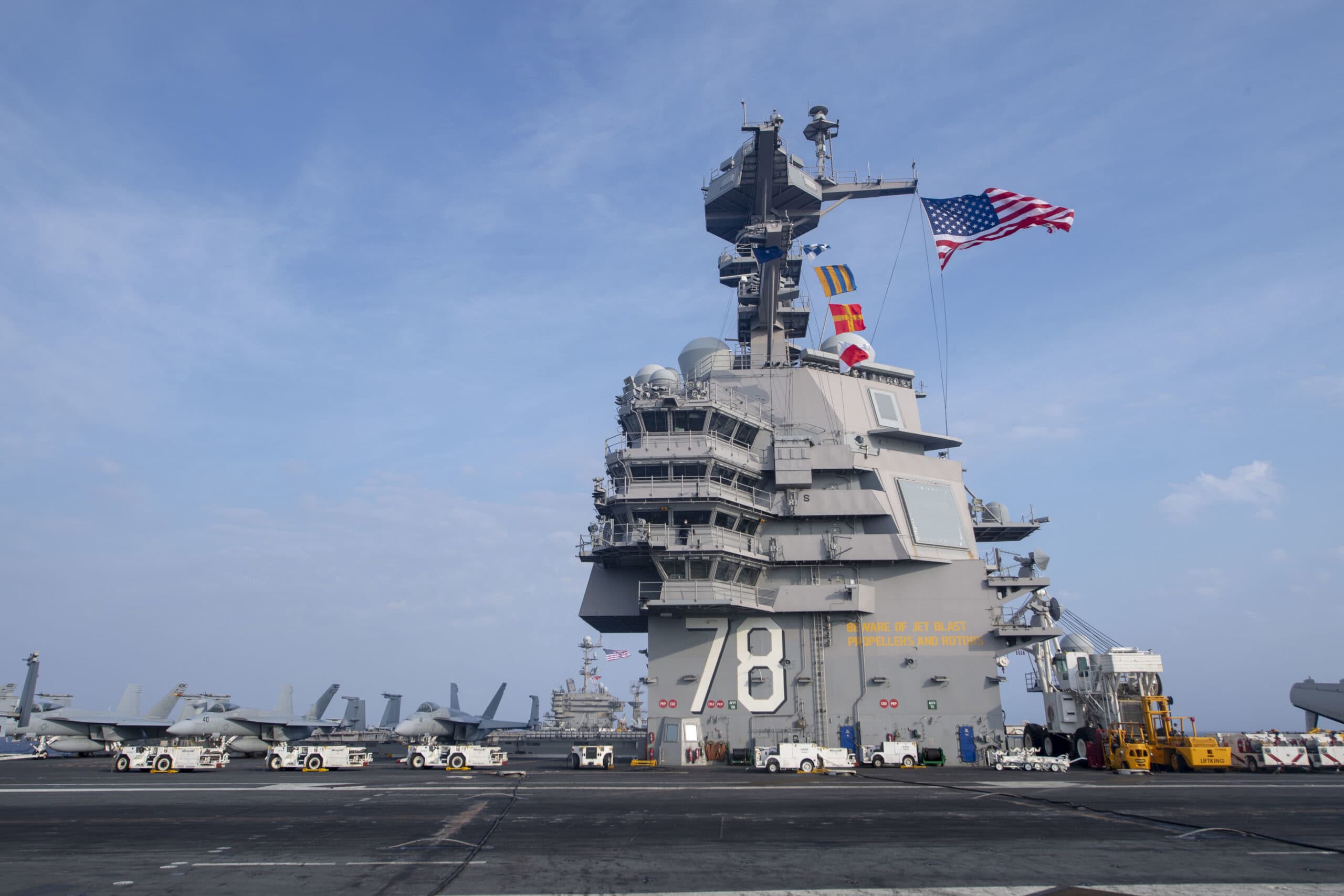
The Ford-class aircraft carrier USS Gerald R. Ford (CVN 78) and the Nimitz-class aircraft carrier USS Harry S. Truman (CVN 75) transit the Atlantic Ocean June 4, 2020, marking the first time a Ford-class and a Nimitz-class aircraft carrier operated together underway. Ford is underway conducting integrated air wing operations, and the Harry S. Truman Carrier Strike Group remains at sea in the Atlantic as a certified carrier strike group force ready for tasking in order to protect the crew from the risks posed by COVID-19, following their successful deployment to the U.S. 5th and 6th Fleet areas of operation. (U.S. Navy photo by Mass Communication Specialist Seaman Sawyer Connally)
A central part of that strategy is China’s enormous anti-ship missile arsenal.
The DF-21D, often called a “carrier killer,” is a ballistic missile that is believed to have a range of roughly 1,500 kilometers. The longer-range DF-26 can reach much farther and is considered to be a threat to Guam, a critical U.S. logistics and air hub.
China would also fight with its fleets of submarines, long-range bombers, drones, and satellites.
It would conduct electronic warfare, and no doubt engage in cyberattacks – feats the Iranians would struggle with. Chinese forces would force the U.S. Navy to operate farther east, complicating its own strategy.
The Geography Would Favor Beijing
Consider the geography of the Iran conflict and a potential contingency in the Indo-Pacific.
The war against Iran has been fought around a narrow chokepoint where American power can be concentrated quickly, whereas a war against China would take place across the vast Western Pacific, much closer to Chinese bases than American ones.
If the conflict centered on Taiwan, Chinese aircraft, missile forces, and naval units would be operating near home territory with shorter supply lines and land-based support.
U.S. forces would need to project power across long distances while protecting bases in Guam, Okinawa, and Japan, all of which could face missile attack in the opening phase of a war.
That would be a problem for U.S. forces because logistics often decide wars. Between fuel, spare parts, runway repairs, and missile reloads, the winning side needs to perfect its ability to support its fighters and hardware at all times.
U.S. forces would be heavily dependent on scattered bases throughout the region, requiring fighter jets and bombers to travel long distances, potentially with the support of vulnerable tankers – and that’s a problem.
Why Washington Is Spending Big Now
If the $1.5 trillion FY2027 defense budget request seemed shocking, consider it in the context of a potential war with China.
The proposal includes 34 new ships for the Navy, more than 4,200 missiles, torpedoes, and bombs, 123 aircraft, expanded munitions production, and major funding for submarines, missile defense, shipyards, and next-generation aircraft.
The Air Force separately seeks 85 more F-35s, while the Navy is pushing for a larger fleet and more strike capacity.
The budget is not so much a response to Iran as it is about preparing for a future contingency in the Pacific and defending the American homeland in the long term.
Stockpiling weapons and expanding capacity now is a necessity – without it, the U.S. risks being unable to fight modernized Chinese forces in the coming years.
About the Author: Jack Buckby
Jack Buckby is a British researcher and analyst specializing in defense and national security, based in New York. His work focuses on military capability, procurement, and strategic competition, producing and editing analysis for policy and defense audiences. He brings extensive editorial experience, with a career output spanning over 1,000 articles at 19FortyFive and National Security Journal, and has previously authored books and papers on extremism and deradicalization.