

The Montana-class would have been the largest, most heavily armed, and best-protected battleship the United States Navy ever put to sea. As one U.S. naval historian told me: “Nothing would have been more powerful. This would have been the ultimate battleship to ever sail.”
Five hulls were authorized. Names were chosen. Yards were assigned. And then, in the middle of the largest naval war in human history, the Navy looked at what it was about to build and decided to cancel every one of them. Why? The flaw was easy to see: she was obsolete before the plans were even drawn up.
The Montana-Class: It Would Have Been the Best Battleship Ever
There is a state in the union with no battleship to its name.
Every other American state with sufficient population and political weight to argue for a hull eventually got one.
Montana never did.
The reason is BB-67 — the lead ship of a class that was authorized, designed, funded, and assigned to a Navy yard before being killed mid-war by the very service that had built her on paper. The Montana-class was the last battleship class the United States Navy would ever design.
It was also the only American battleship class genuinely capable of going gun-for-gun with Japan’s Yamato-class super-battleships — and the Navy walked away from it on purpose.
This is the story of why, at least, how I see it, and how many naval experts and historians have explained it to me.
What The Montana-Class Was Supposed To Be
The Montana-class began as a 1938 design study for a “slow battleship” intended to succeed the fast Iowa-class then on the drawing board.
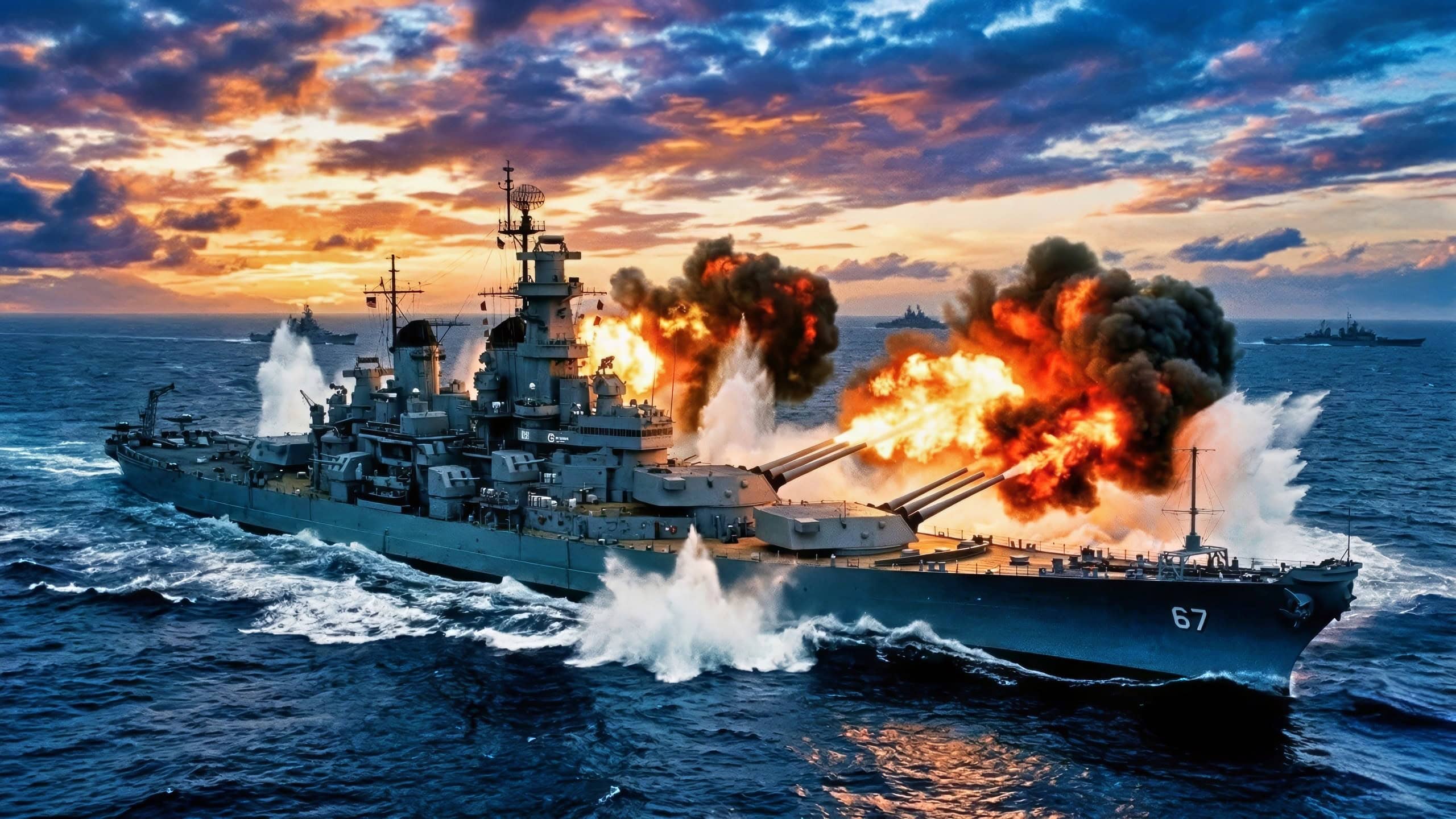
Montana-Class Battleship Firing Guns. Image Created Using Nano Banana.
The first two hulls were authorized by Congress in 1939 under the Second Vinson Act, with three more added later under the Two-Ocean Navy Act of 1940. Five names were assigned: Montana (BB-67) and Ohio (BB-68) at the Philadelphia Navy Yard, Maine (BB-69) and New Hampshire (BB-70) at the New York Navy Yard, and Louisiana (BB-71) at the Norfolk Navy Yard.
Where the Iowa-class had been built around the requirement to keep up with Essex-class carriers at flank speed, the Montana-class was built around a different requirement: not speed, but firepower and survivability. The class was the first American battleship design freed from interwar treaty constraints, and Navy designers used that freedom to throw away the rulebook.
The numbers tell the story: Twelve 16-inch/50 caliber Mark 7 guns in four triple turrets — three more main-battery tubes than the Iowa-class carried. Each gun could throw a 2,700-pound armor-piercing shell. A Montana broadside would have been the heaviest in U.S. Navy history.
A standard displacement of 60,500 tons, with full-load displacement reaching roughly 70,500 tons. She would have been 921 feet 3 inches long overall, with a beam of 121 feet — wider than the Panama Canal locks could accommodate. The Navy knew this. Designers accepted it. A separate plan was authorized to widen the canal locks to fit the ships, although that plan was later cancelled along with the battleships themselves.
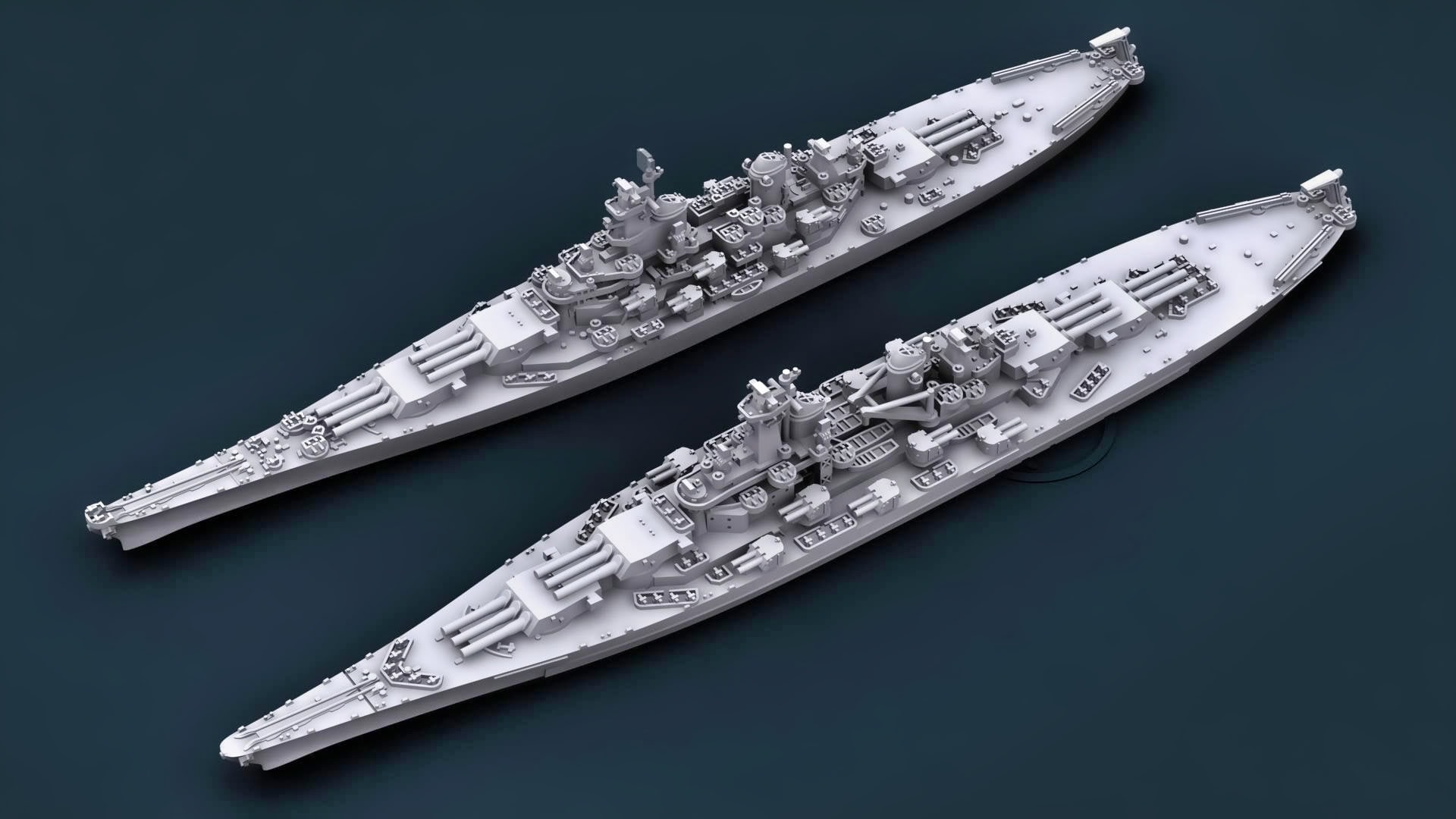
Montana-Class Battleship vs. Iowa-Class. Image Credit: Creative Commons.
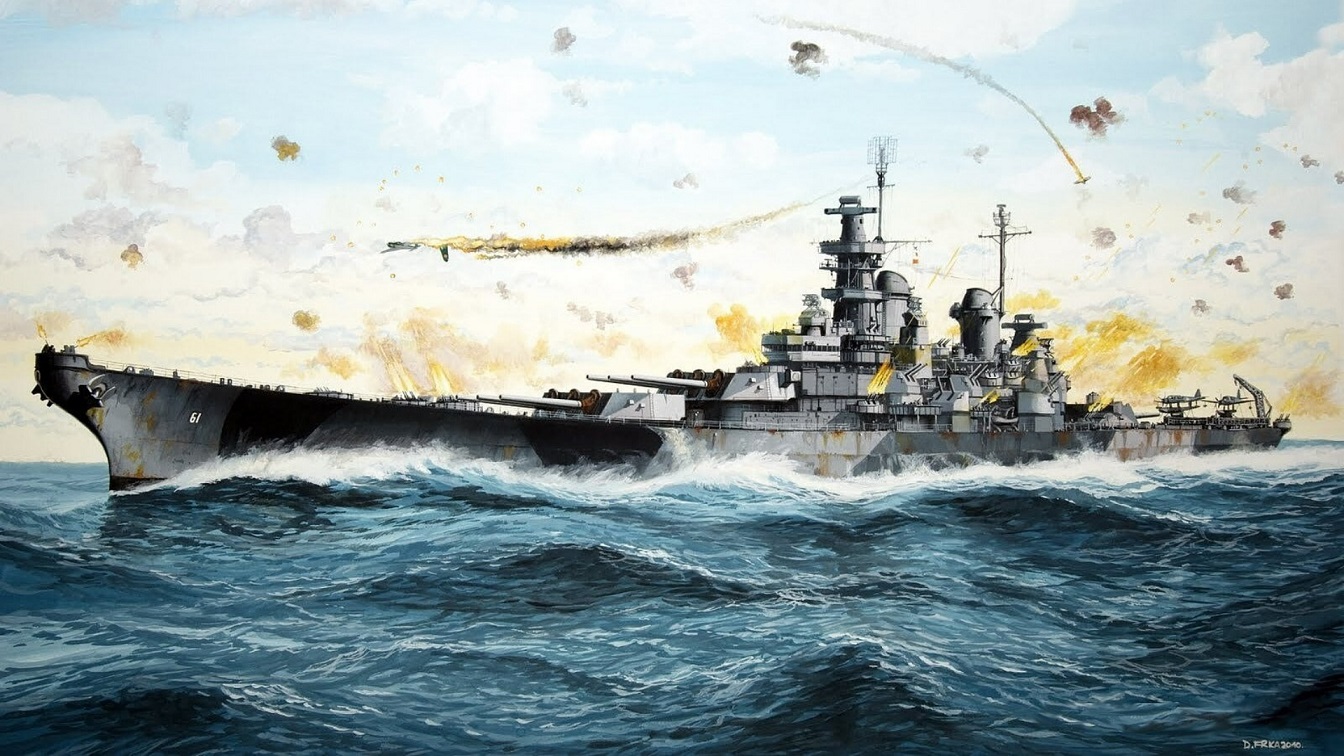
Iowa-class battleship artist painting. Image Credit: Creative Commons.
Armor heavy enough to defeat its own guns. The Montana-class would have been the only new World War II–era American battleship adequately armored against 16-inch shellfire — a quality the Iowa-class lacked. The torpedo defense system used a four-bulkhead internal bulge with liquid-loaded compartments engineered to absorb the gas-bubble energy of a torpedo warhead detonation.
Twenty 5-inch/54 caliber dual-purpose guns in ten twin mounts as secondary armament, replacing the 5-inch/38 caliber mounts standard across the rest of the U.S. fleet.
A maximum speed of 28 knots — slower than the Iowa-class by several knots, the price paid for armor and additional main battery.
If completed, the five Montana-class hulls would have given the late-1940s U.S. Navy seventeen new battleships, an advantage no other navy on earth could have approached.
Why The Navy Wanted It
The Montana-class was, fundamentally, an answer to a problem that came out of the interwar naval treaty system. The Washington Naval Treaty of 1922 had capped battleship displacement at 35,000 tons.
America’s first new battleships of the late 1930s — the North Carolina and South Dakota classes — were built to that ceiling. The Iowas, ordered after Japan walked away from the treaty system, expanded to 45,000 tons but accepted a critical compromise: they had to fit through the Panama Canal, which kept their beam — and therefore the volume available for armor and internal protection — within strict limits.
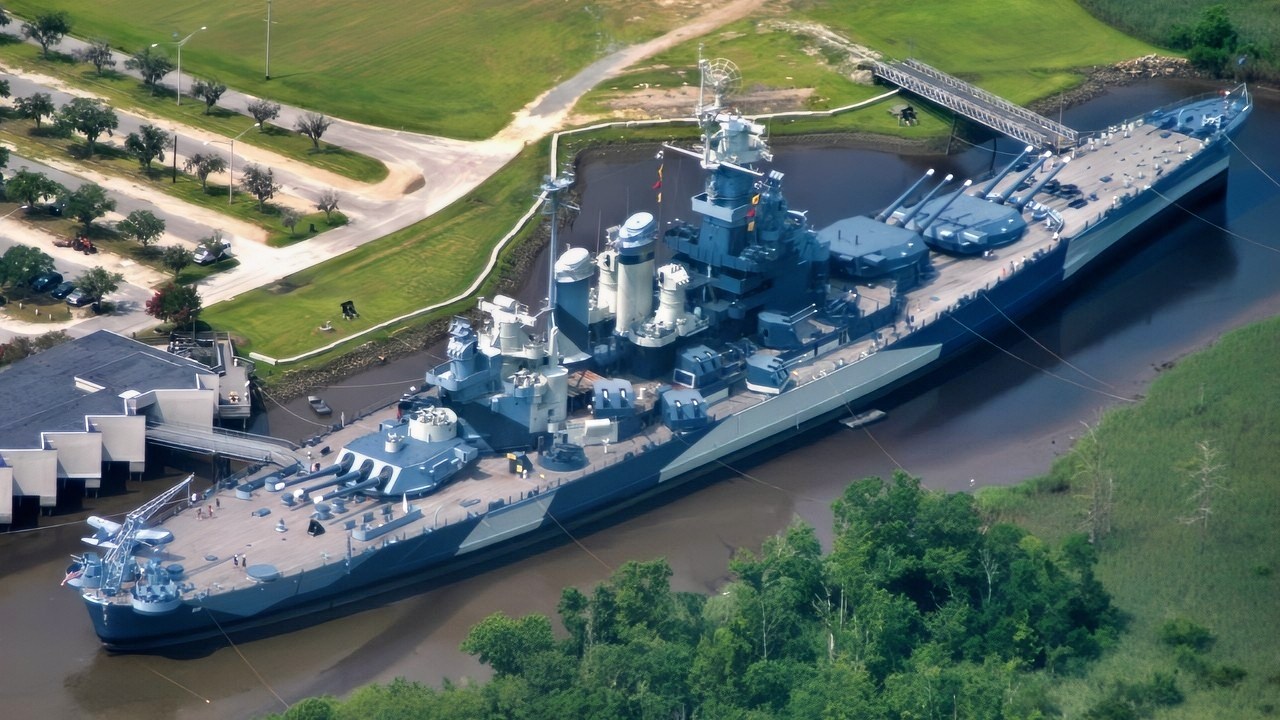
USS North Carolina Battleship. Image Credit: Creative Commons.
By the late 1930s, U.S. naval intelligence had reason to believe Japan was building something far larger and far more heavily armed than anything the Royal Navy or the U.S. Navy had on the slipway. The class would later be revealed as the Yamato — 72,000 tons full load, nine 18.1-inch guns, the largest battleship ever built. American intelligence about Yamato was incomplete at the time, but Pentagon planners assumed something massive was coming.
The Montana-class was the answer. The hull would be wider than the Panama Canal could accommodate because winning a Pacific gun duel mattered more than keeping a maintenance shortcut between the oceans. The armor would be heavy enough to absorb hits from her own guns because the assumed enemy would be throwing comparable weight back. The main battery would carry twelve barrels because the Yamatos and their projected follow-ons might carry nine 18-inch guns of their own.
That logic looked airtight in 1939 and 1940. It survived Pearl Harbor. It even survived the early months of the Pacific War.
It did not survive the Battle of Midway.
What Changed The Navy’s Mind
The Imperial Japanese Navy lost four fleet carriers at Midway in June 1942. The U.S. Navy lost one. Within weeks, anyone paying attention inside the Bureau of Ships and the Bureau of Ordnance understood that the war the Montana-class had been designed to fight — a fleet engagement of opposing battle lines — was not the war that was actually being fought.
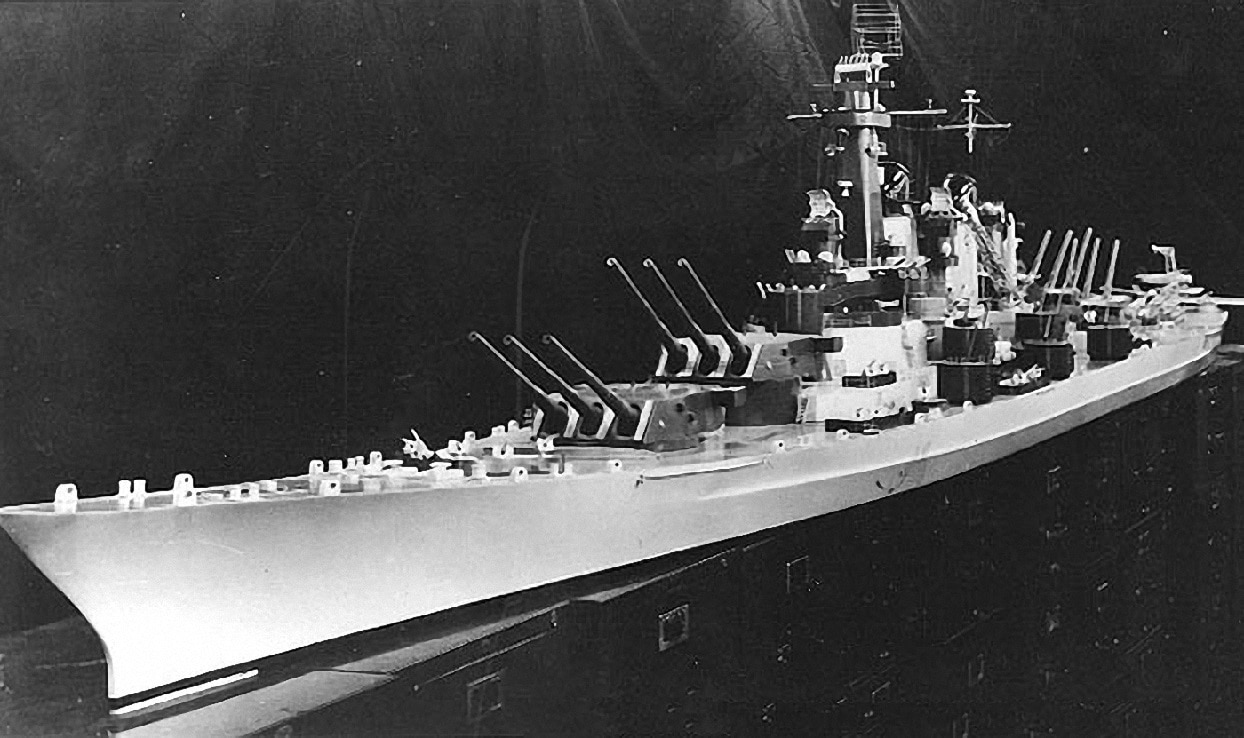
Montana-class Battleships. Image: Creative Commons.
The Battle of the Coral Sea the previous month had already pointed at the same conclusion. Aircraft carriers, not battleships, were now deciding fleet actions. Battleships in the Pacific were being relegated to two roles: anti-aircraft escort for the fast carriers, and shore bombardment in support of amphibious operations. The Iowa-class could perform both missions. Building five even larger battleships, optimized for a surface gunnery duel that was not happening, looked increasingly indefensible.
In May 1942 — just weeks before any keel could be laid — the Montana-class was suspended. The official reason was production priority. The yards needed to build aircraft carriers, destroyers, escort carriers, landing craft, and submarines. In October 1942, work was delayed again to free shipbuilding capacity for some eighty destroyers urgently needed for the Battle of the Atlantic.
By the summer of 1943, the calculation was no longer about delay. It was about cancellation.
The July 1943 Decision
On July 21, 1943, all five Montana-class battleships were officially canceled. No keel had ever been laid.
The order to cancel came not because the ships were technically unsound — they were arguably the best battleship design the United States ever produced on paper — but because the Navy had finally accepted what the previous fourteen months of carrier warfare had been saying.
The dominant capital ship of the war was the aircraft carrier. The Essex-class was rolling out of American yards faster than any warship class in history. The Iowas were sufficient for what battleships were now being asked to do. Five additional super-battleships, each costing as much as multiple Essex hulls and tying up yard capacity for years, made no defensible sense.

Montana-class drawing.
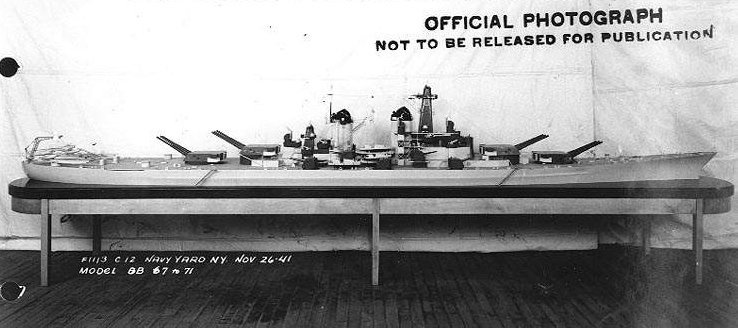
Montana-class model.
The design work was not entirely wasted. The propulsion arrangement developed for the Montana-class was adapted for the Midway-class aircraft carriers, which entered service late in the war. The 5-inch/54 caliber dual-purpose gun designed for the Montana secondary battery debuted in 1945 aboard those same Midways and remained in service across the U.S. carrier fleet for years. The torpedo defense lessons learned during Montana’s design work informed every postwar surface combatant the Navy built.
But Montana herself and her four sisters never floated.
The Last Battleship Class America Ever Designed
The Montana-class is the cleanest case study in modern U.S. naval history of an institution recognizing its own obsolescence in real time. The Navy did not cancel the class because the design failed. It canceled the class because the entire category of warship the design represented had been demoted mid-war by combat experience the Navy had not entirely anticipated.
After July 21, 1943, the United States Navy never designed another battleship, well, until recently, but we will leave that debate for another time. The four Iowa-class hulls already on the slipways became the last American battleships ever commissioned. Every surface combatant designed since — every cruiser, every destroyer, every Aegis ship, every Zumwalt — has accepted the proposition that the aircraft carrier is the capital ship and the surface fleet is built around it.
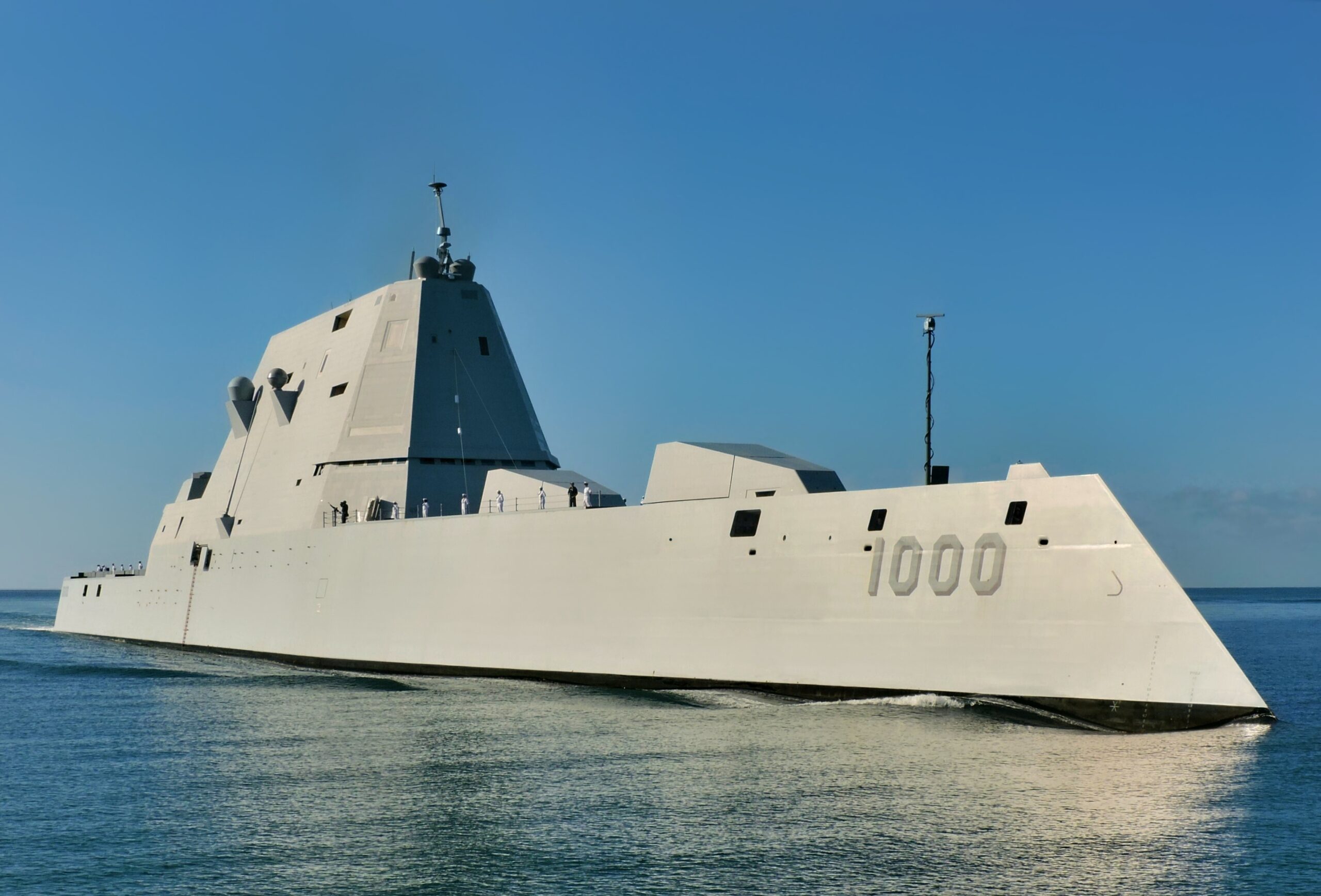
Zumwalt-Class Destroyer U.S. Navy. Image Credit: Creative Commons.
The five names assigned to BB-67 through BB-71 — Montana, Ohio, Maine, New Hampshire, Louisiana — are now historical curiosities. Subsequent ships have carried some of them. Submarines, mostly. The state of Montana remained, as the Navy itself sometimes joked, the child without a toy — the only state in the union without a namesake battleship.
The Montana-class is what happens when a service designs a weapon for the last war and then has the institutional discipline to recognize, before the steel is cut, that the next war will be different. The Navy got that call right in July 1943.
Whether the Pentagon is making comparable calls today, with comparable institutional discipline, about the platforms it is building for whatever comes after the carrier era — that is a different question, and a much harder one.
The five hulls of the Montana-class never sailed. As much as it breaks my heart to say, it was the right call.
About the Author: Harry J. Kazianis
Harry J. Kazianis (@Grecianformula) was the former Senior Director of National Security Affairs at the Center for the National Interest (CFTNI), a foreign policy think tank founded by Richard Nixon based in Washington, DC. Harry has over a decade of experience in think tanks and national security publishing. His ideas have been published in the NY Times, The Washington Post, The Wall Street Journal, CNN, and many other outlets worldwide. He has held positions at CSIS, the Heritage Foundation, the University of Nottingham, and several other institutions related to national security research and studies. He is the former Executive Editor of the National Interest and the Diplomat. He holds a Master’s degree focusing on international affairs from Harvard University. Kazianis is Editor-In-Chief of 19FortyFive.