
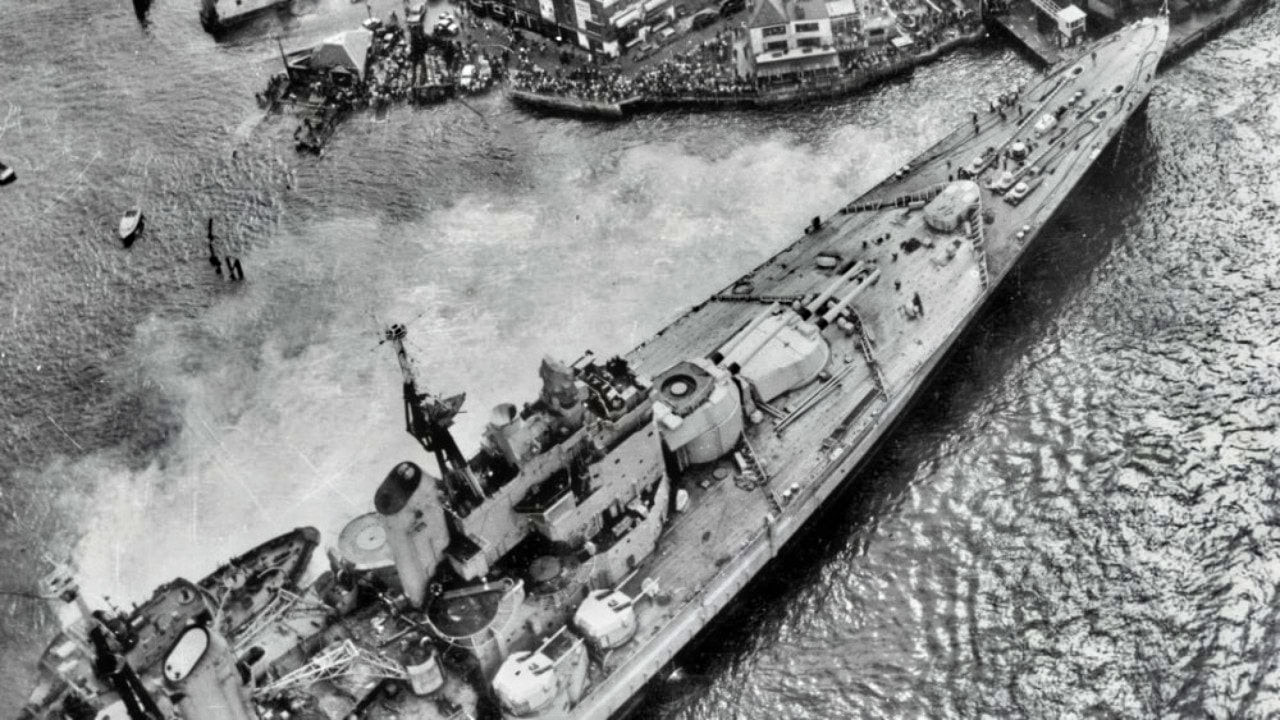
The British Royal Navy’s HMS Vanguard — the 814-foot, 30-knot, 51,000-ton fast battleship laid down at John Brown shipyard in Clydebank, Scotland on March 14, 1941, commissioned into Royal Navy service on August 9, 1946, and ultimately scrapped at Faslane, Scotland in early 1962 — was the last battleship ever constructed in human history.
HMS Vanguard, The Last Battleship Ever Built:
The Royal Navy built the British Empire. The small island nation ruled the seas for hundreds of years, thanks to a robust shipbuilding industry, outstanding leadership, and sailing expertise.
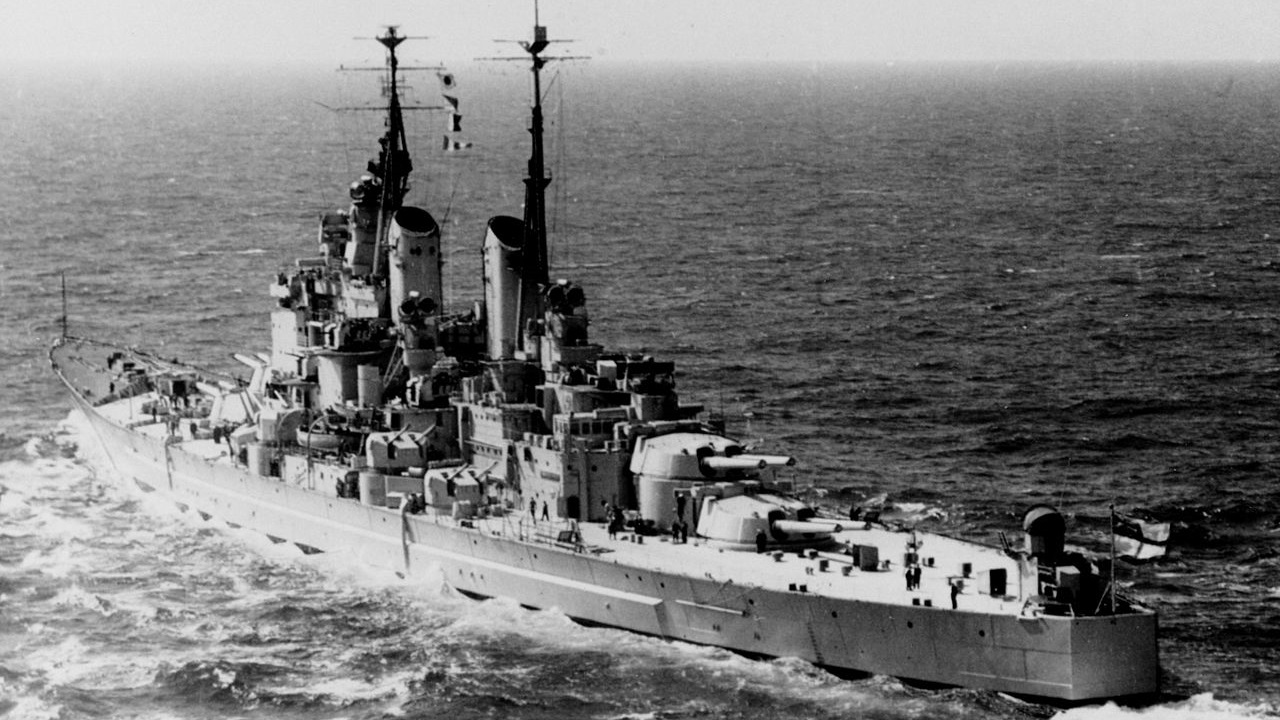
Stern quarter view of the Royal Navy battleship HMS Vanguard (23).
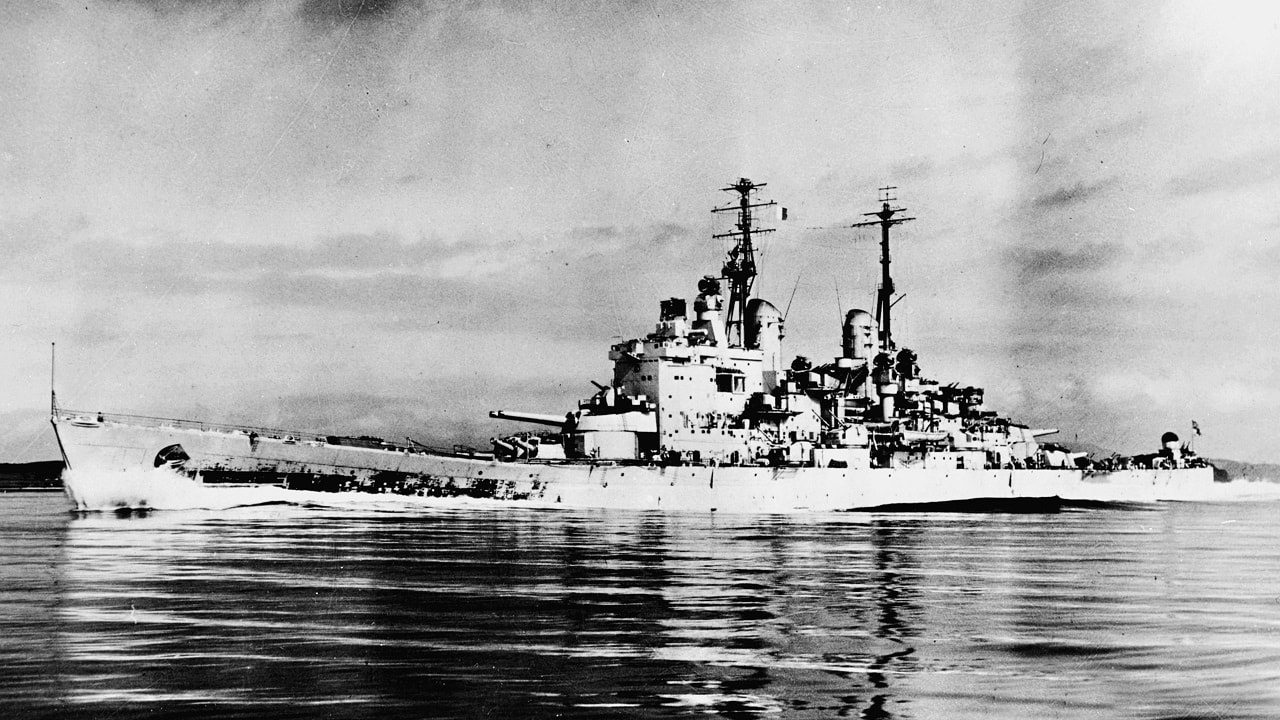
The Royal Navy battleship HMS Vanguard (23) steaming at high speed while running trials in 1946.
Launched in 1906, the HMS Dreadnought battleship revolutionized naval warfare by introducing an “all-big-gun” armament and steam turbine propulsion, making all previous battleships instantly obsolete.
Designed by Admiral Sir John “Jacky” Fisher, this heavily armored 18,000-ton vessel could outrun and outgun any contemporary, establishing British maritime supremacy and sparking a major arms race with Germany
However, the economy has struggled since World War II, and the Royal Navy’s numbers and prestige have dwindled. Since 2000, the number of European and NATO destroyers and frigates has shrunk by 32 percent, and submarine fleets have fallen by 28 percent.
The Royal Navy Is A Shadow Of Its Former Self
As of April of 2026, the Royal Navy can field just 15 major surface combatants and 10 nuclear-powered submarines (4 ballistic missile submarines and 6 attack submarines).
It consists of seven Type 23 frigates, eight River-class offshore patrol vessels, six Type 45 destroyers, six Astute-class attack submarines, four Vanguard-class nuclear-armed submarines, two aircraft carriers, the HMS Queen Elizabeth and HMS Prince of Wales, and two amphibious assault ships, which could double as light aircraft carriers in an emergency.
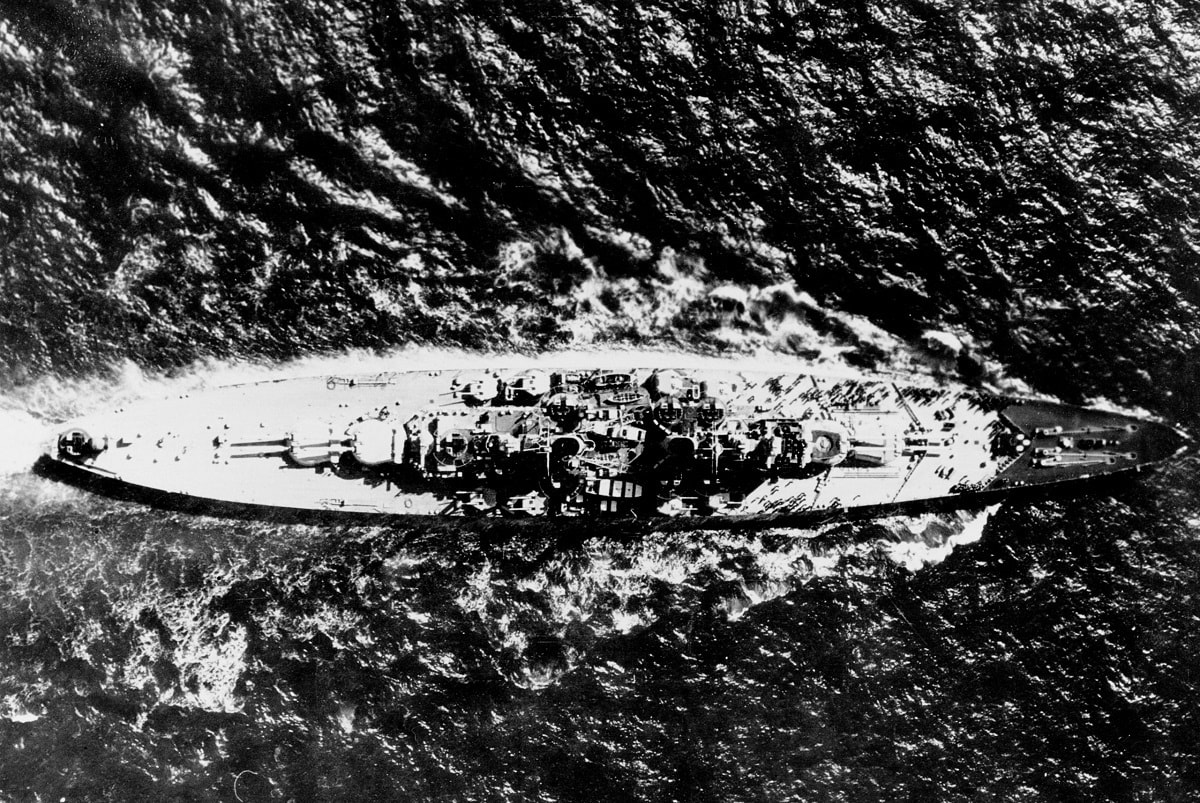
Overhead view of the Royal Navy battleship HMS Vanguard (23) underway.
It is a sad state of affairs for an island nation that once ruled the seas with the power of its navy, including its powerful dreadnoughts.
The last of her dreadnoughts, HMS Vanguard, was the best of them.
Royal Navy Battleship HMS Vanguard Was A Powerful Ship
HMS Vanguard was a British fast battleship built during World War II, and wasn’t commissioned until after the war ended. She was the largest and fastest of the Royal Navy’s battleships, and the only ship of her class. Vanguard was the last battleship in history to be built.
HMS Vanguard measured 814 feet in length and was capable of 30 knots. She was heavily armed with 97 guns, including 4 twin 15-inch main guns. It served until 1960, when it was decommissioned and scrapped.
Designed as an improved King George V, she was laid down in 1941 and was equipped with massive 15-inch guns, heavy armor, powerful engines, and an impressive array of anti-aircraft batteries, including 73 40mm Bofors mounts and 16 5.25-inch dual-purpose guns.
But it was not cheap. HMS Vanguard cost approximately $800 million to build today.
British Lion-Class Battleships Were Supposed To Be Britain’s Defense:
In 1940, at the outset of World War II, the British expected that their Royal Navy would be outnumbered by German and Japanese warships. They designed the Lion-class of battleships with turrets for three 16-inch guns, but work on these was slowed, and it was learned that they wouldn’t be completed until at least 1943.
The Royal Navy had plenty of 15-inch (381 mm) guns and turrets in storage to allow one ship of a modified Lion-class design with four twin-15-inch turrets to be completed faster than the Lion-class vessels that had already been laid down.
HMS Vanguard was laid down on March 14, 1941, but work on her began and stopped several times as her design evolved in response to lessons learned during the war.
The construction of HMS Vanguard was also slowed during the war because the Royal Navy prioritized the construction of smaller anti-submarine escort vessels, aircraft carriers, and urgent repairs to existing ships over the completion of new battleships.
With the urgent demands of the Battle of the Atlantic, Vanguard’s construction was repeatedly paused as resources and labor were diverted to higher-priority projects.
Lack Of Effective Anti-Aircraft Fire Doomed HMS Prince Of Wales
One lesson in point was the sinking of the HMS Prince of Wales and HMS Repulse, which were destroyed and sunk by the Japanese aircraft. Operating without any air cover, which was supposed to be overhead from Singapore, the two British warships were sunk just days after Pearl Harbor.
British design teams and engineers determined that the anti-aircraft weapons onboard the Prince of Wales were ineffective against Japanese fighters and bombers.
Because of the slowed construction, HMS Vanguard was not commissioned before the end of the war and never saw combat.
However, HMS Vanguard’s Anti-Aircraft Arsenal Was Huge:
As mentioned above, the British had learned their lesson after the sinking of the pride of the Royal Navy, the HMS Prince of Wales and HMS Repulse.
All 20mm anti-aircraft mounts were replaced with the outstanding Bofors 40mm guns, equipped with an advanced anti-aircraft suite designed for Pacific War threats.
She carried 73 Bofors 40mm guns (ten sextuple, one twin, 11 single mounts) for close-range defense, supported by sixteen 5.25-inch (133mm) guns in eight twin turret mounts. These were dual-purpose, capable of surface or high-angle fire against aircraft, with fully remote power control.
Powerful Engines Pushed The Battleship To 30 Knots
HMS Vanguard had four sets of single-reduction geared Parsons steam turbines, each housed in a separate engine room.
Each set consisted of one high-pressure and one low-pressure turbine, driving a five-bladed propeller 14 feet 9 inches (4.5 m) in diameter. The turbines were powered by eight Admiralty 3-drum boilers in four boiler rooms at a working pressure of 350 psi (2,413 kPa; 25 kgf/cm2) and temperature of 700 °F (371 °C).
The engines were designed to produce a total of 130,000 shaft horsepower (97,000 kW) and to operate at 30 knots (35 mph). However, during her sea trial in July 1946, the ship achieved more than 136,000 shp (101,000 kW) at 31.57 knots (36.33 mph).
She carried 4,850 long tons of fuel oil and 427 long tons of diesel. The ship had a range of 8,250 nautical miles at 15 knots.
HMS Vanguard’s Armor Protection
The ship featured advanced armor protection based on the King George V-class, optimized for lessons learned during WWII. Her main belt was 14 inches (356mm) thick abreast the magazines, with deck armor up to 6 inches (152mm) and 13-inch (330mm) turret faces.
She featured superior underwater protection against torpedoes, with a “liquid sandwich” system designed to absorb 1,000lb TNT explosions.
However, unlike the Germans and Americans, the British no longer believed that heavy armor for the conning tower served any real purpose, given the very small chance of hitting it.
HMS Vanguard’s conning tower was therefore protected with only 3 inches (76 mm) of armor on the face and 2.5 inches on the sides and rear. The secondary conning tower aft had 2 inches (51 mm) of armor on its sides.
HMS Vanguard Never Saw Combat
Because she was not commissioned until 1946, she never fired her guns in anger. During the Cold War that ensued, the battleship wasn’t known for its anti-submarine capabilities, and the Royal Navy was concerned that Russian torpedoes would be a problem despite its heavy armor. It did, however, serve during NATO operations during the Cold War.
The Royal Navy used her as a training ship and then placed her in the Reserve Fleet in 1955. Just prior to her retirement in 1960, HMS Vanguard was used in the film “Sink The Bismarck!”
She was used to depict the interiors of bridges, Admiral’s Quarters, and gun turrets on Hood, Bismarck, and King George V. She was decommissioned and sold for scrap. HMS Vanguard was then towed to Faslane, Scotland, and her demolition process was completed in early 1962.
It was the last battleship of the Royal Navy to be scrapped.
About the Author: Steve Balestrieri
Steve Balestrieri is a National Security Columnist. He served as a US Army Special Forces NCO and Warrant Officer. In addition to writing on defense, he covers the NFL for PatsFans.com and is a member of the Pro Football Writers of America (PFWA). His work has been regularly featured in many military publications.