
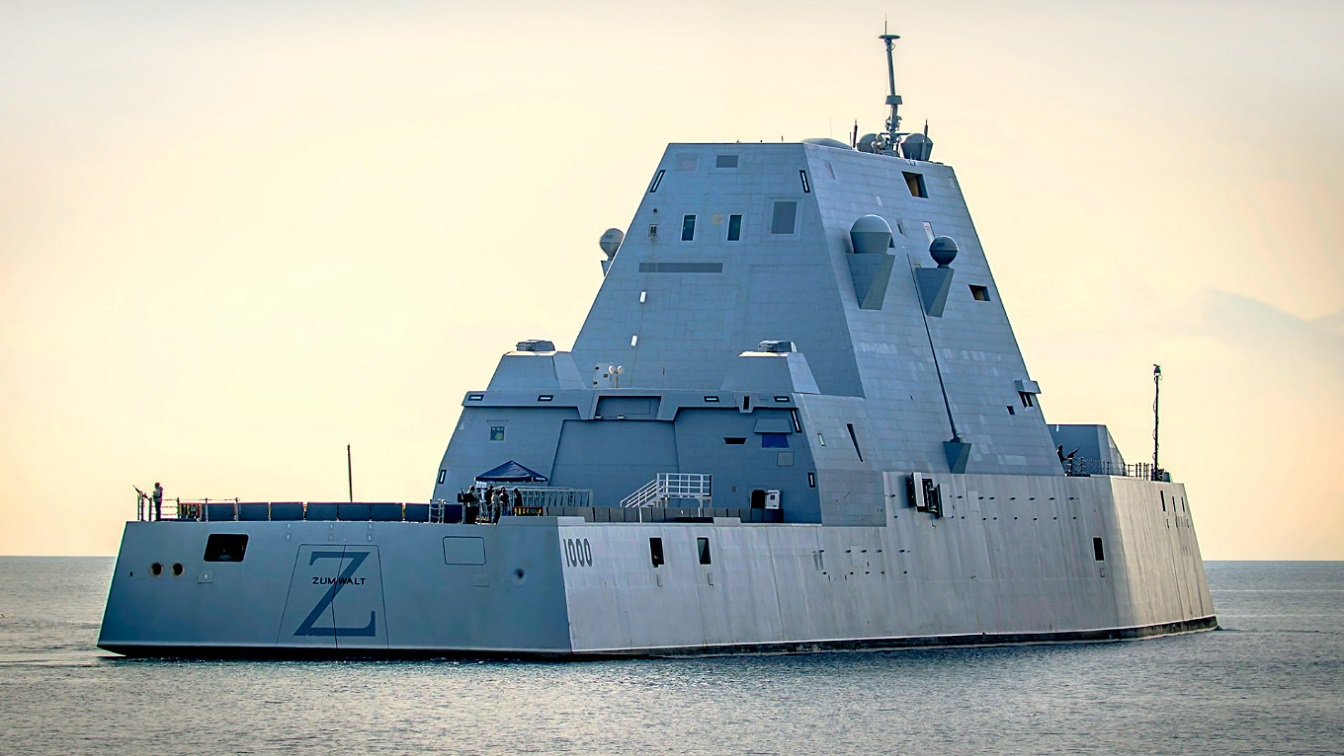
The Zumwalt-Class was supposed to be the future of the surface fleet. The Navy planned to build 32. It got three. Naval officials get red in the face when I ask them about the Zumwalt-class. As one U.S. Navy officer told me last week, the program “was a trainwreck from the start and never should have been funded. Was it a waste of taxpayer money? You bet it was.”
And the Trump-class battleship might make the same mistakes if we are not careful.
The Zumwalt-Class: The Stealth Destroyer Failure
There is a particular kind of program failure that should haunt the United States Navy more than it does.
Not the failures where the design was wrong from the start, where the requirements were never coherent, where the contractors were never up to the task. Those failures are easy to learn from.
The hardest failures are those in which the strategic requirement was real — the Navy genuinely needed the capability the program was built to deliver — yet the program nevertheless collapsed under its own ambition, leaving the requirement unmet and institutional confidence to try again significantly diminished.
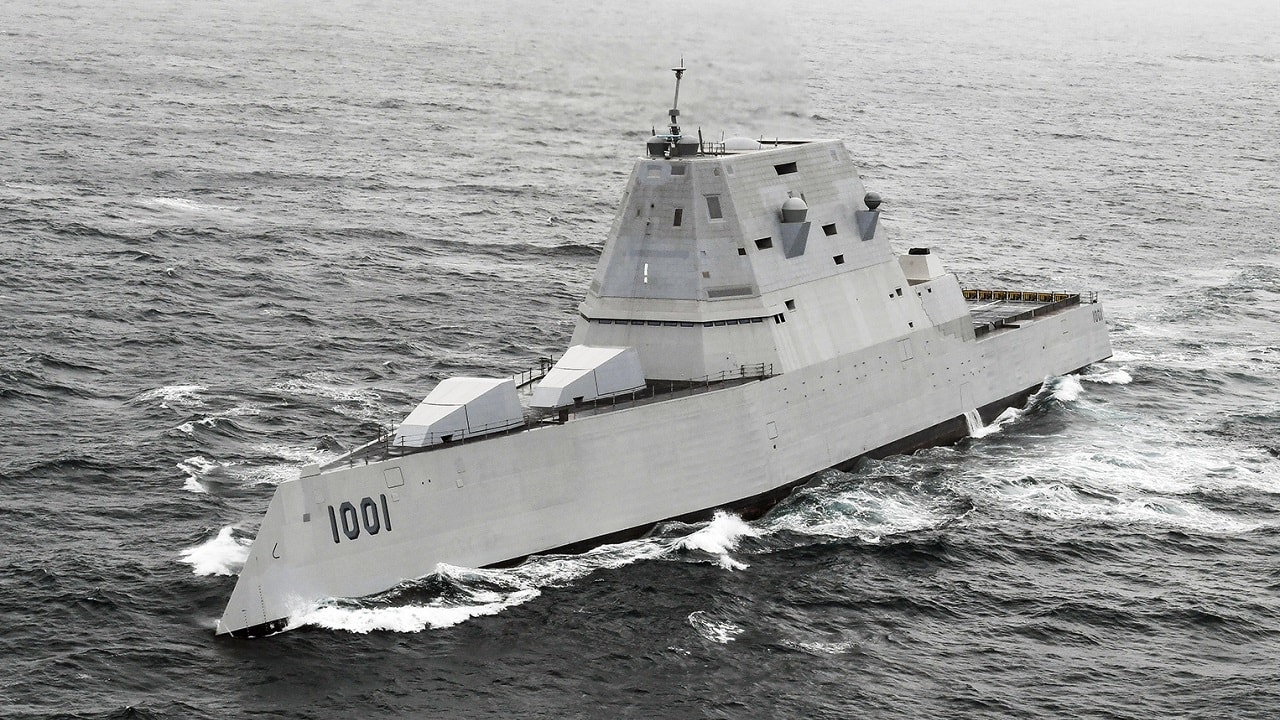
210421-N-FC670-1062 PACIFIC OCEAN (April 21, 2021) Zumwalt-class guided-missile destroyer USS Michael Monsoor (DDG 1001) participates in U.S. Pacific Fleet’s Unmanned Systems Integrated Battle Problem (UxS IBP) 21, April 21. UxS IBP 21 integrates manned and unmanned capabilities into challenging operational scenarios to generate warfighting advantages. (U.S. Navy photo by Chief Mass Communication Specialist Shannon Renfroe)
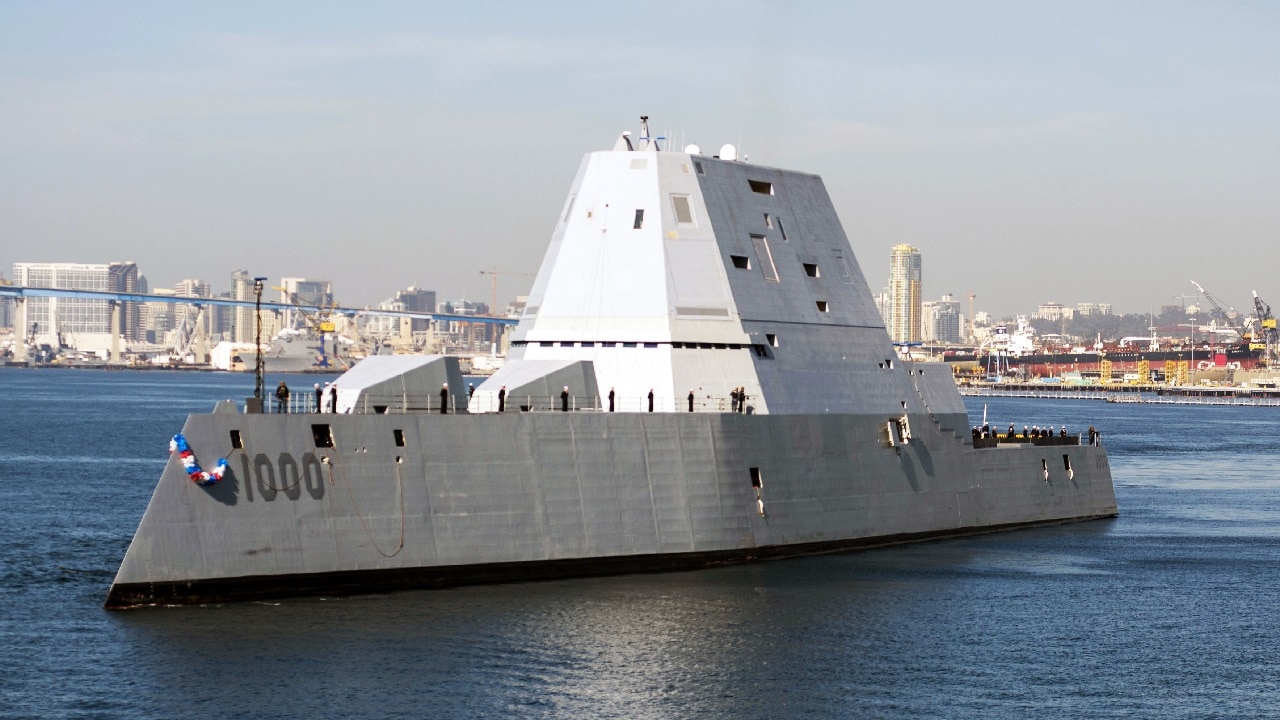
SAN DIEGO (Dec. 8, 2016) The guided-missile destroyer USS Zumwalt (DDG 1000) arrives at its new homeport in San Diego. Zumwalt, the Navy’s most technologically advanced surface ship, will now begin installation of combat systems, testing and evaluation and operation integration with the fleet. (U.S. Navy photo by Petty Officer 3rd Class Emiline L. M. Senn/Released)
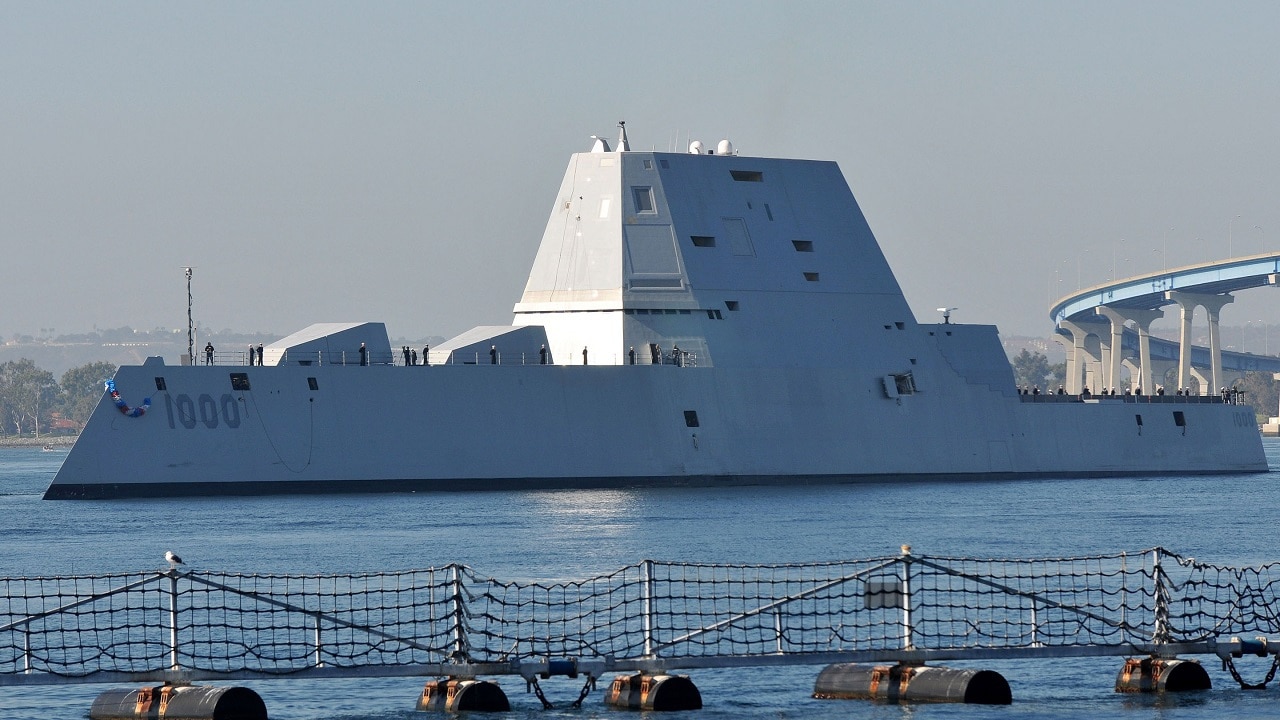
161208-N-ZF498-130 .SAN DIEGO (Dec. 8, 2016) The U.S. Navy’s newest warship, USS Zumwalt (DDG 1000) passes Coronado bridge on its way to Naval Base San Diego. Zumwalt is the lead ship of a class of next-generation multi-mission destroyers, now homeported in San Diego. (U.S. Navy photo by Petty Officer 3rd Class Anthony N. Hilkowski/Released)
The Zumwalt-class destroyer is that kind of failure.
And the Trump-class battleship that President Donald Trump announced on December 22, 2025, at his Mar-a-Lago resort is — whatever else it is — the United States Navy’s second attempt at solving the strategic problem the Zumwalt-class was killed for failing to solve.
Here is what the Navy wanted the first time. Here is what went wrong. And here is what the second attempt would have to get right to actually deliver.
What The Zumwalt-Class Was Supposed To Be
The Zumwalt-class began in the late 1990s as the SC-21 program and, by the early 2000s, had evolved into the DDG(X) — later DDG-1000 — destroyer of the future. The original requirement was straightforward: the Navy was phasing out its last battleships (USS Missouri decommissioned in 1992) and needed a successor capable of providing sustained naval surface fire support to Marine landings and littoral operations.
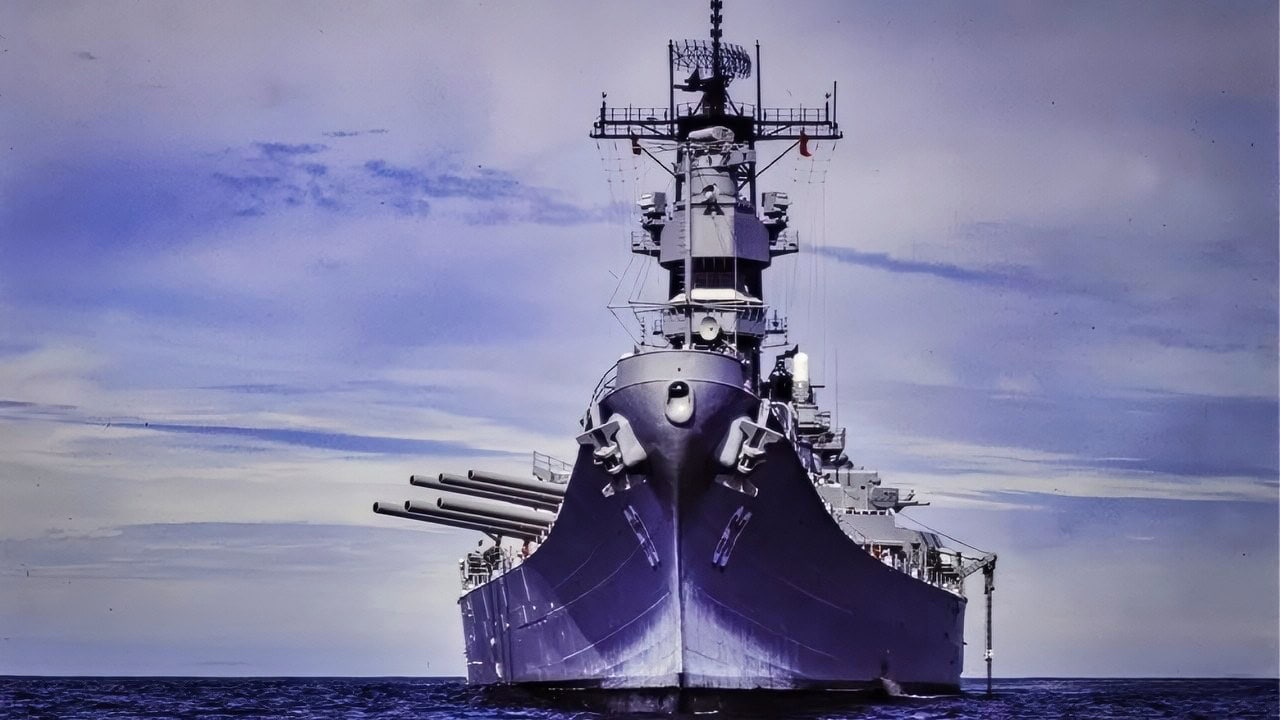
USS Missouri Navy Battleship. Image Credit: Creative Commons.
The previous solution — Iowa-class 16-inch guns reactivated in the 1980s — was no longer viable on aging hulls.
What the Navy actually built was something far more ambitious.
The Zumwalt was supposed to integrate, in a single hull, every next-generation technology then conceivable: a stealth tumblehome hull with a radar cross-section closer to a fishing boat than a destroyer, two 155mm Advanced Gun Systems firing GPS-guided Long-Range Land Attack Projectiles out to 83 nautical miles, 80 cells of Mk 57 Vertical Launch System for missiles, integrated power generation capable of supporting future railgun and laser weapons, and sufficient automation to crew the ship with 95 sailors instead of the 300 a comparable Arleigh Burke required.
The original program plan called for 32 hulls.
Per-ship cost was estimated at roughly $1.4 billion.
The Zumwalt-class was supposed to be the backbone of the surface combatant fleet through the 2030s and beyond.
And, just like anything with the U.S. Navy these days when it comes to shipbuilding, it seems like none of the plan actually came to fruition.
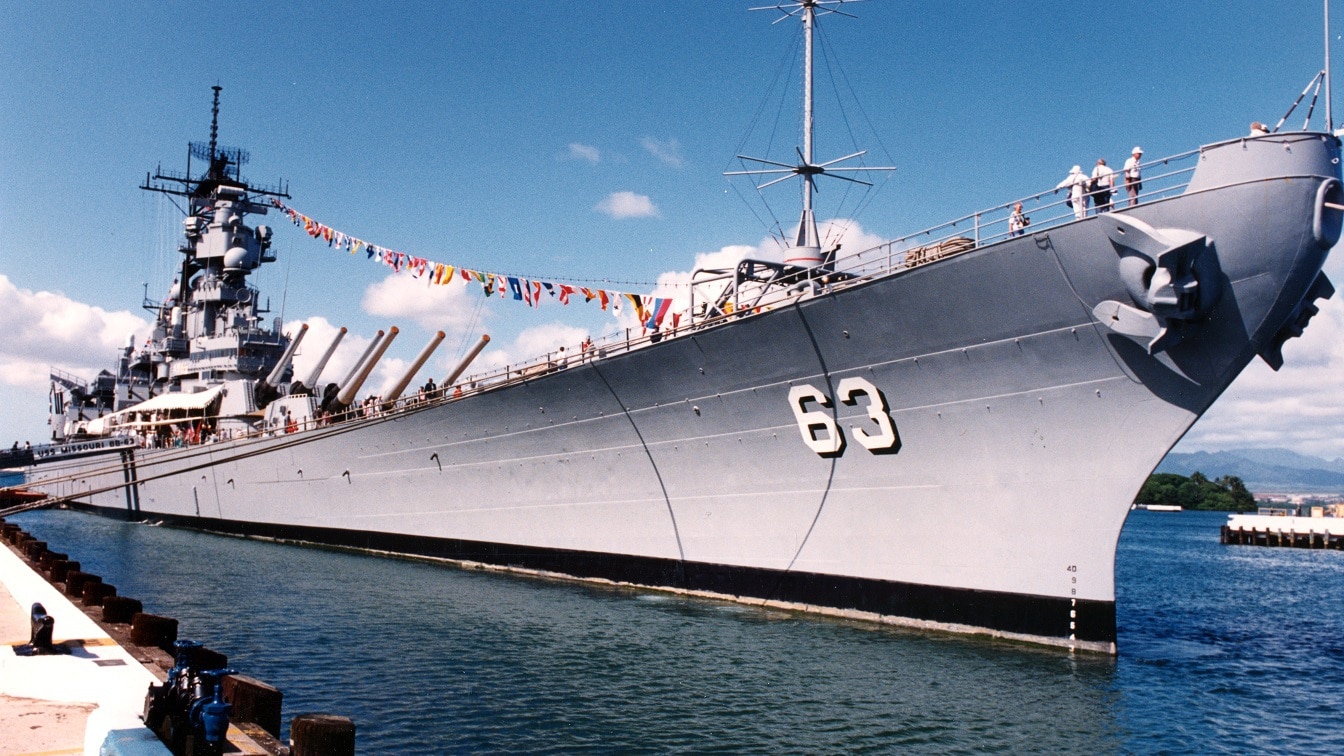
The battleship USS Missouri (BB-63) stands moored to a pier at Naval Station Pearl Harbor, Hawaii. Missouri is in Hawaii to take part in the observance of the 50th anniversary of the Japanese attack on Pearl Harbor.
What Actually Happened
The procurement record is brutal. Cost growth wiped out the case for serial production almost immediately.
By January 2009, internal Pentagon documents showed the per-ship price had reached roughly $5.96 billion, an 81 percent increase over the original Navy estimate.
That breach triggered the Nunn-McCurdy Amendment, requiring the Navy to either re-justify the program to Congress or kill it. Defense Secretary Robert Gates announced in April that the Department of Defense’s proposed 2010 budget would cap the program at three ships.
The institutional history of those decisions is now part of the public record carried in current Naval News reporting on the Trump administration’s new battleship plan, which traces the Zumwalt program’s collapse as the immediate predecessor to the current Trump-class proposal.
The technical record was worse than the cost record.
The Advanced Gun System — the Zumwalt’s signature weapon, the entire reason for the ship’s gunfire support mission — was rendered useless when the cost of a single LRLAP shell ballooned to roughly $800,000 to $1 million, comparable to a Tomahawk cruise missile. The Navy canceled LRLAP procurement, leaving the Zumwalt’s 155mm guns without ammunition they could actually fire. The AGS was incompatible with standard naval ammunition. The two main guns aboard each Zumwalt became, in operational terms, ballast.
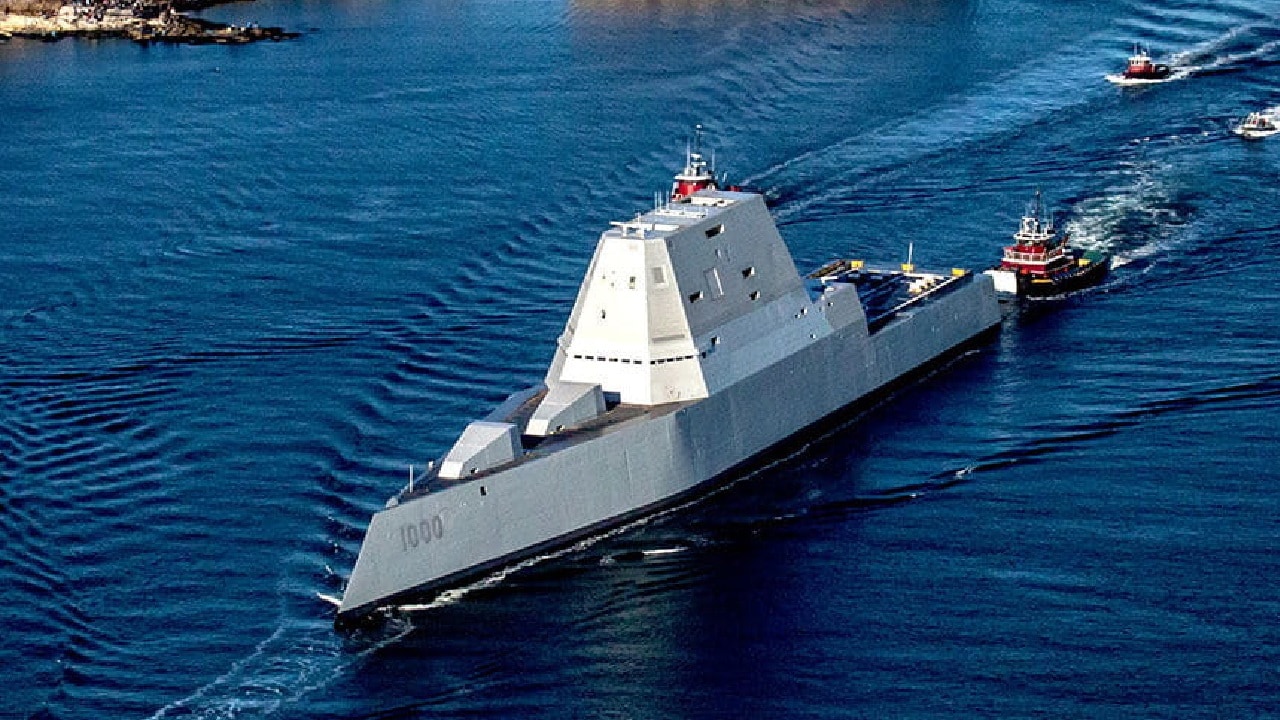
Zumwalt-class destroyer. Image Credit: Raytheon.
USS Zumwalt (DDG-1000) was commissioned in 2016 and broke down in the Panama Canal shortly afterward, in an incident that became emblematic of the program’s reliability problems. USS Michael Monsoor (DDG-1001) failed during sea trials in 2017. USS Lyndon B. Johnson (DDG-1002), the third and final hull, took years to commission.
The total program cost across three ships ranged from $22.5 to $24.5 billion, or $7.5 to $8 billion per ship — meaning the Zumwalt’s per-hull cost approached that of a Nimitz-class aircraft carrier on a vastly smaller, far less capable platform. As of March 2025, with new Conventional Prompt Strike hypersonic missile integration costs added, the per-ship figure has been revised upward to approximately $9.5 billion each.
The three Zumwalts are now being refit as hypersonic strike platforms. The two 155mm guns aboard USS Zumwalt have been removed and replaced with 12 launch tubes for Conventional Prompt Strike missiles. The original surface fire support mission has been formally abandoned. The ships are searching, in the apt phrase from defense critic Sébastien Roblin, for a mission they were not built to perform.
What the Zumwalt was supposed to deliver — a heavily armed, stealthy, large surface combatant capable of sustained ordnance delivery against shore targets while integrating future directed-energy and electromagnetic weapons — was the strategic requirement.

151207-N-ZZ999-435.ATLANTIC OCEAN (Dec. 7, 2015) The future USS Zumwalt (DDG 1000) is underway for the first time conducting at-sea tests and trials in the Atlantic Ocean Dec. 7, 2015. The multimission ship will provide independent forward presence and deterrence, support special operations forces, and operate as an integral part of joint and combined expeditionary forces. (U.S. Navy photo courtesy of General Dynamics Bath Iron Works/Released)
The Navy did not get it. The requirement did not go away.
What Trump Announced In December 2025
On December 22, 2025, at Mar-a-Lago, President Trump stood next to a rendering of a warship and announced the Trump-class battleship — designated BBG(X) in some Navy planning documents, with the lead ship to be named USS Defiant (BBG-1).
The official Navy announcement described the class as a 30,000 to 40,000-ton large surface combatant — roughly the same physical size as the Iowa-class, though at substantially less displacement. The official Navy Department release described the class as “American-designed, 30,000 to 40,000-ton large surface combatants, or battleships” intended to “meet the realities of modern maritime conflict.”
The renderings released by Naval News from the announcement showed a hull that, in technical terms, is far closer to a Russian Kirov-class nuclear-powered battlecruiser than to anything the U.S. Navy has built since 1944. The lead ship is depicted with SPY-6 radar arrays, at least 100 VLS cells, two Mark 45 5-inch deck guns forward, larger-diameter VLS tubes for Conventional Prompt Strike hypersonic weapons, an apparent railgun installation forward, and directed-energy weapons capable of engaging incoming threats at megawatt-class power levels.
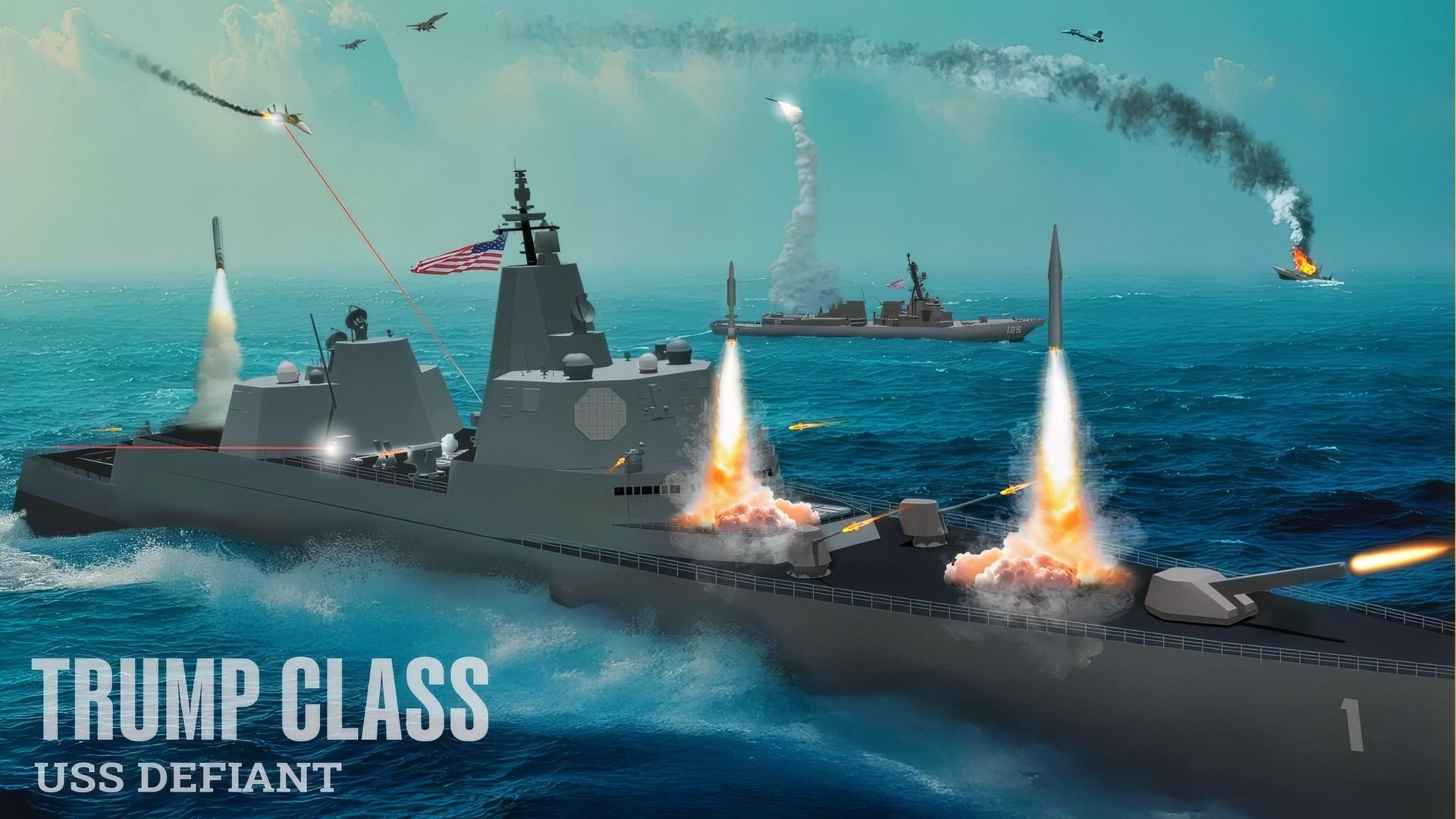
Trump-Class Battleship USS Defiant. Image Credit: Creative Commons.
The advertised mission set is comprehensive. Nuclear-capable sea-launched cruise missiles. Hypersonic strike weapons. Electromagnetic railguns. Megawatt-class lasers. Crew complement is projected at 650 to 850 sailors — much smaller than an Iowa-class crew but well above the Zumwalt’s automation target.
The procurement plan, as articulated by Navy Secretary John Phelan during the announcement, begins with two ships, scales to ten, with eventual ambitions of “between 20 and 25” hulls as part of what the administration is calling the “Golden Fleet.”
Phelan’s framing of the lead ship is the part of the announcement that matters. “The Iowa-class was designed to go on the attack with the biggest guns,” Phelan said at the announcement. “Today, the USS Defiant will reach out and kill the archers. Defiant has the size and the capacity to serve fleet commanders, and this new battleship will command everything from warships to drones, and everything in between.”
That is not a description of a battleship in the traditional sense. That is a description of the ship the Zumwalt was supposed to be.
How The Trump-Class Could Make Good On What The Zumwalt Was Supposed To Deliver
The strategic logic that produced the Zumwalt-class in the early 2000s has not gone away. The U.S. Navy still needs a large surface combatant capable of carrying meaningful numbers of vertical launch cells, integrating directed-energy weapons that require dramatic increases in onboard power generation, hosting hypersonic strike weapons that demand larger-diameter VLS tubes than the Mk 41 currently provides, and serving as a command-and-control platform for distributed maritime operations, including unmanned surface and undersea vehicles.
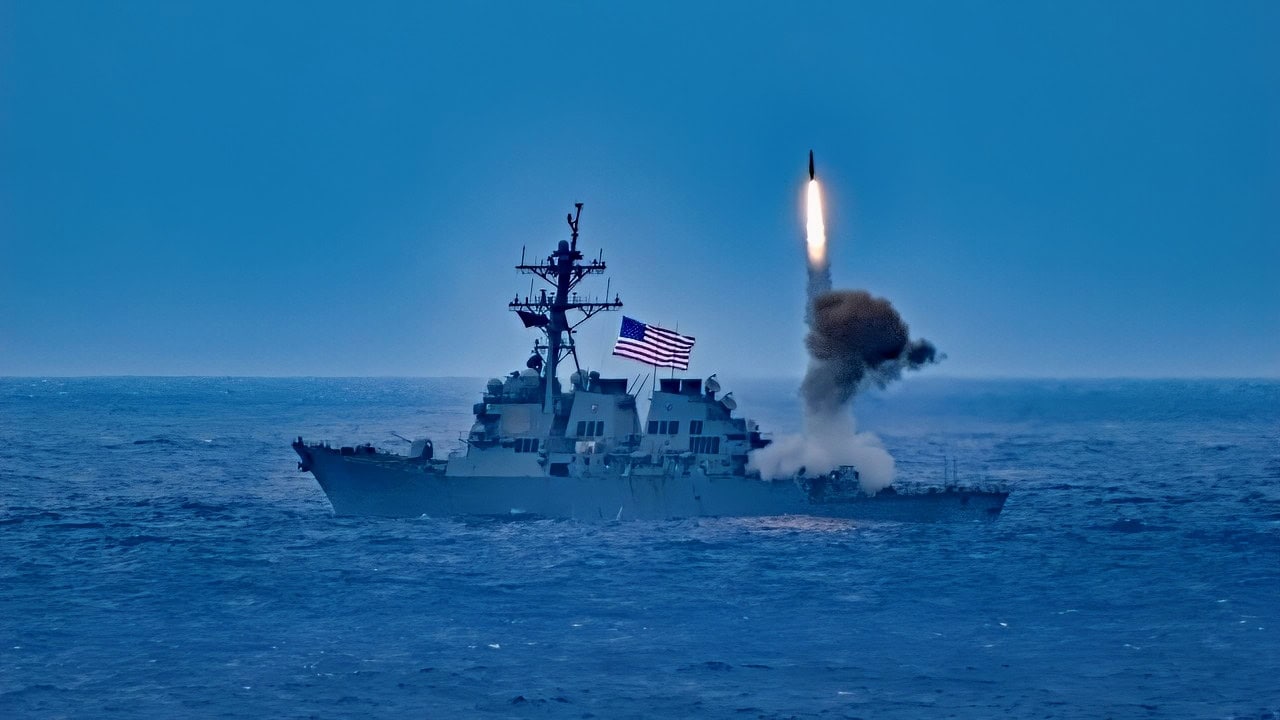
(March 24, 2022) – The Arleigh Burke-class guided-missile destroyer USS Milius (DDG 69) launches a Standard Missile (SM) 2 during Surface Warfare Advanced Tactical Training while operating in the Philippine Sea, March 24, 2022. Milius is assigned to Commander, Task Force 71/Destroyer Squadron (DESRON) 15, the Navy’s largest forward-deployed DESRON and the U.S. 7th Fleet’s principal surface force. (Courtesy photo)
The Arleigh Burke Flight III, as confirmed in January 2026 by Vice Admiral Brendan McLane, can no longer accommodate new systems. The DDG(X) program, which was supposed to replace the Ticonderoga-class cruisers and the older Arleigh Burke flights, ran into the same fundamental problem the Zumwalt did — Rear Admiral Derek Trinque revealed in January 2026 that the DDG(X) hull lacked capacity for both the desired number of Conventional Prompt Strike VLS cells and a deck gun. The Navy’s response was to scale up to a larger hull. The Trump-class is, in effect, that scaled-up version.
If the Trump-class actually delivers, here is what it would do that the Zumwalt did not:
Larger hull, more missile cells. The Zumwalt’s 80 Mk 57 VLS cells, while useful, were constrained by hull volume. The Trump-class renderings show at least 100 VLS cells with substantial space allocated for larger-diameter hypersonic tubes. A 35,000-ton hull provides physical volume for missiles the Zumwalt could not carry.
Power generation for directed-energy weapons. The Zumwalt’s integrated electric drive and 78 megawatts of generating capacity were supposed to enable future railguns and lasers. The technology was not ready. By 2026, megawatt-class lasers and modernized railgun designs from General Atomics are far closer to operational maturity than the previous generation. A Trump-class hull built around current power-and-cooling architecture could integrate directed-energy weapons, as the Zumwalt was promised but never received.
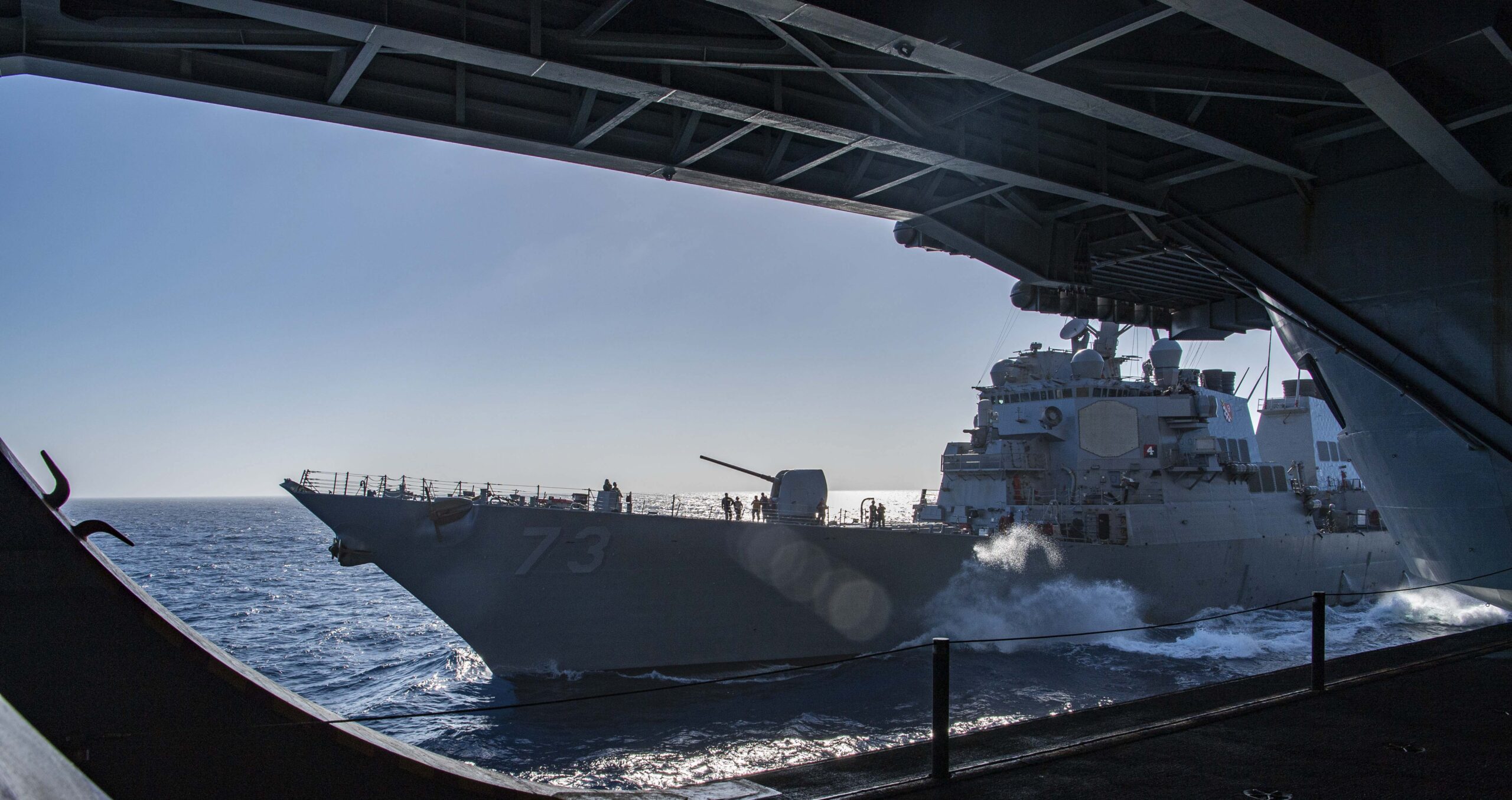
(Aug. 28, 2023) The Arleigh Burke-class guided-missile destroyer USS Decatur (DDG 73) steams alongside the aircraft carrier USS Nimitz (CVN 68) . Nimitz is underway conducting routine operations. (U.S. Navy photo by Mass Communication Specialist Seaman Tomas Valdes)
Hypersonic strike capacity at scale. The current Conventional Prompt Strike refit of the Zumwalt-class adds 12 hypersonic tubes per ship. A Trump-class hull built from the keel up around CPS could carry significantly more, addressing a core gap in the U.S. surface fleet’s strike capacity that has been growing more strategically important as China and Russia field their own hypersonic weapons.
A clearer mission than the Zumwalt ever had. The Zumwalt was a ship in search of a mission. The Trump-class, as Phelan described it, is being pitched as a missile-archer counter—a platform optimized to engage the long-range anti-ship missile shooters that are the centerpiece of Chinese and Russian anti-access/area-denial strategy. That is a coherent mission set if the technology delivers.
The Reasons To Be Skeptical
The same reasons the Zumwalt failed apply to the Trump-class.
CNN’s analysis of the announcement noted that the Navy’s most recent major surface combatant program — the Constellation-class frigate — was canceled in November 2025 after running three years late and costing roughly $2 billion in obligated funds for two ships rather than the planned twenty.
The USS John F. Kennedy carrier is two years behind schedule. The Ford-class itself is under Phelan-ordered review for cost and capability concerns.
The submarine industrial base cannot deliver Virginia-class boats at the contracted rate of two per year.
Mark Cancian of the Center for Strategic and International Studies, quoted in CNN’s coverage, noted that the term “battleship” has historically referred to ships with large-caliber guns and heavy armor, neither of which the Trump-class would carry. Cancian’s preferred framing is that the design is closer to a guided-missile battlecruiser than a battleship.
The railgun, a key capability touted in the rendering, was canceled by the Navy in 2021 after technical challenges proved too difficult to overcome. General Atomics has pitched updated railgun designs since then, but a working operational railgun has yet to be fielded by any navy on Earth.
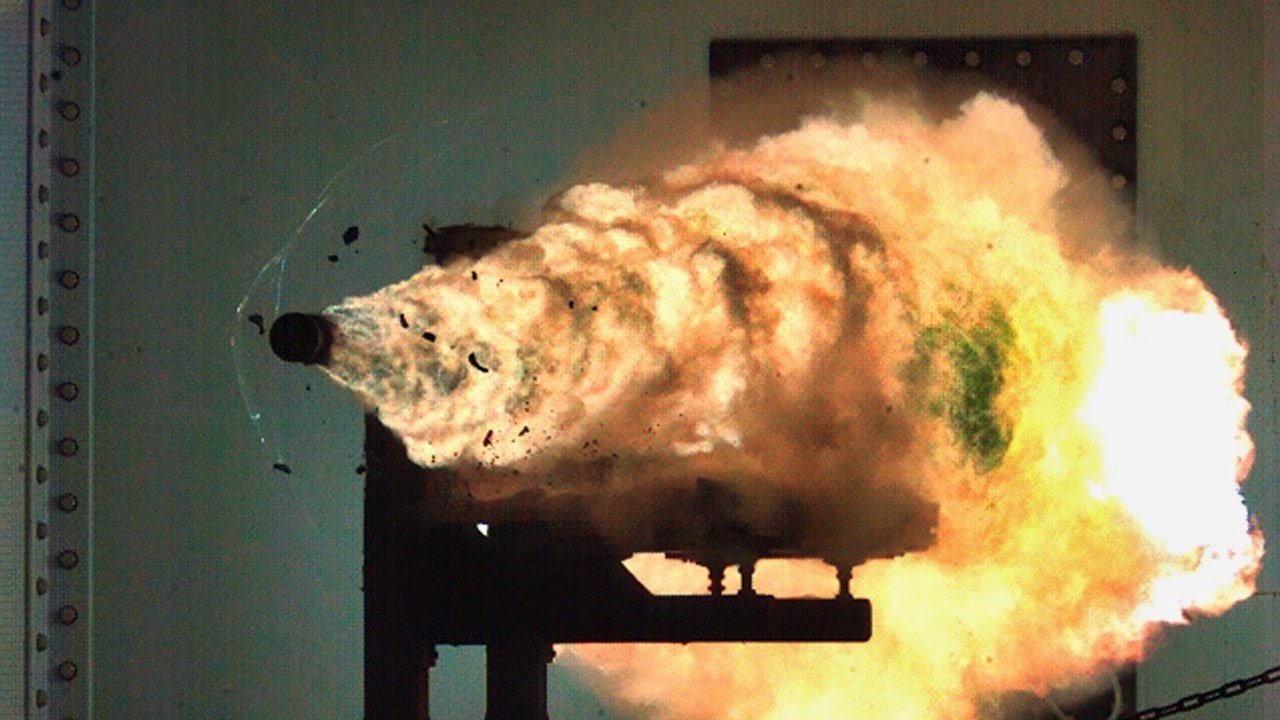
(Jan. 31, 2008) Photograph taken from a high-speed video camera during a record-setting firing of an electromagnetic railgun (EMRG) at Naval Surface Warfare Center, Dahlgren, Va., on January 31, 2008, firing at 10.64MJ (megajoules) with a muzzle velocity of 2520 meters per second. The Office of Naval Research’s EMRG program is part of the Department of the Navy’s Science and Technology investments, focused on developing new technologies to support Navy and Marine Corps war fighting needs. This photograph is a frame taken from a high-speed video camera. U.S. Navy Photograph (Released)
The shipyards that would build the Trump-class are not idle. The three U.S. yards capable of large surface combatant construction — Bath Iron Works, Ingalls Shipbuilding, and Newport News — are already at maximum tempo on aircraft carriers, Arleigh Burke destroyers, and submarine work. Hanwha Philly Shipyard, which the Trump administration has floated as a potential builder, has never built a defense vessel as of January 2026.
And the program’s funding has not been authorized. The Trump-class exists, as of April 2026, in the form of renderings and a presidential announcement. The first appropriation has not been made.
The Lesson That Has Not Been Learned
The Zumwalt-class failed because the Navy attempted to integrate too many immature technologies into a single hull simultaneously, accepted unrealistic cost estimates, scaled back the procurement run when costs ballooned, and ended up with a ship whose per-unit price was so high that the strategic mission could not be performed at an adequate scale.
The Trump-class is being pitched with substantially more advertised capability than the Zumwalt was ever supposed to carry. Larger hull. More missile cells. More directed-energy weapons. More technology integration. Higher per-unit complexity.
If the Navy and industry have learned the right lessons from the Zumwalt failure, the Trump-class could deliver what the Zumwalt was supposed to deliver — a large, missile-heavy, directed-energy-equipped surface combatant built at meaningful scale to anchor the surface fleet through the 2040s.
If the Navy and industry have not learned those lessons, the Trump-class will become a more expensive version of the same failure: a small number of impressive-looking ships, delivered late and over budget, searching for a mission that the strategic environment kept demanding while the program collapsed.
The first attempt got three hulls. The second attempt is being pitched to twenty- to twenty-five-year-olds.
Whether that pitch survives contact with the same procurement system that produced the Zumwalt is the question Congress will spend the next decade answering.
About the Author: Harry J. Kazianis
Harry J. Kazianis (@Grecianformula) was the former Senior Director of National Security Affairs at the Center for the National Interest (CFTNI), a foreign policy think tank founded by Richard Nixon based in Washington, DC. Harry has over a decade of experience in think tanks and national security publishing. His ideas have been published in the NY Times, The Washington Post, The Wall Street Journal, CNN, and many other outlets worldwide. He has held positions at CSIS, the Heritage Foundation, the University of Nottingham, and several other institutions related to national security research and studies. He is the former Executive Editor of the National Interest and the Diplomat. He holds a Master’s degree focusing on international affairs from Harvard University. Kazianis is Editor-In-Chief of 19FortyFive.

