
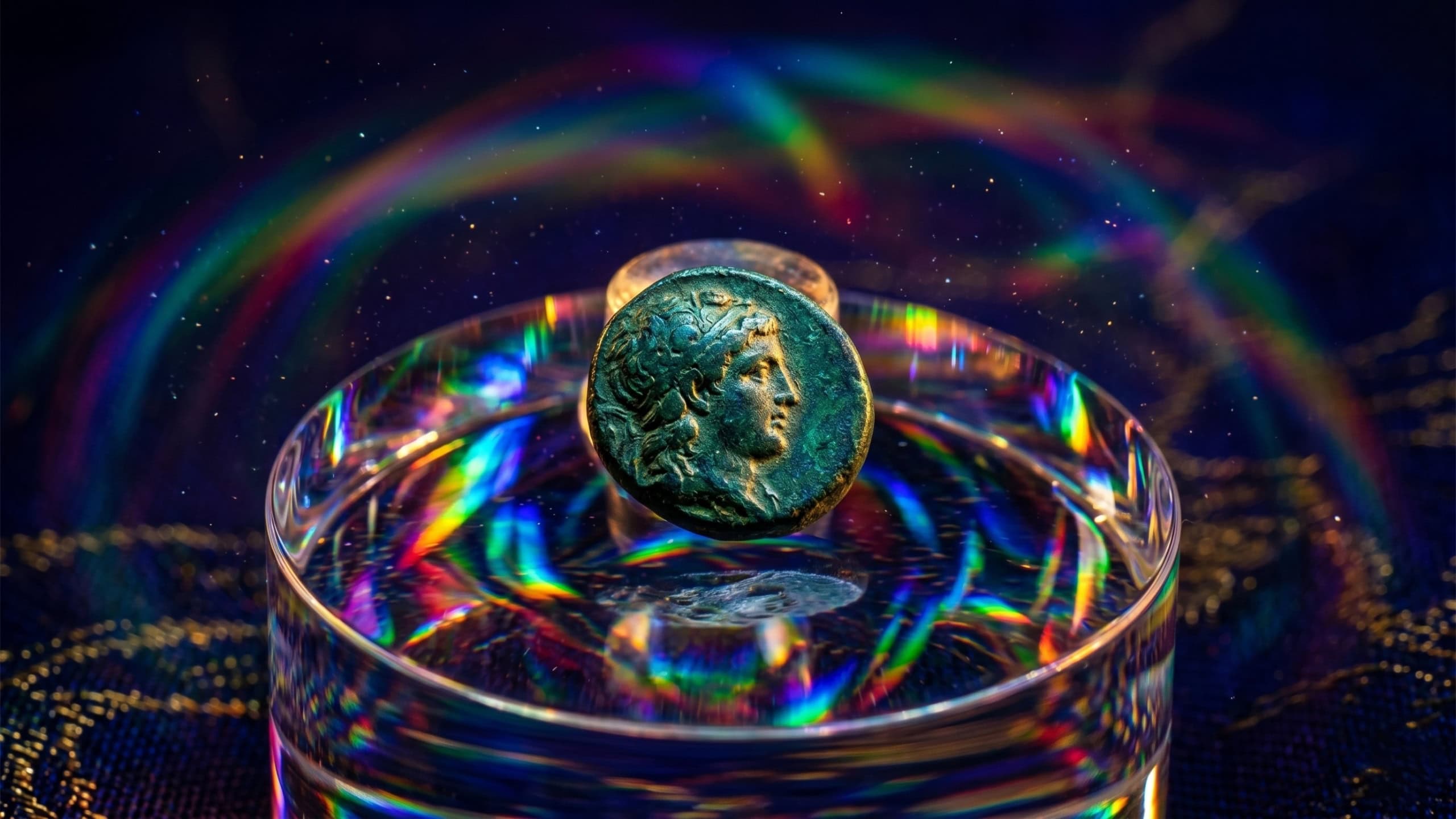
Summary and Key Points: thirteen-year-old boy hiking through a field in Germany — at a location near Berlin that had previously been documented as an archaeological burial site through excavations conducted in the 1950s and 1970s that uncovered ancient pots, urns, a bronze button, and an ancient knife sheath — recently discovered a small bronze coin only thirteen millimeters in diameter that has now been authenticated by Berlin Heritage Authority archaeologist Jens Henker as a genuine ancient Greek coin minted in the city of Troy.
When a Coin Found in a Field Is an Ancient Treasure
One pleasant memory I have of my late grandfather was searching for change after a public event. We would frequent fairs and carnivals after the proceedings and look for money that people may have dropped. I never found anything of note, but it was still fun to try to discover some spare coins that would have made me feel rich.
Quite a Find for an Eagle-eyed Hiker
Now, a 13-year-old boy in Germany got lucky in his search for currency.
He discovered a bronze coin in a field – a treasure that is rare as can be.
He may not have felt wealthy about the find, but he was curious about its origin. It turns out this coin dates to the Third Century B.C.E. It was minted in Troy, in western Turkey, and historians think it was somehow a gift to the dead, but no archaeologist is sure how it ended up near Berlin.
Where Was This Coin From Originally?
This was the first ancient Greek-era find discovered in Germany.
The teenager was enamored with the coin and took it to an archeological center for help identifying it. This was not easy due to its age and diminutive size.
It could not have been worth much to the Greeks, but it still had certain historical significance, making it invaluable now.
“Nobody knew exactly what it was because it was so small,” Jens Henker, an archaeologist with the Berlin Heritage Authority, told Smithsonian magazine. “That it was something old was clear.”
An Ancient Artist Did Yeoman’s Work on the Object
The handiwork and graphic design on the coin are plenty interesting. It depicted “Athena, the Greek goddess of war and wisdom, in a Corinthian helmet, while its reverse features an image of the deity in a kalathos headdress, with a spear in her right hand and a spindle in the other,” as the Smithsonian described.
How Did It Get to Germany?
Historians are still not sure how the coin was found near Berlin. It could have been lost by a more modern collector, but what would such a person be doing carrying a rare artifact around with a few Deutsche Marks?
It Was Found On an Old Dig Site
However, the historians also knew that the field where the coin was found was actually an archaeological dig site. So that would explain how the object could have come to be with some dead people from a much earlier era.
There were digs near the coin’s location in the 1950s and 1970s. This was a burial ground where artifacts like pots and urns were found. One time, diggers unearthed a bronze button and an ancient sheath for a knife.
Honoring the Dead
The coin the teenager found is tiny, though – only 13 millimeters in diameter and probably not worth much in ancient times, but now it is priceless. This might have been a “grave gift” or tribute of some kind, according to Deutsche Welle. This could have been some kind of talisman to remember an ancient act of bravery.
Could the Ancient Greeks Have Traded with Germanic Tribes?
How it came to Germany is anyone’s guess. But goods believed to be from there have turned up in Greece, suggesting a possible commercial relationship between Germany and Greece, and this coin could have been part of some trade transaction.
In fact, a Greek explorer named Pytheas traveled to the British Isles and the Atlantic coast of Europe, Smithsonian recounted. He may have taken some coins with him to pay for goods made by Germanic people.
This Could Have Been Combat Pay
Another interesting possibility is that the Greeks may have been recruiting soldiers from Germany. This coin could have been “hazardous duty pay” for fighting in wars. The Germanic soldier could have fought in Greece and made his way back to Germany, and died, leaving his fortune in a grave.
“We have time periods, especially in the Iron Age, [where] we have a population loss, and we don’t know where the people [went],” Henker said. “Suddenly, they disappear. Maybe they were going down to the Greeks, joining the military forces there.” Still, he cautioned, “That’s not even a hypothesis. It’s an idea only.”
A Remnant of a Fascinating Past
It is interesting to surmise where the coin came from and who may have handled it. The Greeks have shown that their society reached far-flung lands, and the possibility that a soldier may have deposited it in a grave is an intriguing idea that may have inspired the ancient Romans to recruit soldiers from the lands and cities they conquered.
So keep an eye open on your next hike. History could unfold in front of your eyes when you least expect it. With all the metal detectors these days, sleuths looking for treasure could find something glorious with a fascinating history for scholars of antiquity.
About the Author: Dr. Brent M. Eastwood
Author of now over 3,500 articles on defense issues, Brent M. Eastwood, PhD, is the author of Don’t Turn Your Back On the World: A Conservative Foreign Policy and Humans, Machines, and Data: Future Trends in Warfare, plus two other books. Brent was the founder and CEO of a tech firm that predicted world events using artificial intelligence. He served as a legislative fellow for US Senator Tim Scott and advised the senator on defense and foreign policy issues. He has taught at American University, George Washington University, and George Mason University. Brent is a former US Army Infantry officer. He can be followed on X @BMEastwood.