
North Korea set out to announce itself as a naval power, and instead it broadcast one of the most embarrassing shipbuilding failures in recent memory. On May 21, 2025, at the Chongjin shipyard, the country’s second guided-missile destroyer rolled over and partially capsized during its own launch ceremony, in front of leader Kim Jong Un. He called it a “criminal act,” had officials arrested, and ordered the wreck salvaged. A year later, North Korea has righted the ship, repaired it, relaunched it, test-fired cruise missiles from its sister vessel, begun a third destroyer, and announced plans for warships twice the size. The capsize is the image everyone remembers. The real story is what it exposed: a naval ambition sprinting far ahead of the shipbuilding base meant to deliver it, propped up by suspected Russian help, and still unproven as a genuine combat force.
The Ambition: A Leap Toward A Blue-Water, Nuclear-Armed Navy
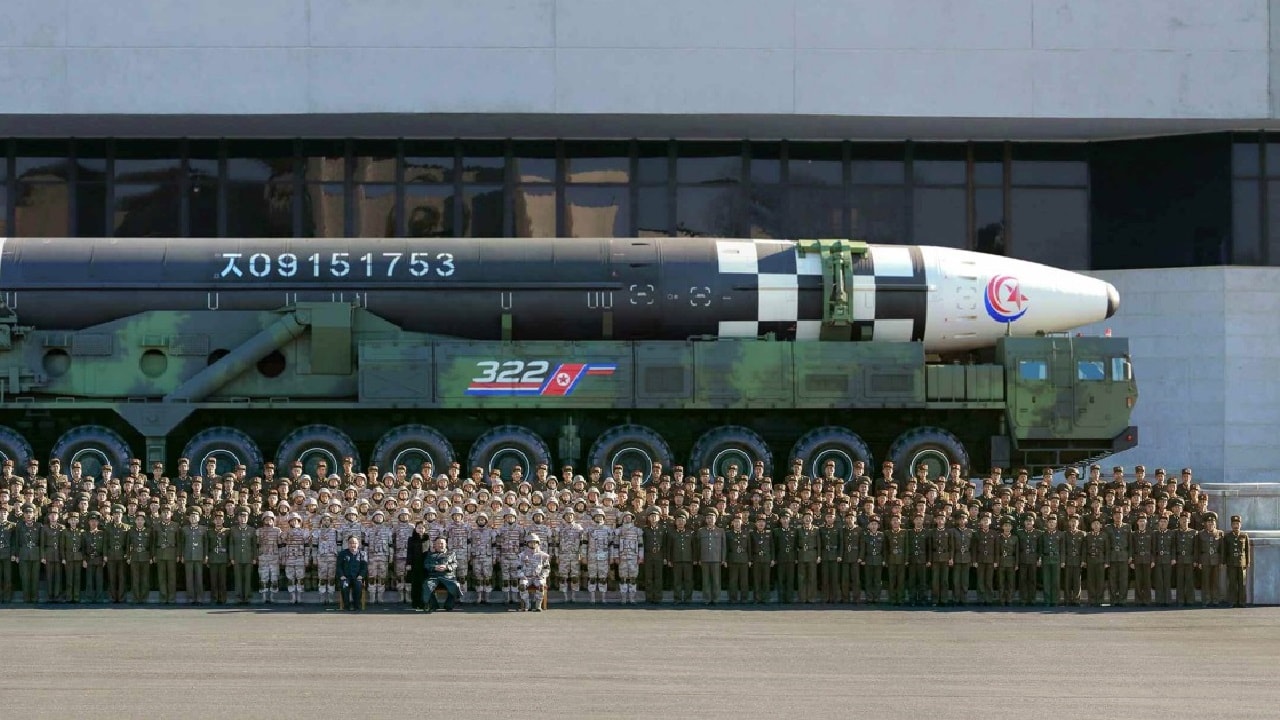
North Korea ICBM. Image Credit: KCNA.
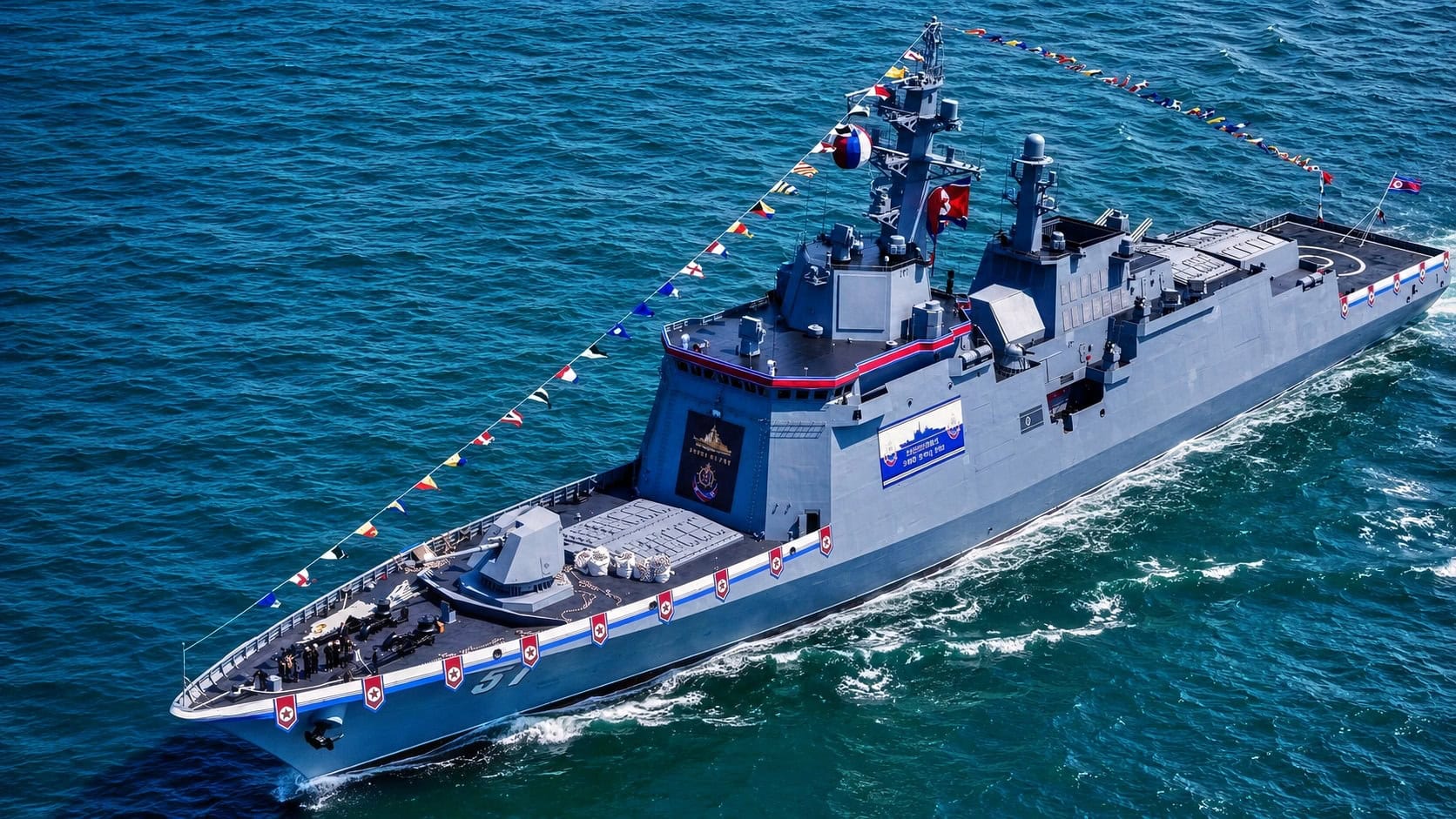
The ship that capsized belongs to the Choe Hyon class, North Korea’s first true guided-missile destroyers and, by a wide margin, the largest warships the country has ever built. Displacing around 5,000 tons and running roughly 140 to 145 meters long, the class is a sharp break from the aging Soviet-era frigates and small missile boats that have long made up the Korean People’s Navy. The lead ship, Choe Hyon, was unveiled with enormous fanfare at the Nampo shipyard in late April 2025, hull number 51.
North Korean state media describes the class as a multipurpose destroyer capable of anti-air, anti-ship, anti-submarine, and anti-ballistic-missile missions, with an estimated 88 vertical-launch cells of varying sizes and, by Pyongyang’s account, the ability to carry nuclear-capable ballistic and cruise missiles — North Korea uses the word “strategic” for its missiles to signal a nuclear role. Those capability claims come from state media and cannot be independently verified, but the ambition behind them is explicit: Kim has framed the program as the centerpiece of a drive to turn his navy from a coastal-defense force into a blue-water, nuclear-armed fleet capable of striking from the sea. For a navy built on small inshore craft, that would be a genuine leap.
What Went Wrong: A Catastrophe On Live Television
The disaster came with the second ship, the as-yet-unnamed vessel later commissioned as Kang Kon, hull 52. On May 21, 2025, North Korea attempted a sideways launch at Chongjin, the method in which a ship enters the water stern-first from a perpendicular slipway. It went catastrophically wrong: the stern transport cradle slid into the water prematurely while the bow stuck on the shipway, crushing part of the hull and leaving the vessel partially capsized — all of it witnessed by Kim, who had come to preside over the ceremony.
His reaction was public and furious. State media reported that Kim called the failure a “criminal act” caused by “absolute carelessness” and “irresponsibility,” and that four officials, including the shipyard’s chief engineer, were arrested and accused of tarnishing the nation’s dignity.
The episode was striking in itself for a regime that almost never admits failure: North Korea acknowledged the accident openly, which outside observers read less as transparency than as a signal of how seriously Kim takes the naval program. The mechanics of the failure were not mysterious. As maritime expert Sal Mercogliano of Campbell University told CNN, if a ship does not move together during a launch, the stresses will tear the hull apart, which is precisely what appeared to happen.
Why It Really Happened: Ambition Outrunning The Shipyard
The capsize was not bad luck; it was a symptom. Analysts who examined the satellite imagery and the launch footage tied the failure to a shipbuilding-capability gap — an inexperienced yard attempting a launch method its engineering could not properly support, with inadequate ballast and launch control. North Korea had designed an ambitious warship and built the hull, but the industrial base and the institutional experience needed to execute the basics of getting it safely into the water had not kept pace with the ambition driving the program.
That gap is the thread running through the entire Choe Hyon story. Floating a 5,000-ton hull is an achievement for a country whose navy was built on patrol boats, but it is the most straightforward part of building a warship. The harder work — integrating a functioning vertical-launch system, radar, and combat-management system into a ship that actually fights as designed — is exactly where an immature shipbuilding industry struggles most, and it is the part North Korea has yet to prove it can do.
The Comeback: Righted, Rearmed, And Reaching Higher
What North Korea did next was genuinely impressive in its speed. Commercial satellite imagery from Maxar, matching South Korean military assessments, confirmed the ship had been pulled upright within roughly two weeks of the accident, by early June 2025. The vessel was then towed about 50 miles north to the Rajin shipyard and relaunched there on June 12, 2025.
The recovery was fast, but as the Center for Strategic and International Studies noted from its satellite analysis, the vessel still had to pass critical phases before it could be deemed operational — the salvage proved North Korea could raise a capsized hull, not that the ship worked.
The program has pressed forward aggressively since. Kim spent two days inspecting the lead ship at Nampo on March 3 and 4, 2026, and on March 4, observed a sea-to-surface strategic cruise missile fired from the destroyer, the kind of test meant to precede commissioning. A larger drill followed on April 12, 2026, with two cruise missiles and three anti-ship missiles launched from Choe Hyon — the first publicly disclosed firing of anti-ship missiles from the ship.
The repaired Kang Kon began navigation and propulsion sea trials in early June 2026, with Kim ordering both destroyers commissioned as soon as possible. A third ship of the class is under construction at Nampo, expected to be completed by October 2026, and Kim has ordered at least two destroyers or larger built every year under a new five-year plan, while announcing ambitions for 10,000-ton warships, twice the size of the Choe Hyon, with satellite imagery showing the Nampo and Chongjin yards being expanded to build them.
The Honest Balance: Russian Help, Real Doubts, And A Real Leap
The skeptic’s case is strong, and it starts with who actually built these ships. South Korean military officials and outside experts say the Choe Hyon was most likely built with Russian assistance amid the deepening military ties between Moscow and Pyongyang, even as some openly doubt whether the ships are ready for active service. The analyst Joseph Bermudez of CSIS put the Russian role at better-than-even odds — likely providing technology, experience, and guidance — while cautioning that the extent of direct equipment contributions cannot be determined.
The most visible piece of Russian kit is the Pantsir-ME naval close-in defense system mounted on the class, a Russian export design. The combat-readiness question is real: test-firing a missile in a controlled demonstration is not the same as fielding a working, integrated warship, and the 10,000-ton ambitions of a yard that just capsized a 5,000-tonner are, for now, aspirational.
The fair counterweight is that none of this is pure theater. In roughly a year, North Korea went from a coastal force with no real destroyers to operating two guided-missile destroyers, with a third under construction — and the fast, public recovery from the capsize suggests genuine commitment and a measure of resilience rather than a one-off propaganda stunt.
Even a partly capable destroyer armed with nuclear-capable cruise and ballistic missiles changes the problem for South Korea, Japan, and the United States: a mobile, harder-to-track sea-based launch platform widens Pyongyang’s potential strike axes in a way a coastal fleet never could. The honest verdict is that this is an immature but real program, neither a fantasy nor a finished threat.
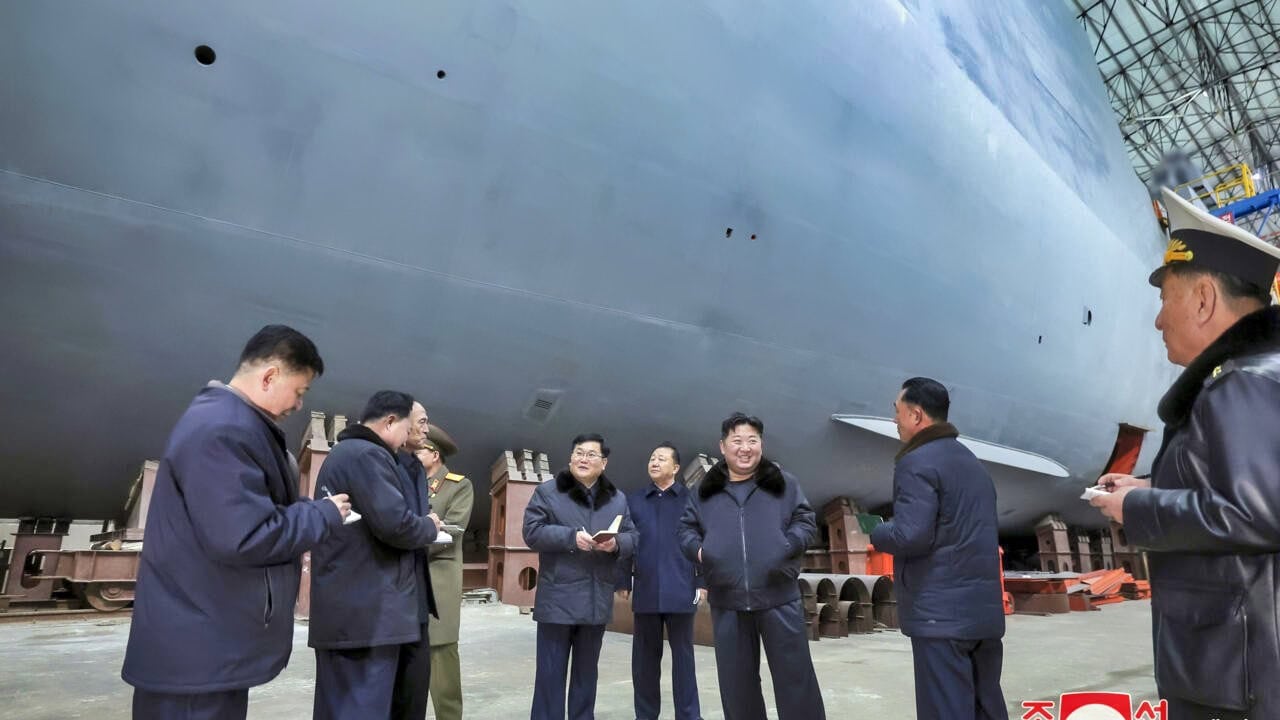
North Korea Submarine KCNA Media Photo.
The Verdict: The Capsize Is The Image, The Trajectory Is The Story
The sight of a brand-new warship rolling over in front of its own leader on state television is the kind of image that defines a program in the public mind, and for North Korea, it was a humiliation. But fixating on the capsize overlooks what came after. North Korea absorbed a very public failure, raised and repaired the ship within weeks, pushed it and its sister vessel through missile tests and sea trials, laid down a third hull, and announced plans for warships twice as large — all inside about a year. The capability still lags far behind the ambition; the ships are very likely relying on Russian help, and whether they can fight as designed remains unproven. None of that has slowed Kim down.
That is the part worth watching. The Choe Hyon class is not yet a serious blue-water navy, and it may be years before North Korea can build and operate one even if everything goes right. But the trajectory — from capsize to commissioning to a third hull to 10,000-ton plans — points in a clear direction, and it is backed by a five-year plan, expanding shipyards, and a leader who treats the program as a national priority.
The capsize was the embarrassing snapshot. The motion behind it, ambition still outrunning capability but refusing to stop, is the real signal, and it is moving faster than a coastal navy ever did.
About the Author: Harry J. Kazianis
Harry J. Kazianis (@Grecianformula) was the former Senior Director of National Security Affairs at the Center for the National Interest (CFTNI), a foreign policy think tank founded by Richard Nixon based in Washington, DC. Harry has over a decade of experience in think tanks and national security publishing. His ideas have been published in the NY Times, The Washington Post, The Wall Street Journal, CNN, and many other outlets worldwide. He has held positions at CSIS, the Heritage Foundation, the University of Nottingham, and several other institutions related to national security research and studies. He is the former Executive Editor of the National Interest and the Diplomat. He holds a Master’s degree focusing on international affairs from Harvard University.

