
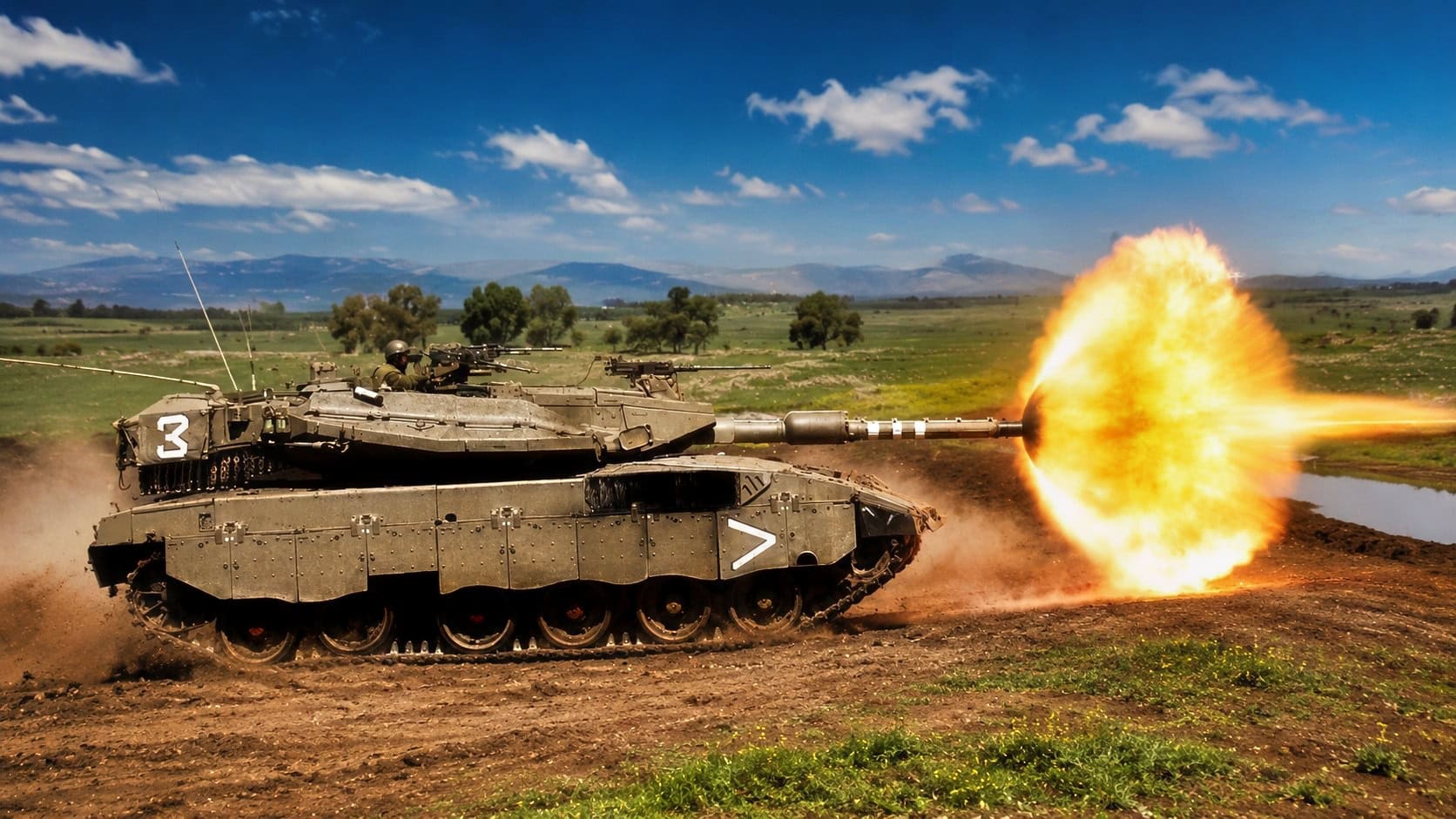
Israel built the Merkava so it would never again be cut off by a foreign arms supplier, and then it built the tank around an engine it does not make. For its entire life, the most sovereignty-driven tank program in the world has run on a foreign powerplant: an American engine in the early marks, and today a German-designed unit license-built in the United States, paired with a German transmission. The tank that exists because Britain refused to sell Israel its tanks now depends on a foreign supplier for the single component that makes it move.
That is not a failure, and it is not a knock on a genuinely world-class machine.
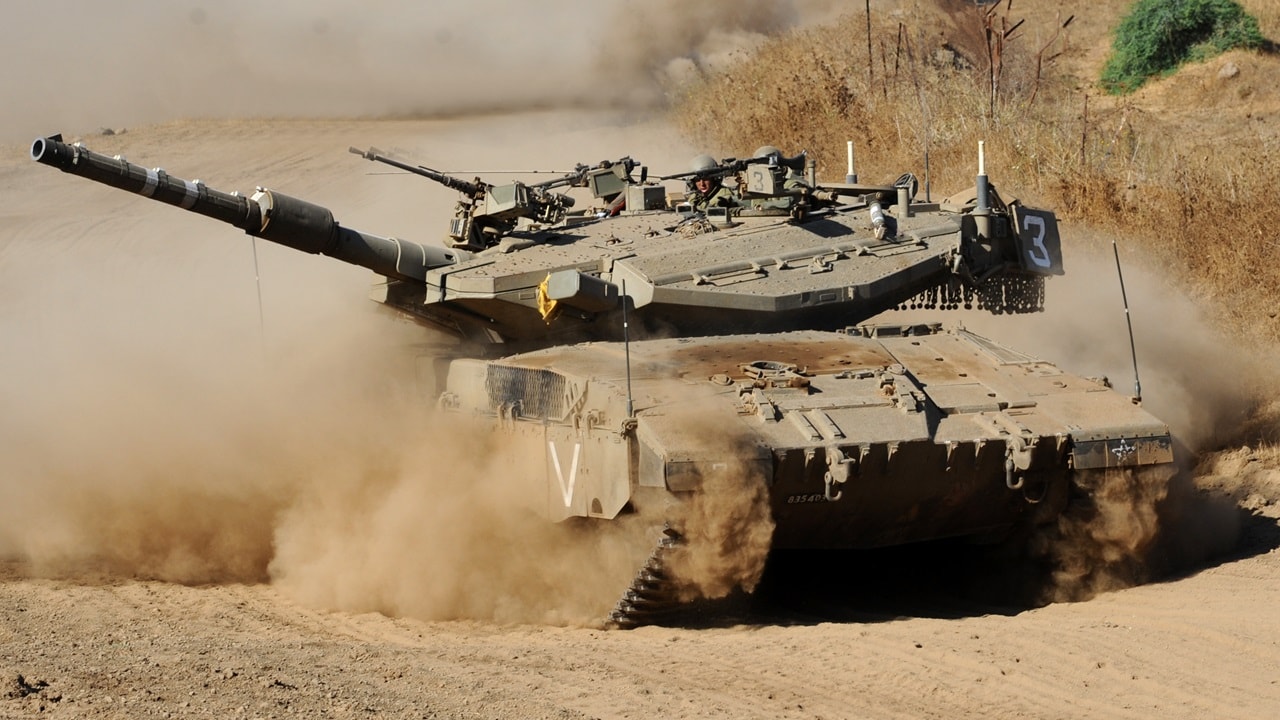
Merkava Tank from Israel
It is the clearest proof of a rule running through every national armor and fighter program on earth: a country can build the hull, the armor, the gun, and the electronics, but the engine is the part almost no one makes alone, and even the most self-reliant builder chooses to import it.
The Sovereignty Origin: A Tank Born From Being Cut Off
The Merkava’s entire identity is self-reliance, and the reason is a betrayal. In June 1969, the British government decided not to sell Israel the Chieftain, then one of the most capable tanks in the world, after two prototypes had already been delivered for trials, because Britain was supplying the same tank to Arab states and bowed to political pressure.
Israel, fielding a patchwork of British Centurions and American M48 and M60 Pattons while Egypt and Syria took delivery of more heavily gunned Soviet armor, was left exposed by a supplier’s political reversal. The lesson Israeli planners drew was permanent: never again let a foreign government hold a veto over the country’s armored force.
In 1970, Brigadier General Israel Tal launched a program to build a wholly indigenous tank, run out of the Ministry of Defense’s Merkava and Armored Combat Vehicles Division. Tal was a combat soldier rather than an engineer, and the heavy Israeli tank losses to anti-tank missiles in the 1973 Yom Kippur War hardened his central conviction: crew survivability would be the overriding priority, ahead of firepower and ahead of speed. That philosophy produced the tank’s most distinctive feature.
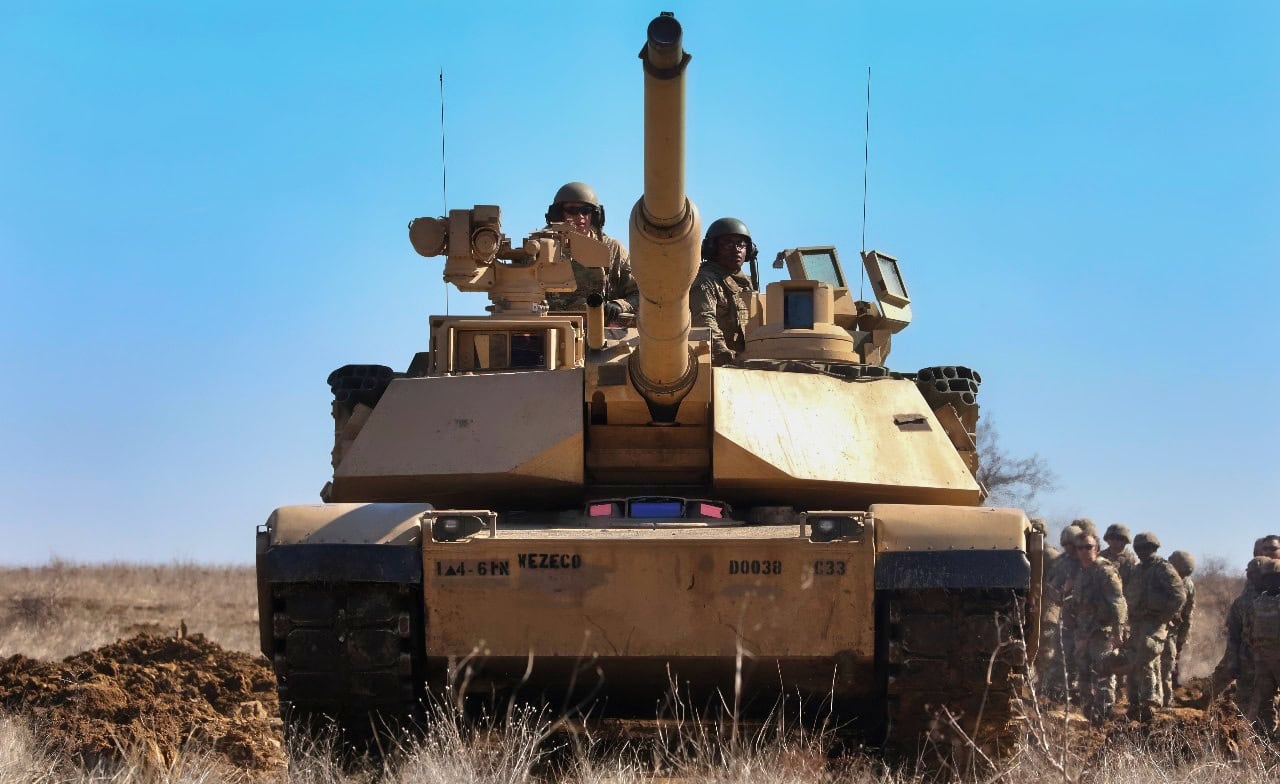
A U.S. Army M1 Abrams, assigned to 4th Battalion, 6th Infantry Regiment, 3rd Armored Brigade Combat Team, 1st Armored Division, fully emerges from the tank firing point to engage the simulated enemy at Novo Selo Training Area, Bulgaria, March 5, 2025. 1st Armored Division, a rotational force supporting V Corps, conducts training with engineers and tank operators in the European Theatre to maintain readiness and instill fundamental Soldier skills that are vital in maintaining lethality. (U.S. Army photo by Spc. Kyle Kimble)
Where every other modern main battle tank, the American M1 Abrams, the German Leopard 2, the Russian T-90, the South Korean K2, places its engine at the rear, the Merkava puts its engine in the front of the hull, using the powerplant itself as an extra layer of armor between an incoming round and the crew. The arrangement also freed up the rear of the hull for a clamshell door, letting the tank evacuate wounded, carry infantry, or take on extra ammunition.
The first designs were developed in 1974, low-rate production was approved in 1977, and the first Merkava Mark 1 reached the IDF’s 7th Armored Brigade in 1979. It has been combat-proven from the 1982 Lebanon War through the fighting in Gaza, and it is a genuine point of Israeli national pride.
The Engine Reality: A Foreign Heart From The Start
For all that sovereign identity, the one part of the Merkava that has never been Israeli is the one that makes it move. The early marks ran the American AVDS-1790, the Teledyne Continental air-cooled V12 from the same family that powered the M48 and M60 Patton series, producing around 900 horsepower in the Mark 1 and stepping up to a 1,200-horsepower AVDS-1790-2AR in the Mark 3.
That engine had been built for decades at General Dynamics Land Systems’ Muskegon, Michigan, plant, the same line that turned out more than 44,000 AVDS-1790 engines for the Pattons and the Merkava over the years.
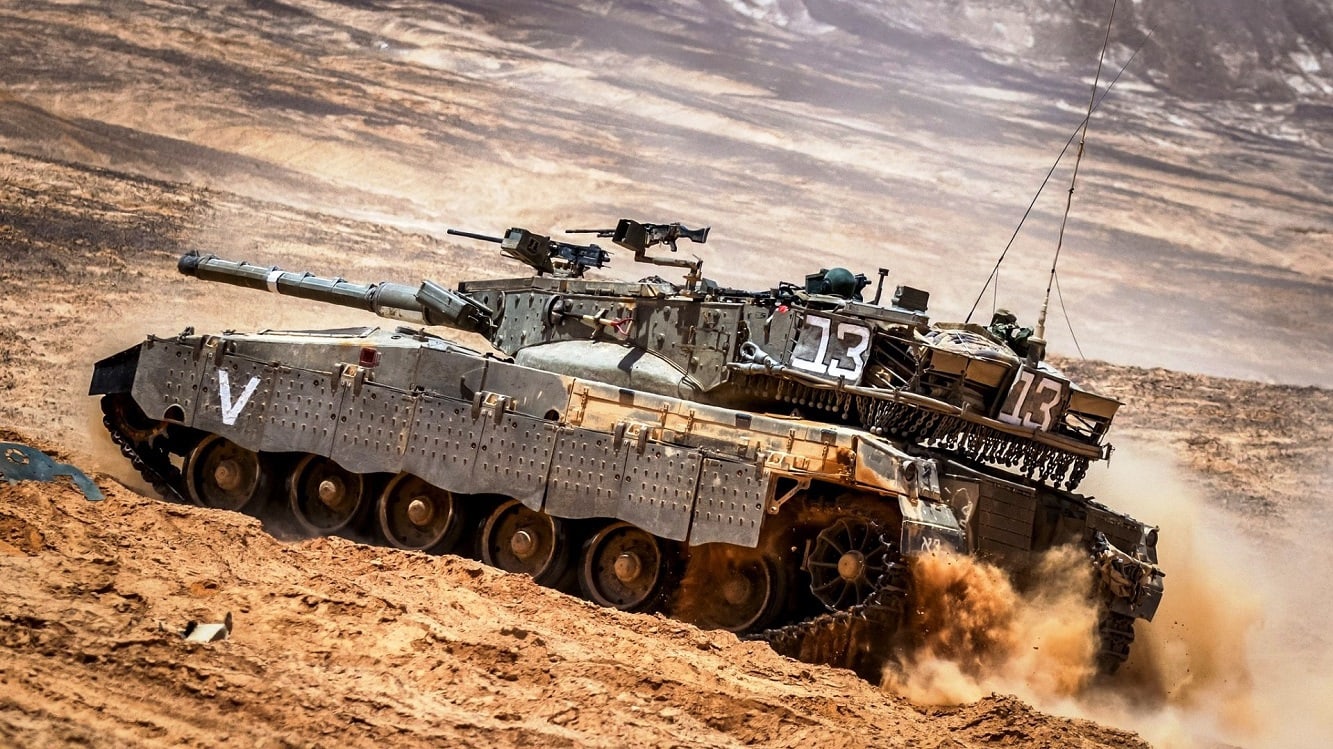
Merkava Tank. Image Credit: Creative Commons.
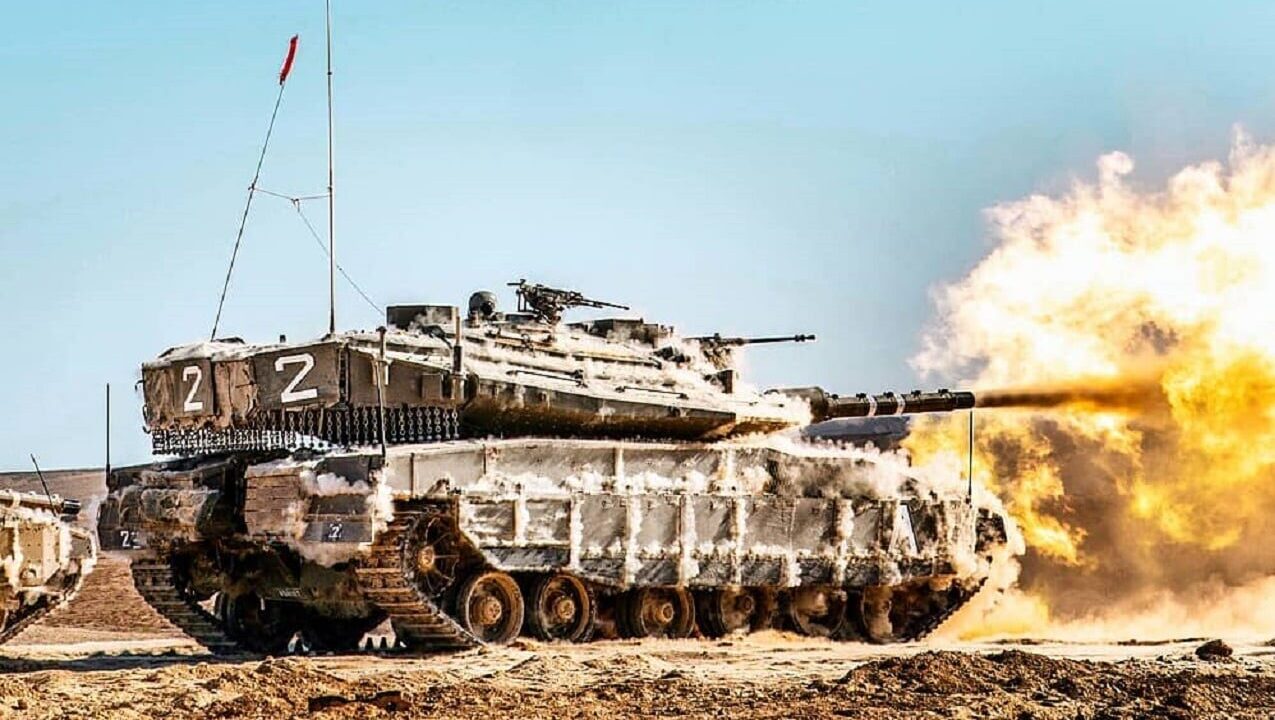
Israeli Merkava Tank. Image Credit: Creative Commons.
The current Mark 4 and Mark 5 “Barak” moved to something more powerful and less Israeli still. They run the GD883, the designation for the German MTU 883, a 1,500-horsepower turbocharged V12 diesel paired with a German Renk RK325 automatic transmission, representing a 25 percent jump in power over the Mark 3. The extra power was necessary because the Mark 4 had grown heavy, up to roughly 65 to 70 tons with its Trophy active-protection system and added armor.
The MTU 883 is part of the MTU EuroPowerPack family, the same engine line used in the latest Leopard 2 variants and the French Leclerc, and it is widely considered the most powerful tank diesel of its kind. The engine is the single most significant component of the Merkava made outside Israel, and the same powerpack drives the Namer heavy armored personnel carrier built on the Merkava chassis, which broadens this dependence across Israel’s heavy armor.
The Current Hook: A Foreign Engine, Renewed In 2026 On U.S. Funding
This is not a historical footnote that Israel has since engineered away. The dependence is being actively renewed, and it now runs on American alliance funding. On February 17, 2026, the U.S. Army Contracting Command at the Detroit Arsenal awarded Rolls-Royce Solutions America a firm-fixed-price contract worth $73,528,916 for Merkava power-pack kits, specified as “Power Pack Less Transmission” full and lite kits with containers and engineering support, with the work centered in Graniteville, South Carolina, and completion scheduled by the end of 2032. The award sits inside a cumulative framework valued at roughly $463 million, and it is financed through the foreign military sales funds the United States allocates to Israel.
The corporate detail closes the circle. Rolls-Royce now owns the MTU brand, through its Rolls-Royce Power Systems division, so the company building Israel’s “MTU 883” powerpack and the German engineering behind that engine are of the same lineage. The supply chain has passed through several hands, from General Dynamics at Muskegon to L3Harris and then, in 2021, to Germany’s Renk.
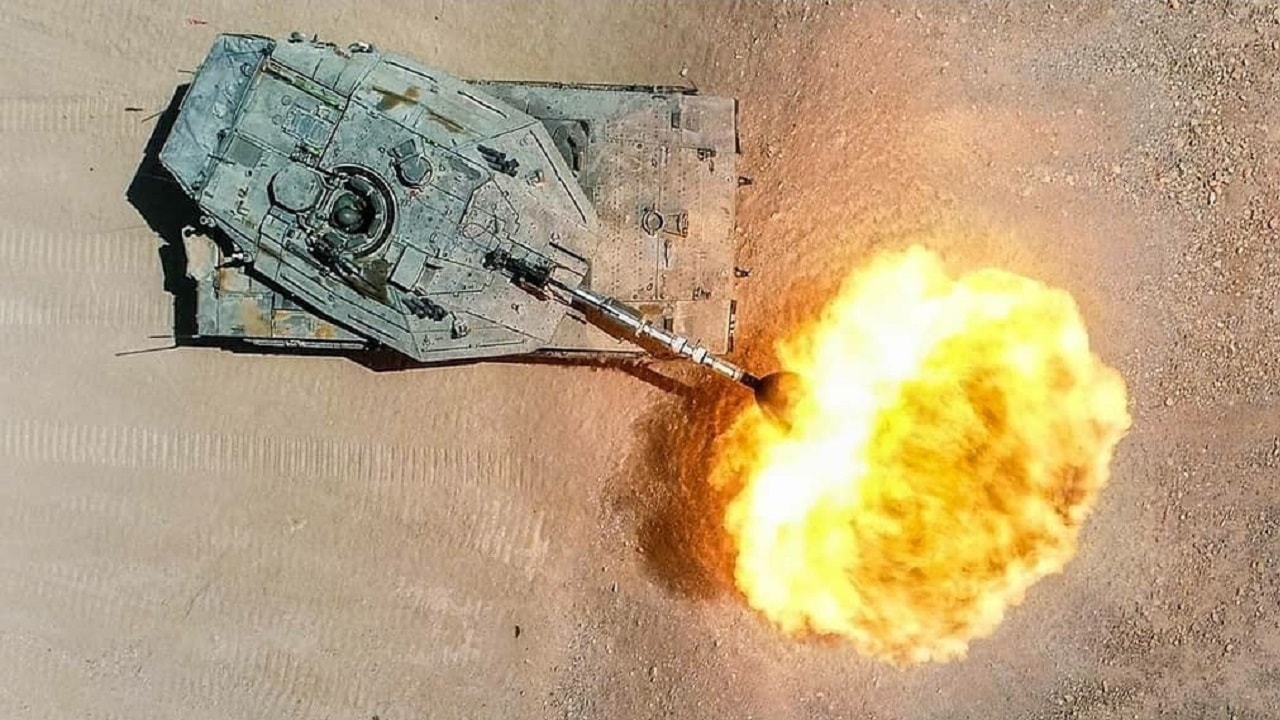
Merkava IV tank. Image Credit: Creative Commons.
The tank built to free Israel from foreign suppliers now has its heart manufactured in South Carolina by a British-owned company that is building a German-designed engine, and is paid for through a U.S. military aid program. There is a quiet echo in that arrangement of the very dependence the Merkava was created to escape.
The Honest Nuance: Chosen, Not Forced
What separates Israel’s case from the others is that its engine dependence was chosen and is managed, not imposed by an embargo or forced by a failure. South Korea ended up on a German engine for its K2 Black Panther because its own indigenous powerpack failed durability testing. Turkey lost the German engine for its Altay to an arms embargo.
Israel faced neither. The Mark 3 ran a more indigenous engine, and Israel adopted the German MTU pack for the Mark 4 because it was the proven 1,500-horsepower option for a heavier tank, not because anything Israeli had collapsed. Just as important, Israel secured that supply through its deep defense relationship with the United States and through U.S. foreign military sales funding, which binds financing, contracting, and delivery into a single durable framework.
That makes the dependence low-risk in a way that it is not for almost anyone else. A country whose engines are embargoed or whose own design fails is stuck. Israel, by contrast, made a rational procurement choice and locked in the supply with its closest ally, tapping a mature industrial base and a pipeline built to outlast short-term budget turbulence.
Israel could very likely develop a tank engine if it had no other option. It chose instead to buy the best available powerpack and guarantee it through the alliance. The irony is not that Israel cannot build an engine. It is that the one program whose entire purpose was self-reliance looked at the economics and concluded, like everyone else, that importing the engine was the smarter move.
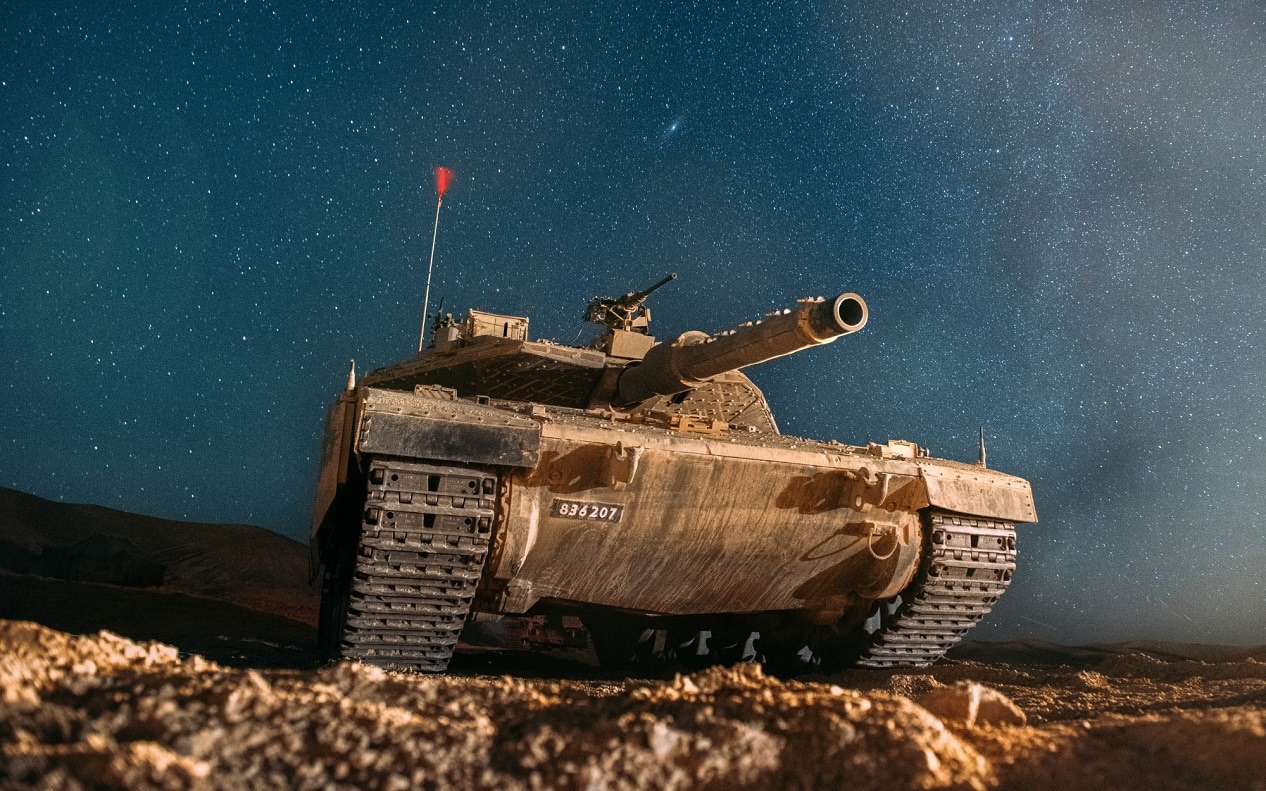
Merkava Tank. Image Credit: Creative Commons
The Bigger Pattern: The One Part No One Builds Alone
The Merkava completes a picture that every recent national armor and fighter program has been filling in from a different direction. Turkey’s Altay was left without a heart when Germany imposed an embargo on its MTU engine. South Korea’s K2 used a German engine and transmission because its own powerpack failed testing. Sweden’s Gripen and Turkey’s Kaan fly on American engines, giving Washington a veto over their exports. India’s Tejas runs on a General Electric engine because its indigenous Kaveri program failed. Each of those is a story of a nation forced, blocked, or let down on its way to the same destination.
Israel is the case that removes the last alibi. It was not embargoed, its own engine did not fail, and no one held a gun to its head. The most self-reliance-driven tank builder on the planet simply chose a foreign engine freely because building a competitive 1,500-horsepower diesel engine for a tank is so costly and technically demanding that even a country defined by military self-sufficiency declined to do it.
That is what makes the Merkava the proof rather than just another example: the engine chokepoint is not about a particular nation’s capability or willpower. It is structural. The hull, the armor, the gun, and the electronics are the achievable parts that a capable defense industry can master. The engine is the part that a handful of firms in a handful of countries build for everyone else, and the rest of the world, however sovereign its ambitions, buys it from them.
The Verdict: The Most Self-Reliant Tank Still Imports Its Heart
The Merkava is everything Israel built it to be in almost every respect: a world-class, combat-proven tank, designed around its crews more thoroughly than any other, and a real and lasting symbol of the country’s ability to arm itself. The exception is the engine, and the exception has held for half a century, from the American AVDS of 1979 to the German-designed, American-built, Rolls-Royce-supplied powerpack contracted in 2026. The tank conceived as a declaration of independence on tracks has always run, and still runs, on a heart made somewhere else.
That is not the embarrassment it might first appear to be. It is the most telling evidence available that the engine is the one component a nation cannot simply will into existence, because the country that tried hardest to depend on it, no one weighed the cost and chose to import it anyway. Israel built the Merkava so it would never again be at the mercy of a foreign supplier.
Fifty years on, the tank moves on an engine from abroad, paid for by an ally, and the lesson is the same one every other builder has learned: you can build the chariot, but the chariot still needs a heart you almost certainly have to buy.
About the Author: Harry J. Kazianis
Harry J. Kazianis (@Grecianformula) was the former Senior Director of National Security Affairs at the Center for the National Interest (CFTNI), a foreign policy think tank founded by Richard Nixon based in Washington, DC. Harry has over a decade of experience in think tanks and national security publishing. His ideas have been published in the NY Times, The Washington Post, The Wall Street Journal, CNN, and many other outlets worldwide. He has held positions at CSIS, the Heritage Foundation, the University of Nottingham, and several other institutions related to national security research and studies. He is the former Executive Editor of the National Interest and the Diplomat. He holds a Master’s degree focusing on international affairs from Harvard University.

