
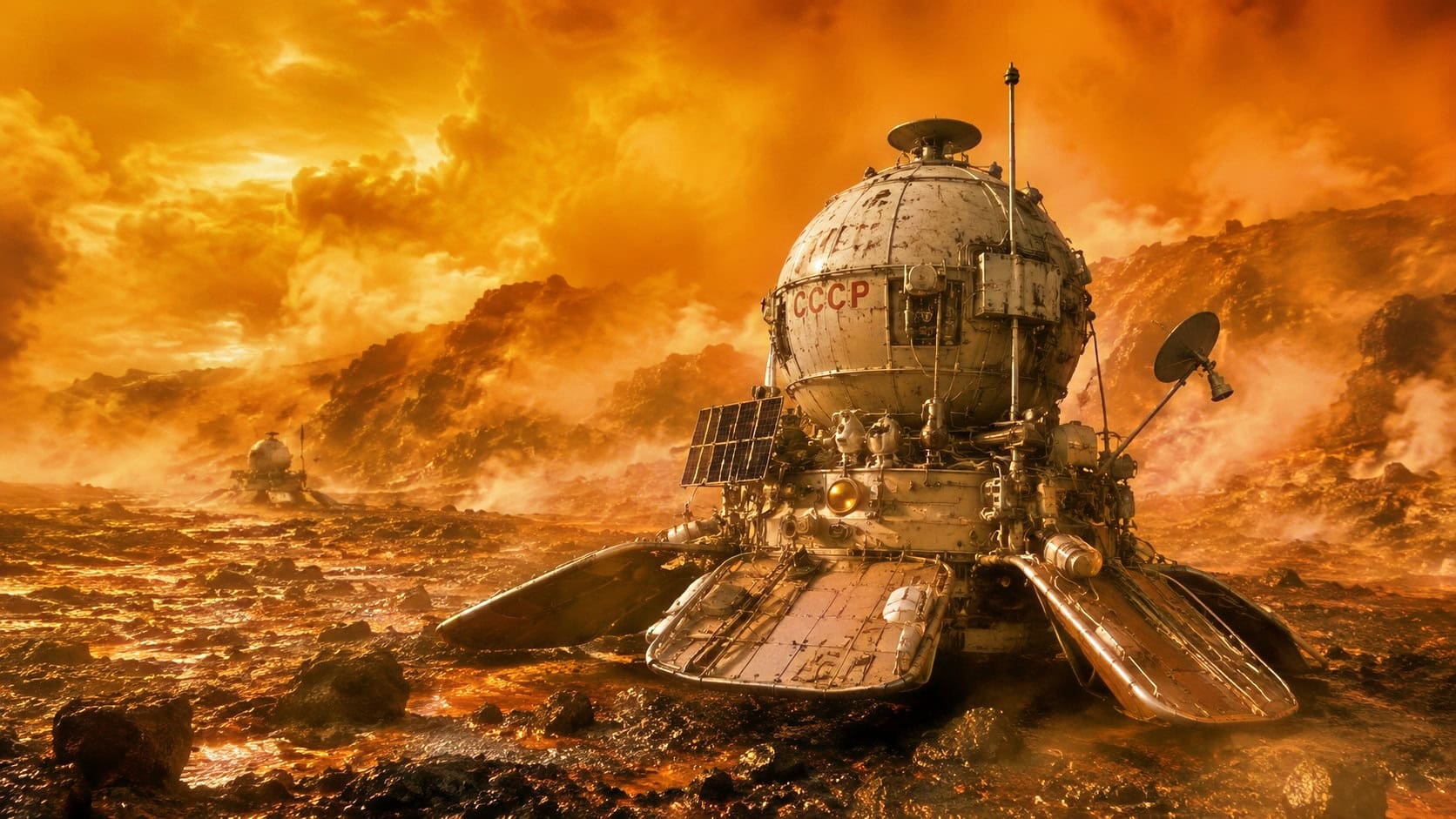
The Soviet Union launched Venera 13 and Venera 14 in late 1981 with the objective of surviving long enough on the surface of Venus to transmit scientific data. The spacecraft landed in March 1982, encountering Venus’s ultra-harsh conditions: a surface temperature of 870 degrees Fahrenheit, atmospheric pressure 90 times that of Earth, and clouds of sulfuric acid. Venera wasn’t just a spacecraft mission but an engineering exercise designed to survive what is arguably the most hostile planetary surface in the solar system, where temperatures are hot enough to melt lead, and the pressure is equivalent to being 3,000 feet underwater.
Lethal Venus

NASA’s Space Shuttle Discovery. Image Taken by 19FortyFive.com on October 1, 2022.
NASA Space Shuttle Discovery. Image Credit: 19FortyFive.com taken on October 1, 2022.
Venus is roughly Earth-sized and often called Earth’s twin. But in reality, the surface of Venus is insanely dangerous. Why? Runaway greenhouse effect; the dense atmosphere consists of 96 percent CO₂. This has trapped enormous amounts of heat in the atmosphere. The surface temperature barely changes between day and night.
The atmosphere is so dense that a descending spacecraft effectively has to move through liquid-like air. So landing on Venus is not like landing on Mars; Venus is more like descending into a gigantic pressurized furnace.
Building the Landing Craft
In building the Venera spacecraft, Soviet engineers assumed the landers would eventually die. That was all but assured. So the goal was humble: to delay death long enough to allow the crafts to transmit scientific data back to Earth.
Accordingly, Venera was constructed as a titanium-reinforced pressure vessel with a thick metal shell and heavily insulated interior—something like a giant thermos, or a deep-sea submarine.
The main challenges facing the craft were pressure and heat. The external pressure on Venus was essentially trying to crush the spacecraft, while the heat was trying to cook the electronics. The result was that engineers were forced to create a spacecraft that was a heavily armored capsule, a miniature submarine designed to operate inside an oven.
The Cooling Problem
Against the intense heat of Venus, normal cooling systems were impossible. Air conditioning would have been useless; the outside air was already pushing 900 degrees Fahrenheit. So the Soviet solution was to pre-cool the spacecraft’s interior to -10 °C before atmospheric entry. Venera was also constructed with thick thermal foam and sealed compartments.
But the engineers knew that the spacecraft would gradually absorb heat, so the objective was just to buy time—to slow heat transfer rather than stop it outright.
Getting Through the Atmosphere
The density of Venus’s atmosphere was such that it would slow the spacecraft rapidly. Parachutes were deployed to increase survival time, but they also increased the time the spacecraft would spend cooking in the heat. So the Soviet solution was to cut the parachutes at an altitude of 31 miles above the surface; the spacecraft intentionally descended quickly because taking the extra time to descend gradually would have been deadly.
The Science Package
What the probes were designed to do, aside from survive briefly, was collect data. Color cameras on Venera 13 offered the first color panoramas from another planetary surface. The images showed orange-brown volcanic rocks, a hazy yellow sky, and flat basalt slabs. Microphones recorded wind, drill sounds, and mechanical activity from the probes themselves.
The drill sound being recorded was from Venera’s pyrotechnic-powered system. But on the surface, the Venera still had to withstand the elements and prevent atmospheric gases from entering the spacecraft.
The solution was a sealed vacuum-lock-style chamber from which an X-ray fluorescence spectrometer was operated. The spectrometer detected volcanic basalt, rich in sulfur and potassium. In sum, the Venera spacecraft were not simply cameras but miniature robotic geology labs.
The Lens Cap Accident
Space exploration rarely goes off without a hitch. Famously, the Venera 14 camera lens was released and fell to the surface of Venus. Then, the spacecraft’s mechanical soil arm was deployed and landed directly on the discarded lens cap.
The result was that the spacecraft measured the compressibility of the Soviet lens cap rather than the Venusian soil. The spacecraft performed flawlessly, but was defeated by its own lens cap placement in what has been remembered as one of space exploration’s most famous engineering mishaps.
The Big Picture
The Venera missions demonstrated extreme planetary engineering capability at a time when the USSR was competing directly with the US. The information gathered is still used today and has influenced future missions, such as NASA‘s DAVINCI and VERITAS missions.

NASA’s Discovery. Image Credit: 19FortyFive.com taken on October 1, 2022.
More than forty years later, the data collected by Venera remains among the few direct images and recordings from Venus.
MORE – Russia Put a Dog In Space, and It Never Came Home
About the Author: Harrison Kass
Harrison Kass is a writer and attorney focused on national security, technology, and political culture. His work has appeared in City Journal, The Hill, Quillette, The Spectator, and The Cipher Brief. He holds a JD from the University of Oregon and a master’s in Global & Joint Program Studies from NYU. More at harrisonkass.com.