
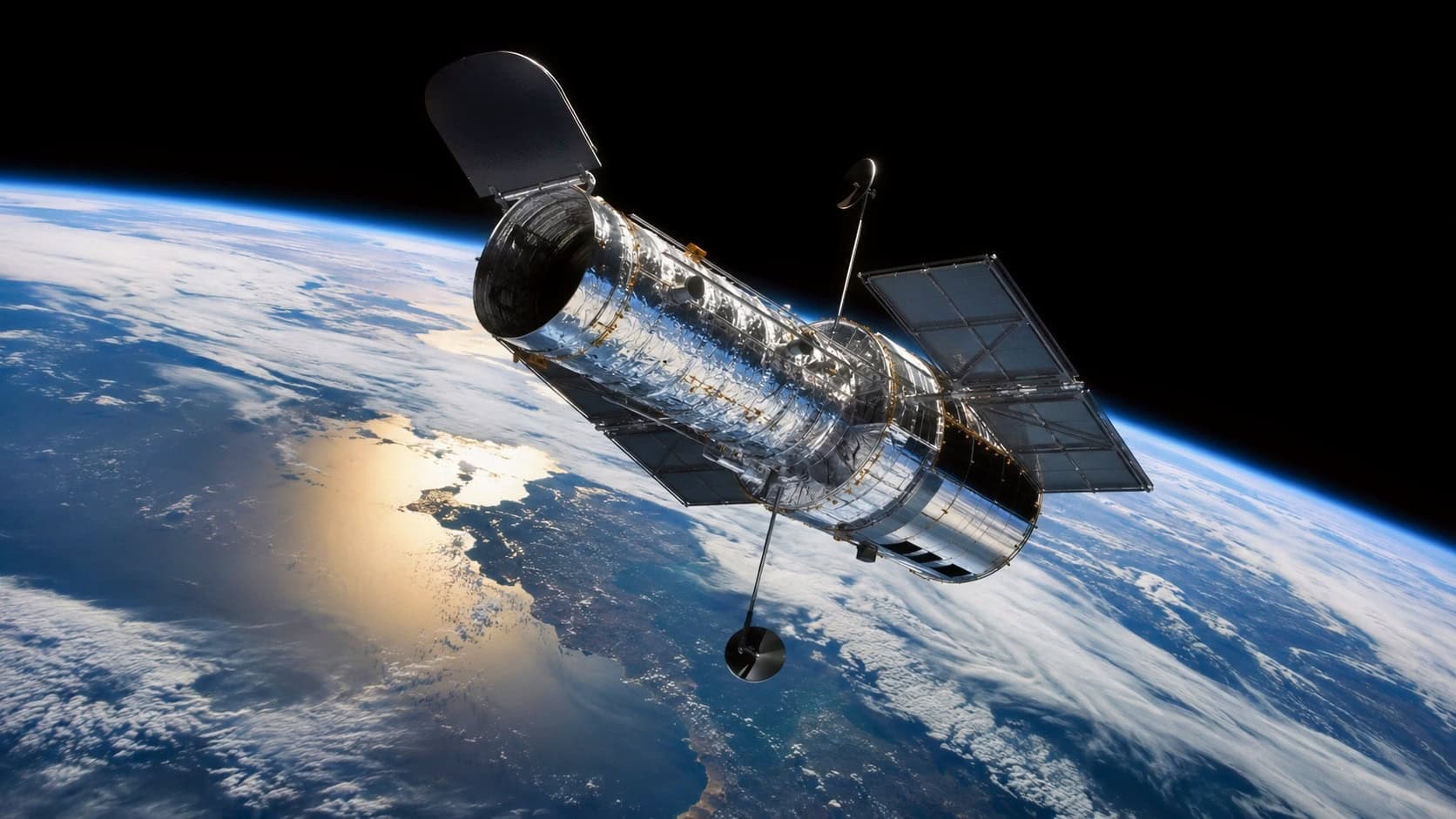
When the Hubble Space Telescope reached orbit in April 1990, it carried what was said to be the most perfectly polished mirror humans had ever made, and it was perfectly wrong. The outer edge had been ground too flat by about 2.2 micrometers, roughly one-fiftieth the width of a human hair, a flaw far too small to see or feel and yet large enough to blur every image the observatory produced. Instead of the sharpest view of the universe ever achieved, Hubble returned fuzzy pictures ringed with halos, barely better than a good telescope on the ground. For three and a half years, it was a punchline and a national embarrassment that nearly took NASA’s credibility, the space station’s funding, and the shuttle program‘s standing down with it.
The cruelest part was that nobody had been careless. The mirror had been polished flawlessly to match a testing instrument that was itself wrong, thrown off by a measurement error of a little over a millimeter.
The flaw was a masterpiece of precision aimed at the wrong target, and the fix, when it came in December 1993, was just as remarkable. Seven astronauts flew the shuttle Endeavor up to the telescope and, in effect, fitted it with eyeglasses.
The Most Perfect Mirror Ever Made
Hubble was the $1.5 billion telescope that was supposed to change astronomy, a school-bus-sized observatory built around a 2.4-meter primary mirror and lofted above the blurring atmosphere to see deeper into space, and further back in time, than any instrument before it.
It was deployed from the space shuttle Discovery on April 25, 1990. The mirror at its heart had been ground and polished at the Perkin-Elmer optics facility in Danbury, Connecticut, to tolerances so demanding that in one sense the contractor succeeded completely. The surface was not sloppy or carelessly made. It was polished with extraordinary precision. It was also the wrong shape.
Hubble Space Telescope: Blurry From The First Images
The first engineering images were better than many ground-based pictures, and for a few weeks, the trouble was not obvious. Then, on a focusing test in late June 1990, the problem became undeniable. Even Hubble’s sharpest shots came back with a crisp core wrapped in a fuzzy halo, and engineers diagnosed the cause as spherical aberration, in which light striking different zones of the mirror focuses at different distances.
NASA announced the flaw publicly on June 27, 1990. Ed Weiler, Hubble’s chief scientist, later described the mood as going from the top of Mount Everest to the bottom of Death Valley. The telescope became a national joke almost overnight, mocked on late-night television and in editorial cartoons, with Maryland Senator Barbara Mikulski, one of Hubble’s strongest backers, dubbing it a “techno-turkey.” In the 1991 film “Naked Gun 2½,” Hubble appeared on a wall of famous disasters alongside the Titanic and the 1906 San Francisco earthquake.
Wrong By One-Fiftieth Of A Hair
The size of the flaw is what makes the story remarkable. The outer edge of the mirror was too flat by about 2.2 micrometers, the figure NASA describes as roughly one-fiftieth the width of a human hair. That sounds almost meaningless until it is multiplied across the geometry of a telescope. Light hitting the outer part of the mirror did not reach the same focus as light hitting nearer the center, resulting in a 2.2-micrometer error in the mirror’s shape that scattered every image into a haze. The flaw was not random roughness. It was smooth, consistent, and precise, which told investigators it was a fabrication error; the mirror was polished exactly to the wrong prescription rather than polished badly.
Polished To Match A Flawed Ruler
The mirror had been shaped using a device called a reflective null corrector, an instrument of two small mirrors and a lens that tells the polishers whether the surface is reaching the right curve. When the 1990 investigation led by Jet Propulsion Laboratory director Lew Allen examined that device, it found a lens out of position, incorrectly spaced from the mirrors by 1.3 millimeters, an offset that accounted in detail for the exact blurring seen in orbit.
The error traced back to how the device had been set up. During assembly, a measuring laser reflected off a flake of paint that had chipped away, exposing bare metal and sending the spacing measurement off its intended point. The null corrector was then trusted as authoritative, and the mirror was polished beautifully to match a ruler that was wrong.
The most painful part is that the flaw was catchable on the ground. Perkin-Elmer had two other test devices that gave readings indicating the mirror had spherical aberration, but the team rejected data from other tests and treated the reflective null corrector as correct.
The Allen investigation criticized Perkin-Elmer’s quality-control practices and NASA for failing to oversee them, and noted that a full end-to-end optical test of the assembled telescope, which NASA had declined to require, would almost certainly have caught the problem. The optics themselves were superb. The process around them was not.
NASA At Its Lowest
The blur landed at the worst possible moment for the agency.
The space shuttle fleet, only recently flying again after the Challenger disaster, was grounded that same summer of 1990 by hydrogen fuel leaks. NASA’s planned space station was years behind and badly over budget, and in June 1993, it survived a vote in the House of Representatives by a single vote, 215 to 216, on an amendment that would have killed it.
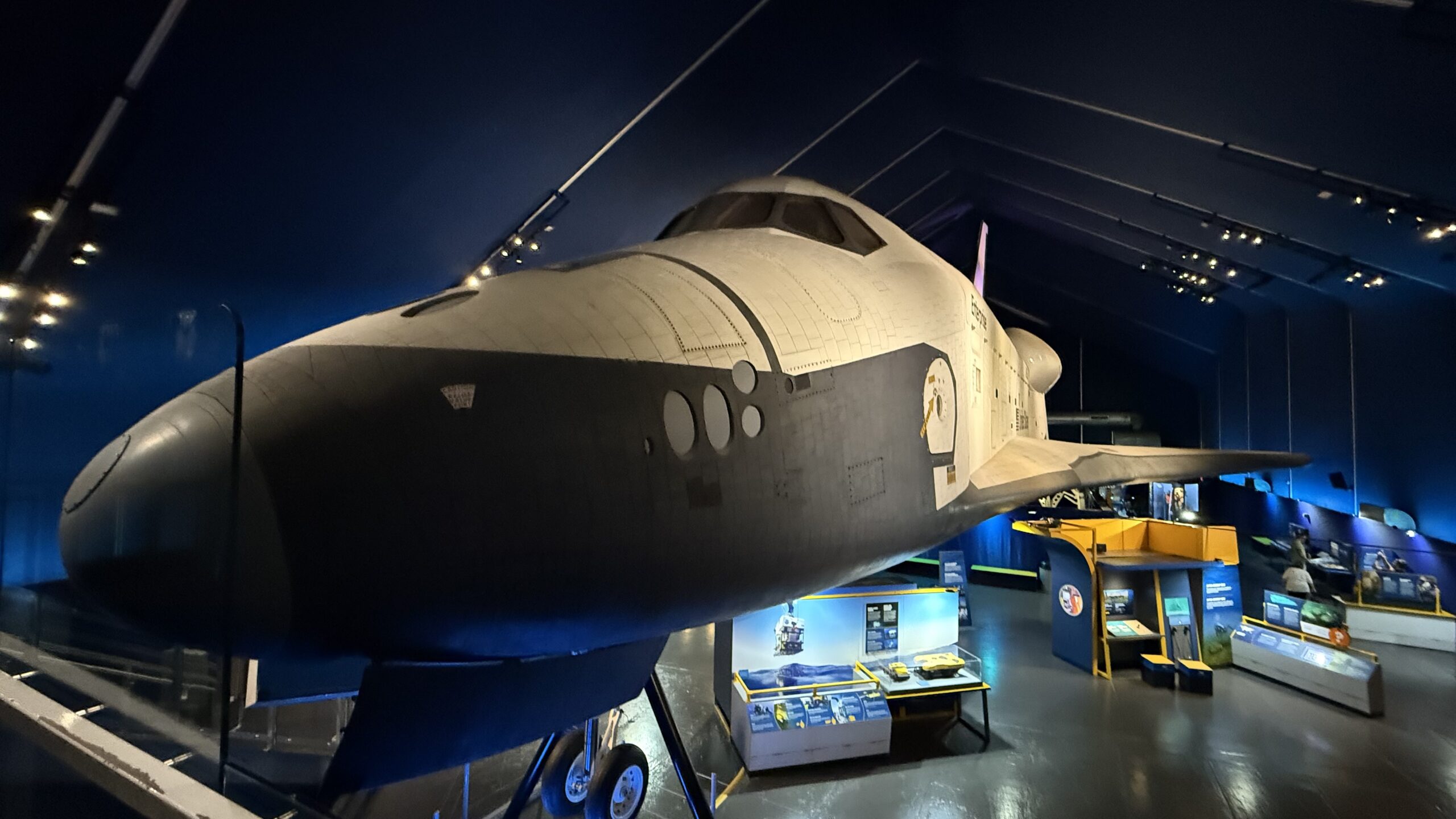
NASA Space Shuttle Onboard USS Intrepid. 19FortyFive.com Image.
Hubble’s fuzzy images had become the public symbol of a NASA that could not get things right. By the time the repair mission flew, as NASA’s own official history put it, the agency’s reputation, the credibility of its shuttle and astronaut corps, and the future of the space station all rode with the crew, who would come back either heroic and vindicated or disgraced. The astrophysicist John Bahcall told the New York Times in 1993 that if the Hubble repair failed, space science could be written off for the foreseeable future.
Giving The Telescope Glasses
The way out came from the precision of the flaw itself. Because the mirror’s exact error was known, opticians could calculate optics with precisely the opposite error to cancel it out, the same logic as a prescription lens.
The fix had two parts. A new camera, the Wide Field and Planetary Camera 2, was built with its own built-in corrective optics and replaced the original, correcting its own light without help. For Hubble’s other instruments, which had no way to build in corrections, engineers at NASA and Ball Aerospace built a refrigerator-sized unit called COSTAR that deployed five pairs of corrective mirrors, some as small as a nickel, on motorized arms to intercept the light and fix it before it reached the instruments behind. Installing COSTAR meant removing one instrument, the High-Speed Photometer, sacrificing one to save the other three.
The repair flew as Servicing Mission 1, aboard the shuttle Endeavor, which launched on December 2, 1993, with a crew of seven veteran astronauts. Over a roughly eleven-day flight, they carried out a record five spacewalks totaling more than 35 hours, the most ever attempted in a single shuttle mission, installing WFPC2 and COSTAR and also replacing the telescope’s solar arrays, gyroscopes, and other components.
It remains one of the most complex crewed missions NASA has ever flown, and it proved that a major observatory could be repaired in orbit.
From Techno-Turkey To The People’s Telescope
The proof came a few weeks later. The first sharp image, a single clean star, came down on December 18, 1993, and in January 1994, NASA unveiled before-and-after pictures of the spiral galaxy M100, blurry in the old view and razor-sharp in the new one.
Weiler called the result fixed beyond our wildest expectations. When he showed Mikulski the comparison images before the press conference, the senator who had called Hubble a techno-turkey looked at them and said it was like putting on my glasses.
From there, the most embarrassing instrument in NASA’s history became arguably its greatest success.
Hubble went on to help prove the existence of supermassive black holes, pin down the age of the universe, capture the Pillars of Creation and the Deep Field images of the earliest galaxies, and study the light of distant supernovae that revealed the universe’s expansion is accelerating, the discovery of dark energy that earned Hubble astronomer Adam Riess a share of the 2011 Nobel Prize in Physics.
Mikulski, who became one of its fiercest defenders, took to calling it The People’s Telescope. COSTAR, having done its job, was removed in 2009 once Hubble’s instruments all carried their own correction, and it now sits in the Smithsonian.
The mirror, polished flawlessly to the wrong shape, by a fraction of a hair, ended up at the center of the most productive telescope ever built, rescued by a crew that flew up and gave it glasses.
About the Author: Harry J. Kazianis
Harry J. Kazianis (@Grecianformula) was the former Senior Director of National Security Affairs at the Center for the National Interest (CFTNI), a foreign policy think tank founded by Richard Nixon based in Washington, DC. Harry has over a decade of experience in think tanks and national security publishing. His ideas have been published in the NY Times, The Washington Post, The Wall Street Journal, CNN, and many other outlets worldwide. He has held positions at CSIS, the Heritage Foundation, the University of Nottingham, and several other institutions related to national security research and studies. He is the former Executive Editor of the National Interest and the Diplomat. He holds a Master’s degree focusing on international affairs from Harvard University.

