
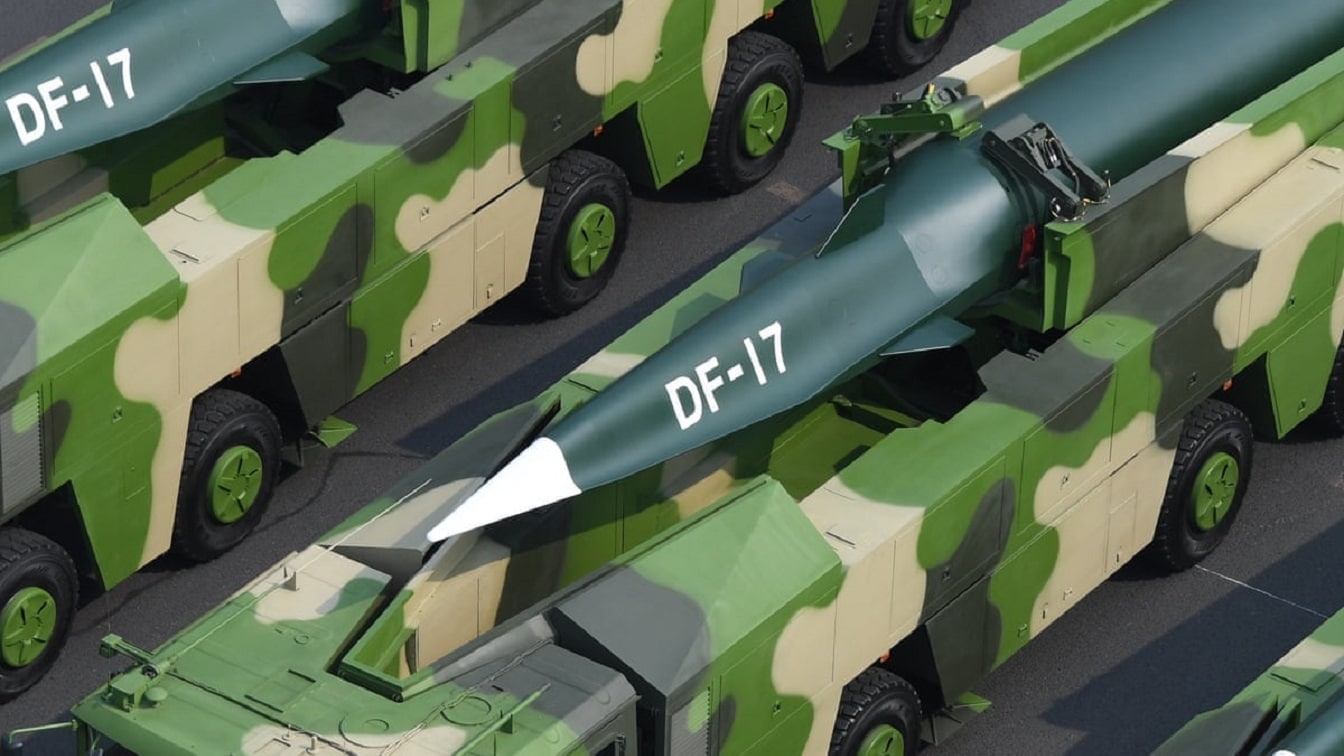
Several days ago, the CCP released footage for the first time showing the launch of a DF-17 hypersonic ballistic missile.
The footage was taken during a joint training exercise in the Gobi Desert. The exercise simulated multiple waves of strikes and included participation by the PLA and PLAAF. Multiple types of missiles were showcased during this exercise, but the highlight was the DF-17, a hypersonic medium-range ballistic missile (MRBM).
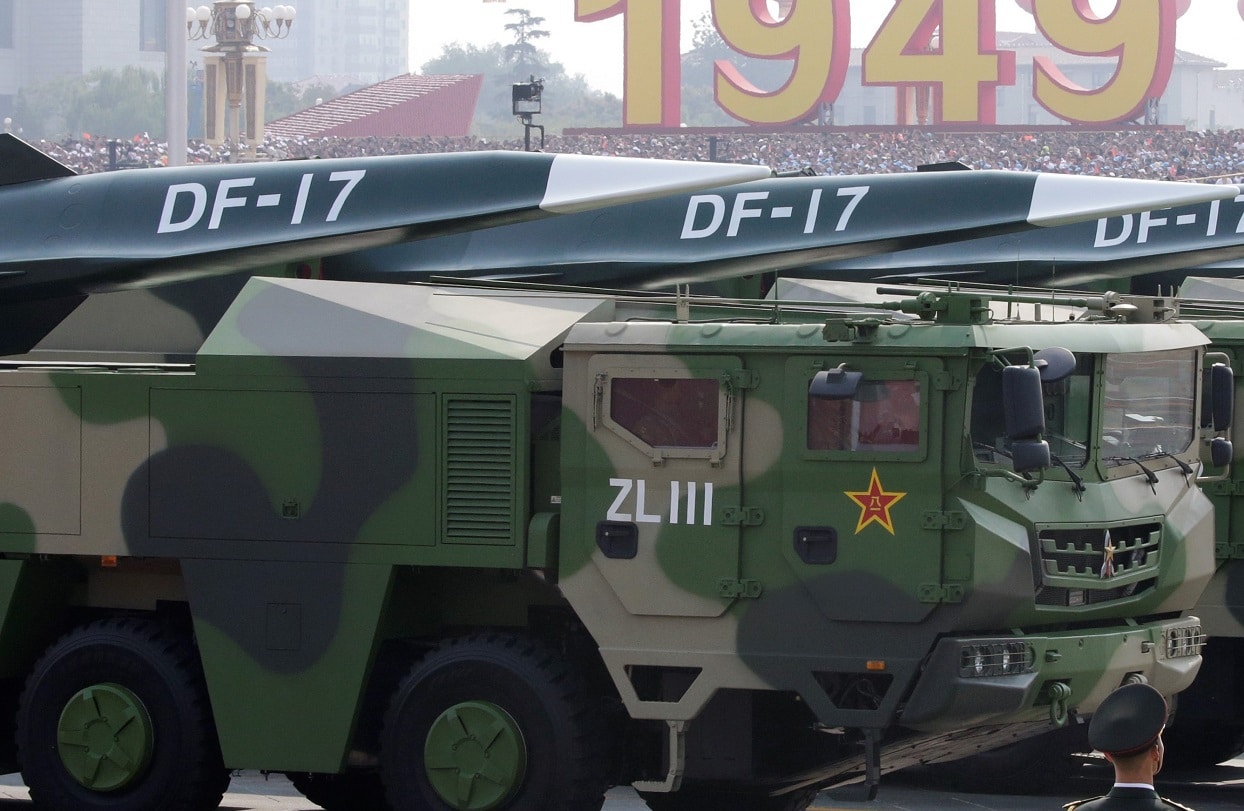
Image of DF-17 missile. Image: Creative Commons.
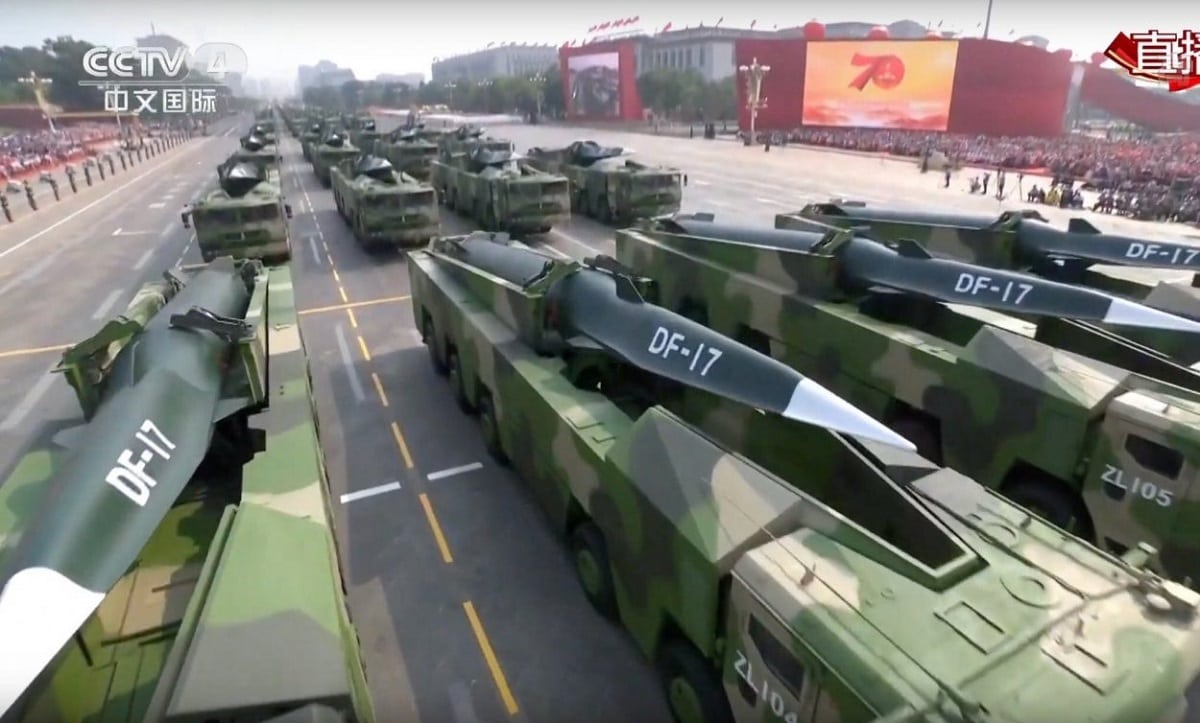
DF-17 Missiles
First revealed in 2017, the system is one of China’s most recent additions to its growing inventory of hypersonic missiles.
China’s DF-17 Revealed
The recent exercise was the first time the DF-17 launch sequence has been shown to the general public. “The exercise took place under field conditions.
The fact that launch vehicles maneuvered across complex terrain indicates that field operations have become the basic mode of combat, rather than conducting military operations in fixed, pre-selected areas,” Du Wenglon, a Chinese military commentator, said to state news channel CCTV.
The exercise, Du continued, was designed to be difficult for the Rocket Forces (PLARF), forcing them to launch in less-than-ideal conditions.
Still, Chinese state news concluded that the PLARF successfully engaged and defeated the enemy with DF-17 and other missiles.
Exercises such as these are a deliberate show of force. The goal of this exercise in particular was to showcase the PLA’s ability to rapidly mobilize and respond to medium/intermediate-range threats.
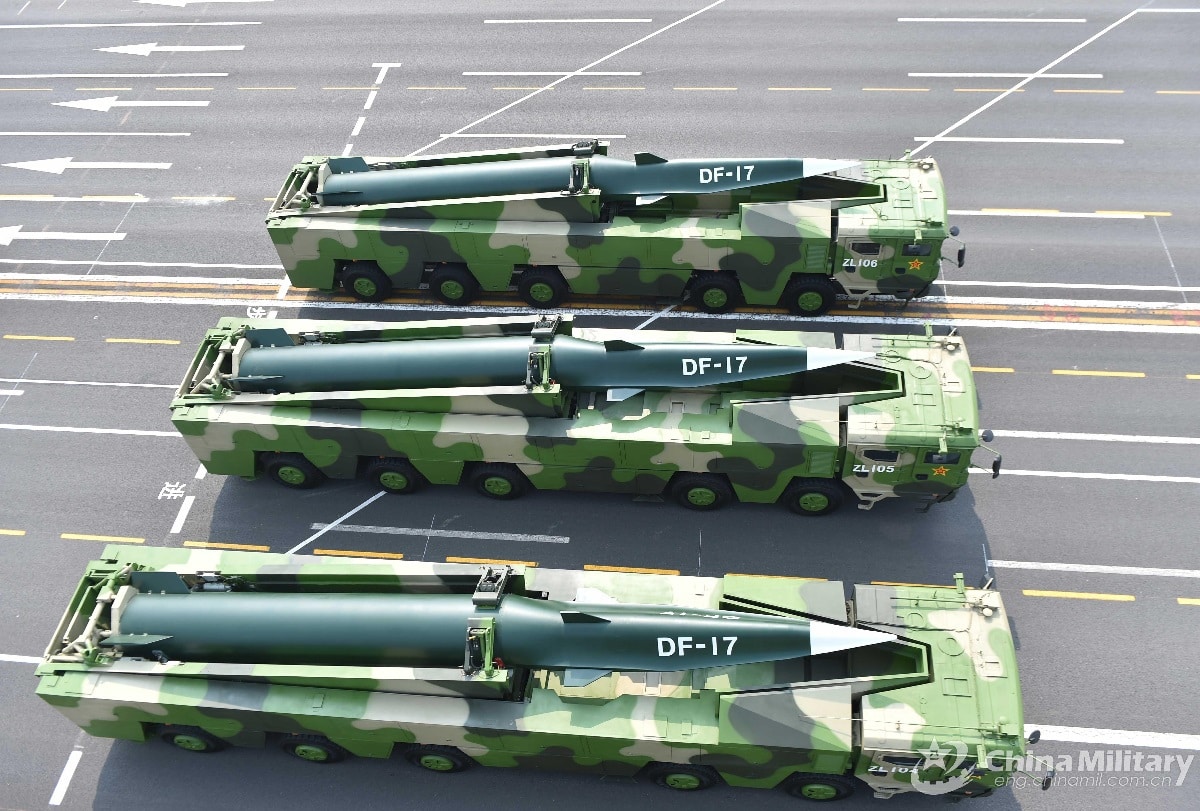
Chinese DF-17 missiles. Image: Chinese internet.

DF-17. Image Credit: Creative Commons.
“The exercise also featured multiple missile types, demonstrating that we have different missiles to respond to different targets and operational scenarios,” Du added.
The fact that this is the first time a DF-17 launch has been displayed to the public is no accident either. The message to the United States is clear: “Mess with us, and you will regret it.”
Training merits aside, military exercises are, at the end of the day, intentional posturing to the enemy.
Specs and Capabilities
The DF-17 is an MRBM, with an operational range generally estimated at 1,800 to 2,500 kilometers. This range allows it to strike targets throughout East Asia, including Taiwan, Japan, and U.S. military installations in the region.
The missile travels at hypersonic speeds, exceeding Mach 5 and potentially reaching Mach 10 under certain conditions.
Like many modern missile systems, the DF-17 can carry both conventional and nuclear payloads, making it a versatile platform for a wide range of military missions.
It is launched from a road-mobile transporter-erector-launcher, which enhances its survivability by allowing it to relocate and avoid detection before launch.
What sets the DF-17 apart from more traditional ballistic missiles is its use of a hypersonic glide vehicle rather than a traditional ballistic warhead.
After the missile is launched, its rocket booster carries the glide vehicle to a high altitude.
At that point, the vehicle separates and reenters the upper atmosphere, where it glides toward its target at extremely high speed.
Unlike conventional ballistic missiles that follow predictable parabolic trajectories, the glide vehicle travels along a flatter, more variable path and can maneuver in flight.
This type of trajectory makes it more difficult for radar systems to track and for missile defenses to intercept.
Another Addition to China’s Hypersonic Arsenal
The development of the DF-17 began in the early 2010s as part of China’s broader effort to incorporate hypersonic weapons into the PLARF. U.S. intelligence agencies first detected tests of what would later become the DF-17 in 2014, when the system was referred to as the Wu-14.
Between 2014 and 2017, China conducted a series of test flights, gradually improving the vehicle’s performance and reliability.
By November 2017, tests had successfully integrated the missile booster with the glide vehicle, demonstrating a fully functional system.
The DF-17 was publicly revealed during a military parade on October 1, 2019, and it subsequently entered operational service with the PLA Rocket Force.
The DF-17 is also designed for precision strike missions. Its guidance system is believed to incorporate a combination of inertial navigation and terminal guidance, enabling it to strike high-value targets such as military bases, air defense installations, and potentially moving naval forces with high accuracy.
The missile could, many analysts speculate, be used to strike naval assets such as aircraft carriers or their escort vessels, as it would be nearly impossible for most air defense systems to intercept.
Is the DF-17 a Threat to the U.S.?
Many aspects of the DF-17 remain highly classified. According to some reports, the missile is capable of carrying nuclear warheads, although the CCP has yet to officially confirm this.
The missile’s conventional payload size is also classified, so it is unknown how much damage the missile can cause if it were to, say, hit an aircraft carrier.
This ambiguity is likely intentional on China’s part, as it adds a layer of uncertainty to any U.S. planning. Is the missile a threat? Is it a simple scare tactic from the CCP? Who knows.
On paper, the missile poses a significant threat to U.S. and allied assets near mainland China.
Because of the missile’s advanced guidance systems, it is capable of striking both hardened bases and moving warships.
Combined with China’s other arsenal of short-range and long-range ballistic missiles, the DF-17 fits in with a comprehensive and deadly network of missile systems to attack any adversary within its claimed territory.
In practice, however, it remains unclear how capable China’s hypersonics are. Given the CCP’s policy, it will likely remain this way until a missile impacts an American aircraft carrier.
About the Author: Isaac Seitz
Isaac Seitz, a Defense Columnist, graduated from Patrick Henry College’s Strategic Intelligence and National Security program. He has also studied Russian at Middlebury Language Schools and has worked as an intelligence Analyst in the private sector.