A great debate has raged among astronomers for many years as to how many planets there really are in the Solar System.
When I was a kid, there were nine planets. At some point in my life, without me realizing it much, the scientific community reduced that number by one, declaring that Pluto, the farthest planet from the sun, was too small to be a planet.
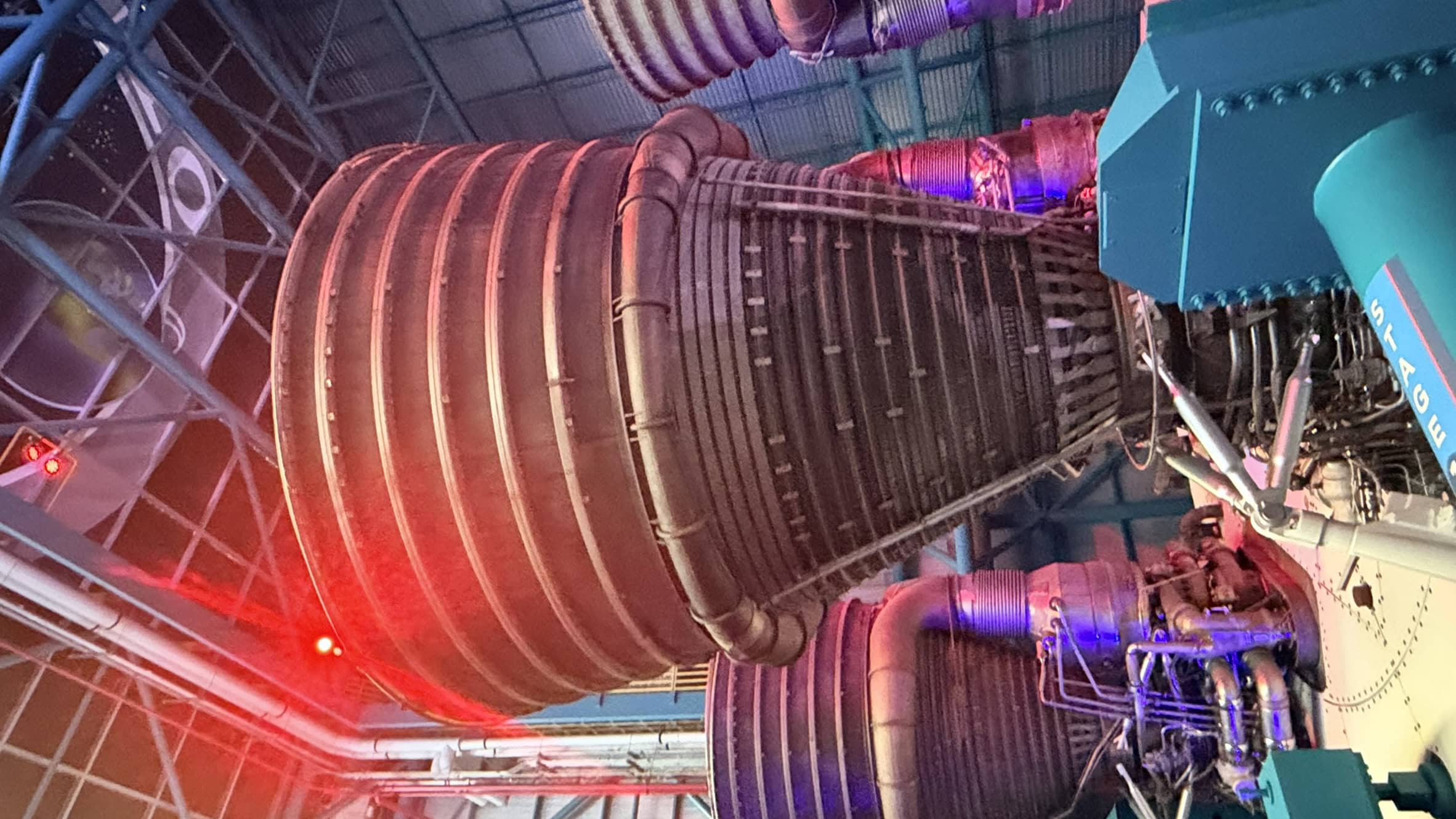
Saturn V Rocket. 19FortyFive.com Original Image.
The new consensus associated Pluto with the dwarf planets in the Kuiper Belt, that string of celestial bodies–what some think are proto-planets–orbiting just outside our Solar System.
However, not all scientists are on board with excluding Pluto from our Solar System.
Regardless, we know there are nearly 1,000 confirmed natural moons in our Solar System. And many of them orbit the same planet.
Which means the world’s space programs are not only interested in exploring the other eight (maybe nine soon, once more?) planets of the Solar System. Back in 1988, the Soviet Union wanted to explore Mars’s two moons, specifically Phobos.
The Soviet Phobos program represented one of the most ambitious planetary exploration efforts of the late Cold War.
Unlike earlier Soviet Mars missions that focused on the Red Planet itself, Phobos 1 and Phobos 2 were designed to investigate both Mars and the Red Planet’s enigmatic moon, Phobos.
Had the program succeeded completely, it would have achieved the first landing on a Martian moon and the first operation of a mobile robot there.
Unfortunately, the missions became another chapter in the Soviet Union’s long history of spectacular engineering coupled with heartbreaking failures.
Mock Engine Test at NASA Kennedy Space Center on 6/28/2026. Taken by Harry J. Kazianis.
Why Phobos?
By the mid-1980s, Soviet planners wanted to leap beyond simple Mars flybys and orbiters. Their objectives were to study Mars from orbit and to map its atmosphere and surface. Scientists were interested in examining the interaction between the solar wind and Mars.
Interestingly, it has been determined that Mars’ magnetosphere was weakened billions of years ago, allowing the continuous solar wind to erode the planet’s unprotected atmosphere over time.
The Soviets wanted to examine Phobos more closely by landing two scientific stations on the strange moon.
At the time, Phobos fascinated scientists because nobody knew its origin. Some believed it was a captured asteroid.
Others argued it might have formed alongside Mars. Understanding its composition promised clues about the Solar System.
An International Mission
Although it is remembered as a Soviet mission, Phobos involved scientists from 14 countries. Researchers from France, Sweden, Austria, West Germany, Switzerland, and even the United States contributed instruments.
NASA also provided tracking support through its Deep Space Network.
This international cooperation made Phobos one of the largest scientific collaborations undertaken during the Cold War.
A Flying Laboratory
The spacecraft themselves were enormous.
Fully fueled, each probe weighed over 6,200 kilograms, making them among the largest interplanetary spacecraft ever launched at the time.
They carried an astonishing suite of instruments, including visible and infrared cameras, thermal imagers, spectrometers, X-ray and gamma-ray detectors, plasma analyzers, magnetometers, laser and radar altimeters, dust detectors, and solar observatories.
The mission wasn’t simply about taking pictures. It was intended to study Mars as an entire planetary system.
The Two Landers
Perhaps the most innovative aspect of the mission was its pair of Phobos landers. One was a stationary science platform.
The other, called PROP-F, was extraordinary. Rather than driving on wheels, it would move by employing controlled hops across the moon’s tiny gravity field.
Because Phobos’ gravity is roughly 2,000 times weaker than Earth’s, a wheeled rover would have struggled for traction.
Engineers instead designed a robot capable of jumping from location to location while carrying instruments to analyze rocks, magnetic fields, and surface chemistry.
It would have been humanity’s first hopping robot on another world.
Phobos 1: Lost to Human Error
The first spacecraft was launched in July 1988.
Everything appeared normal until ground controllers uploaded a routine software command. One command accidentally turned off the spacecraft’s attitude-control system.
Without that attitude control, the spacecraft could no longer point its solar panels toward the sun.
Its batteries are drained. Communications ceased forever.
The spacecraft never reached Mars. It remains one of the most infamous software mistakes in the history of Spaceflight.
Phobos 2 Reaches Mars
The second spacecraft launched only days later. This one succeeded. After a seven-month cruise, it entered Martian orbit in January 1989. For nearly two months, it performed an impressive scientific campaign.
Phobos 2 studied the dust surrounding Mars, the solar wind, magnetic fields, energetic particles, and Phobos itself. It also returned 37 high-resolution images of Phobos, many revealing details as small as roughly 40 meters across.
Until much later, spacecraft visited the moon, providing humanity’s best close-up views.
New Science
The mission produced significant scientific results despite ending prematurely. Infrared observations helped produce some of the first mineralogical maps of Mars.
Scientists investigated atmospheric aerosols, plasma interactions, and the Martian bow shock, where the solar wind encounters the planet.
The mission also greatly improved understanding of Mars’ magnetic environment and how the solar wind strips particles from the Martian atmosphere.
These results led to dozens of scientific papers in the early 1990s.
The Final Failure
Everything depended on the final encounter. The spacecraft was supposed to approach within roughly 50 meters of Phobos before releasing both landers.
Instead, on March 27, 1989, communications suddenly stopped.
Subsequent investigations concluded that the most likely culprit was the onboard computer, although problems with the spacecraft’s radio transmitter may also have contributed.
By the time the spacecraft reached Mars, multiple onboard computers were already malfunctioning, leaving little redundancy.
Neither lander ever deployed.
The mission ended just days before what would have been its greatest achievement.
The Television Images
Nature describes remarkable observations of Phobos 2 during its close approaches to the moon.
Those images revealed substantial variations in surface brightness, grooves, and crater fields, evidence of different geological terrains, and important clues about the moon’s composition and history.
These observations significantly expanded scientists’ understanding of Phobos and remained among the best available until much later missions.
Plasma Physics Around Mars
A 1988 paper in Spaceflight discussed the scientific objectives and instrumentation before the doomed spacecraft reached Mars.
According to the authors of that nearly 40-year-old paper, many of the key experiments involving the plasma surrounding Phobos, Mars’ atmosphere, and the other objectives discussed in the previous section succeeded.
So, the Phobos mission was not a total failure despite the catastrophes that befell the two probes.
Legacy
The Phobos program became a symbol of both Soviet ambition and misfortune. At the time of the mission, the Soviet Union itself was in its death throes.
Like so many things the Soviets were developing at this time, the program’s reach extended.
Indeed, the engineering was genuinely ahead of its time. A hopping robot on another celestial body would not become a mainstream concept for decades.
The mission also showcased unusually broad international scientific cooperation, despite the Cold War.
Here again, though, that level of cooperation, understood within the framework of the Mikhail Gorbachev-era reforms then sweeping across the USSR, explains the unusual level of international cooperation the Soviets enjoyed on this mission.
Yet, the program reinforced a painful pattern in Soviet, and later Russian, planetary exploration: technically brilliant spacecraft repeatedly undone by software faults, electronics failures, or launch problems.
Neither the follow-on Mars 96 mission nor Forbos-Grunt succeeded, leaving Phobos as one of the Solar System’s most elusive exploration targets.
Even so, Phobos 2 was far from a complete failure.
It successfully reached Mars, conducted nearly two months of valuable science, returned humanity’s best images of Phobos for many years, and laid important groundwork for future exploration of Mars and its mysterious moons.
About the Author: Brandon J. Weichert
Brandon J. Weichert is the Senior National Security Editor at 19FortyFive.com. He also manages The Weichert Brief on Substack. Weichert also hosts “National Security Talk” on Rumble. He is the author of four bestselling national security books, the most recent of which is A Disaster of Our Own Making: How the West Lost Ukraine (Encounter Books). Follow him via Twitter/X @WeTheBrandon.