
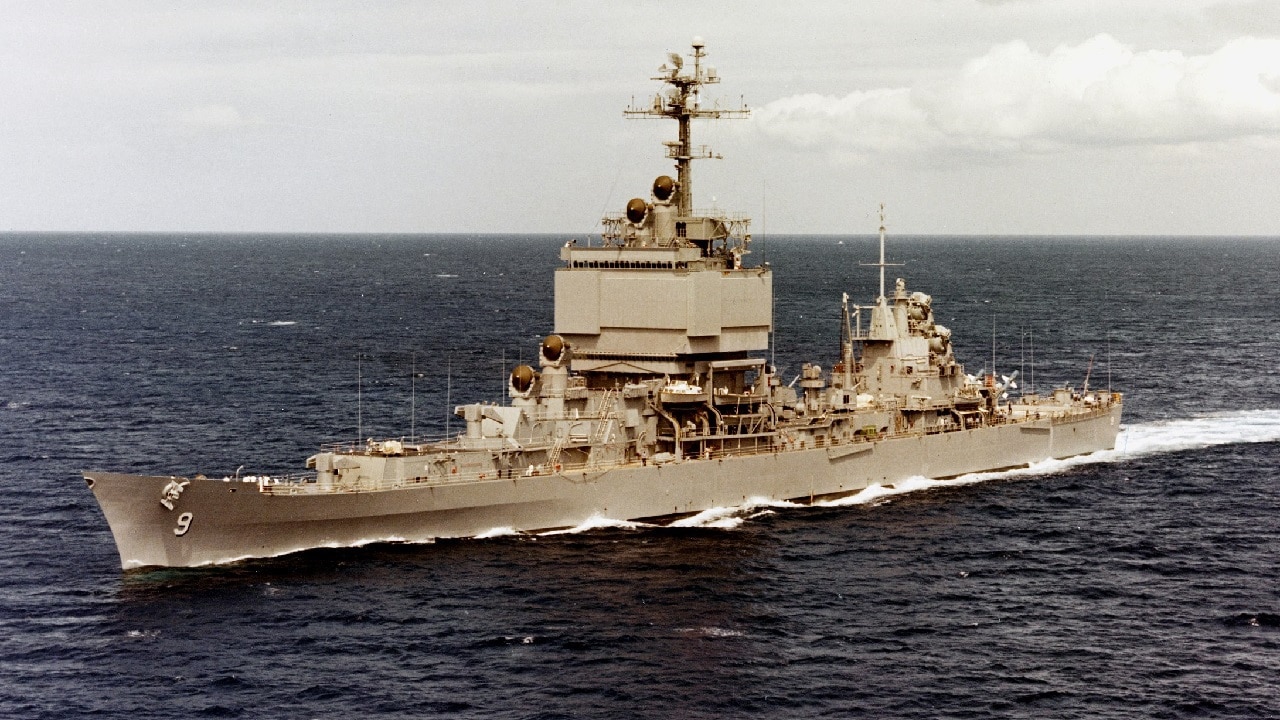
The remaining hull of ex-USS Long Beach (CGN-9) sits at Puget Sound Naval Shipyard and Intermediate Maintenance Facility, stripped of the superstructure that once made it one of the most recognizable warships in the U.S. Navy. The bow and stern are gone. The reactors have been defueled. The ship that entered service in 1961 as the first nuclear-powered surface warship in history is now listed by the Navy as stricken, with final disposition pending, according to the service’s Naval Vessel Historical Evaluation.
That is a hard ending for a ship that once represented a serious bet on the future of sea power. Long Beach was built as a guided-missile cruiser at the moment when the Navy was absorbing two technological revolutions at once: nuclear propulsion and long-range naval missiles. It was a 721-foot warship with two C1W nuclear reactors, two General Electric turbines, 80,000 shaft horsepower, and enough range to make fuel logistics look like an old limitation. It carried Talos and Terrier missiles, later Standard ER missiles, ASROC, guns, Phalanx, Harpoon, and Tomahawk cruise missiles as the Navy modernized the ship across more than three decades of service.
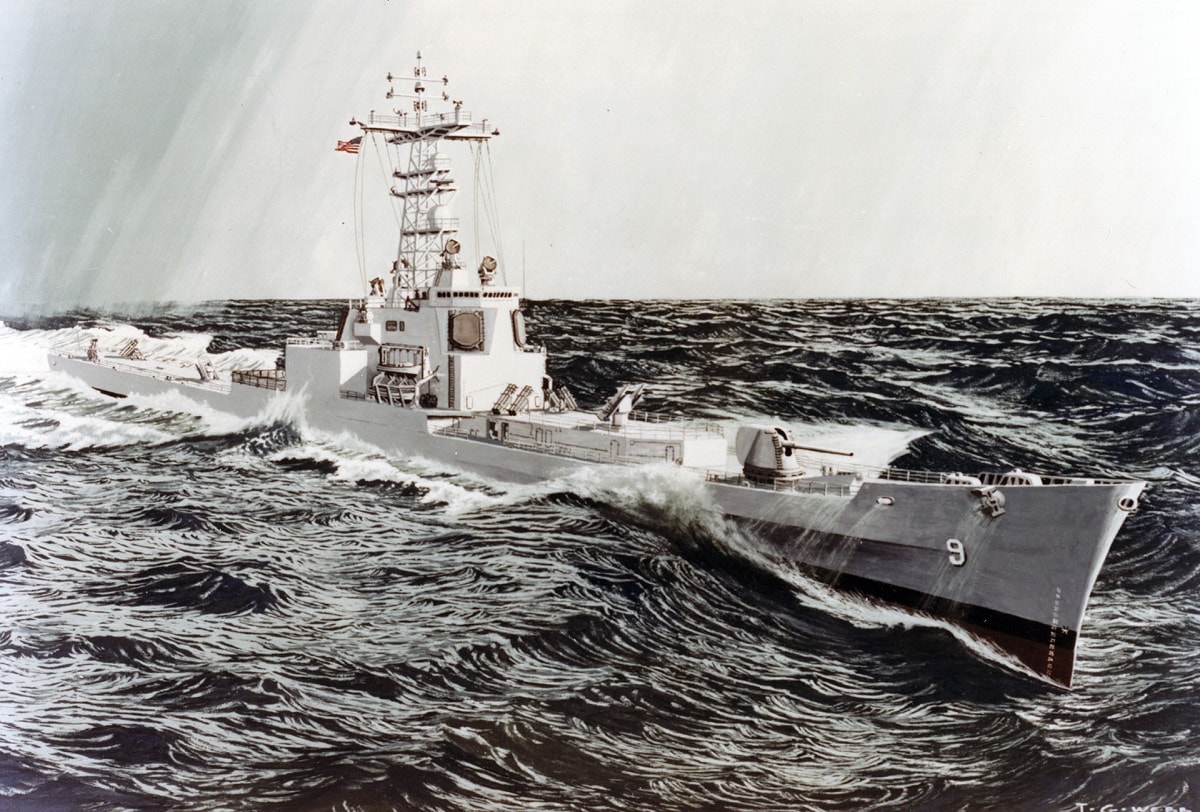
USS Long Beach. Image: Creative Commons.
The ship’s career explains why nuclear power looked so attractive to Cold War planners. Its current disposal process explains why the Navy later confined nuclear surface propulsion mostly to aircraft carriers, while the cruiser force returned to conventional power. Long Beach proved that a nuclear cruiser could work. The Navy’s later fleet showed that endurance alone did not settle the cost, maintenance, manning, modernization, and disposal questions that came with such a ship.
USS Long Beach CGN-9 Is Now A Puget Sound Disposal Case
The current story began to move again in 2026. On April 7, Naval Sea Systems Command opened a public comment period on the Navy’s determination that ex-Long Beach was ineligible for listing in the National Register of Historic Places. The NAVSEA notice stated that the ship had been decommissioned in 1995 and was moored at Puget Sound Naval Shipyard and Intermediate Maintenance Facility awaiting final disposition. The comment period closed June 7.
That process matters because federal agencies have to consider historic properties before taking actions that could affect them. The Advisory Council on Historic Preservation explains that Section 106 of the National Historic Preservation Act requires federal agencies to consider the effects of projects they carry out, assist, fund, permit, license, or approve. In Long Beach’s case, the Navy concluded that the ship no longer retained enough historic integrity for listing. The official evaluation says the superstructure, main armament, bow, stern, and other defining features had been lost.
As of June 29, 2026, the Navy had also moved into the contracting-planning phase. A federal contracting notice for “Defueled Ex-Long Beach (CGN 9) Transportation & Disposal” describes market research for companies able to transport, dismantle, demilitarize, and dispose of the cruiser, including its defueled reactor plants. An industry day was held June 24 and 25 in Washington, with white paper responses due July 10. The notice was an RFI, and the Navy had not yet awarded a disposal contract.
The practical meaning is clear enough. The famous ship is already far removed from its 1960s appearance. The remaining structure now represents a nuclear-ship disposal requirement rather than a complete cruiser waiting for preservation.
USS Long Beach Was Built For A Nuclear And Missile-Age U.S. Navy
Long Beach was laid down on Dec. 2, 1957, at Bethlehem Steel’s Fore River Shipyard in Quincy, Massachusetts, launched on July 14, 1959, and commissioned on Sept. 9, 1961, at Boston Naval Shipyard. The official Navy history identifies her as the first nuclear-powered surface warship in history, a distinction that placed the cruiser in the same early nuclear fleet story as USS Nautilus and USS Enterprise.
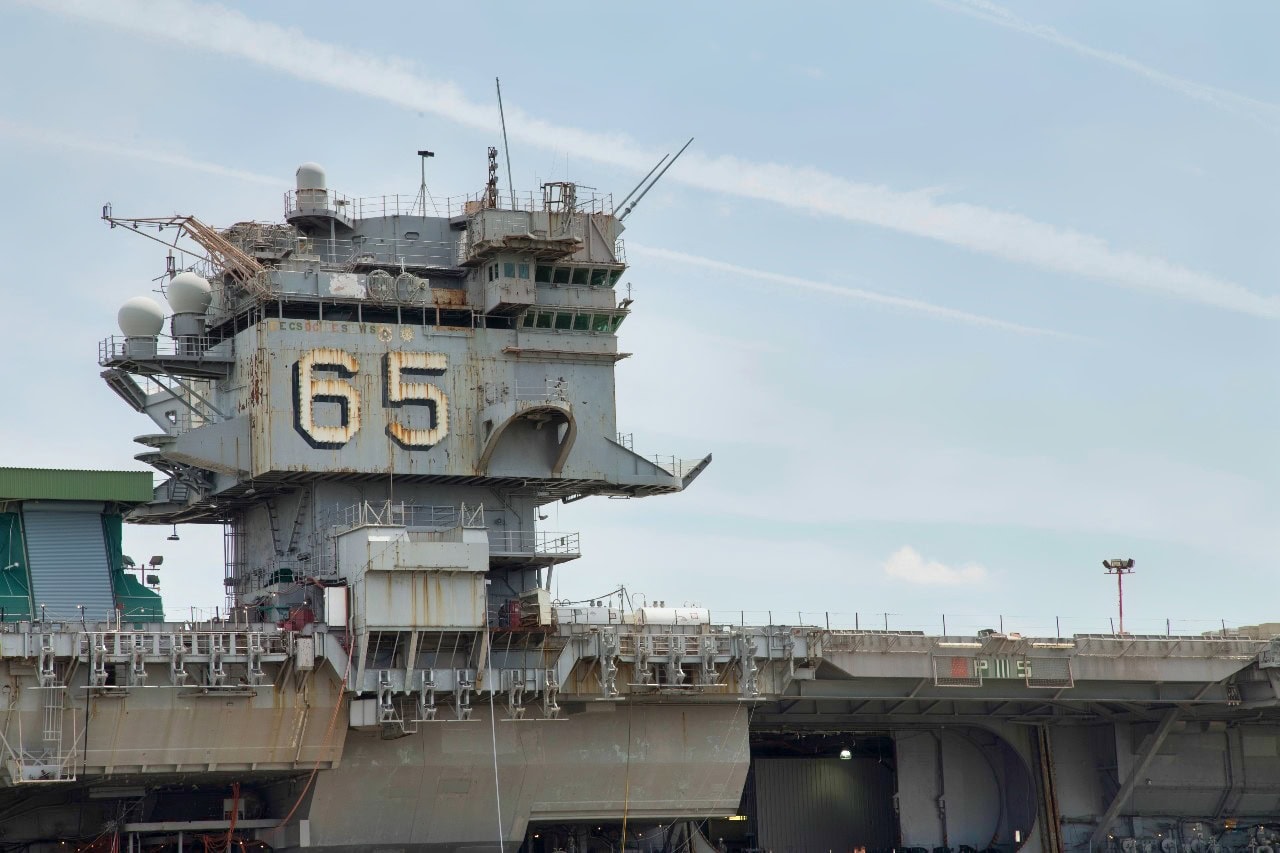
NEWPORT NEWS, Va. (July 15, 2018) — USS Enterprise (CVN 65) sits pierside at Newport News Shipbuilding following its decommissioning in February 2017. (U.S. Navy photo by Mass Communication Specialist 2nd Class Cat Campbell/RELEASED)
The design was unusual even by Cold War standards. The Navy evaluation identifies Long Beach as the sole member of her class and the last U.S. Navy cruiser built on a traditional cruiser hull. All later U.S. cruisers, according to that evaluation, were built on scaled-up destroyer hulls. That alone makes Long Beach historically important, quite apart from the nuclear plant.
The ship was also a missile-age experiment. Earlier cruisers carried large guns as their defining weapons. Long Beach was designed around radars, air defense missiles, anti-submarine weapons, and the expectation that modern fleet defense would be fought at ranges far beyond the old gun line. Its original missile outfit included Talos and Terrier systems, while later modernization brought Standard ER missiles and Tomahawk armored box launchers after the Talos launcher was removed. The ship’s armament changed because the Navy around it changed.
Long Beach was an operational test of a serious proposition: a surface combatant that could escort nuclear carriers, provide fleet air defense, and keep pace with fast-moving carrier task forces without needing oilers to sustain propulsion.
Operation Sea Orbit Made USS Long Beach A Global Demonstration
Long Beach’s most famous deployment came in 1964, when the Navy assembled the first all-nuclear-powered surface task group. The formation included USS Enterprise, USS Long Beach, and USS Bainbridge. A Navy photo record from June 1964 shows the three ships operating together in the Mediterranean, with Enterprise, Long Beach, and Bainbridge in formation and Enterprise’s crew spelling out Einstein’s equation on the flight deck.
Operation Sea Orbit was designed to send a message about mobility. Long Beach, Enterprise, and Bainbridge sailed around the world without the normal fuel logistics that constrained conventionally powered warships. The Navy’s evaluation states that during 58 steaming days Long Beach covered more than 30,000 miles at an average speed of 25 knots without being refueled or resupplied. Foreign dignitaries visited during calls connected to the voyage, including Karachi, Melbourne, Wellington, and Rio de Janeiro.
That voyage showed the strongest case for nuclear-powered surface forces. A task group that did not need propulsion fuel had more freedom to move at sustained high speed. It could shift between theaters with fewer logistical pauses. It also gave Washington a public demonstration of American technical power at a time when nuclear technology carried enormous strategic symbolism.
Nonetheless, the voyage also underscored a distinction that would matter later. Nuclear propulsion solved the fuel problem for the ship’s engines. It did not remove every other demand associated with operating a surface combatant. Crews still needed food, weapons still had magazine limits, equipment still required maintenance, and every nuclear-powered hull brought specialized training and shipyard burdens.
USS Long Beach Served In Vietnam, The Persian Gulf, And The Cold War Fleet
Long Beach served for more than 33 years, from 1961 until decommissioning and striking on May 1, 1995. The Navy evaluation lists deployments to the Mediterranean, the Gulf of Tonkin, the Western Pacific, the Indian Ocean, the Persian Gulf, and other operating areas. It records repeated Vietnam service periods, a Navy Unit Commendation for 1968, a Combat Action Ribbon for April 26, 1972, participation in Kuwaiti tanker reflagging, and anti-aircraft cover during Operation Nimble Archer in 1987.
That long service record is important because it prevents an easy dismissal of the nuclear cruiser idea. Long Beach was expensive and unusual, but the ship operated in the real fleet, was deployed repeatedly, received major modernizations, and remained relevant enough to carry newer weapons as the Cold War evolved. By the time Tomahawk launchers appeared on the ship, Long Beach had moved far beyond its original early-1960s configuration.
The ship also sat at the center of a fleet that was changing around aircraft carriers. Nuclear carriers made sense because a carrier’s air wing, flight operations, electrical demands, speed, and endurance all benefited from a huge propulsion plant and long service life. Nuclear submarines made even more obvious sense because nuclear power transformed undersea endurance. For surface escorts, the equation was harder. A cruiser gained range and speed endurance, but it still carried the cost and complexity of a nuclear propulsion crew and nuclear maintenance base while fighting with missiles and sensors that aged quickly.
The Navy did build other nuclear-powered cruisers and cruiser-type ships after Long Beach, including Bainbridge, Truxtun, the California class, and the Virginia class. The experiment did not stop with one hull. However, the U.S. nuclear cruiser force disappeared after the Cold War. The broader nuclear-powered naval world remains dominated by submarines and aircraft carriers, a pattern reflected in the World Nuclear Association’s updated survey of nuclear-powered ships, which notes that nuclear power is especially suited for vessels that need long periods at sea without refueling and lists U.S. nuclear propulsion today around aircraft carriers and submarines.
The U.S. Navy Walked Away From Nuclear Cruisers
The simplest explanation for Long Beach’s place in history is also the most useful one. Nuclear power gave the ship extraordinary propulsion endurance, but the Navy eventually judged that the payoff was greater for carriers and submarines than for cruisers.
A nuclear cruiser still needed escorts, ammunition, aircraft support, ports, overhauls, trained nuclear personnel, and specialized industrial capacity. The ship also needed periodic modernization because the combat system mattered as much as the propulsion plant. A conventional cruiser with modern missiles and sensors could perform most escort missions at lower nuclear-support cost, provided the fleet’s logistics network could support it.
The Ticonderoga-class cruisers that followed were conventionally powered. They were built around the Aegis combat system rather than nuclear propulsion. That reflected where the Navy placed its operational priority for surface combatants: air defense command, missile capacity, and fleet integration. A nuclear plant extended propulsion endurance, but the Navy bought large numbers of conventionally powered Aegis cruisers instead.
Long Beach therefore became a one-ship symbol of a path the Navy considered, tested, and then narrowed. Nuclear power remained central to the submarine force and aircraft carriers. Surface combatants moved in another direction. That decision looks even more significant now as the Navy struggles with cruiser retirements, destroyer production, missile capacity, and shipyard limits. Long Beach’s story belongs to that wider industrial history because advanced capability still depends on what the Navy can afford to build, crew, modernize, and dispose of over a full service life.
Ex-Long Beach Shows The Back-End Cost Of Nuclear Warships
The current disposal process is a final chapter in that full-life calculation. EPA’s public explainer on nuclear vessels describes the basic process for retired nuclear ships: nuclear fuel is removed, reactor compartments are cut out, sealed, transported, and disposed of at approved sites, and remaining ship materials are eventually dismantled and recycled. That is a regulated, specialized process even after a reactor has been defueled.
Long Beach went through major deactivation work long ago. After the 1994 deactivation ceremony at Norfolk, the ship was towed to Newport News Shipbuilding, where the entire superstructure was removed, and the reactors were defueled. The hull then moved through the Panama Canal to the Puget Sound Naval Shipyard, where it has waited to be recycled. In 2015, Puget Sound completed a limited-scope hull preservation availability that removed the bow and stern.
That history explains the Navy’s National Register conclusion. Long Beach remains historically significant as an idea and as a former ship, but the remaining hull no longer carries much of the physical form that made the cruiser recognizable. The Navy’s finding uses the language of preservation law, but the point is practical: too much of the original ship has already been removed.
The cost issue also extends beyond Long Beach. A 2018 GAO report on the ex-USS Enterprise found that dismantling and disposing of the first nuclear-powered aircraft carrier could cost more than $1 billion, depending on the option chosen, and raised questions about oversight and regulation. Enterprise was a far larger and more complex ship than Long Beach, with eight reactors rather than two. The comparison still helps explain why nuclear-ship disposal is a serious government program rather than ordinary scrap work.
That back-end burden does not erase what Long Beach accomplished. It does explain why nuclear propulsion has to justify itself over decades. The costs do not end when the ship leaves the fleet. They continue through defueling, storage, dismantlement, transportation, waste handling, environmental compliance, and final disposal.
USS Long Beach And The Limits Of Nuclear Surface Power
Long Beach deserves a larger place in public memory than it usually receives. The ship was the first nuclear-powered surface warship in history, the only ship of its class, the last U.S. cruiser built on a traditional cruiser hull, and a central participant in Operation Sea Orbit. It served in Vietnam, through late Cold War operations, and into the early post-Cold War period. It carried several generations of weapons during a career that began in the Kennedy years and ended after Desert Storm.
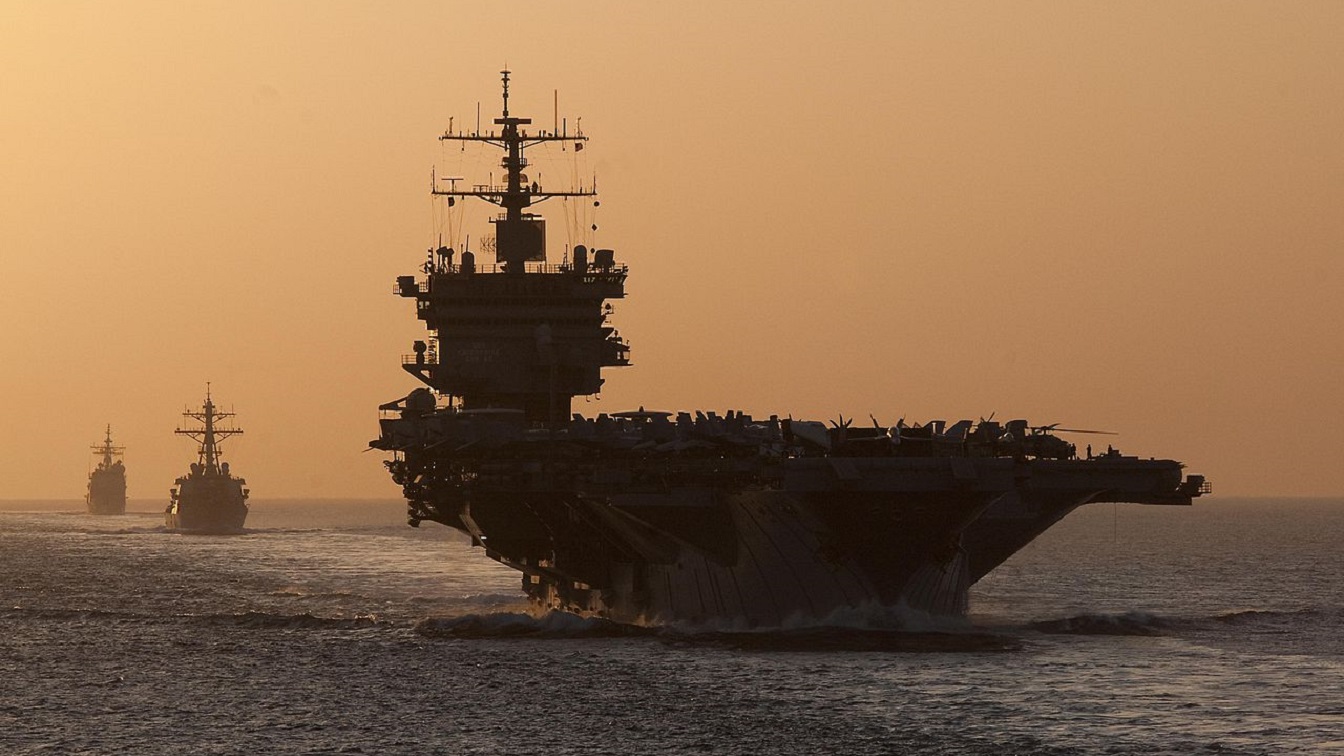
The aircraft carrier USS Enterprise, right, the guided-missile destroyer USS Porter (DDG 78) and the guided-missile cruiser USS Vicksburg (CG 69) transit back to their homeport of Norfolk, Va. Enterprise, Porter and Vicksburg are returning from a deployment to the U.S. 5th Fleet area of responsibility, where the ship conducting maritime security operations, theater security cooperation efforts and support missions for Operation Enduring Freedom. (U.S. Navy photo by Mass Communication Specialist 3rd Class Jeff Atherton/Released).
The Navy’s final judgment on nuclear cruisers was more restrained than the optimism that surrounded the early nuclear fleet. Nuclear power survived where its advantages were overwhelming. Submarines gained undersea endurance that diesel-electric boats could not match. Aircraft carriers gained sustained high-speed operations and the electrical and steam capacity needed for large flight decks. Cruisers gained range, but they did not escape the rest of the surface fleet’s economics.
As of June 29, 2026, the remnant of ex-Long Beach is no longer a complete cruiser. It is a defueled nuclear-powered warship hull awaiting disposal through a federal process that will require specialized industrial capacity. That is the ending now attached to one of the most ambitious surface combatants the U.S. Navy ever built.
Long Beach proved that a nuclear cruiser could steam with extraordinary freedom. The Navy never made that model the standard for its surface combatant fleet.
About the Author: Harry J. Kazianis
Harry J. Kazianis (@Grecianformula) was the former Senior Director of National Security Affairs at the Center for the National Interest (CFTNI), a foreign policy think tank founded by Richard Nixon based in Washington, DC. Harry has over a decade of experience in think tanks and national security publishing. His ideas have been published in the NY Times, The Washington Post, The Wall Street Journal, CNN, and many other outlets worldwide. He has held positions at CSIS, the Heritage Foundation, the University of Nottingham, and several other institutions related to national security research and studies. He is the former Executive Editor of the National Interest and the Diplomat. He holds a Master’s degree focusing on international affairs from Harvard University.

