
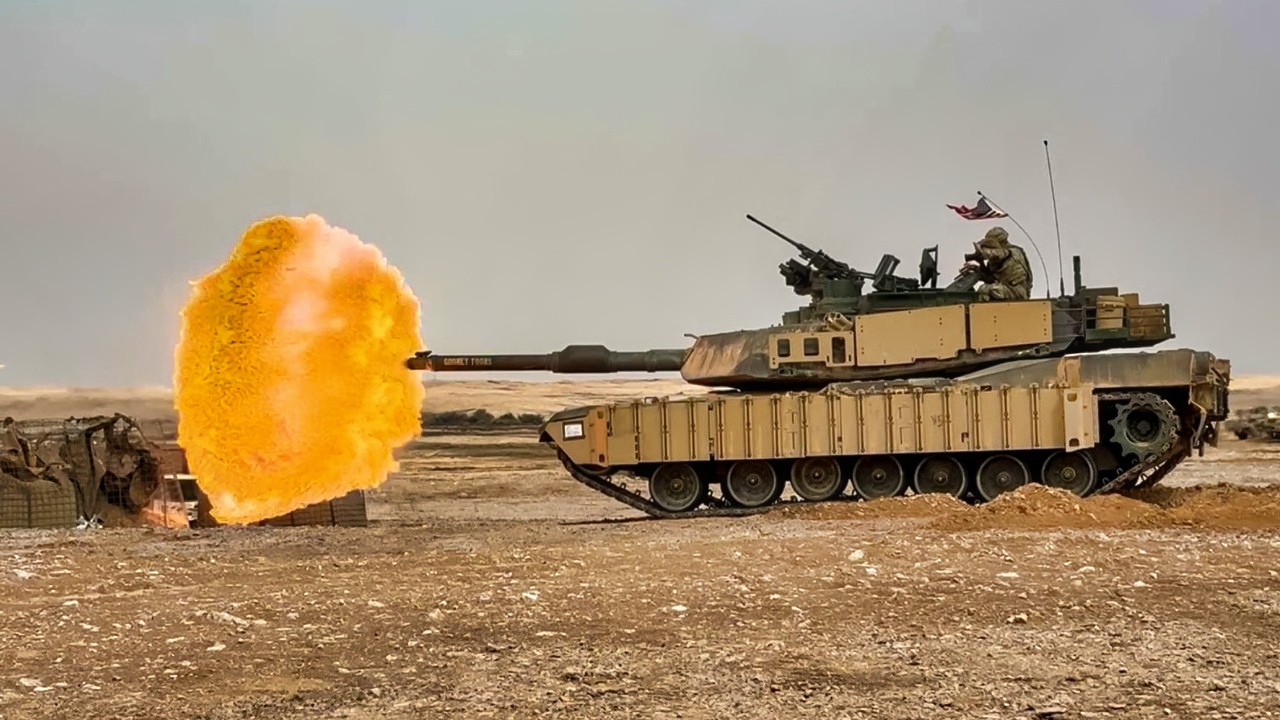
The M1A2 SEPv3 is currently the most advanced iteration of the Abrams main battle tank (MBT) in service. The tank incorporates the latest technologies to enhance its survivability and situational awareness.
The tank is arguably one of the most advanced and well-protected tanks in the world; however, considering the M1A1’s performance in Ukraine, the big question is how well the SEPv3 would perform against drones.
Would the tank have performed better on the battlefield against its older counterparts, or would the multi-million dollar tank have struggled like all the others?
Is the SEPv3 Protected Against Drones?
It is important to remember the context in which the M1A2 SEPv3 was designed. First unveiled in 2017, the global war on terror (GWOT) was still in full effect.
As a result, many of the upgrade packages added to the M1A2 focused on protection against IEDs and landmines, as those were the primary threats to the tank at the time.
The tank received new explosive reactive armor (ERA) and the Israeli-made Trophy active protection system (APS) to protect against anti-tank missiles.
At the time, unmanned aerial systems (UAS) were considered, but very few people within the Army predicted that drones would evolve the way that they did in Ukraine.
Hence, C-UAS was not a high priority for the Army at the time.
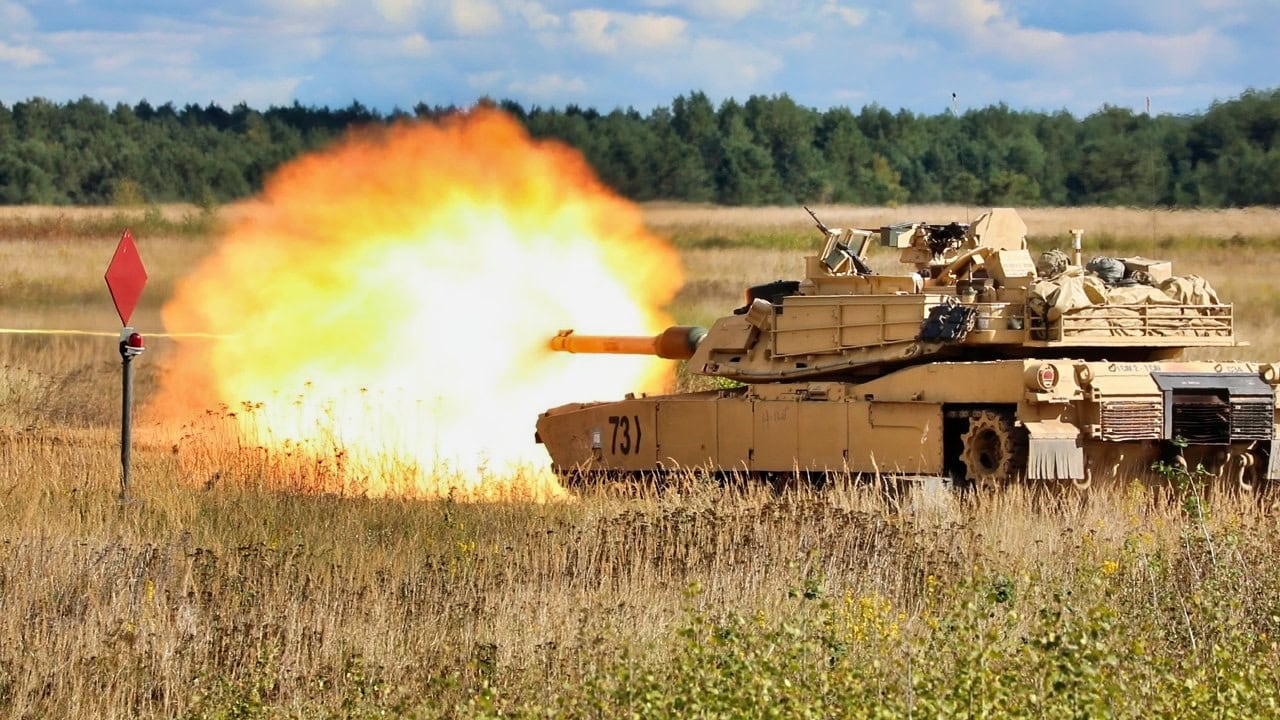
U.S Army troopers assigned to 3rd Armored Brigade Combat Team, 1st Cavalry Division fire the M1A2 SEPV3 Main Battle Tanks as part of gunnery qualification, Sept. 22, 2022, on Mielno Tank Range, Drawsko Pomorskie Training Area, Poland. Training like this ensures the units readiness in order to provide combat-credible forces in support of NATO allies and regional security partners. (U.S. Army Photo by Staff Sgt. Charles Porter)
The biggest priority behind the SEPv3 program was to increase crew situational awareness. The tank is fitted with improved forward-looking infrared (FLIR) for target detection and acquisition in both day and night conditions.
The common remotely operated weapons station (CROWS) is fitted with improved cameras that increase the commander’s field of view by about 340% and provide additional target acquisition capabilities.
Furthermore, the tank is equipped with improved communications and networking equipment, as well as new vehicle health management systems (VHMS).
All of these improvements are designed to ensure that the crew has a complete and constantly updated picture of the battlefield as soon as they embark on a mission. The SEPv3 was designed to operate on multi-domain battlefields and to thrive against both regular and irregular threats.
Why the Abrams “Failed” in Ukraine
Before we evaluate the SEPv3 against drones, it is important to understand why the Abrams tanks in Ukraine failed.
The M1A1SA (Situational Awareness) tanks sent to Ukraine lack many of the upgrades found on M1A2 SEPv3 tanks. This, however, was the least of their problems.
The M1 Abrams was designed to operate in a broader American/NATO combined arms environment with infantry, air, and artillery support at close call.
Ukraine’s Abrams tanks found themselves outside of their operational comfort zone.
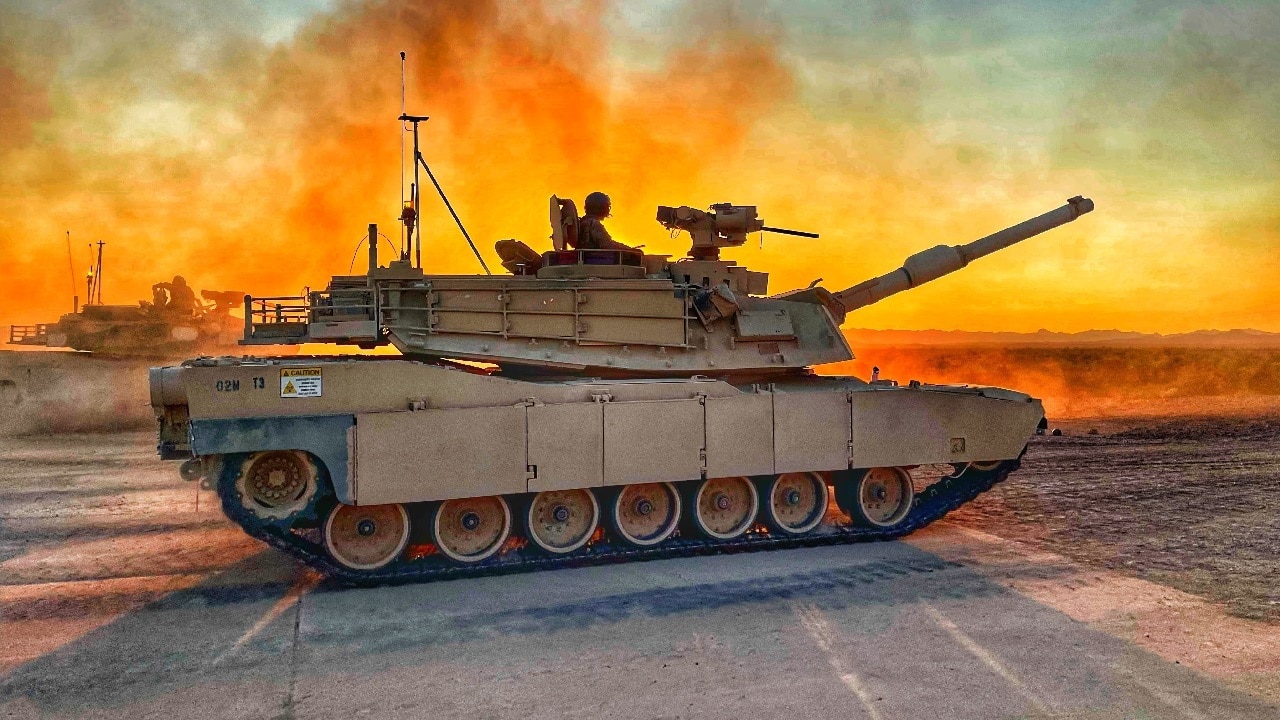
US Army M1 Abrams Tank. Image Credit: Creative Commons.
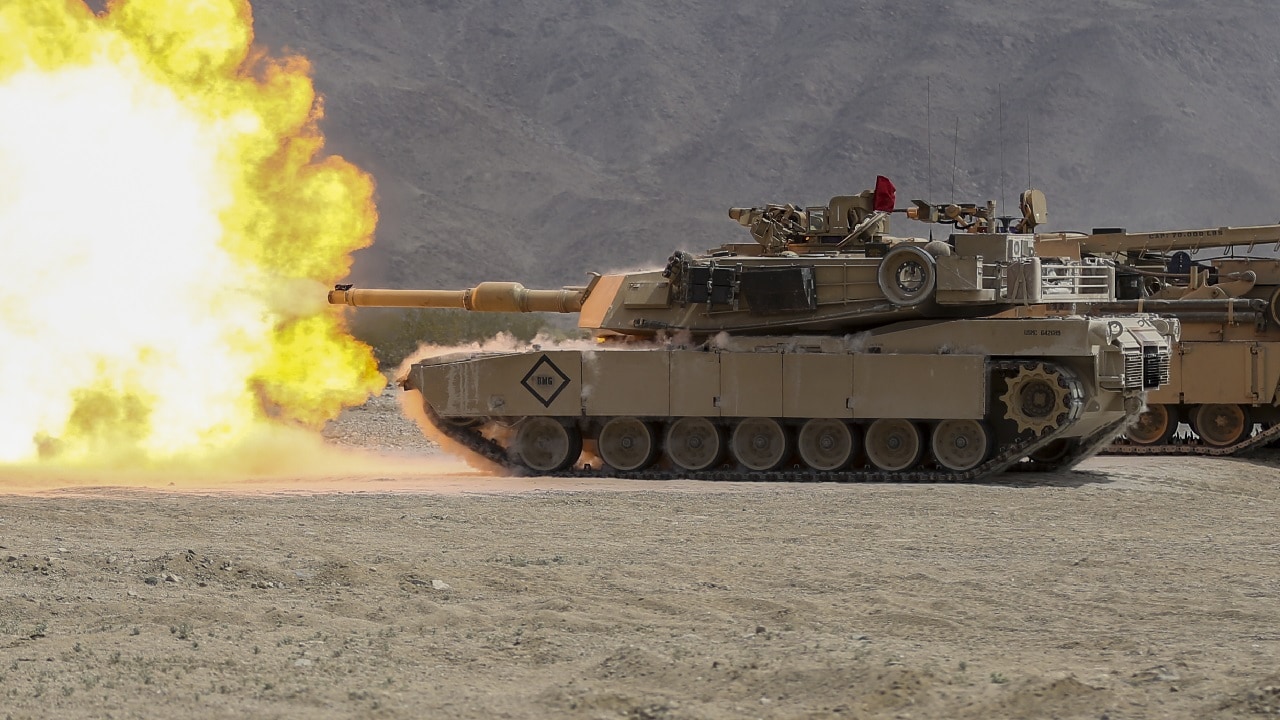
An M1 Abrams Tank fires off a round as a demonstration during 1st Tank Battalion’s Jane Wayne Spouse Appreciation Day aboard the Marine Corps Air Ground Combat Center, Twentynine Palms, Calif., April 3, 2018. The purpose of the event is to build resiliency in spiritual well being, the will to fight and a strong home life for the 1st Tanks Marines and their families. (U.S. Marine Corps photo by Lance Cpl. Rachel K. Porter)
The tanks entered Ukrainian service at a time when the country’s armored forces had been battered and beaten after years of war with the Russians.
The M1A1 often went into combat unsupported, without any air or infantry support, which is not how the tank was designed to fight.
In Ukraine, the M1 Abrams proved to be easy pickings for the Russians.
While drones definitely played a significant part, many tanks were picked off by Russian ATGMs, mainly the 9M133 Kornet.
Other tanks were disabled by landmines and abandoned, and others were damaged/destroyed by drones.
To be fair, the M1 still offered much greater protection than Ukraine’s Soviet-era tanks and probably saved the lives of multiple tank crews, but it was far from the game-changer that many people expected it to be. By 2024, the Ukrainians had lost most of the 31 American-supplied Abrams tanks.
Operating Outside its Intended Environment
Would the SEPv3 have performed better if it had been sent to Ukraine instead of the older version? In all honesty, probably not.
While it is true that the SEPv3 offers much better survivability and situational awareness than the M1A1, it would not have solved the fundamental issues the Ukrainian Army faced at the time (and still faces).
SEPv3s would still have received insufficient infantry/air support, faced a numerically superior force, and the tanks would have been sent in too few numbers to make a real difference on the battlefield.
The most they would have done is protect the lives of their crew, which is obviously a huge value, but overall, they likely would not have performed much differently than other Abrams variants.
Overall, the M1A2 SEPv3 is an amazing tank and one of the best in the world. However, it was made before the current proliferation of drones.
Its protective measures in areas where drones can easily strike, such as the roof, are relatively vulnerable.
Granted, this can be said of every other tank currently in existence, but that only underscores the fact that no one predicted the current battlefield environment.
Alone, the SEPv3 is weak to drones, but the tank was not designed to operate alone. In a proper combined-arms environment, the tank would operate with infantry and infantry fighting vehicles (IFVs), both of which are much better equipped for C-UAS than the tank. The tank performs its breakout role while infantry and IFVs protect it from threats such as drones.
About the Author: Isaac Seitz
Isaac Seitz, a Defense Columnist, graduated from Patrick Henry College’s Strategic Intelligence and National Security program. He has also studied Russian at Middlebury Language Schools and has worked as an intelligence Analyst in the private sector.