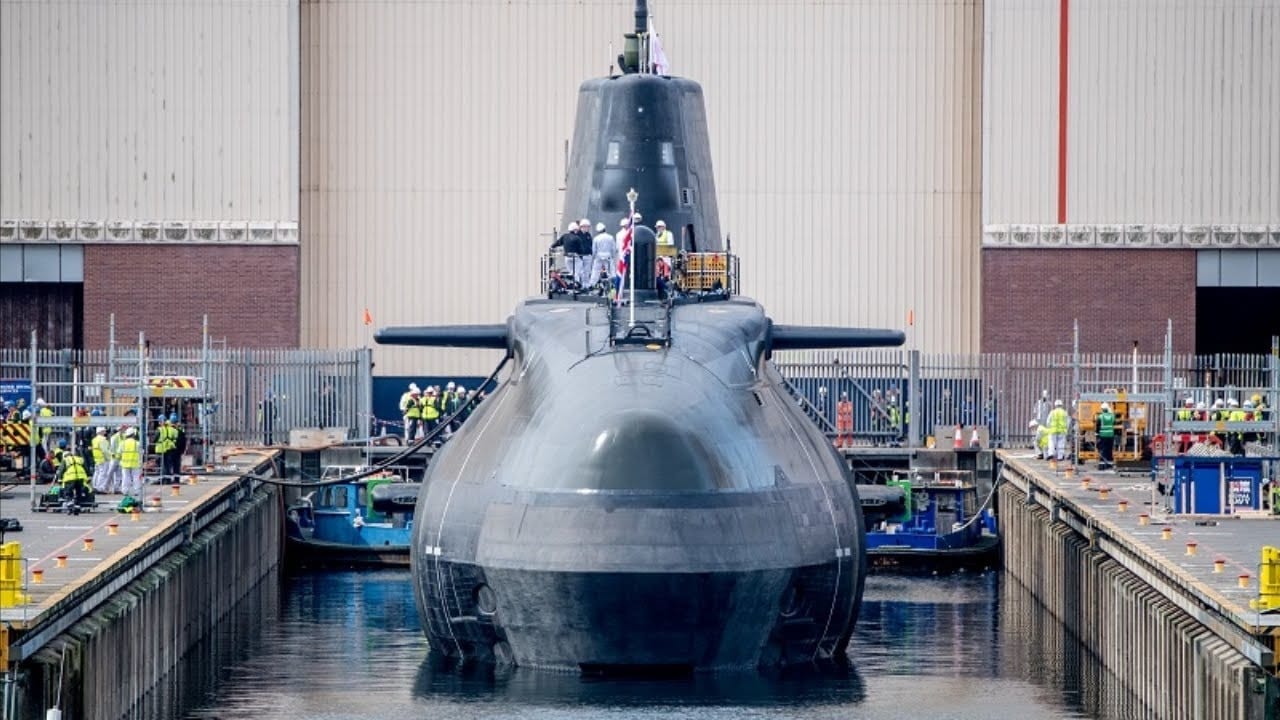
A popular British military publication, UK Defense Journal, confirms that the British Royal Navy has once again reached a point where no Royal Navy attack submarine is deployed at sea.
Rather than a single isolated maintenance issue, this has become a dangerous, recurring problem.
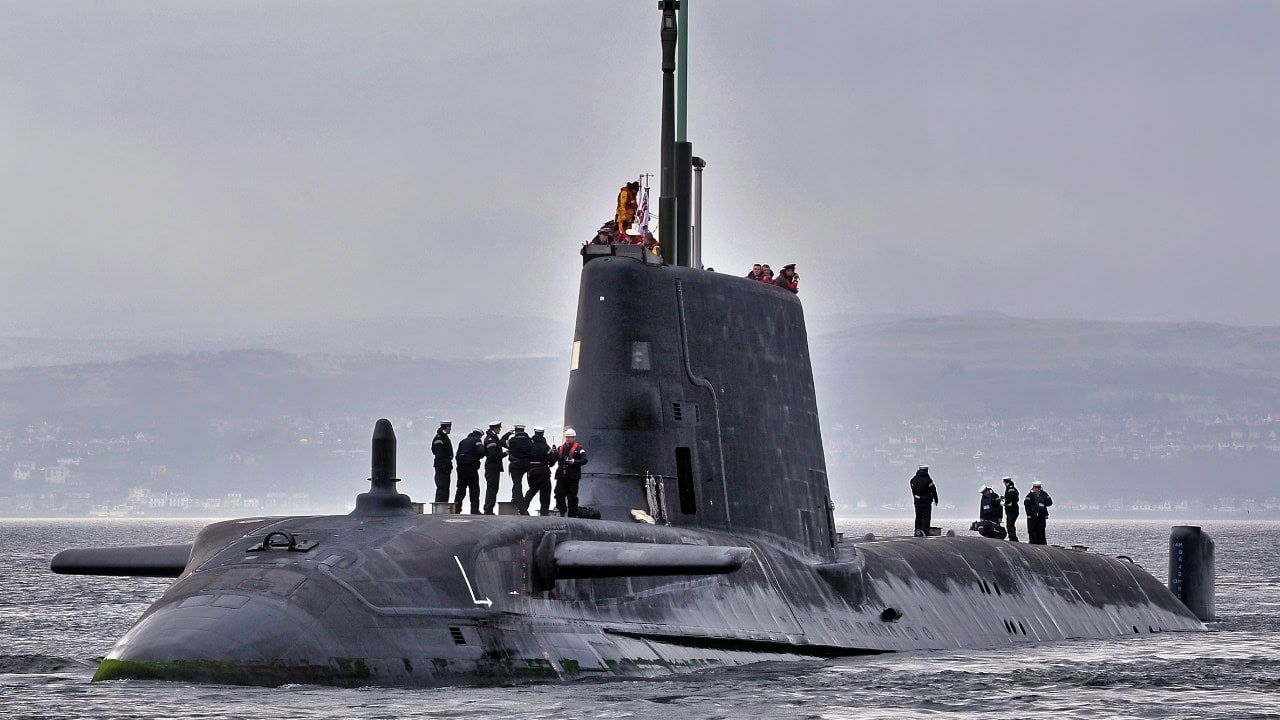
Astute-Class Submarine. Image Credit. Creative Commons.
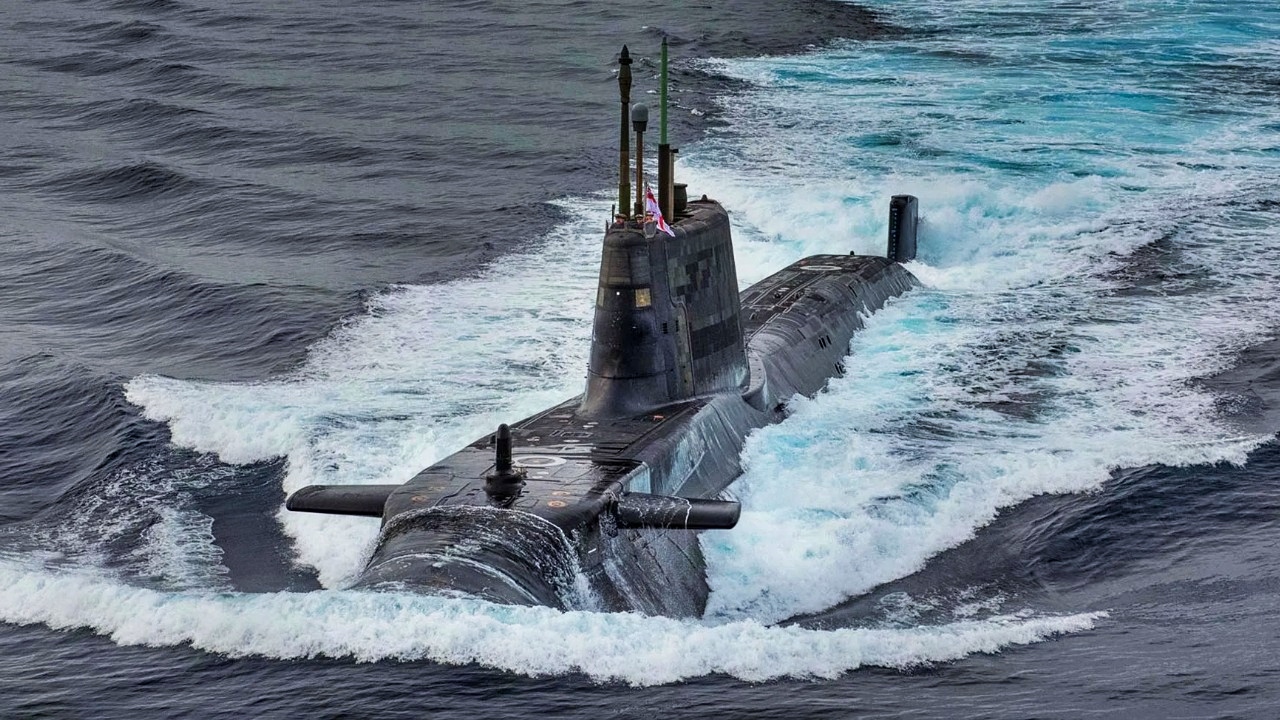
Astute-Class Royal Navy Submarine. Image Credit: Royal Navy.
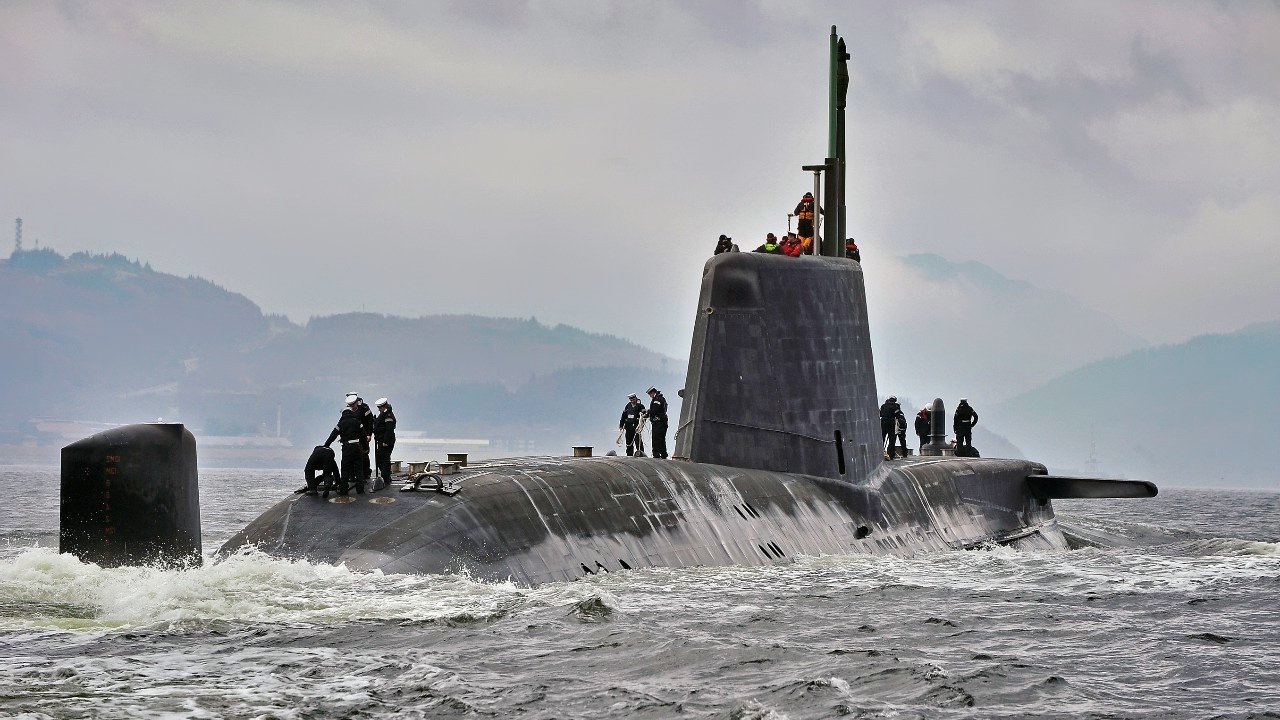
Astute-Class Submarine. Image Credit: Creative Commons.
In fact, from a historical perspective, it’s an astonishing issue, considering that just 80 years ago, the Royal Navy was considered the world’s most powerful navy.
Now, it’s not even a second-rate navy. In fact, it’s not a combat-ready navy at all.
“Not at sea” does not necessarily mean permanently combat-incapable. Yet it does mean that Britain cannot respond immediately with one of its most valuable military assets if a crisis suddenly erupts.
For a nation whose maritime strategy has rested upon continuous undersea presence for decades, that represents a significant operational gap.
The Astute-Class Is Not the Problem
The Astute-class attack submarine is among the most capable nuclear-powered attack subs in the world. Its strengths include exceptional acoustic stealth (often described as quieter than a dolphin).
An Astute-class has unlimited range (thanks to its nuclear range), too. This submarine’s sonar suites rank among the world’s best.
Meanwhile, the Astute-class provides critical land-attack capabilities for the tiny Royal Navy, thanks to its US-made Tomahawk cruise missile arsenal. Astute-class submarines have excellent defensive systems, notably the Spearfish heavyweight torpedoes.
What’s more, these boats provide pivotal covert intelligence collection capabilities for the Royal Navy.
In other words, the British have one of the world’s best attack submarines.
It’s just that they lack sufficient numbers of them, which is causing a strategic crisis in the Royal Navy–at a time when London wants their diminishing Royal Navy to do more.
Lord West’s Warning
Perhaps the strongest criticism of this sad state of affairs for the once-proud Royal Navy comes from former First Sea Lord and Security Minister, Admiral Lord West. The UK-based paper, The Telegraph, spoke with Lord West, who described the situation facing the Royal Navy as deeply worrying.
That’s because submarines require continuous presence rather than episodic deployments.
Lord West’s broader concerns for the Astute-class attack submarine force are strategic rather than technical.
After all, Russia has sharply increased its own submarine patrols of the North Atlantic over the last several years, as tensions between London and Moscow have intensified.
NATO relies heavily upon the Royal Navy’s attack submarines to monitor Russian ballistic missile submarine movements in the North Atlantic, to protect the critical Greenland-Iceland-United Kingdom (GIUK) Gap, and to support overall NATO aircraft carrier operations.
Astute-class submarines have a pivotal role, too, in escorting Britain’s nuclear deterrent.
If Britain temporarily lacks attack submarines at sea, NATO loses one of its primary undersea surveillance assets precisely where Russian submarine activity remains most intense.
An Industrial Base Problem
Maintenance is the root cause of the crisis affecting the Royal Navy’s Astute-class submarine force (which, as Lord West highlighted, is having major negative impacts on Britain’s overall strategic situation).
Modern nuclear-powered submarines spend a large portion of their complex lives undergoing maintenance.
Britain’s main problem is that maintenance periods have become dramatically longer than originally planned.
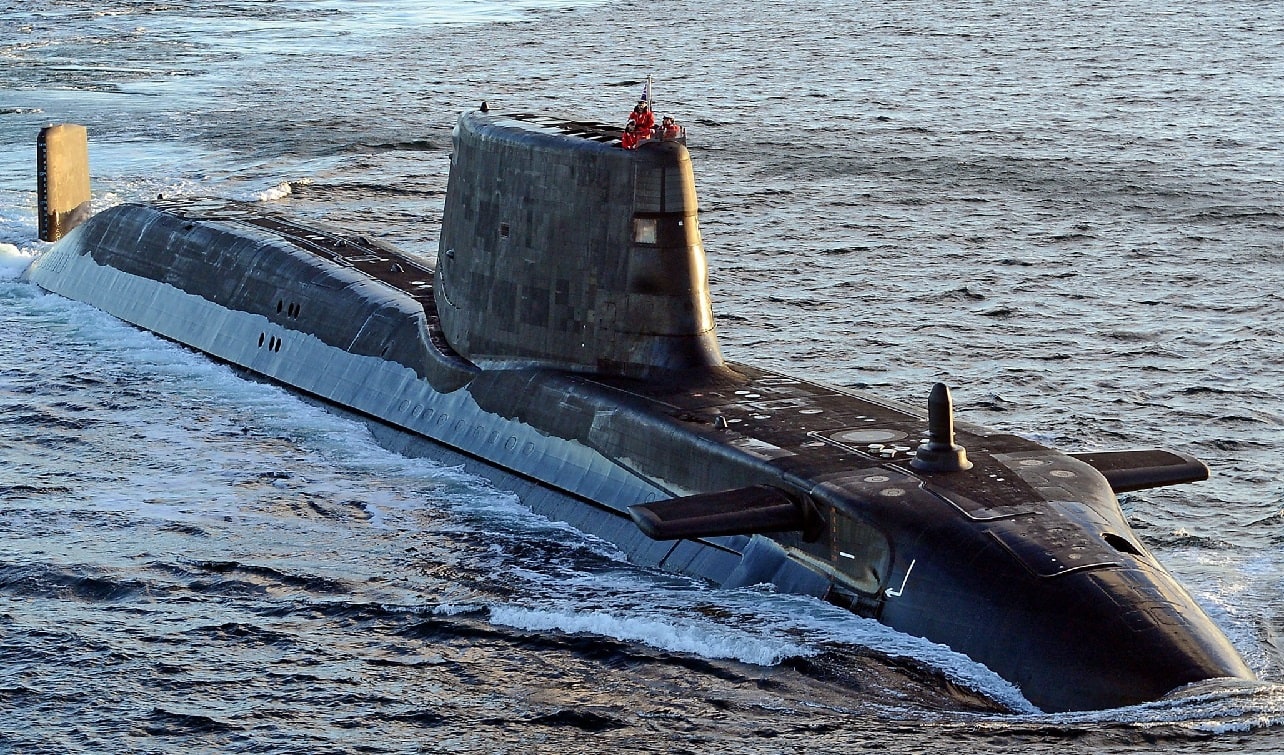
Astute class submarine HMS Ambush is pictured during sea trials near Scotland. Ambush, second of the nuclear powered attack submarines, was named in Barrow on 16 December 2010 and launched on 5 January 2011.
That’s likely because Britain’s dockyard capacity is limited. Skilled engineers remain in short supply in Britain, too.
What’s more, the necessary maintenance infrastructure supporting their nuclear submarine program has suffered decades of underinvestment.
Oh, and spare parts, along with specialized suppliers, have become massive bottlenecks in Britain’s declining naval shipyard capacity.
This is not your grandfather’s Royal Navy, and it certainly is not your grandfather’s industrial Great Britain. Because of this, Britain possesses a fleet that exists mostly on paper. Sure, the Royal Navy counts six world-class submarines in its small fleet.
But if several are simultaneously unavailable for extended maintenance, actual combat power falls well below theoretical strength.
This is a challenge affecting virtually every Western navy, by the way. Britain, however, is one of the most pronounced cases of this sad, seemingly unstoppable industrial decline.
Russia Is Not Standing Still
Several reports in the international press highlight how Russia’s submarine force has intensified its naval activities, especially in the North Atlantic. The Russian Navy cannot compete toe-to-toe with certain Western navies, such as the United States Navy.
But since the Soviet days, Moscow has possessed a highly advanced–and lethal–submarine force.
And Russia has drastically modernized its nuclear attack submarine force at a time when the aforementioned defense-industrial base and naval shipyard limitations of Western navies are forcing a major decline in capabilities.
Russia is also improving its ballistic missile submarine force and pairing it with increasingly sophisticated long-range cruise missiles.
Moscow has armed some of their submarines with lethal hypersonic weapons, too.
This was a threat that became evident last year, when the US Navy’s newest aircraft carrier, the USS Gerald R. Ford, was participating in NATO naval exercises in the North Sea, and NATO F-35s had to conduct anti-submarine operations, as the Russians were trailing the $13 billion US carrier with a hypersonic missile-armed submarine.
The spastic NATO response to the presence of one Russian sub highlighted just how vulnerable Western surface fleets were to these new Russian hypersonic weapons.
Further, the Russians are increasing their presence in the North Atlantic and Arctic to support their ongoing expansion in the Arctic region, meaning the number of Russian submarines in British waters or near British territory is unlikely to decline anytime soon.
For Britain, whose geography places it directly along the approaches to the GIUK Gap, maintaining continuous submarine patrols in these regions is not simply symbolic or helpful to its NATO allies. It’s a core tenet of British national security policy.
Strategic Takeaway
Taken together, the stories about the drastically reduced availability of Britain’s Astute-class nuclear-powered attack submarines suggest that the British Royal Navy’s ongoing submarine crisis is less about declining technology than it is about declining sustainment.
The Astute-class remains one of the finest nuclear attack submarines in the world, capable of matching almost any peer adversary beneath the waves.
The problem is that exquisite capabilities mean little if the submarines spend prolonged periods in dry dock rather than on patrol–at a time when the Russians are pressuring British territorial security and sovereignty at a higher rate than at any time since the Cold War.
Across NATO, in fact, military planners increasingly face the same dilemma that the Royal Navy is experiencing: advanced platforms are becoming more capable, more expensive, and more maintenance-intensive.
As Russia expands its submarine activity in the North Atlantic and China rapidly enlarges its own undersea fleet in the Indo-Pacific, the decisive question may no longer be who holds the best submarines–but who can keep enough of them at sea when a crisis begins.
The British Royal Navy, like Britain itself, is undergoing rapid decline. Unless things change in London for the better–and soon–that decline will be terminal.
About the Author: Brandon J. Weichert
Brandon J. Weichert is the Senior National Security Editor at 19FortyFive.com. He also manages The Weichert Brief on Substack. Weichert also hosts “National Security Talk” on Rumble. He is the author of four bestselling national security books, the most recent of which is A Disaster of Our Own Making: How the West Lost Ukraine (Encounter Books). Follow him via Twitter/X @WeTheBrandon.