
Summary and Key Points: The United States Navy counts 292 battle force ships, and in the last week of June only 80 were underway, with 101 deployed, according to the U.S. Naval Institute’s fleet tracker. Four of the fleet’s eleven aircraft carriers were deployed. Federal law under Title 10 requires the Navy to keep eleven operational carriers, so the service extended USS Nimitz to March 2027 even though the carrier completed her final deployment in December and may lack the reactor life to sail again. A Government Accountability Office review found 75 percent of carrier and submarine maintenance periods finish late, and the readiness cycle turns every fleet into thirds.
The Navy Aircraft Carrier Problem
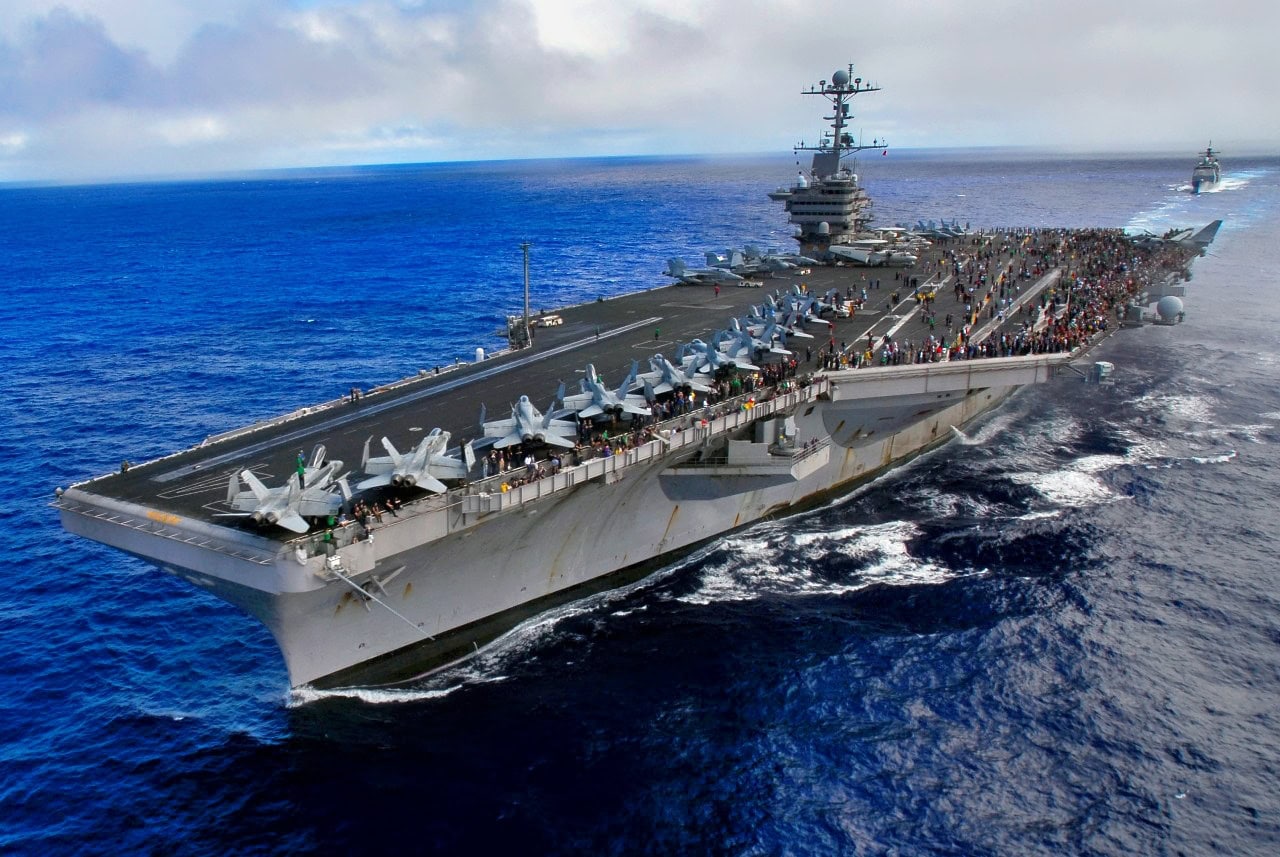
Nimitz class aircraft carrier USS John C. Stennis (CVN 74) leads guided-missile cruiser USS Antietam (CG 54) prior to conducting an air power demonstration. The air power demonstration showed the capability of Stennis and Carrier Air Wing 9 to service members’ family and friends who were invited to get underway with the ship. Stennis is returning to the United States after a 7 month long deployment promoting peace, regional cooperation and stability, and supporting the global war on terrorism.
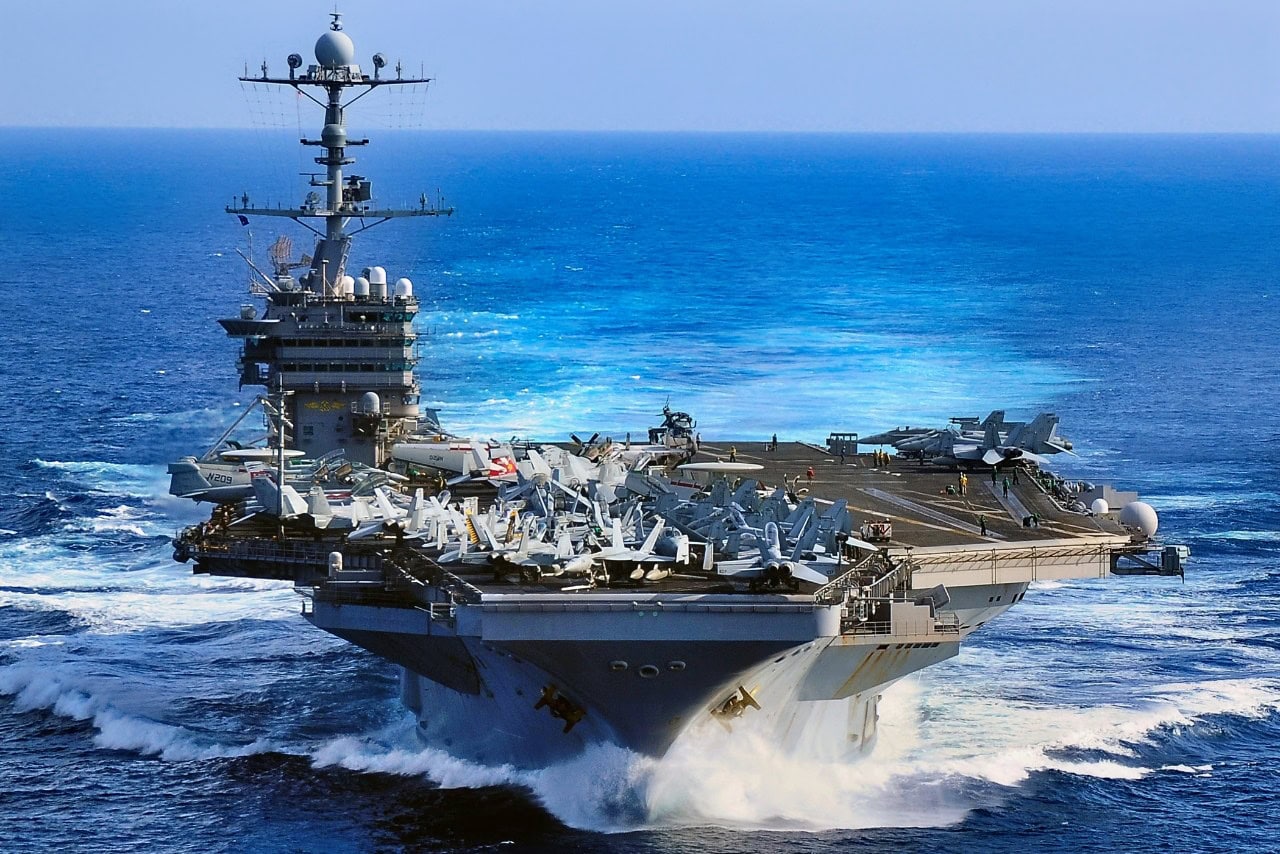
091115-N-6720T-106 PACIFIC OCEAN (Nov. 15, 2009) – USS George Washington (CVN 73) steams through the Pacific Ocean. George Washington, the Navy’s only permanently forward-deployed aircraft carrier, is currently participating in ANNUALEX 21G, a yearly bilateral exercise with the U.S. Navy and the Japan Maritime Self Defense Force. (U.S. Navy photo by Mass Communication Specialist Seaman Adam K. Thomas/RELEASED)
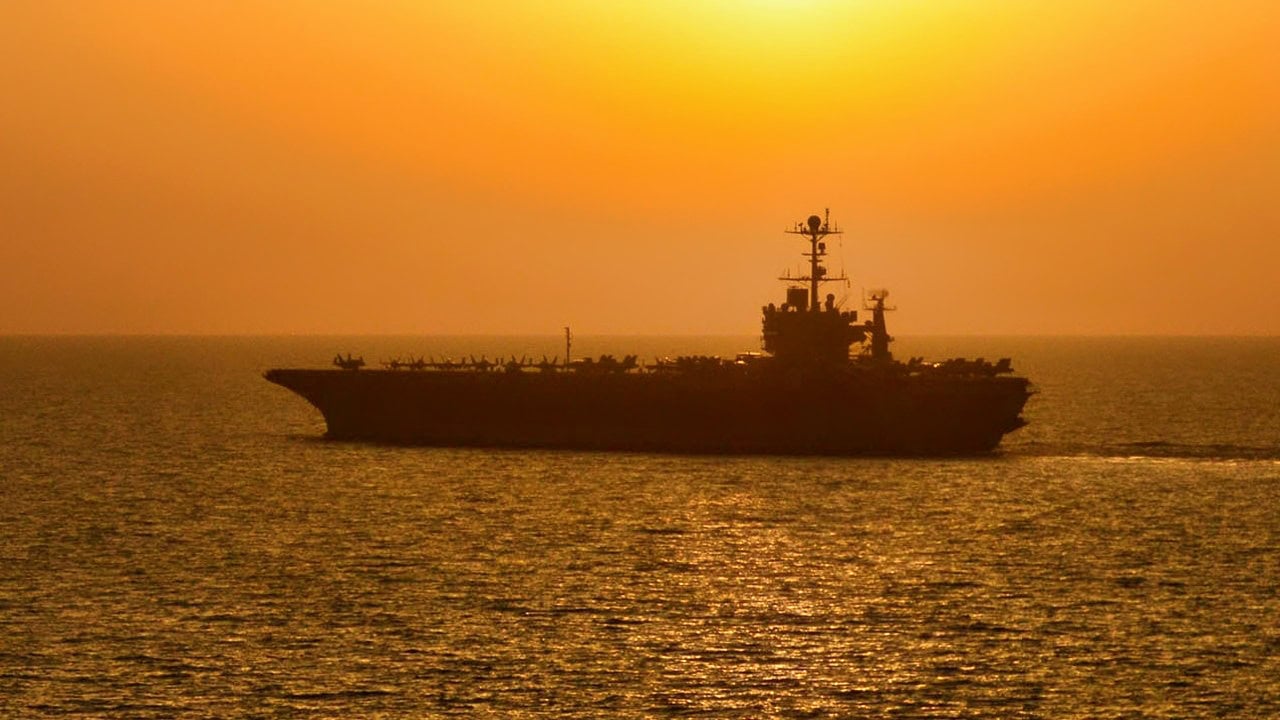
(Oct. 19, 2013) The aircraft carrier USS Harry S. Truman (CVN 75) is underway during sunset. Harry S. Truman, flagship for the Harry S. Truman Carrier Strike Group, is deployed to the U.S. 5th Fleet area of responsibility conducting maritime security operations, supporting theater security cooperation efforts and supporting Operation Enduring Freedom. (U.S. Navy photo by Mass Communication Specialist 2nd Class Mike DiMestico/Released)
The most honest symbol of American naval power this week is riding at anchor in New York Harbor. USS Nimitz, the oldest carrier in the fleet, is the centerpiece of the International Naval Review celebrating the Navy’s 250th year, and the crowds along the Hudson are seeing a warship in a category of her own: a carrier that completed her final deployment in December, whose retirement was postponed not because the Navy needs her to fight but because federal law requires eleven operational carriers and her replacement is running two years late.
Analysts assess that after a quarter century since her last refueling, Nimitz may not have the reactor life to deploy again, even in an emergency. She is, functionally, a legal instrument with a flight deck.
That one ship, counted but not really available, is the whole American fleet in miniature. The Navy that the public talks about is the one on paper. The Navy that exists on any given day is far smaller, and the gap between the two is arithmetic, not scandal — arithmetic worth understanding before the next debate about fleet size begins.
Naval Arithmetic: 292 Ships on the Books, 80 Actually Underway
The U.S. Naval Institute publishes a weekly fleet tracker, and its table for June 29 is the most clarifying document in American seapower: total battle force, 292 ships, made up of 233 commissioned warships and 59 support vessels, of which 101 were deployed, and 80 were underway at all. Read that again with the marketing stripped off. On a typical week, fewer than a third of the American fleet is deployed, and barely a quarter of it is moving. Of the 233 commissioned warships, 72 were deployed.
The rest were pierside at home, open for maintenance, or running local training off their own coasts.
The week’s disposition puts faces on the numbers: George Washington patrolling the Philippine Sea after Valiant Shield, Theodore Roosevelt arriving in Pearl Harbor to lead the RIMPAC exercise, Lincoln and Bush carrying the Iran war in the Middle East, Eisenhower slipping out of Norfolk for local operations, and dozens of destroyers, amphibious ships, and support ships scattered across the map.
It looks like a lot. Against 292 hulls, it is the fraction that the readiness cycle allows.
This is the fleet against which Washington conducts its perennial argument about a 355-ship Navy, a floor written into law in 2018. Whichever number wins that debate, the usable fraction will obey the same rule as the current fleet.
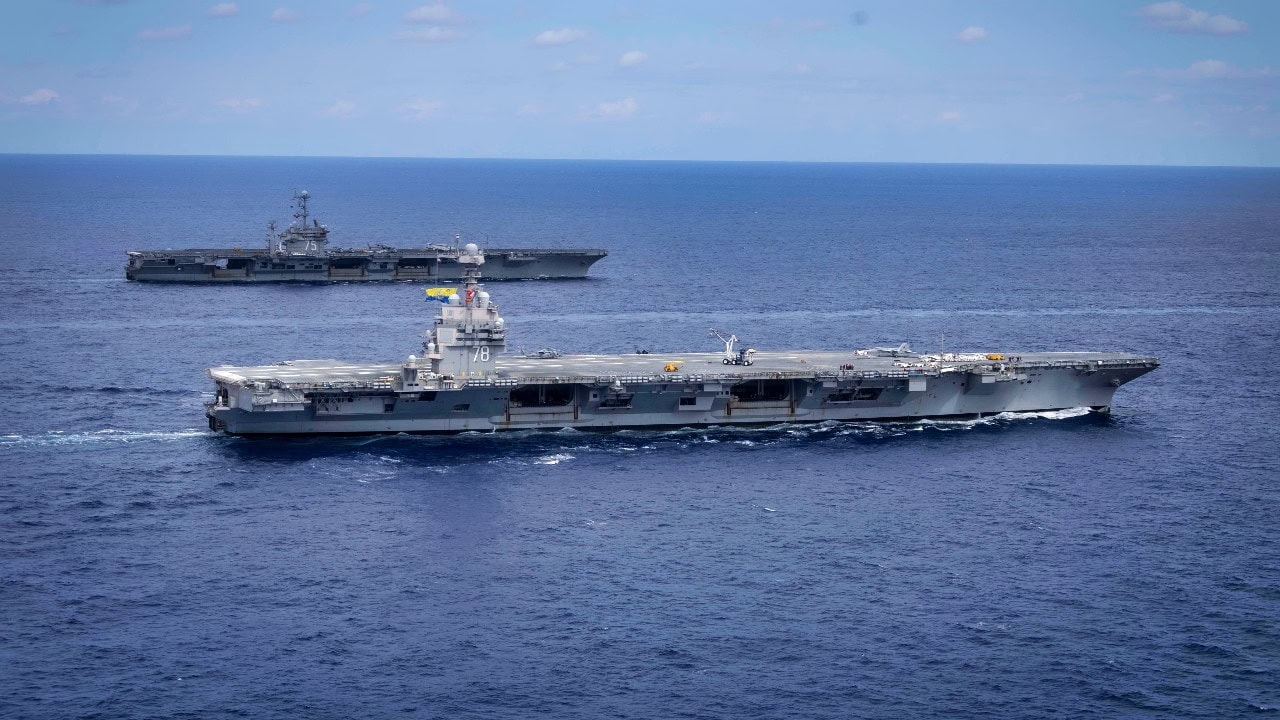
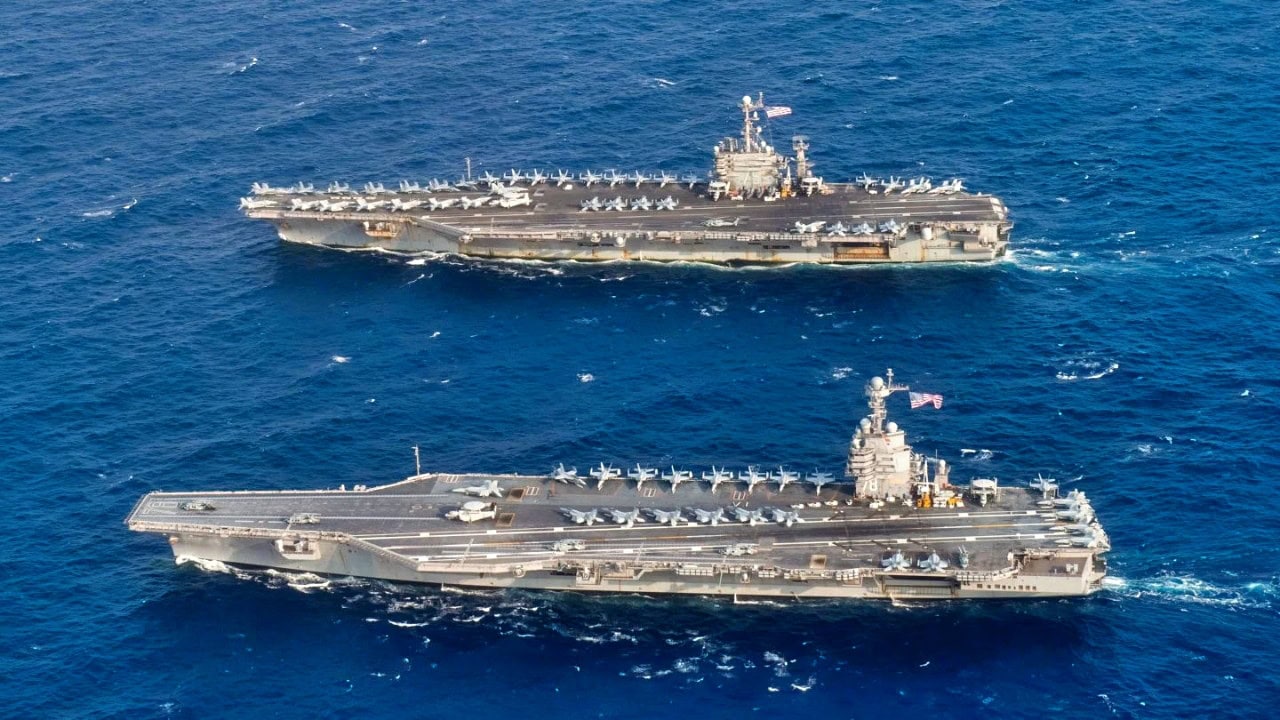
ATLANTIC OCEAN. (Aug. 24, 2024) The Nimitz-class aircraft carriers USS Harry S. Truman (CVN 75), back, and the world’s largest aircraft carrier, USS Gerald R. Ford (CVN 78), sail in formation in the Atlantic Ocean, Aug. 24, 2024. USS Gerald R. Ford is the flagship of the Gerald R. Ford Carrier Strike Group. The aircraft carrier is underway in the Atlantic Ocean to further develop core unit capabilities and skills such as fuels certification and ammunition on-load during its basic phase of the optimized fleet response plan. (U.S. Navy photo by Mass Communication Specialist 2nd Class Maxwell Orlosky).
Fleet Reality: Why Every Navy Is Actually Three Navies
The rule has a name in Pentagon documents — readiness cycles — and a simpler expression in practice: for every ship forward, there is roughly one ship recovering from being forward and one ship getting ready to go.
A deployment grinds machinery, expends ordnance, and burns out crews; the ship that returns needs months of depot maintenance. The ship emerging from maintenance has a rebuilt hull and a green crew and needs months of workups before anyone would send it to combat. Deploy, repair, train, repeat: the cycle means a steady-state navy delivers about a third of itself to the fight on any given day, and that is when the system works on schedule.
It rarely does. A 2020 Government Accountability Office review found that 75 percent of planned maintenance periods for the Navy’s aircraft carriers and submarines finished late, and the delays cascade: a ship stuck in the yard compresses the training of the crew waiting on it, which extends the deployment of the ship it was meant to relieve, which deepens the maintenance bill when that ship finally comes home.
Gerald R. Ford’s just-concluded deployment is the cycle under wartime stress in a single hull: a record 326 days at sea supporting the Iran campaign — and even that deployment included weeks alongside in Croatia for repairs after a shipboard fire, per USNI News reporting, because machinery does not care that there is a war on.
Nuclear carriers add a wrinkle no other warship has: the Refueling and Complex Overhaul, a once-in-a-lifetime rebuild at the midpoint of a 50-year service life that exposes the ship’s reactors and, in theory, takes four years. In practice, it has been consuming five and six, and there is essentially always at least one carrier so deep inside Newport News Shipbuilding that it exists only as a hull number and a payroll.
Aircraft Carrier Case Study: How 11 Becomes 4
Now apply all of it to the eleven-carrier fleet, ship by ship, as of this week.
Four are deployed: Lincoln and Bush in the Middle East — Lincoln at 224 days at sea as the month began, Bush having reached the theater the long way around Africa to avoid the Bab el-Mandeb — with George Washington in the western Pacific and Theodore Roosevelt at RIMPAC. Ford is home from her record war deployment and headed into recovery.
Eisenhower is running local operations off the East Coast. The rest, as the same accounting noted, are in maintenance, refit, or pre-deployment training in some form, and two of them are in the deepest hole a carrier can occupy. Stennis remains inside her much-delayed overhaul at Newport News, now 14 months behind schedule at roughly five and a half years in the yard, with $483 million added to finish; Truman entered her own five-year overhaul last month, due back in January 2031, and as the Australian Naval Institute observed, she arrives carrying repairs from a February 2025 collision, while 2024 already offered a preview of this squeeze with a brief period of zero American carriers in the Pacific.
This year repeated the lesson at length: between the last week of January and the last week of May, not one American carrier operated in the Pacific, because the Pacific-based flattops had been pulled to the Iran war or were trapped in the readiness cycle.
And the replacements are late. The future John F. Kennedy‘s delivery slipped from July 2025 to March 2027 to finish certifying the new arresting gear and weapons elevators, according to the Navy’s own budget documents, and the future Enterprise moved from 2029 to July 2030 and has since slipped again toward 2031.
Eleven becomes four the same way 292 becomes 80: one cycle, applied to ships that each cost more than most countries’ navies.
Defense Ledger: The Law Says 11, So the Navy Counts a Ship That May Never Sail Again
Which returns the story to the carrier anchored off Manhattan.
Title 10 of the U.S. Code, Section 8062, requires the Navy to maintain not less than eleven operational aircraft carriers, and with Kennedy late, the only way to obey the statute was to extend the Nimitz to March 2027, aligning her retirement with her replacement’s arrival. Nobody involved pretends the extension bought the fleet a twelfth of usable combat power; it bought compliance.
Nimitz did her last real work in December, closing a deployment that included strikes on ISIS targets in Somalia, then made a farewell circumnavigation of South America to reach her decommissioning berth.
The episode is worth remembering whenever force-structure floors are debated as if they measured capability: the statute counts hulls, and the readiness cycle decides what the hulls can actually do.
The Counterpoints: Surge Power, Allied Decks, and China’s Version of the Same Math
The strongest answer to all of this is that the arithmetic describes peacetime rhythm, not wartime capacity, and the Iran war has been proving it.
Deployments were extended, carriers doubled up in CENTCOM, and the Ford stayed out nearly eleven months; the readiness cycle exists precisely so the Navy can break it on purpose when ordered, surging ships that would otherwise be training.
Allied decks add depth to the raw count misses, from British carriers to the growing list of F-35B-capable ships among friends in the Pacific. And the same math binds the competition. The Pentagon’s latest China report counts a Chinese battle force well over 370 ships, the world’s largest by number, but Beijing’s fleet obeys the thirds too, with far less deployment experience and a posture built around its own coast. Counting hulls flatters China in exactly the way it flatters America.
All of that is true, and the surge argument carries a cost its advocates should say out loud: surge is a loan.
Every extended deployment is maintenance deferred and crew fatigue banked, and the bill arrives at the same overloaded shipyards that are already returning carriers 14 months late. The Navy has been paying the Iran war’s readiness loan for months.
The repayment schedule runs through Newport News.
When the naval review ends, Nimitz will make the short run down to Norfolk and wait out the months until the law lets her go.
Somewhere in the Arabian Sea, Lincoln’s sailors will soon pass 230 consecutive days at sea.
The Navy America talks about has 292 ships and eleven carriers. The Navy America has is the 80 hulls that were underway this week — and four flight decks doing the work the public believes eleven are doing.
About the Author: Harry J. Kazianis
Harry J. Kazianis (@Grecianformula) was the former Senior Director of National Security Affairs at the Center for the National Interest (CFTNI), a foreign policy think tank founded by Richard Nixon based in Washington, DC. Harry has over a decade of experience in think tanks and national security publishing. His ideas have been published in the NY Times, The Washington Post, The Wall Street Journal, CNN, and many other outlets worldwide. He has held positions at CSIS, the Heritage Foundation, the University of Nottingham, and several other institutions related to national security research and studies. He is the former Executive Editor of the National Interest and the Diplomat. He holds a Master’s degree focusing on international affairs from Harvard University.

