
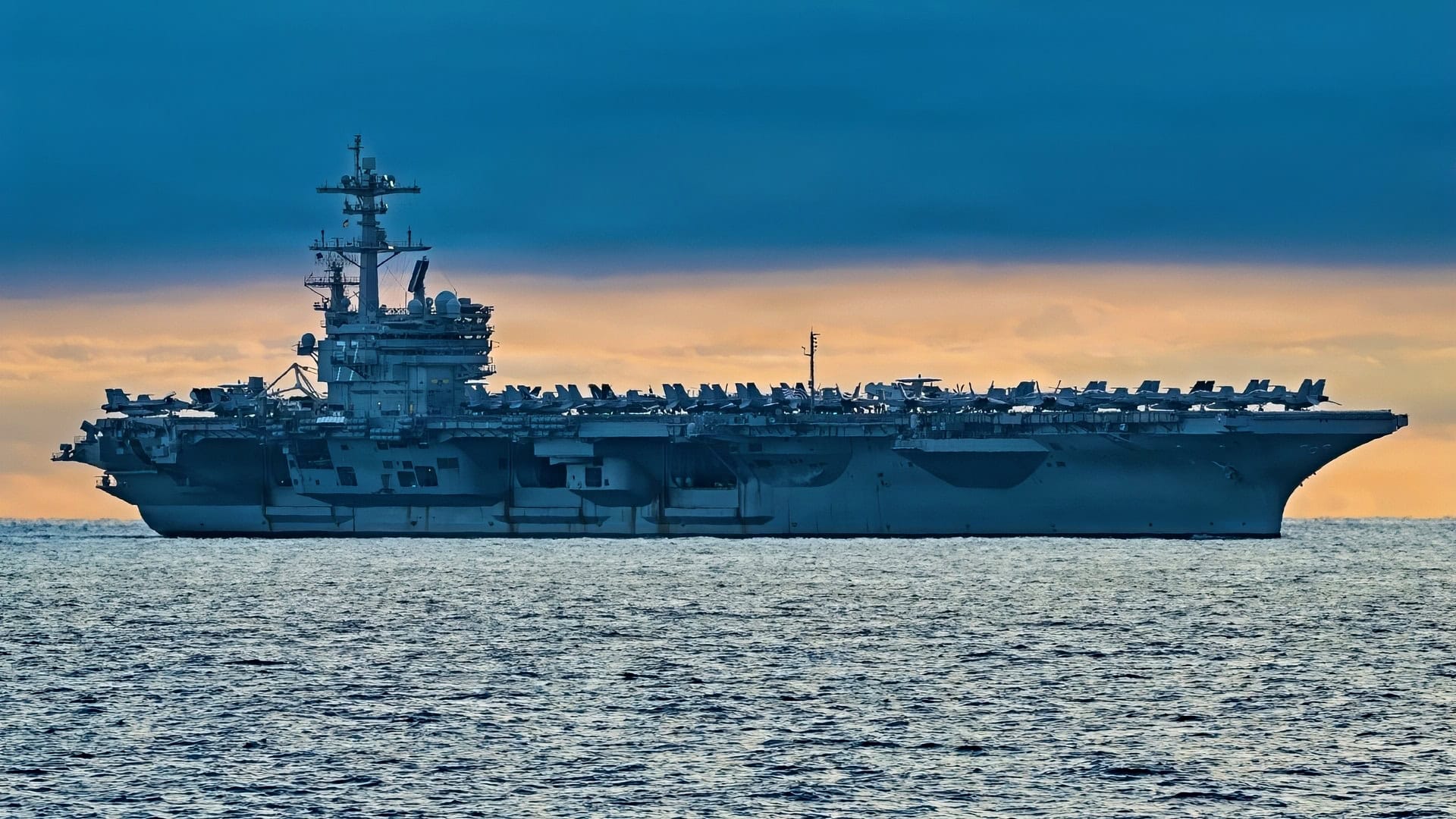
The USS George H. W. Bush (CVN-77) was the final Nimitz-class aircraft carrier to enter service.
Commissioned in 2009, she is one of the most recent and modern carriers in the U.S. Navy and still has a long service life ahead of her.
Although she shares most everything in common with the other ships of her class, Bush received multiple design changes and improvements during her construction, making her firmly distinct from the other Nimitz-class carriers.
She serves as a bridge between the Nimitz-class and the newer, more capable Gerald R. Ford-class supercarriers.
Aircraft Carrier Comare: What Separates Bush From Her Sister Ships?
Although Bush is still technically a Nimitz-class carrier, she incorporates a number of design changes that separate her from other ships of her class.
After learning lessons from her sister ships, the designers integrated improvements that would later inform the design of the newer Ford-class carriers, making CVN‑77 a transitional platform between generations.
One such change is a redesigned island superstructure positioned further aft on the flight deck, which improves flight operations and reduces interference with onboard sensors.
Additional enhancements include a composite mast, an improved hull design, upgraded propellers for greater efficiency and reduced noise, and modernized fuel-handling systems.
The hull was built using high-strength, low-alloy steel, which was used extensively to reduce weight while maintaining durability and improving overall performance and survivability in combat conditions.
In terms of sheer size, the carrier ranks among the largest warships in the world. It measures approximately 1,092 feet in length and displaces over 100,000 tons when fully loaded.
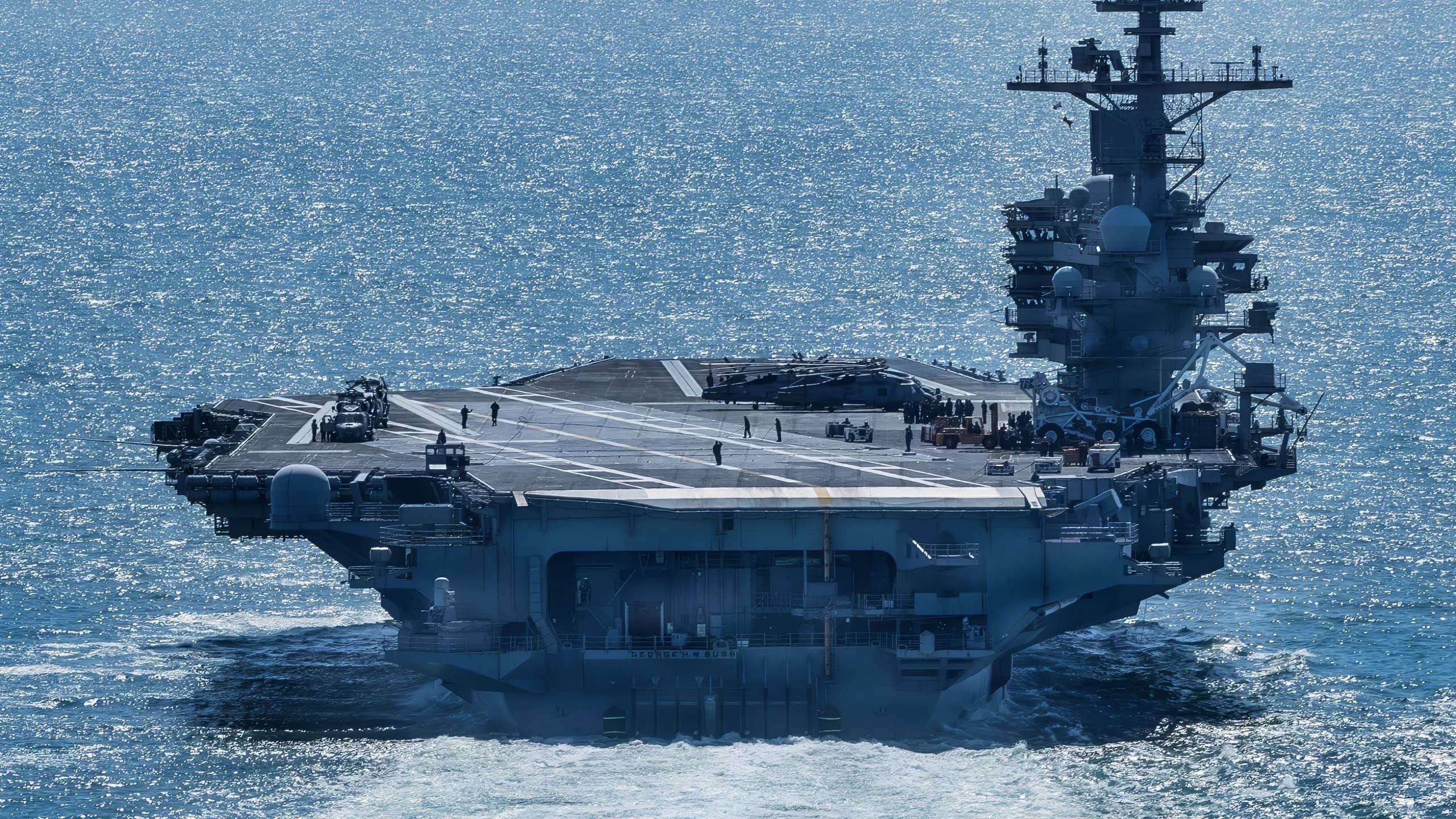
USS George H.W. Bush Heading Out to Sea. Image Credit: U.S. Navy.
Its expansive flight deck covers about 4.5 acres, providing space for large-scale aviation operations.
The ship is powered by two Westinghouse A4W nuclear reactors that drive four shafts, generating around 260,000 shaft horsepower and allowing speeds exceeding 30 knots.
The nuclear propulsion system provides essentially unlimited range, enabling the vessel to operate at sea for decades without refueling its reactors, limited mainly by crew endurance and supply logistics.
World-class Capabilities for This Supercarrier
Like her sister ships, Bush can carry an air wing of around 89-90 aircraft.
A typical air wing consists of F/A‑18 Super Hornets for strike and air-superiority missions, EA‑18G Growlers for electronic warfare, E‑2 Hawkeye aircraft for airborne early warning, and MH‑60 helicopters for search-and-rescue and anti-submarine operations.
The ship utilizes a traditional steam-powered catapult-assisted take-off but arrested recovery (CATOBAR) configuration to launch and recover its aircraft.
Her flight deck is angled to allow simultaneous launch and recovery operations in high-intensity situations.

The USS George H.W. Bush Carrier Strike Group sails in formation during a strait transit exercise in the Atlantic Ocean, Feb. 8, 2026. The George H.W. Bush Carrier Strike Group is at sea as an integrated warfighting team. Composite Training Unit Exercise (COMPTUEX) is the Joint Force’s most complex integrated training event and prepares naval task forces for sustained high-end Joint and combined combat. Integrated naval training provides combatant commanders and America’s civilian leaders highly capable forces that deter adversaries, underpin American security and economic prosperity, and reassure Allies and partners. (U.S. Navy photo by Mass Communication Specialist 3rd Class John R. Farren)
If needed, Nimitz-class ships can launch around 250 combat sorties in a single day for offensive or defensive operations.
Most carriers rely on escort ships for air defense and protection, but the Nimitz-class includes a few defensive armaments of its own.
These include RIM‑162 Evolved Sea Sparrow missiles, Rolling Airframe Missiles, and Phalanx Close-In Weapon Systems designed to intercept incoming threats such as aircraft and anti-ship missiles.
The ship is further protected by electronic warfare systems and decoys that reduce its vulnerability to modern weapons.
In recent years, the Bush has served as a platform for testing emerging technologies.
In 2025, she was used to test the Locust Laser Weapon System (LWS), which is currently in development as a potential countermeasure against unmanned aerial systems (UAS).
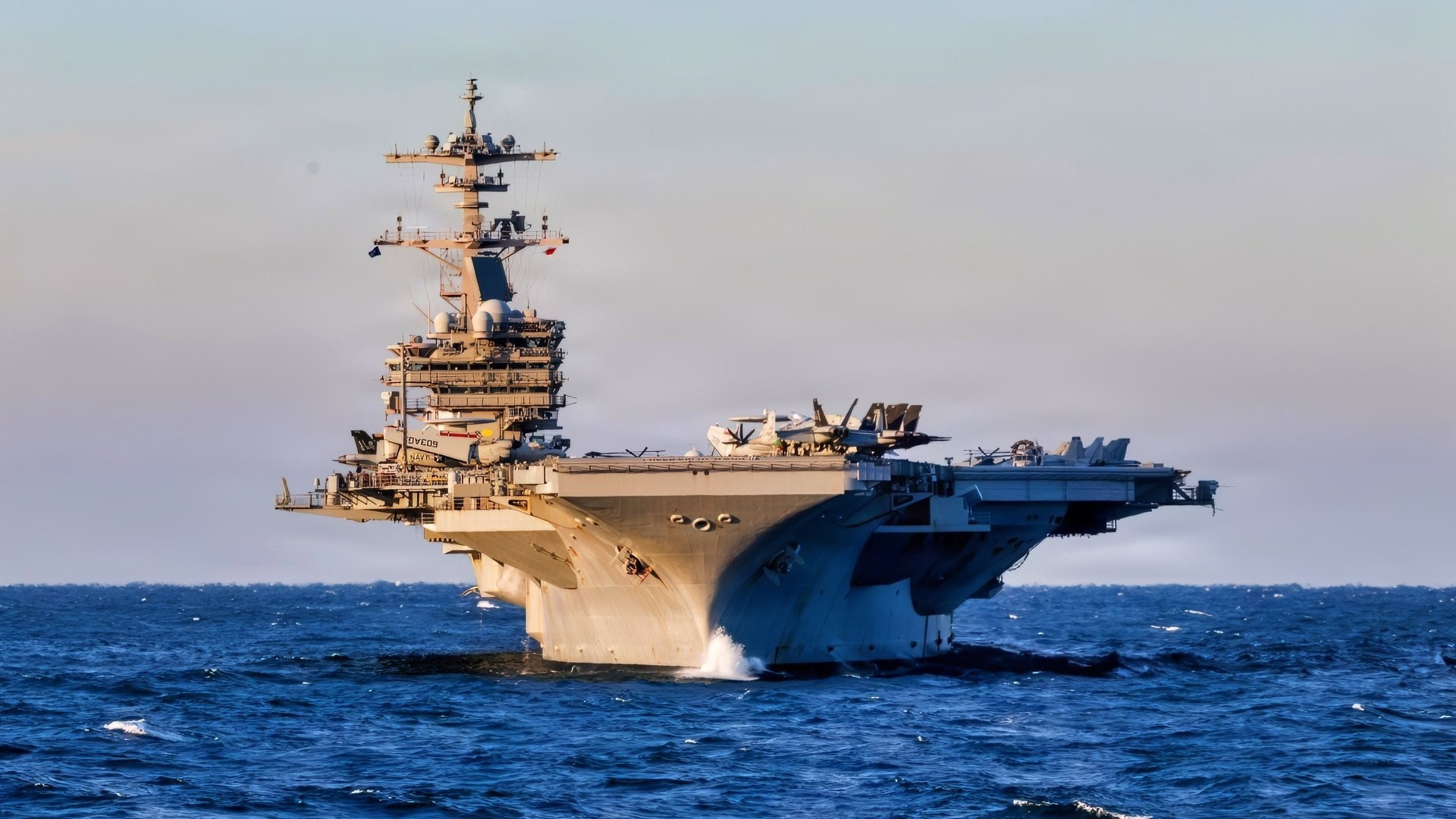
The Nimitz-class aircraft carrier USS George H.W. Bush (CVN 77) sails in the Atlantic Ocean, Feb. 6, 2026. The George H.W. Bush Carrier Strike Group is at sea as an integrated warfighting team. Composite Training Unit Exercise (COMPTUEX) is the Joint Force’s most complex integrated training event and prepares naval task forces for sustained high-end Joint and combined combat. Integrated naval training provides combatant commanders and America’s civilian leaders highly capable forces that deter adversaries, underpin American security and economic prosperity, and reassure Allies and partners. (U.S. Navy photo by Mass Communication Specialist 3rd Class John R. Farren)
Exact details of the live-fire exercise were not revealed, but the Navy reported that the systems successfully detected, engaged, and shot down multiple UASs.
Operational History
Commissioned in 2009, George H. W. Bush does not have a long or rich service history like some of her predecessor do.
Still, she has participated in numerous deployments since her commissioning. After initial trials and training, it conducted its first major deployment in 2011, operating in the Mediterranean Sea and the Middle East in support of U.S. Operation Enduring Freedom and Operation New Dawn.
Subsequent deployments have taken the carrier to the Arabian Gulf, the North Sea, and the Mediterranean, where it has participated in combat missions, maritime security operations, and multinational exercises with allied naval forces.
Earlier this year, Bush was expected to reinforce the U.S. naval buildup near Iran prior to the start of Operation Epic Fury, but the USS Abraham Lincoln and Gerald R. Ford were sent instead.
On March 31st, however, the decision was made to deploy Bush to the Middle East (likely due to some of Ford’s mishaps).
Her presence marked the first time three U.S. aircraft carriers operated in the Middle East simultaneously since 2003, when the U.S. invaded Iraq. As of writing this, the carrier was last spotted in the Southeastern waters of Africa, where she helped to enforce the U.S. blockade of the Strait of Hormuz.
She will likely remain there until a peace settlement is formalized by all sides, which, needless to say, may take a little while longer.
About the Author: Isaac Seitz
Isaac Seitz, a Defense Columnist, graduated from Patrick Henry College’s Strategic Intelligence and National Security program. He has also studied Russian at Middlebury Language Schools and has worked as an intelligence Analyst in the private sector.