
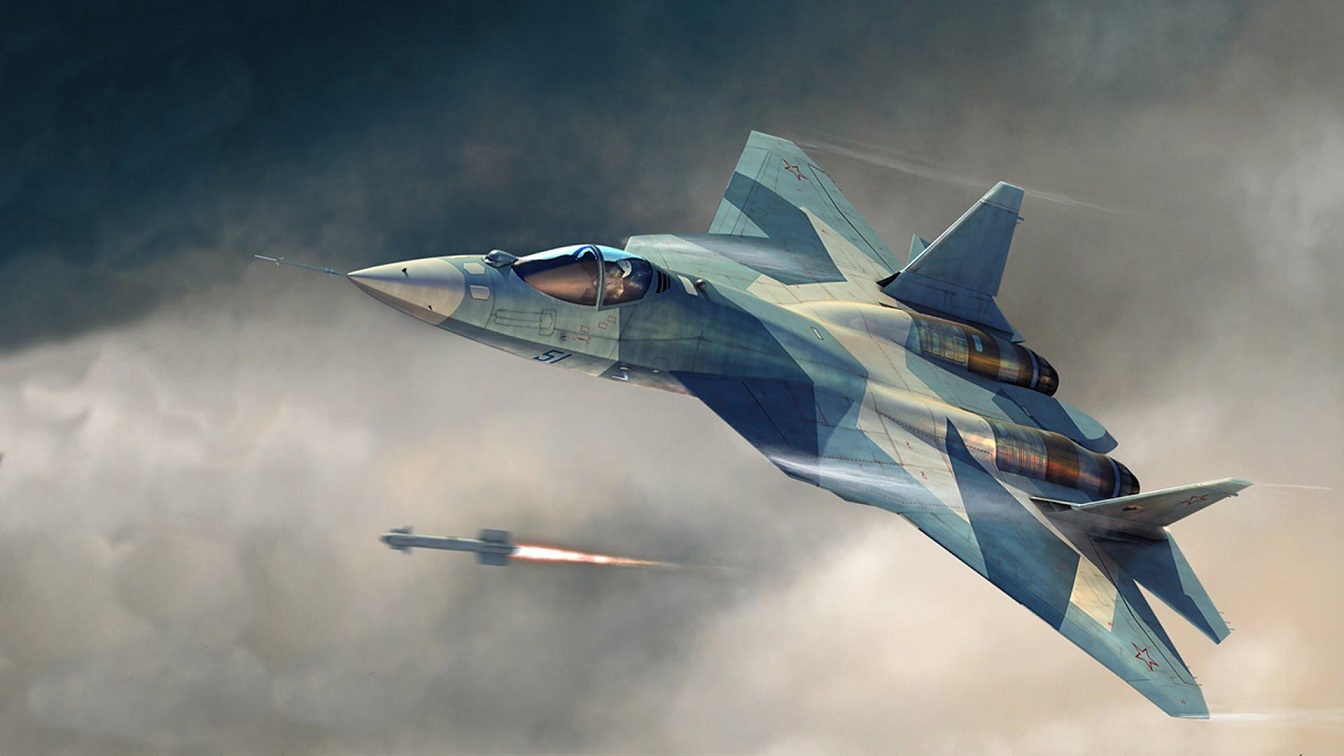
Summary and Key Points: Russia conceived the Sukhoi Su-57 as its answer to the American F-22 Raptor, a stealth air-superiority fighter ordered in a batch of 76 aircraft. Sixteen years after first flight, the Russian Aerospace Forces operate roughly 30 of them, and the jet’s documented combat work has consisted of standoff cruise-missile launches flown from deep inside Russian airspace. Moscow has instead found the aircraft new jobs: a two-seat Su-57D variant that flew in May with a rear cockpit built for controlling drones, export deliveries to Algeria that made it the first fifth-generation fighter besides the F-35 ever sold abroad, and testbed duty for a definitive engine that has been in testing since 2017.
Russia’s Su-57 Felon: Aerospace Mystery No More
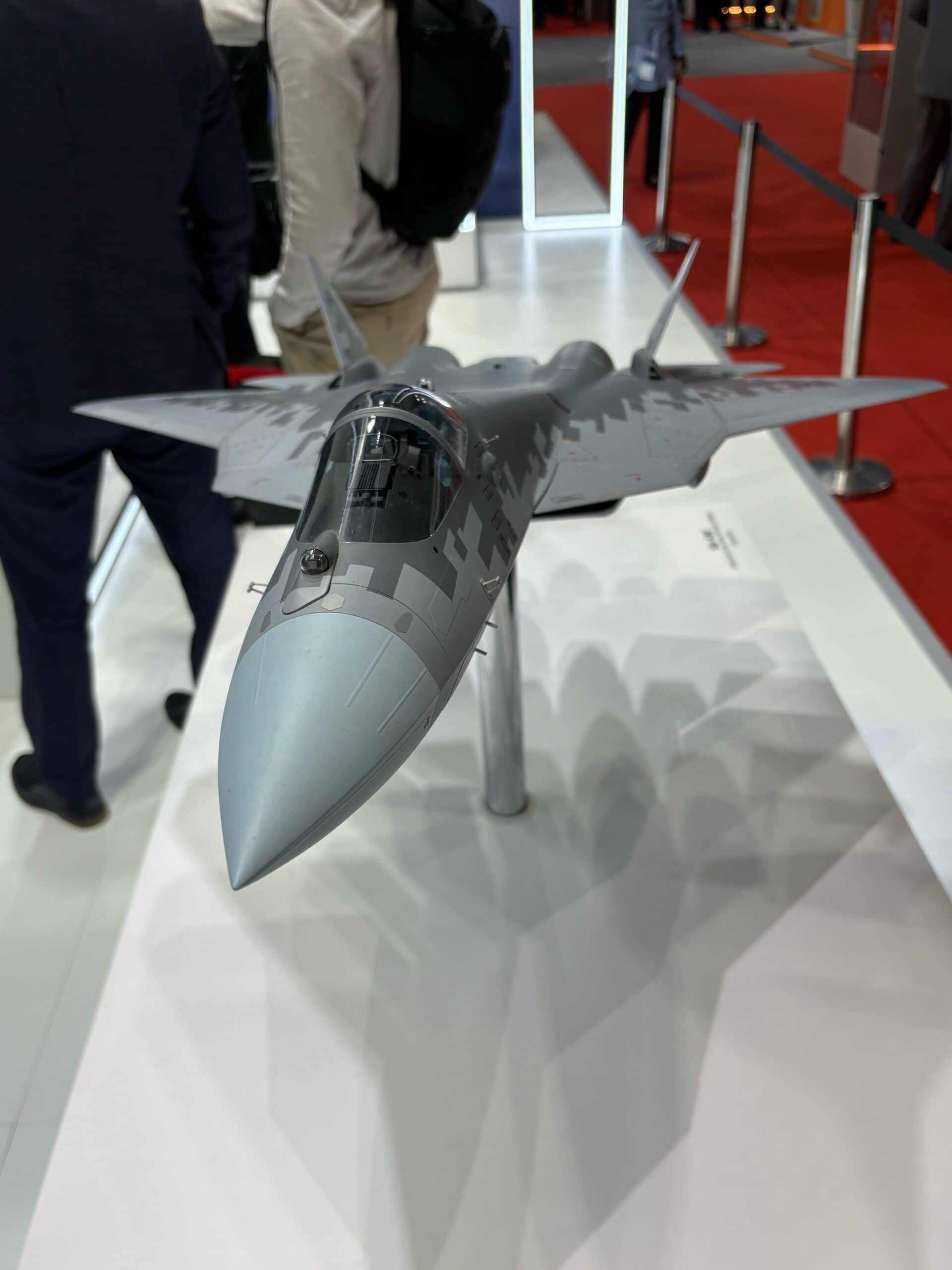
Su-57 Model 19FortyFive Original Photo
The single most revealing mission in the Su-57’s combat history was flown against a Russian aircraft. In October 2024, one of the jets penetrated defended Ukrainian airspace and used a short-range air-to-air missile to destroy an S-70 Okhotnik, Russia’s own stealth combat drone and the Su-57’s designated robotic wingman, after the flying wing lost control and wandered roughly ten miles behind Ukrainian lines.
Moscow judged it better to kill the drone than to let its secrets land in Western hands, and the only aircraft trusted to go get it was the fighter it was built to fly beside. A program conceived more than two decades ago to duel F-22 Raptors over contested skies found itself executing its most daring penetration mission to shoot down its own wingman.
That incident is the program in miniature, because the Su-57’s real story is identity drift. The jet Russia designed and the jet Russia operates are two different aircraft, and the thing that separates them is a number.
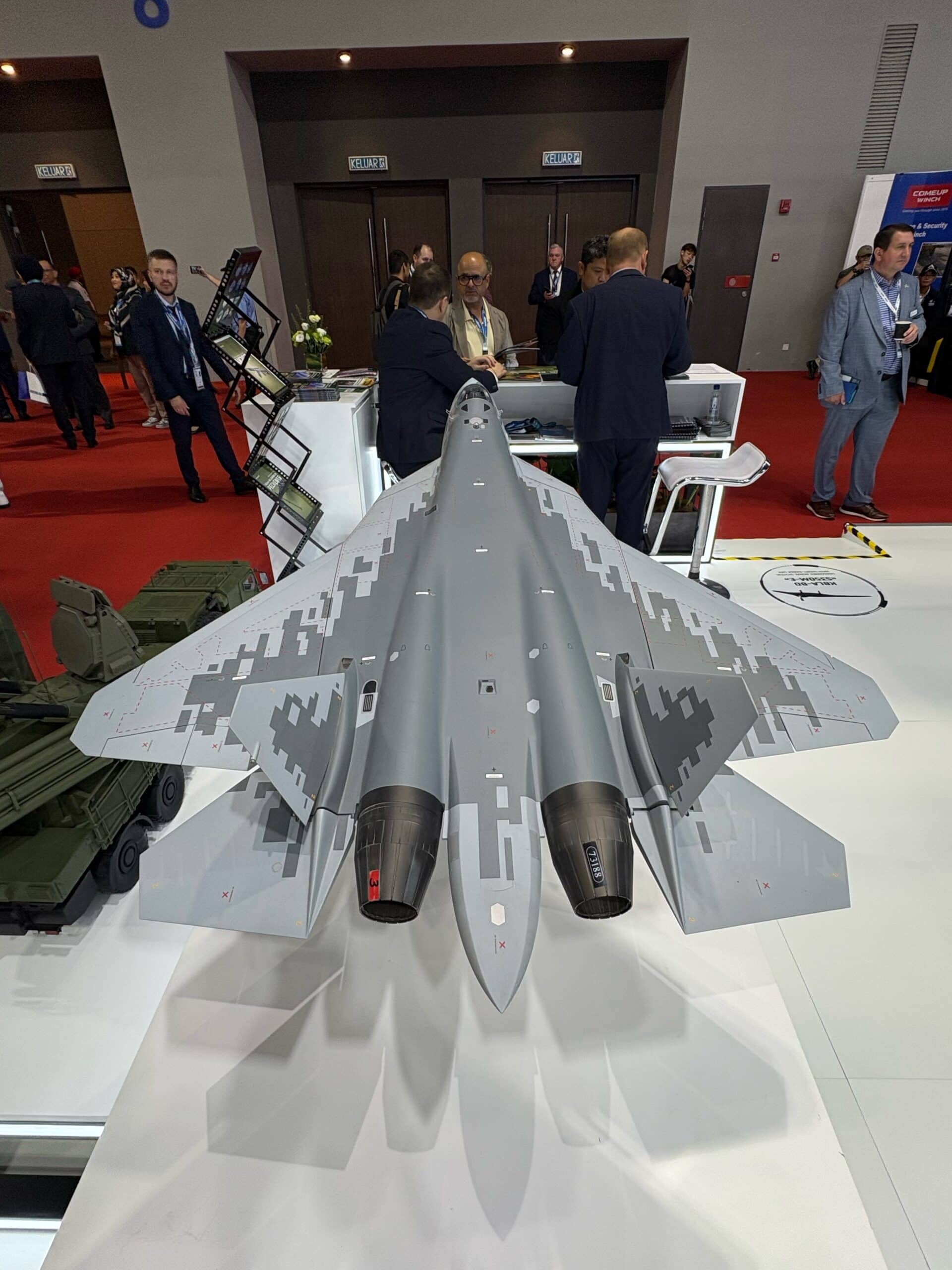
Su-57 Model 19FortyFive Original Photo
Aerospace Origins: The Fighter Built to Duel the Raptor
The PAK FA program that produced the Su-57 was Russia’s formal answer to American fifth-generation airpower: a large, twin-engine, stealthy air-superiority machine, the design analysts have long called the F-22’s closest philosophical rival rather than the F-35’s, meant to combine supersonic cruise, internal weapons carriage, a sensor suite built around the N036 radar’s multiple arrays, and extreme thrust-vectoring agility.
The prototype flew in January 2010, four years after the F-22 entered service, and the type formally joined the Russian Aerospace Forces in December 2020 with an order on the books for 76 aircraft — itself a fraction of the F-22’s truncated 187, let alone early Russian talk of far larger fleets.
The design brief, in other words, was symmetrical competition: Russia’s stealth fighter meeting America’s, squadron against squadron. Sixteen years after the first flight, that symmetry exists only on paper, because the squadrons were never built.
Production Reality: Sixteen Years, Roughly 30 Jets
The delivery ledger tells the story with brutal economy. At the end of 2023, the Russian Aerospace Forces had 21 production Su-57s plus ten prototypes. Seven more arrived in 2024 and two in April 2025, after which deliveries largely paused for the rest of the year during a modernization push, before a fresh batch with upgraded defensive sensors arrived in February, according to Rostec. Independent counts of the production fleet range from about 20 to just over 30 aircraft. Russia’s answer to this arithmetic is an acceleration campaign: new production facilities opened in August 2025, with the Aerospace Forces’ deputy commander-in-chief, Lt. Gen. Alexander Maksimtsev, confirming preparations for faster deliveries, and claims circulating that output could exceed 25 jets this year. Those claims get their test in the delivery ledger, which is where every previous acceleration promise has fallen short.
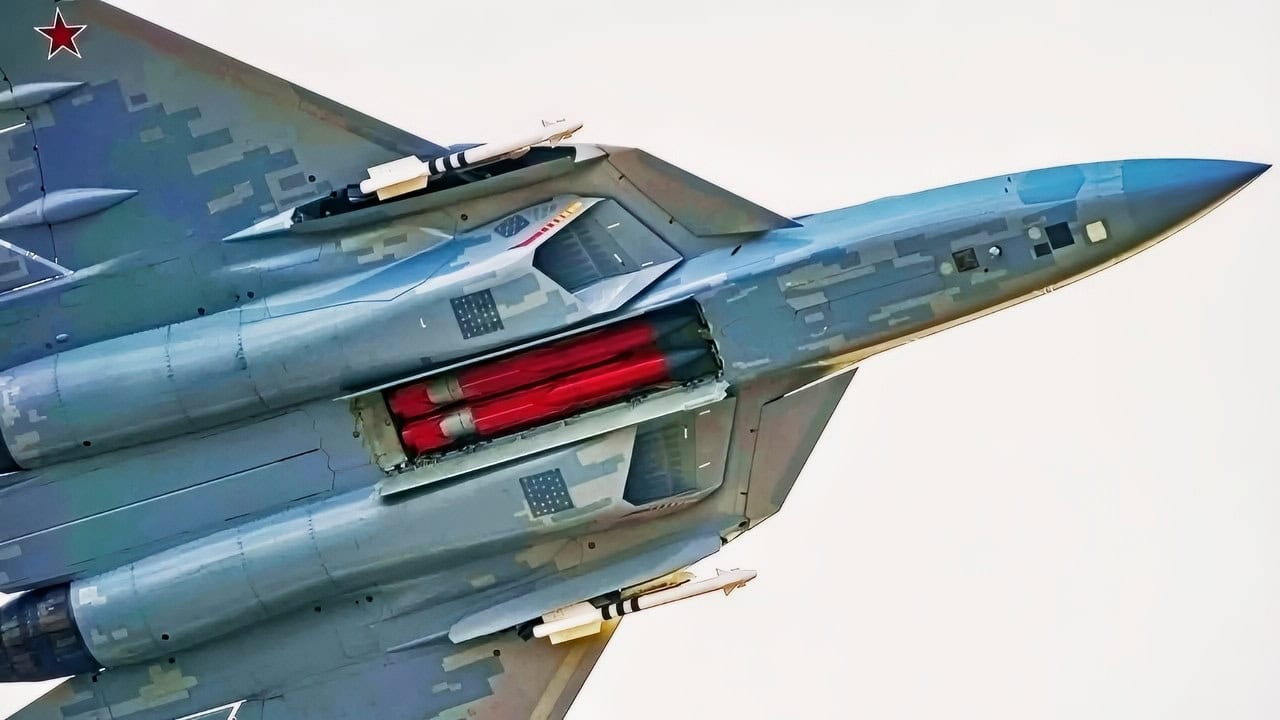
Su-57 Felon Fighter UAC Stock Photo.
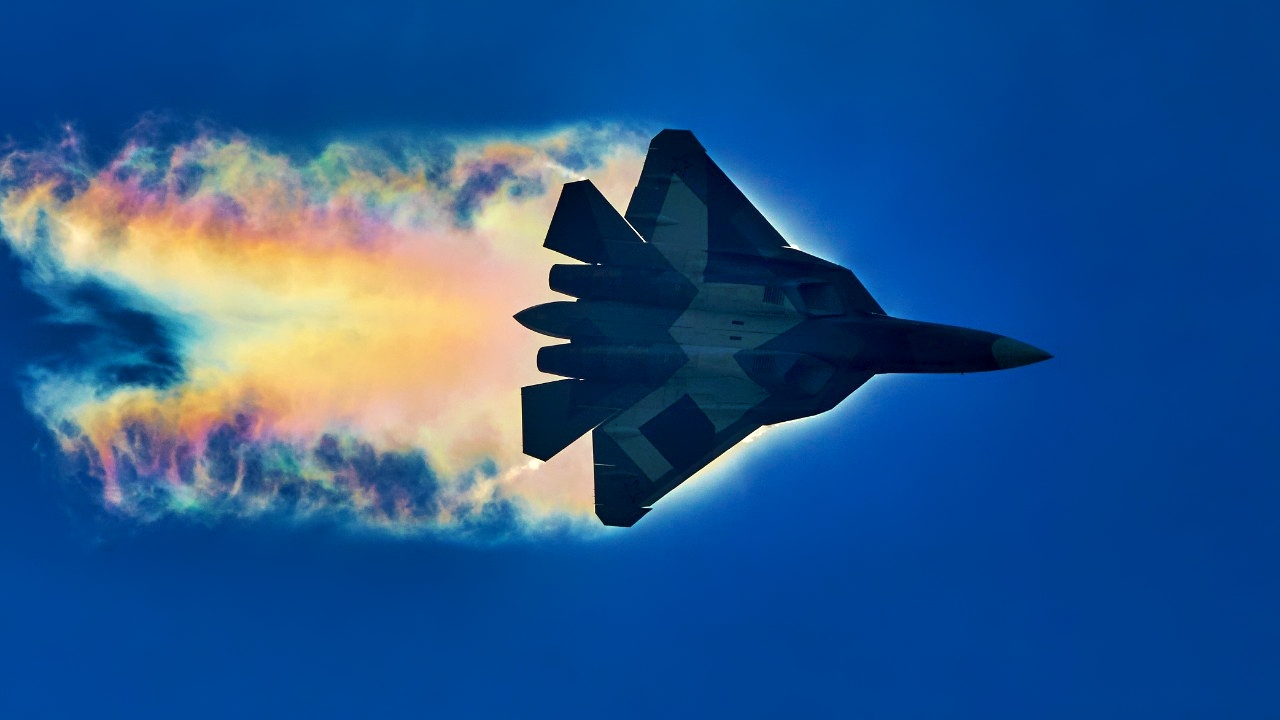
Russia’s Su-57 Felon Fighter

Su-57 Felon Fighter from Russian Air Force.
Two comparisons calibrate the scale. Lockheed Martin delivers roughly as many F-35s in a single quarter as Russia has built production Su-57s in total. And open-source fleet estimates now put China’s J-20, a program younger than the PAK FA, at nearly 500 aircraft. Even the Su-57’s definitive engine is still missing: the jets fly on an interim powerplant derived from the Su-35’s, while the AL-51F-1, which was supposed to deliver true fifth-generation supercruise, has been in testing since 2017 and has yet to equip the fleet. A fighter fleet of 30 airframes, whatever its qualities, cannot contest the airspace of a country the size of Ukraine, let alone screen a front against NATO. So the airframe went looking for work that a small fleet could actually do.
Ukraine Ledger: The Missile Truck That Never Crosses the Line
The combat record is the drift made visible. The type’s documented war has been fought almost entirely at arm’s length: a February 2024 strike saw a Su-57 escorted by two Su-35s launch a stealthy Kh-69 cruise missile from above Russian-held Luhansk, and by that May, Ukrainian sources reported intensified Su-57 strikes flown from the airspace of Kursk, Bryansk, and occupied Luhansk. Always standoff, always behind the line.
The pattern’s price was paid on the ground instead: in June 2024, Ukrainian long-range drones struck the Akhtubinsk test center and damaged at least one Su-57, with Russian military bloggers complaining bitterly that the country’s most valuable fighters sat in the open without protective shelters. This spring, the war reached even deeper, when Ukraine’s Unmanned Systems Forces claimed drone hits on four advanced combat aircraft, Su-57s among them, at Shagol air base near Chelyabinsk, some 1,700 kilometers from the border, with the force’s commander, Robert Brovdi, calling such raids “critical to reducing the enemy’s strike potential.”
After a lull following the Shagol attack, the Felon returned to work in May, and the shape of that work hasn’t changed. Ukrainian air-raid monitoring channels logged more than ten separate Su-57 cruise-missile launch events during the month, with the jets operating over the Kursk border region, the Azov Sea near Mariupol, and Crimea, firing Kh-59 and Kh-69 missiles from positions hundreds of kilometers behind the reach of Ukrainian defenses.
Army Recognition’s analysis of the pattern describes an aircraft functioning “primarily as a standoff precision-strike platform rather than a deep-penetration stealth fighter,” and carries the caveat this whole ledger deserves: the activity is documented through Ukrainian monitoring alerts, has not been independently confirmed, and goes unacknowledged by the Russian Defense Ministry. Reports this spring add a new weapon, deepening the same identity — the S-71K, a roughly 300-kilometer-class cruise missile, a type said to be designed to strike without approaching a Patriot engagement zone. Whatever the brochures say about supermaneuverability and stealth duels, the Su-57’s actual war has been the war of a very expensive, very cautious missile truck.
Drone Mothership and Export Flagship: The Jobs the Su-57 Found
The pivots away from the original mission are where the program has been most inventive. The drone-teaming role predates the war, with one of the earliest flying prototypes assigned to Okhotnik integration work back in 2019, and it graduated from concept to hardware on May 19, when the two-seat Su-57D flew for the first time with chief test pilot Sergey Bogdan at the controls.
The stretched tandem cockpit exists for a back-seater whose job is not flying but managing: controlling drones like the Okhotnik, coordinating strikes, running electronic warfare. It is a combat-control aircraft in a fighter airframe, and a tacit admission that the most useful thing a scarce fifth-generation jet can do is direct cheaper, less scarce assets.
The second job is a salesman. Algeria signed for 14 aircraft back in December 2019 as part of a larger fighter deal, and in November 2025, United Aircraft Corporation’s chief announced the first two jets had been delivered to a foreign customer — “They have begun combat duty and are demonstrating their best qualities,” Vadim Badekha said — with footage from Algeria confirming operations by February.
However small the batch, the milestone is real: the Su-57 became the first fifth-generation fighter other than the American F-35 ever delivered to an export customer.
The bigger prize remains India, where Moscow has reportedly offered the two-seat variant, technology transfer, and local production, even, per earlier reporting, full source-code access, to close a deal Indian media describe as under advanced discussion. New Delhi has confirmed none of it and has issued no formal request as of early this year, so the India chapter stays in the realm of courtship. Vietnam’s long-rumored interest sits even further out. The export push and the domestic program now feed each other: foreign money underwrites the production expansion that Russia hopes will finally give its own air force a real fleet.
And beneath both jobs runs the third: the Su-57 as flying laboratory — testbed for the still-absent definitive engine, for a new export powerplant shown at Dubai, for flat two-dimensional thrust-vectoring nozzles meant to fix the jet’s notoriously unstealthy rear aspect, and for the systems Russia says will feed its sixth-generation work.
The Counterpoints: Preservation Is a Strategy, and the Drift Has a Logic
The case for Russia’s handling deserves its hearing. Husbanding 30 irreplaceable airframes is rational; no air force risks its scarcest asset on penetration missions that a cruise missile can fly instead, and the standoff campaign has delivered real strikes at no confirmed cost in the air. The Russians argue the type has been combat-tested harder than any fifth-generation rival, with the design refined by wartime feedback, a claim carried entirely by Russian sourcing, though not an empty one.
The drone-mothership pivot aligns with where every serious air force is heading; the Americans are building the F-47 around collaborative combat aircraft on the same logic. And if the promised production ramp materializes, today’s odd jobs could, in hindsight, look like a bridge across the lean years.
All of it is true, and all of it describes the same underlying fact from a kinder angle: these are the virtues of a fighter that cannot be fleet.
The Su-57’s evolution is genuine — into a standoff shooter, a drone shepherd, an export flagship, a laboratory — and every step of it was compelled by the number Russia failed to build.
The jet that opened this story by shooting down its own wingman now has a two-seat version flying with a back seat built for drones, a pair of siblings on combat duty in North Africa, and a war record conducted almost entirely from its own side of the line.
Somewhere in the original PAK FA briefings is a fighter that meets Raptors over contested skies.
The aircraft Russia actually operates has never once been asked to try.
About the Author: Harry J. Kazianis
Harry J. Kazianis (@Grecianformula) was the former Senior Director of National Security Affairs at the Center for the National Interest (CFTNI), a foreign policy think tank founded by Richard Nixon based in Washington, DC. Harry has over a decade of experience in think tanks and national security publishing. His ideas have been published in the NY Times, The Washington Post, The Wall Street Journal, CNN, and many other outlets worldwide. He has held positions at CSIS, the Heritage Foundation, the University of Nottingham, and several other institutions related to national security research and studies. He is the former Executive Editor of the National Interest and the Diplomat. He holds a Master’s degree focusing on international affairs from Harvard University.