
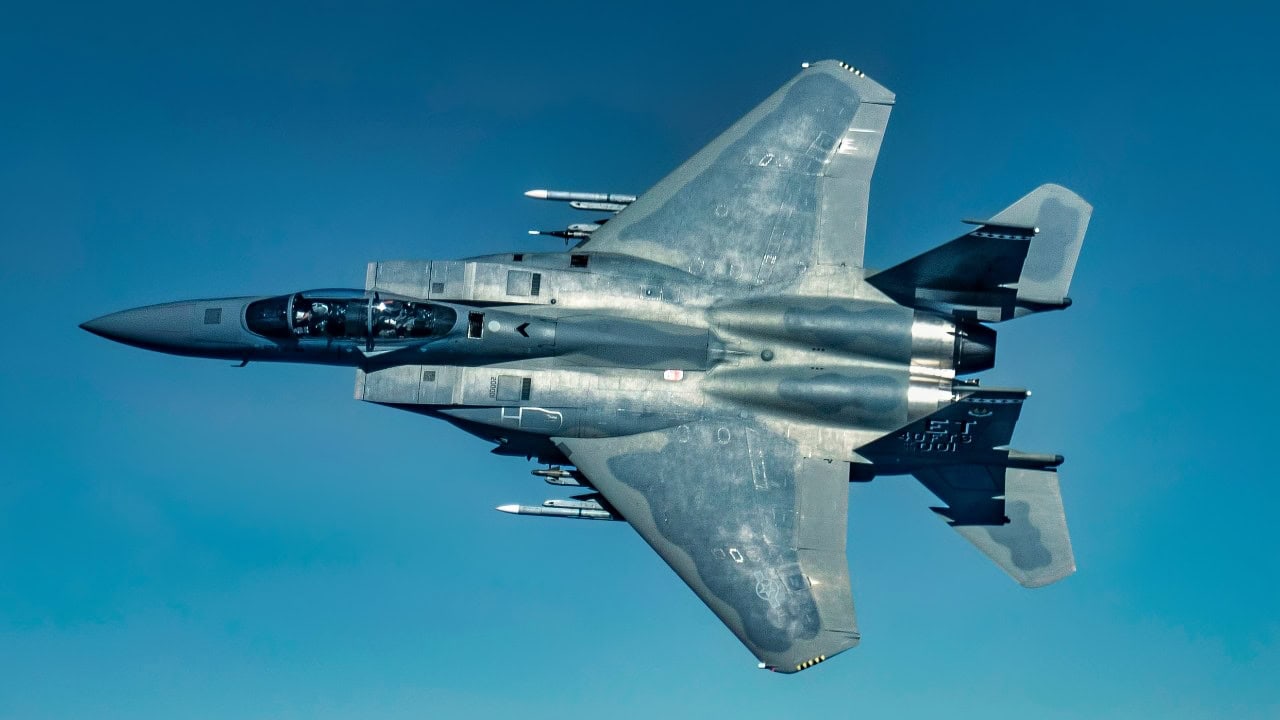
Summary and Key Points: On July 1, U.S. Pacific Air Forces released a photograph it had never released before: an American F-15EX Eagle II fighter flying in close formation with a combat drone, the first image the Air Force has ever published of a collaborative combat aircraft alongside a crewed fighter. The drone in the frame was not built in America. It is the MQ-28 Ghost Bat, the first military aircraft designed and built in Australia in more than 50 years, and while the U.S. Air Force is still flying off the competing prototypes for its own drone-wingman program, the Australian aircraft has already shot down a target with a missile, flown from a U.S. Navy range, and drawn buyers from Berlin to Tokyo. America’s newest airpower photo is a picture of somebody else’s airplane.
The F-15EX Has a Combat Drone Ally: Introduction
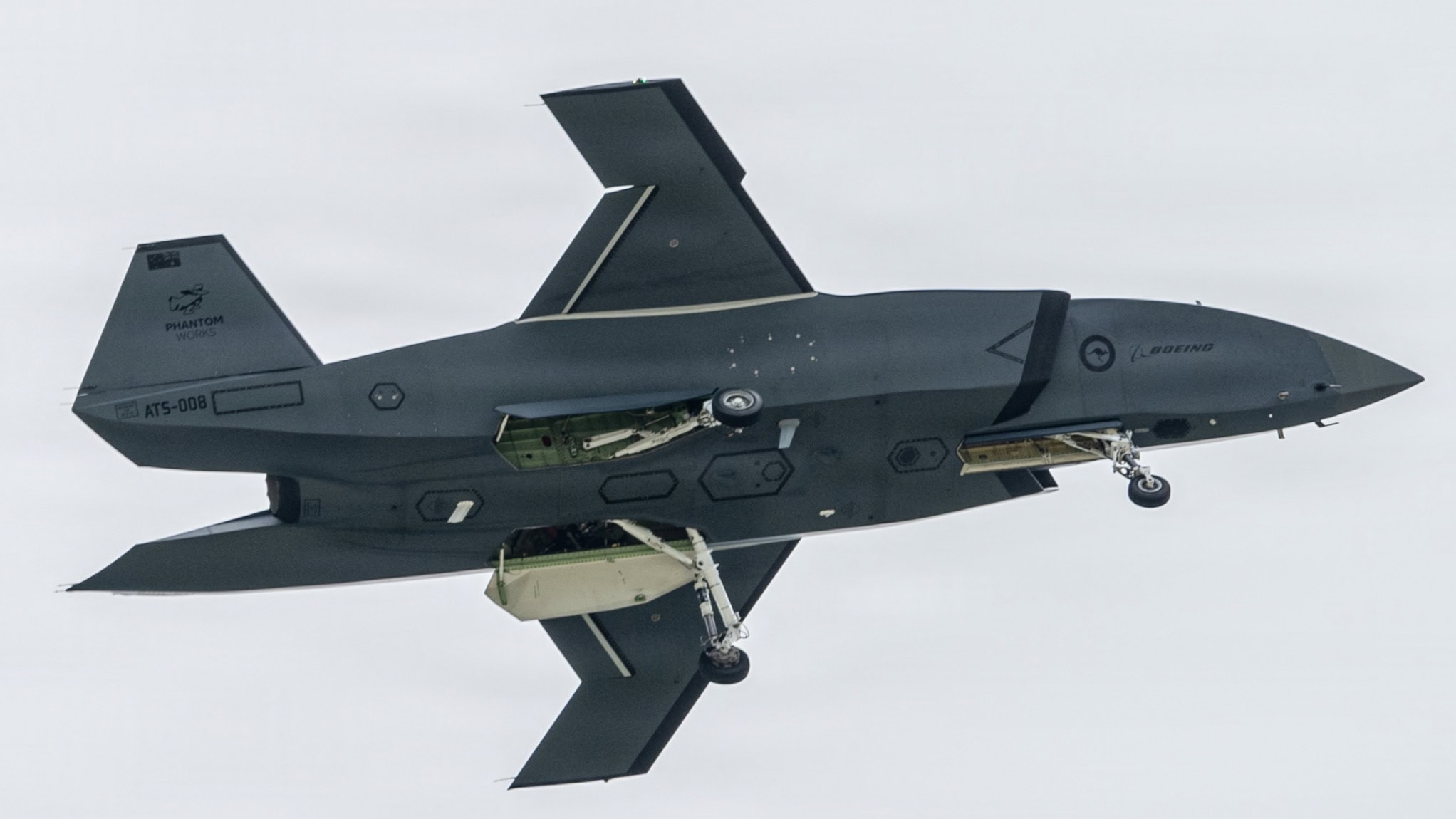
A Boeing Defence Australia’s MQ-28 Ghost Bat, a production representative test aircraft, performs a flyover during Exercise Valiant Shield 2026 over Rota, Commonwealth of the Northern Mariana Islands, June 25, 2026. Collaborative Combat Aircraft are semi-autonomous aircraft that operate under the oversight of human operators.
The image came out of Exercise Valiant Shield 2026, the large joint drill across the Pacific, and it landed as a milestone precisely because of what it implied rather than what it showed.
A crewed F-15EX from the 85th Test and Evaluation Squadron, the unit that develops operational concepts for the combat air force, flew over the Philippine Sea beside an uncrewed MQ-28. The concept it teased is the one every major air force is now chasing: a crewed fighter directing autonomous drones that carry extra sensors, weapons, and risk so the human crew does not have to. The newest American fighters were designed to be exactly that kind of quarterback. What the competitor coverage raced past is the detail sitting in plain sight in the caption: the drone doing the teaming is Australian, and it is further along than anything the United States owns.
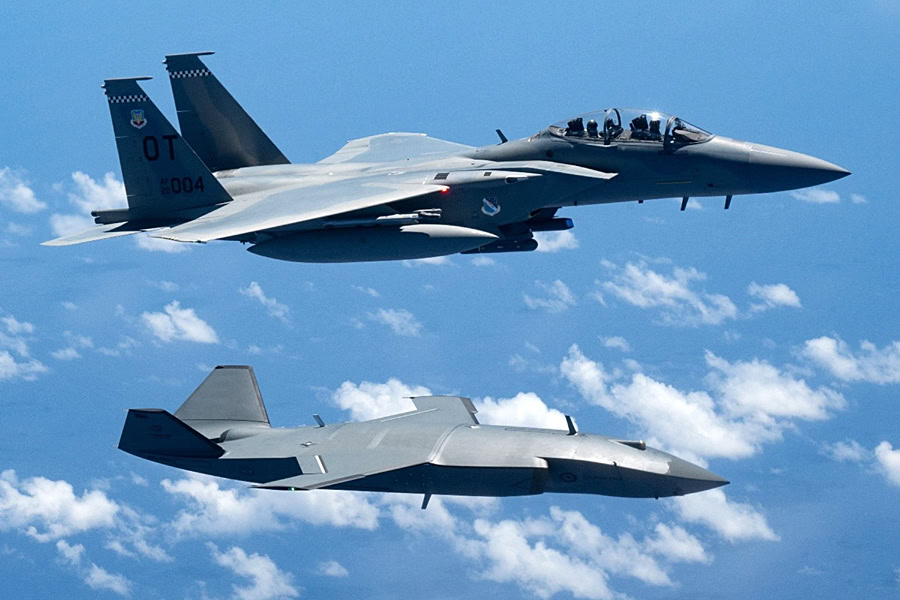
An MQ-28 Ghost Bat and US Air Force F-15EX Eagle II pictured together during Exercise VALIANT SHIELD 2026 over the Philippine Sea. US Pacific Air Forces photo.
Aerospace Reality: The Drone Australia Built
The MQ-28 Ghost Bat began life as Boeing’s Airpower Teaming System, developed in Australia for the Royal Australian Air Force under a “Loyal Wingman” program, and it carries a distinction no American drone can claim: it is the first military aircraft designed, built, and flown in Australia in over half a century, a sovereign program whose aircraft are produced only on Australian soil.
It first flew in 2021, passed its 100th test flight in March 2025, and is a genuinely modern combat aircraft, stealth-shaped to reduce its radar signature, roughly 38 feet long, powered by autonomy software rather than a remote pilot, and built around a swappable nose that lets a single airframe carry surveillance sensors, electronic-warfare gear, or, in time, weapons.
Its publicly reported range runs beyond 3,700 kilometers, the kind of reach the Pacific demands. Canberra has poured a billion Australian dollars into it and, in December 2025, committed roughly A$1.4 billion more to push the aircraft from prototype to frontline service, bringing the program’s running total to A$2.4 billion.
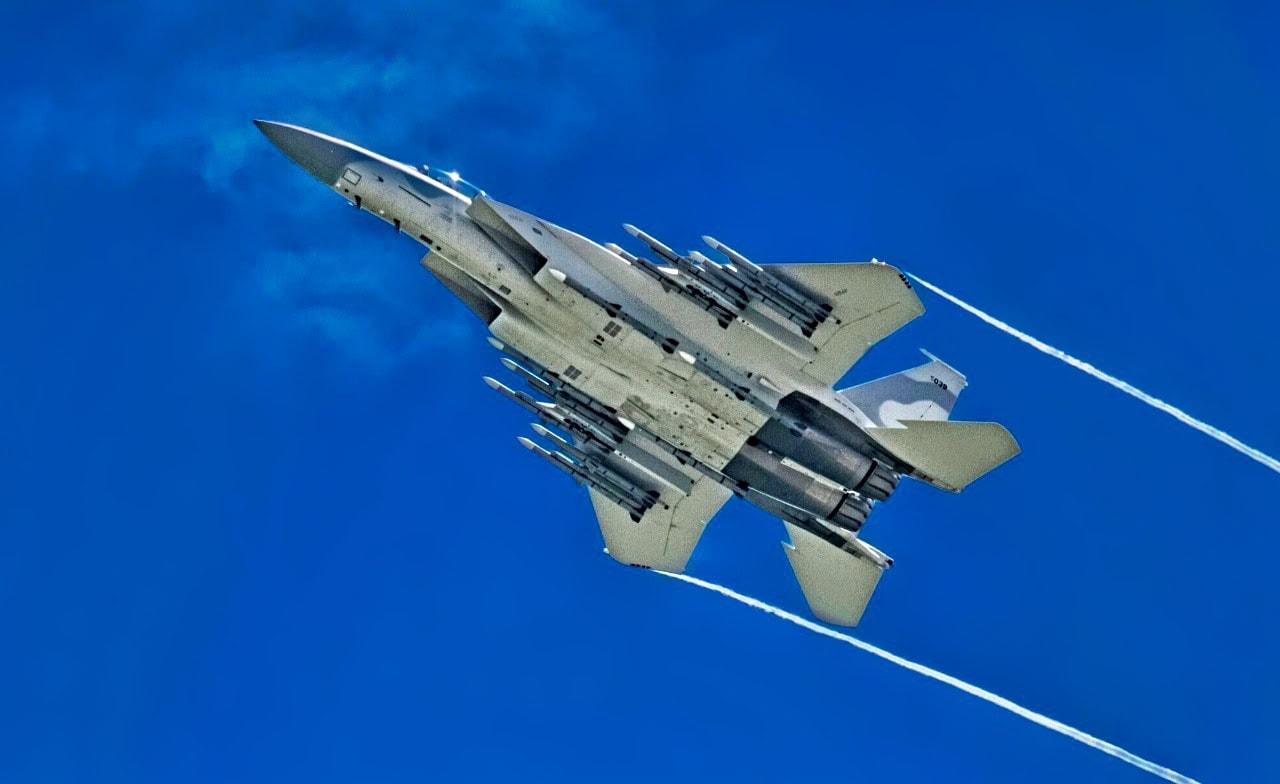
F-15EX Eagle II from U.S. Air Force
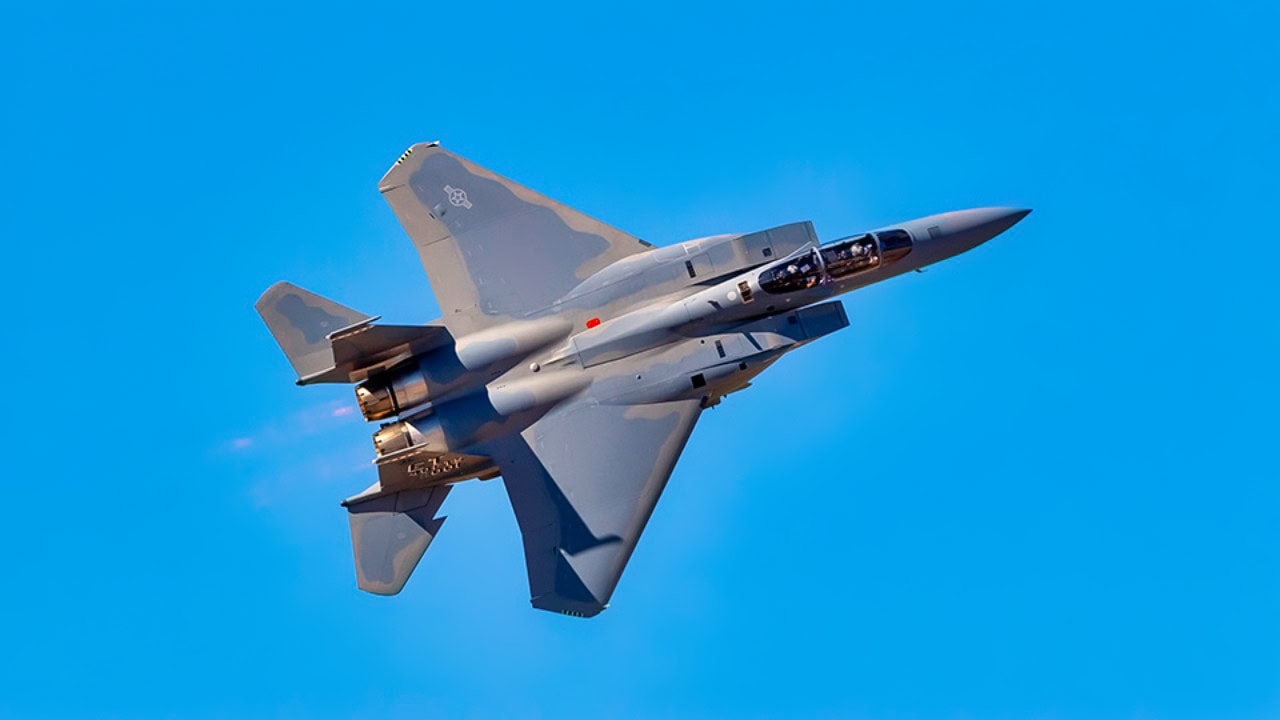
F-15EX Eagle II Fighter from Boeing.
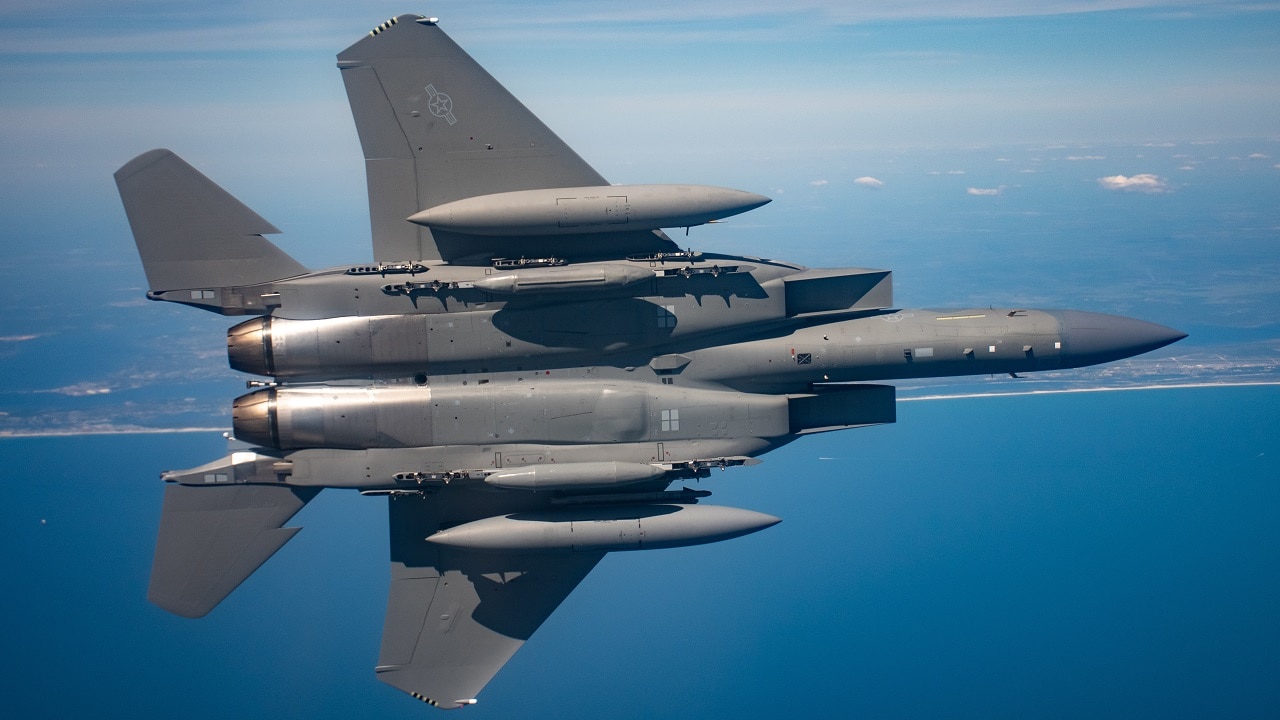
An F-15EX Eagle II from the 85th Test and Evaluation Squadron, 53rd Wing, takes flight for the first time out of Eglin Air Force Base, Fla., April 26, 2021, prior to departure for Northern Edge 2021. The F-15EX brings next-generation combat technology to a highly successful fighter airframe that is capable of projecting power across multiple domains for the Joint Force. (U.S Air Force photo by 1st Lt Savanah Bray)
The reason this matters to Washington is maturity. Most collaborative combat aircraft in the allied world are still proving they can fly the mission. The Ghost Bat has started proving it can fight it.
Defense Ledger: What It Has Already Done
The turning point came at the Woomera range in December 2025, when an MQ-28 flew as a loyal wingman with an RAAF E-7A Wedgetail and an F/A-18F Super Hornet and autonomously fired a live AIM-120 AMRAAM that destroyed an aerial target drone. Boeing billed the shot as the first time an autonomous aircraft had completed an air-to-air kill with an AMRAAM, running the whole chain itself, taking off, patrolling, committing, and firing, though it was not the first uncrewed jet ever to loose a beyond-visual-range missile, since Turkey’s Kızılelma had fired one about a month earlier. The distinction still matters: it put the Ghost Bat in a category almost no rival CCA had reached, a drone that has actually shot something down.
Then it left home. In May 2026, Boeing confirmed the MQ-28 had flown its first missions ever outside Australia, three flights at the Point Mugu Sea Range at a U.S. Navy base in California, framed as proof that the aircraft could be dropped onto an allied base and turned around fast. The choice of a Navy range rather than an Air Force one was not subtle about where Boeing sees American demand, and a U.S. Navy test squadron has since deployed to Australia to work on the aircraft under a skills-sharing agreement.
The Berlin unveiling of a larger, longer-ranged Block 3 with an internal weapons bay followed in June, an export-focused variant Boeing intends to build from 2028. Which brings the story to the July 1 photograph over the Philippine Sea, the Air Force’s first published image of a CCA flying with a crewed fighter, and the honest question underneath it.
The Open Question: Did the Eagle Actually Command the Drone?
The competitor cards treated the formation as a triumph of teaming. The more accurate reading is that no one outside the program knows how much teaming occurred. Pacific Air Forces stated flatly that it “will not discuss specific flight operations or tactical integration details,” which leaves the central question unanswered: did the F-15EX’s back-seat weapons officer actually command the Ghost Bat, or did the two aircraft simply share a piece of sky for the cameras? The technology to do the former plainly exists, since an F-22 controlled a General Atomics drone in October 2025 and an F-35 followed in May 2026, and a two-seat fighter with a spare crewmember is widely considered the most natural drone controller in the inventory. But a formation photo is not a command demonstration, and saying so is the difference between reporting the milestone and selling it. What the image confirms is intent. What it does not confirm is control.
The Counterpoints: Whose Program Is This, Really?
Several caveats keep the thesis honest. The Ghost Bat is not actually competing for the U.S. Air Force’s own CCA program of record, which already has the General Atomics YFQ-42A and Anduril YFQ-44A in production; America “counting on” the Australian drone really describes the Navy’s interest and the export lane, not the flagship Air Force effort.
Operational RAAF service is not expected until 2028 for the interim Block 2, with the export-standard Block 3 later still, so “combat-ready” describes a trajectory rather than a fielded squadron.
The “most mature allied CCA” framing is partly Boeing’s own sales pitch, carried here as the company’s claim backed by the AMRAAM kill. And the whole loyal-wingman model rests on economics that remain a projection: analysts estimate a production MQ-28 might run $10 to $15 million against $80 million or more for a crewed fighter, with air forces eyeing roughly two drones per jet, but those unit costs have to survive contact with real production before the math is proven.
All of that granted, the strategic picture is unusual enough to state plainly.
The United States is the wealthiest military power on Earth and the pioneer of stealth and unmanned aviation, and the drone that just flew beside its own fighter over the Pacific, the one it chose to photograph as a glimpse of the future, was designed and built by an ally that decided to move faster. Germany’s Rheinmetall has partnered to offer the Ghost Bat to Berlin, and Japan, South Korea, and Singapore have all shown interest, which means the aircraft may end up a coalition standard while America’s own program is still choosing a winner.
It is the same lesson playing out under the ocean, where Australia’s Ghost Shark undersea drone reached the water while the U.S. Navy’s equivalent ran late. In the air and beneath the sea, the most combat-ready autonomous systems in the alliance right now are wearing Australian markings, and Washington is lining up to buy in.
MORE – Ukraine Is Hunting Russia’s S-400 Air Defense
About the Author: Harry J. Kazianis
Harry J. Kazianis (@Grecianformula) was the former Senior Director of National Security Affairs at the Center for the National Interest (CFTNI), a foreign policy think tank founded by Richard Nixon based in Washington, DC. Harry has over a decade of experience in think tanks and national security publishing. His ideas have been published in the NY Times, The Washington Post, The Wall Street Journal, CNN, and many other outlets worldwide. He has held positions at CSIS, the Heritage Foundation, the University of Nottingham, and several other institutions related to national security research and studies. He is the former Executive Editor of the National Interest and the Diplomat. He holds a Master’s degree focusing on international affairs from Harvard University.

