
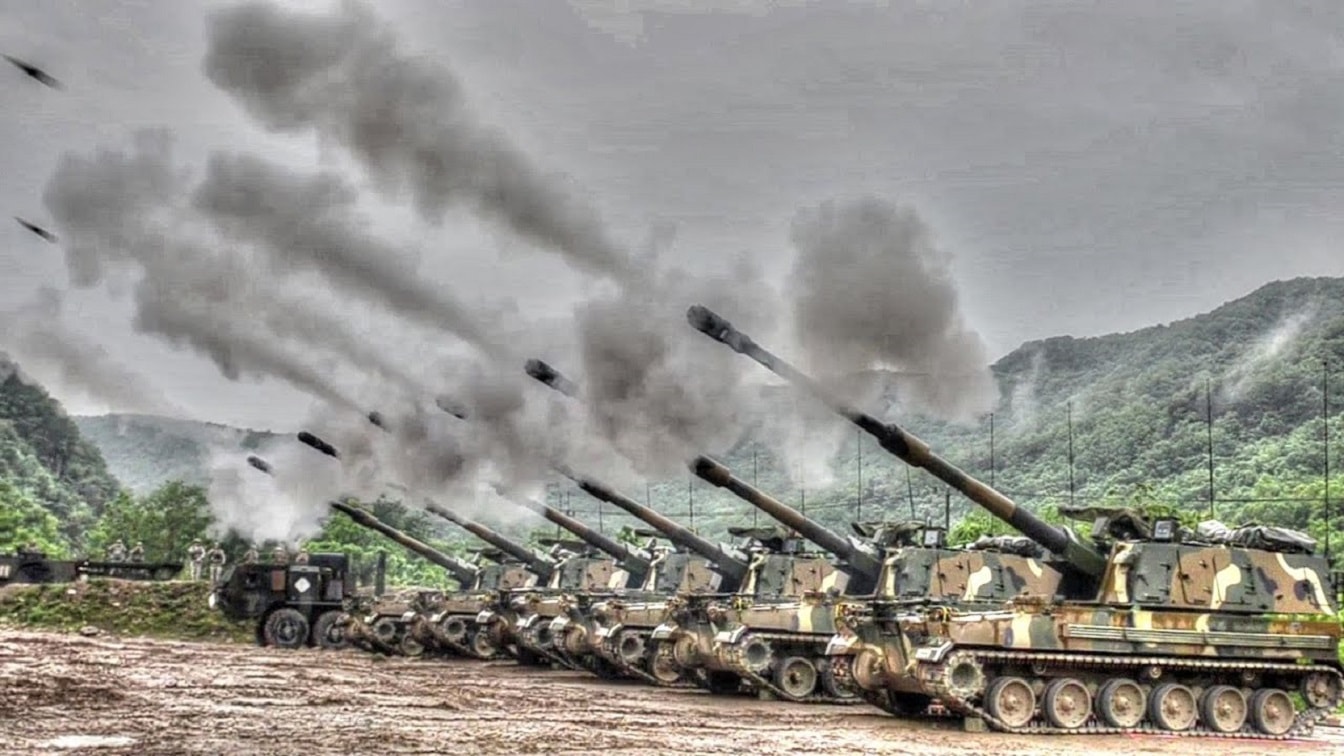
The K9 Thunder is the most exported tracked self-propelled howitzer in the world, in service or on order with 11 nations and holding a majority share of the global market for systems sold since 2000. It has outsold the American M109 Paladin, the German PzH 2000, and the French CAESAR, and it did so despite being, on paper, a conventional 155mm howitzer rather than a technological leap. What makes the K9 special is not the gun. It is how South Korea builds and sells it, and a business model that Washington, Berlin, and Paris have been unwilling to match.
The K9 Thunder Is a Powerhouse: An Introduction
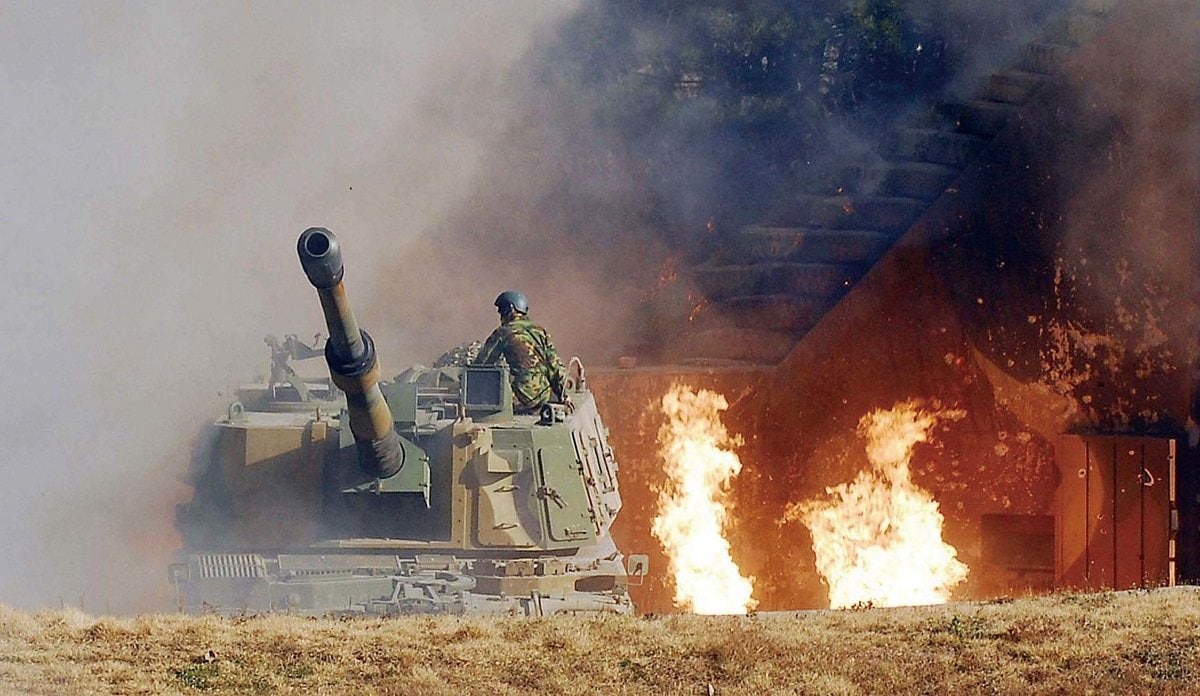
South Korean Marine Corps K9 self-propelled howitzer preparing counterattack right after the initial attack from North Korea in 2010.
South Korea’s Hanwha Aerospace has spent the past few years turning a domestic artillery piece into a global export phenomenon, and the numbers explain why defense analysts now treat the K9 Thunder as the benchmark for modern tube artillery.
A Hanwha executive framed the company’s edge plainly at a 2025 defense exhibition, describing the Korean industry’s strength as a one-stop shop that manufactures the entire system inside Korea without dependence on foreign suppliers.
That self-sufficiency, paired with a production line that has never gone cold since the 1990s, is the foundation of an export record that established Western manufacturers have been unable to match.
The K9 is a genuinely capable howitzer, but its dominance is a story about industrial strategy first and firepower second.
The Gun Built to Outrun Counter-Battery Fire
The K9 was born from a specific and unforgiving problem. Developed from 1989 by South Korea’s Agency for Defense Development together with the company now known as Hanwha, and entering service in 1999, the howitzer was designed to counter North Korea’s massive artillery force along one of the most heavily militarized borders on earth.
That mission demanded a gun that could fire hard, move immediately, and survive the counter-battery fire that arrived within minutes of a shot. The answer was a fully tracked, armored, 47-ton vehicle carrying a 155mm 52-caliber gun, built around the tactic artillery crews call shoot-and-scoot.
Its performance in that role is what customers actually buy. The K9 can fire a burst of three rounds in 15 seconds, sustain six to eight rounds per minute for three minutes, and drop to two or three rounds per minute for an hour of continuous fire, and it is capable of multiple-rounds-simultaneous-impact missions in which several shells fired on different trajectories strike a target at the same instant.
The gun’s reach depends on the shell, ranging from about 18 kilometers with standard high-explosive rounds to more than 40 kilometers with base-bleed extended-range projectiles.
The decisive figure is time, not distance: the K9 can be ready to fire within 30 seconds of stopping and moving again within 30 seconds of finishing, a tempo that lets it deliver a barrage and vanish before enemy radar completes a firing solution. Much of that sustained rate depends on a companion vehicle, the K10 automated resupply carrier built on the same chassis, which transfers ammunition to the gun via a conveyor without exposing its crew, allowing a battery to keep firing rather than pausing to rearm.
Why 11 Nations Chose It
The reason so many armies with nothing in common keep landing on the same howitzer comes down to four advantages that have little to do with ballistics. The first is delivery speed.
When Russia invaded Ukraine in 2022 and Poland donated its Soviet-era artillery to Kyiv, Warsaw needed replacements immediately, and Hanwha delivered its first K9S within months, a timeline Western contractors working through pandemic backlogs could not approach. South Korea can move that fast because its Changwon line has run continuously for decades, while American M109 production paused for years and had to be restarted from a cold supply chain.
The second advantage is technology transfer, which Western capitals have most resisted. Hanwha routinely allows buyers to build the K9 locally, customize it to national requirements, and participate in the industrial work, which turns a purchase into a domestic manufacturing program rather than an import.
That offer has proven decisive across wildly different customers. Poland has emerged as the largest foreign operator, and the scale is striking: a framework agreement covering up to 672 units, with two executive contracts to date committing 364 howitzers, and the first Polish-customized K9PL variant shipping from South Korea in July 2026, giving Poland one of the largest tracked-artillery forces in Europe.
India builds the K9 Vajra locally and has validated it at 15,000 feet in Ladakh, facing China. Turkey produces its own version as the T-155 Firtina, and Egypt, Australia, and Romania have all secured local assembly. The third and fourth advantages, competitive pricing and a willingness to do business on terms buyers prefer, complete a package that the largest artillery deal in the platform’s history demonstrated when Poland signed on, and that has drawn in Finland, Norway, and Estonia across NATO’s northern flank.
A Platform That Keeps Evolving
The K9’s designers treated it from the start as a platform meant to change rather than a fixed product, and that steady evolution is part of why it keeps winning contracts against newer rivals. With nearly 2,000 units delivered and hundreds more in production, the design has moved through successive upgrades that each solve a specific problem rather than chase novelty.
The current K9A1 added digital fire control, satellite navigation, and improved crew systems.
The K9A2, due to be finalized by 2027, pushes automation much further with a fully automated turret loader that reduces the crew from five to three, cutting training pipelines and long-term costs. A more ambitious K9A3 concept explores unmanned operation and far longer range using gliding munitions.
Hanwha has also extended the K9’s firepower into new form factors to capture buyers with different needs.
The company has unveiled a wheeled 8×8 variant that mounts a K9-derived gun on a road-mobile truck chassis, trading the tracked vehicle’s cross-country reach for faster strategic mobility and lower sustainment costs, explicitly aimed at NATO and European customers seeking rapidly deployable artillery. Because the wheeled system shares the K9’s gun, ammunition, and fire-control lineage, existing operators can adopt it without abandoning their training and logistics. That reuse of a proven core, rather than a clean-sheet redesign, is the same instinct that has guided the whole program.
The K9’s success has exposed a blind spot in how the established artillery powers approach exports.
American and European manufacturers long assumed that the most advanced platform would win contracts on its merits, treating technology transfer as a concession to avoid, delivery timelines as a function of demand rather than urgency, and price as secondary to capability.
The K9 proved the opposite calculation, that a good-enough system delivered fast, at the right price, with full industrial partnership, beats the finest howitzer on paper that arrives years later with no local production. Most armies do not need the single best gun in the world.
They need artillery that works, that they can afford in quantity, and that they can eventually build and sustain themselves, and South Korea understood that before its competitors did.
MORE – The B-2 Spirit Stealth Bomber Can Sink China’s Navy
About the Author: Harry J. Kazianis
Harry J. Kazianis (@Grecianformula) was the former Senior Director of National Security Affairs at the Center for the National Interest (CFTNI), a foreign policy think tank founded by Richard Nixon based in Washington, DC. Harry has over a decade of experience in think tanks and national security publishing. His ideas have been published in the NY Times, The Washington Post, The Wall Street Journal, CNN, and many other outlets worldwide. He has held positions at CSIS, the Heritage Foundation, the University of Nottingham, and several other institutions related to national security research and studies. He is the former Executive Editor of the National Interest and the Diplomat. He holds a Master’s degree focusing on international affairs from Harvard University.