
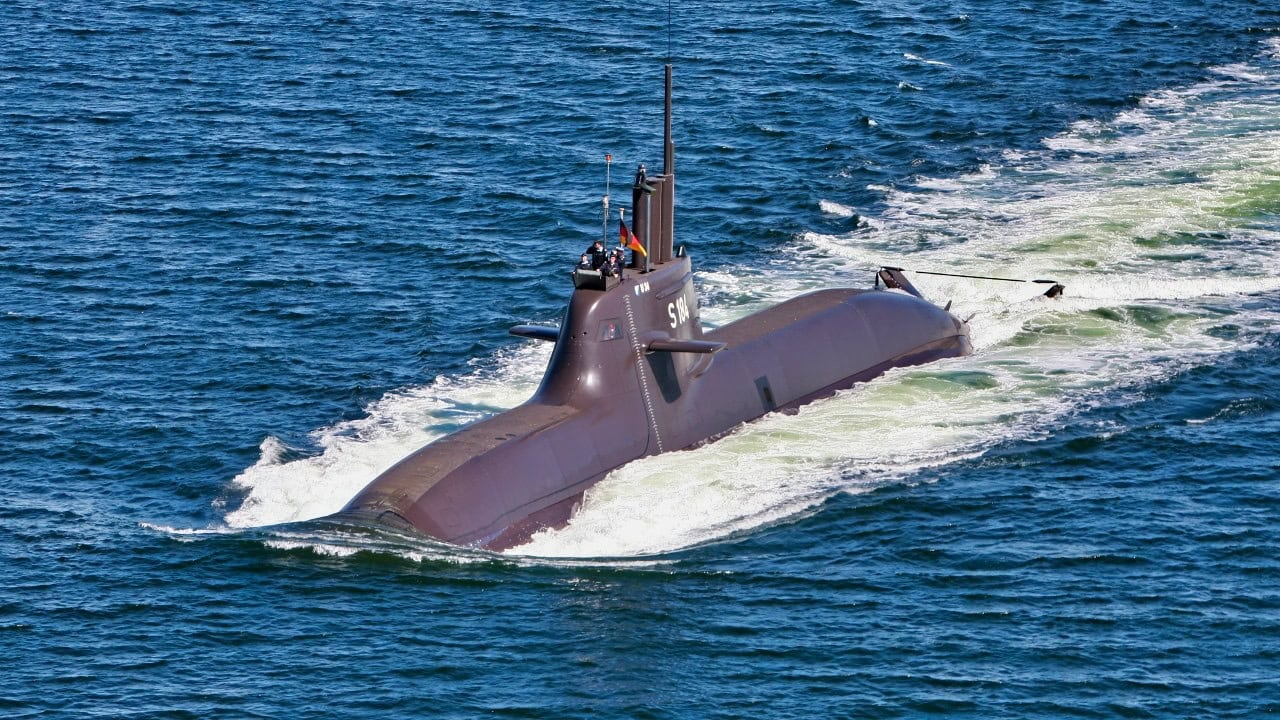
Summary and Key Points: Canada just picked Germany’s Type 212CD as its next submarine, a boat with a hull faceted like a stealth fighter, built from steel that barely registers on a magnetic detector, able to sit submerged for weeks without surfacing. Its most remarkable trick has nothing to do with hiding: it can fire a missile from underwater and shoot down the anti-submarine helicopter trying to kill it, without ever breaking the surface. Here is what makes one of the world’s most advanced conventional submarines so hard to find, and so dangerous to hunt.
Germany’s New Type 212CD Submarine: An Introduction
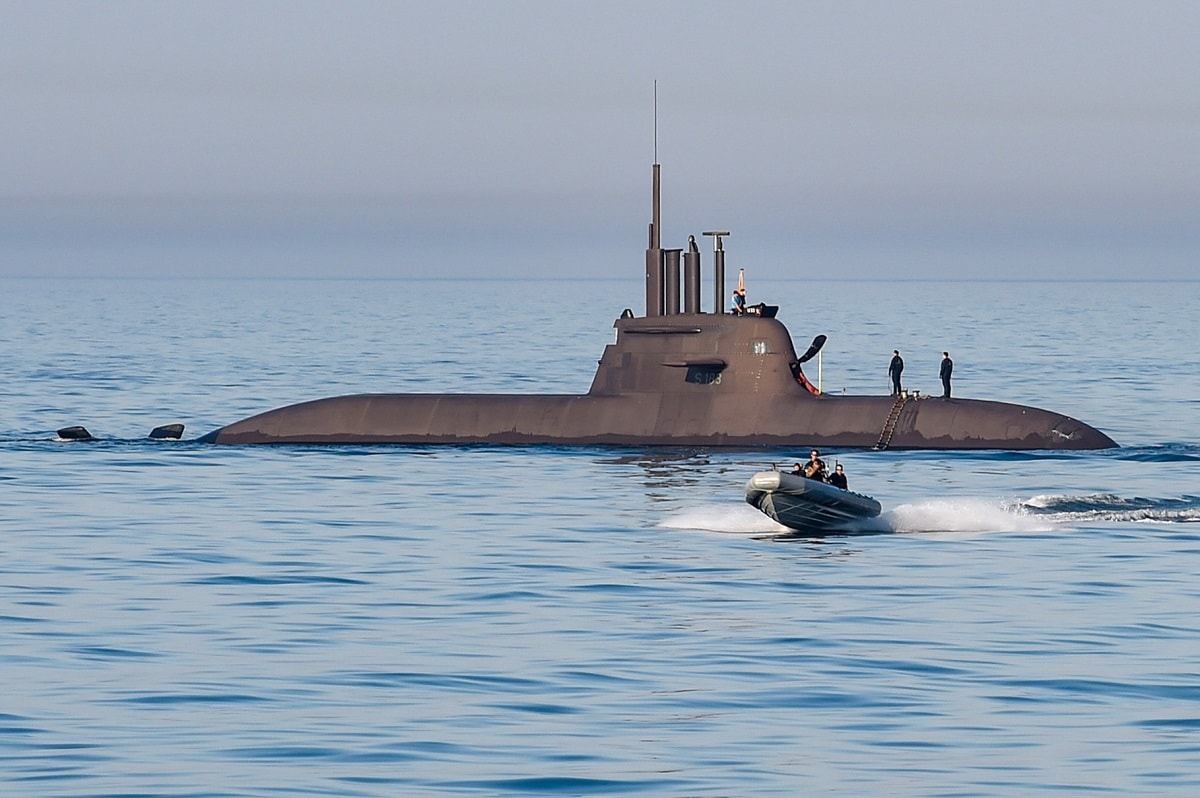
(June 5, 2019) A rigid-hull inflatable boat from the guided-missile destroyer USS Gravely (DDG 107) departs a German U-33 submarine during a passenger transfer exercise. Gravely is underway on a regularly-scheduled deployment as the flagship of Standing NATO Maritime Group 1 to conduct maritime operations and provide a continuous maritime capability for NATO in the northern Atlantic. (U.S. Navy photo by Mass Communication Specialist 2nd Class Mark Andrew Hays/Released)
On July 6, 2026, Canada announced that its next submarine would be German-made, selecting ThyssenKrupp Marine Systems’ Type 212CD to replace the Royal Canadian Navy’s aging Victoria-class boats in what may become the largest defense procurement in the country’s history. Much of the coverage focused on the money and the politics, a deal worth tens of billions of dollars, and a deepening alignment with Germany and Norway. Less has been said about the machine itself, which is a shame, because the Type 212CD is one of the most unusual and capable non-nuclear submarines ever designed. Strip away the procurement story and look at the boat in isolation, and what emerges is a submarine engineered around a single obsession, becoming almost impossible to detect, with one startling exception to the rule that submarines only hide.
The Submarine Shaped Like a Stealth Fighter
The first thing that sets the Type 212CD apart is visible before it ever submerges. Almost every submarine ever built is a smooth cylinder, a rounded tube optimized to slip through water. The 212CD is not. It has a distinctive diamond-shaped outer hull, with flat, angled facets running along its flanks, and the reasoning behind that shape is borrowed directly from stealth aircraft.
A modern anti-submarine warship hunts by sending out active sonar pulses, pings, and listening for the echo that bounces back off a submarine’s hull. A rounded hull tends to reflect that ping straight back toward the ship that sent it, lighting the submarine up.
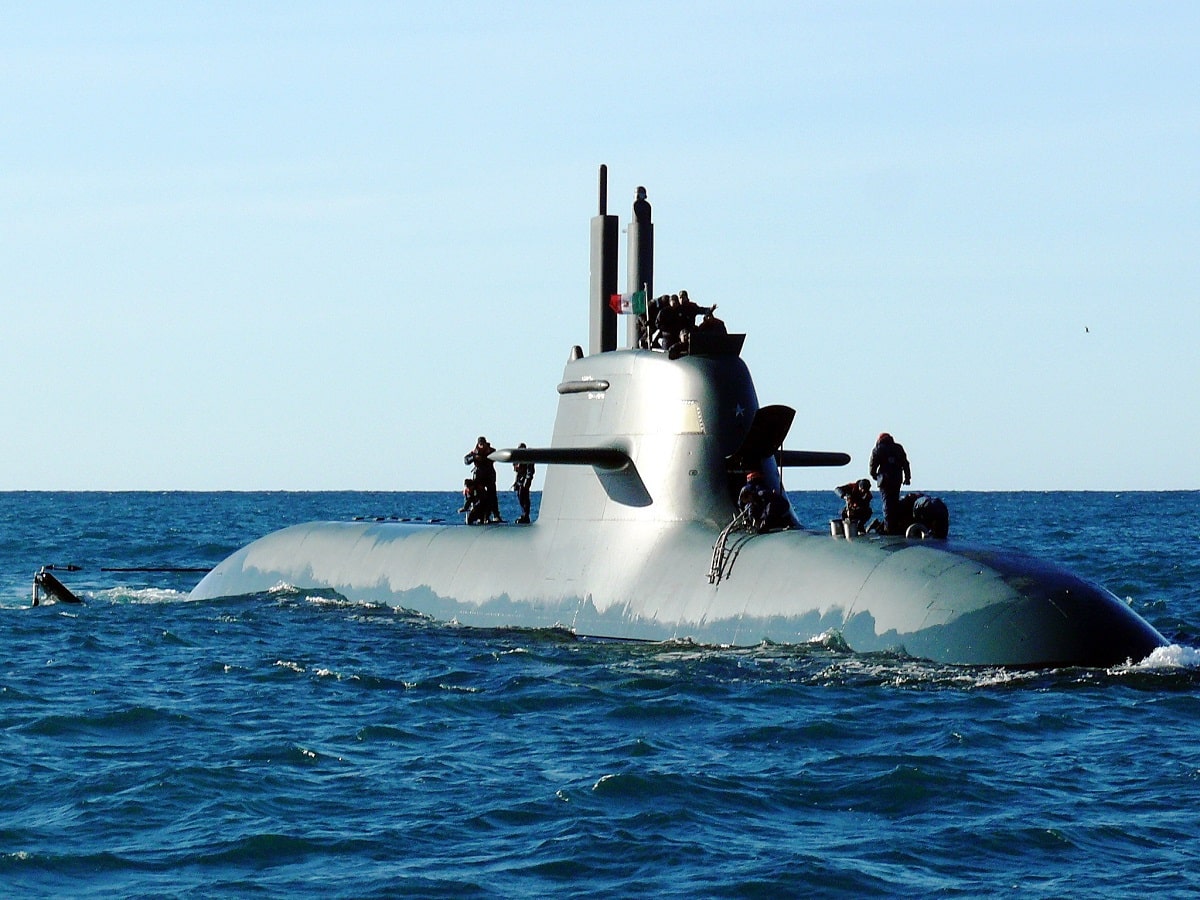
Type 212 Submarine from Germany. Image Credit: Creative Commons.
The 212CD’s faceted hull is designed to do what an F-117 stealth fighter’s angled skin does to radar: deflect the incoming pulse off at an oblique angle, away from the listener, so that far less of the sound energy ever returns to the hunter.
The echo the enemy hears is dramatically weaker, and a weaker echo means a shorter detection range, sometimes the difference between being found and slipping away. It is stealth shaping applied to sound instead of radio waves, and it makes the 212CD, in the words of one Norwegian defense assessment, a candidate for the benchmark in non-nuclear submarine stealth.
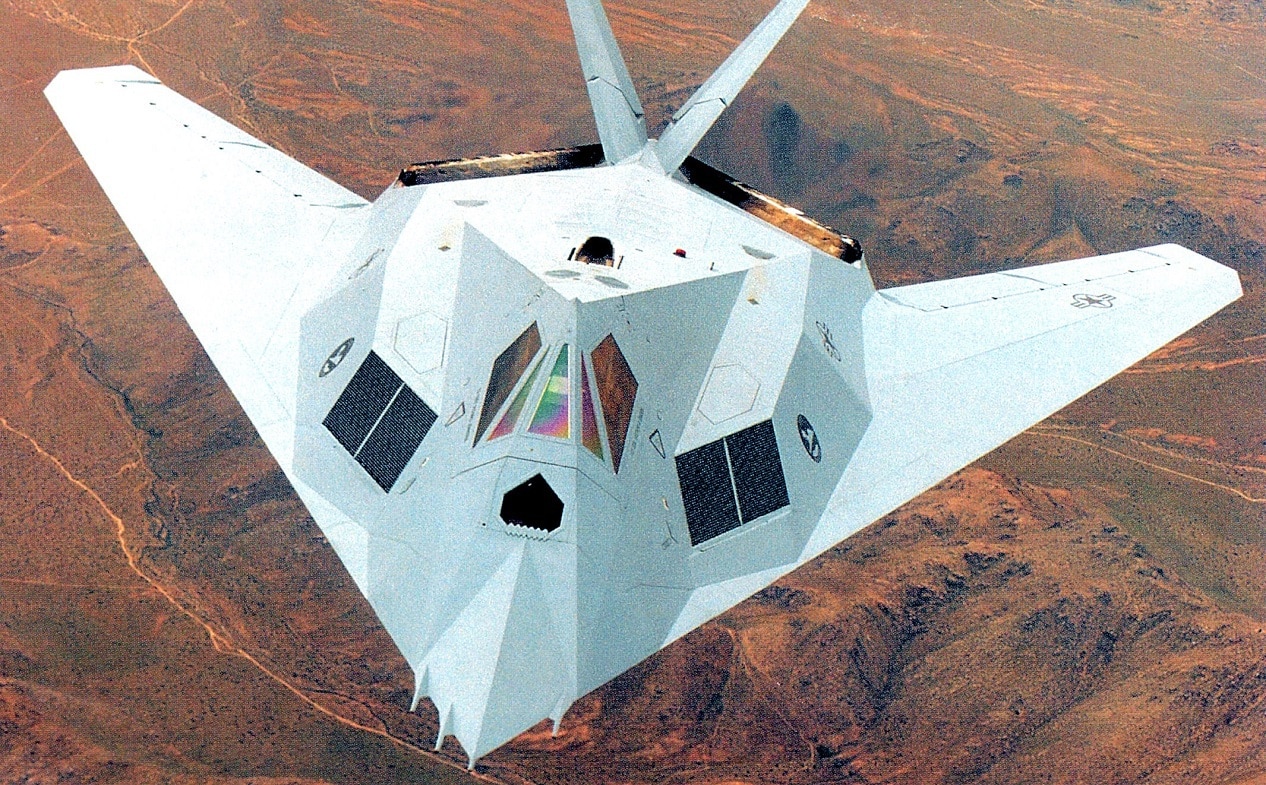
F-117 Stealth Fighter. Image Credit: Creative Commons.
How It Hides
The hull shape is only the outermost layer of a submarine built in layers of concealment. The next is the metal itself. The pressure hull of the Type 212CD is constructed from non-magnetic steel, a deliberate and expensive choice intended to defeat a specific sensor. Maritime patrol aircraft like the P-8 Poseidon carry magnetic anomaly detectors, instruments that sense the faint distortion a large mass of ferrous steel creates in the Earth’s magnetic field as the aircraft flies over it. Against an ordinary steel submarine, that distortion is a giveaway. Against a hull built from amagnetic steel, there is very little signature to detect. Canada has already begun ordering the specialized non-magnetic steel the program requires.
Then there is noise, the oldest way to find a submarine. The 212CD’s machinery, its diesel generators and motors, is mounted on rafts suspended by elastic isolators, so that the vibration of running equipment is absorbed rather than transmitted through the hull into the surrounding water as detectable sound. Combined with a carefully designed multi-bladed propeller and years of hydrodynamic refinement, the result is one of the quietest conventional submarines in the world, and quiet is survival, because a submarine that radiates little noise gives passive sonar arrays almost nothing to lock onto.
The final layer is the one that lets it stay hidden for weeks. Traditional diesel-electric submarines have an inherent vulnerability: they must periodically surface to run their diesel engines and recharge their batteries, a process called snorkeling that exposes them to radar and eyes precisely when they are most detectable. The Type 212 family solved that problem with hydrogen fuel-cell air-independent propulsion.
Inside the boat, hydrogen and oxygen are combined in polymer-electrolyte-membrane fuel cells to generate electricity directly, with almost no moving parts, no combustion, and very little waste heat. That lets the submarine cruise silently while fully submerged for up to roughly three weeks without ever surfacing, a figure the enlarged 212CD is advertised to extend further, with newer battery technology reportedly added to the design. There is even a clever safety solution baked in: because stored hydrogen is dangerously explosive, the fuel and oxidizer are kept in tanks outside the crew’s pressure hull, between the inner and outer hulls, and piped inside only as they are consumed, so only a tiny quantity is ever present around the crew at any moment.
Put those four layers together, a sonar-deflecting shape, a nearly non-magnetic body, isolated quiet machinery, and weeks of submerged endurance, and you have a boat optimized to a remarkable degree for a single purpose: not being found.
How It Fights Back
Everything above describes a submarine built to hide. The Type 212CD’s most striking feature is the one that lets it stop hiding and strike the thing hunting it from the air.
A submarine’s single most dangerous adversary is the anti-submarine helicopter. It is fast, it is agile, it can dip a sonar into the water to listen, move, and listen again, and it can drop a lightweight homing torpedo the instant it gets a fix. Historically, a submerged submarine has been essentially defenseless against one. As TKMS’s own head of research and technology put it, a submarine can relatively easily evade or even hit a frigate, but a helicopter’s agility makes it impossible for a submarine to react in time to save itself. The helicopter has been the hunter that the hunted could not touch.
The Type 212CD is designed to change that through a system called IDAS, the Interactive Defense and Attack System for Submarines. IDAS is a missile, derived from the proven IRIS-T air-to-air missile, that is launched from a standard torpedo tube while the submarine remains fully submerged and deep, well below periscope depth. The boat detects the helicopter with its own sonar, needing only a rough bearing and range. The missile is ejected from the tube, its rocket motor ignites at a safe distance underwater, and it maneuvers beneath the surface toward the target before breaking into the air and accelerating toward the helicopter.
The genius of the system is the thread trailing behind it. IDAS pays out a hair-thin fiber-optic cable as it flies, a physical data link connecting the missile back to an operator sitting at a console inside the submerged submarine. Through that link, the missile streams its own infrared camera image back to the boat in real time, and the operator flies the weapon all the way to impact, able to confirm the target, change aim, switch to a different threat, or abort the shot at any moment right up to the final second. All of it happens without the submarine ever raising a mast, exposing a sensor, or surfacing. It is, in effect, a way for a submarine to shoot back at the aircraft trying to kill it while remaining hidden in the deep, a capability TKMS describes as globally unique, and one first demonstrated with a successful submerged launch from the German submarine U33 back in 2008. With a reported range of around 20 kilometers on the baseline version and multiple missiles carried in a single torpedo tube, IDAS also doubles as a weapon against small surface craft and coastal targets. It was ordered into final development to arm the 212CD in early 2025.
IDAS is not the boat’s only sharp innovation in self-defense. The Type 212CD is also slated to carry SeaSpider, an “anti-torpedo torpedo,” a hard-kill system that intercepts and destroys an incoming enemy torpedo in the water, much like a missile-defense interceptor kills an incoming missile. It is a capability few submarines anywhere possess, and it carries a direct Canadian connection: the rocket motor for SeaSpider is planned to be manufactured in Canada in partnership with Magellan Aerospace. Alongside these defensive systems, the 212CD carries the traditional teeth of a modern submarine, heavyweight torpedoes fired from its six tubes, the ability to lay mines, and accommodation to carry and clandestinely insert special operations forces beyond its core crew of roughly 28.
What a Boat Like This Is For
All of this capability is built around a mission profile that explains why Canada, of all countries, wanted it. The Type 212CD was designed from the outset, in collaboration with Norway, to operate in the harshest environment a submarine can face: under the Arctic ice. That is a mission that punishes any weakness. A boat operating beneath an ice sheet cannot simply surface to snorkel or call for help, which makes the weeks of submerged fuel-cell endurance not a luxury but a necessity, and its stealth is tested against the quietest and most demanding acoustic conditions on the planet.
For a nation whose maritime approaches span three oceans and whose Arctic sovereignty is an increasingly contested question as Russia and China turn their attention northward, a long-endurance, ultra-quiet, under-ice-capable submarine is close to an ideal tool. It can sit silently off a chokepoint for weeks, gathering intelligence; monitor the approaches to a coastline; deter an adversary that can never quite be sure where it is; and, if pressed, defend itself against ships, torpedoes, and even helicopters sent to find it.
There is a limit to how much can be said with certainty about the boat’s ultimate performance, and it is worth being honest about that. TKMS and the German-Norwegian program office keep much of the Type 212CD’s actual technology and specifications classified, which is why published figures for its displacement vary widely, from roughly 2,500 to over 3,000 tons depending on the source and variant, and why some of its capabilities, including the exact details of IDAS and its newest batteries, are described in the careful language of “reportedly” and “planned” rather than confirmed fact. The secrecy is itself a measure of the boat’s sensitivity.
What is not in doubt is the shape of the thing Canada has bought into. The first boats are not expected to arrive until around 2034, and the contract itself still has to be finalized, with a target of 2027. But when they do arrive, the Royal Canadian Navy will operate a submarine engineered to an almost single-minded degree to vanish, one that hides behind a stealth-fighter hull and a body that barely bends a compass needle, that can lurk beneath the ice for weeks on silent power, and that, alone among the traits of a machine built to disappear, can reach up out of the deep and knock down the aircraft hunting it. It is a profile that says a great deal about where undersea warfare is heading, and Canada, after decades of making do, will be operating one of the sharpest examples of it in the world.
About the Author: Harry J. Kazianis
Harry J. Kazianis (@Grecianformula) was the former Senior Director of National Security Affairs at the Center for the National Interest (CFTNI), a foreign policy think tank founded by Richard Nixon based in Washington, DC. Harry has over a decade of experience in think tanks and national security publishing. His ideas have been published in the NY Times, The Washington Post, The Wall Street Journal, CNN, and many other outlets worldwide. He has held positions at CSIS, the Heritage Foundation, the University of Nottingham, and several other institutions related to national security research and studies. He is the former Executive Editor of the National Interest and the Diplomat. He holds a Master’s degree focusing on international affairs from Harvard University.

