
In another big drone-related success for Ukraine, drone strikes from Ukraine have struck ships in the Sea of Azov, near Crimea, which caused Russia to close that corridor.
According to the Guardian, 90 vessels in that sea were attacked in just a week. The Sea of Azov, which is north of the Black Sea and borders both Russia and Ukraine, connects Russia with Eastern Europe. United 24 Media put the number of struck Russian vessels at 105 in an eight-day period.
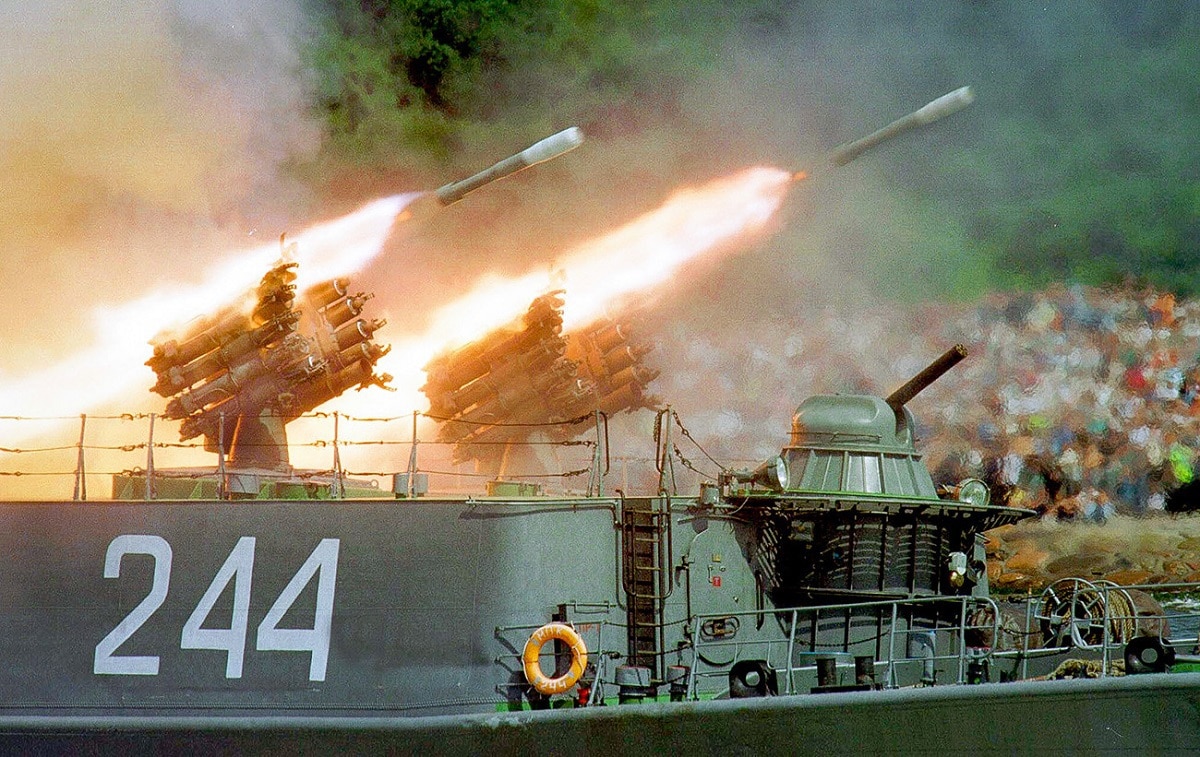
Merkuriy Corvette from Russian Navy. Image: Russian State Media.
As of Monday morning, per Reuters, the corridor remained closed.
Ukraine’s drone forces chief, Robert Brovdi, said on social media that 10 tankers and four ferries were struck overnight.
“The technological humiliation of the [Russian] empire continues. It will fall because of Crimea,” Brovdi added in a social post, as cited by the Guardian.
“The Caspian Sea doesn’t have any connection to the world’s oceans. It has turned into a lake. All of its products – agricultural, fertilizer, whatever – go through this channel and river,” Ukraine’s former defense minister, Andriy Zagorodnyuk, told The Guardian.
Russia, meanwhile, admitted that a tanker had been struck in the canal between the Black Sea and the Sea of Azov by Ukrainian drones, per Reuters.
Yury Slyusar, governor of Russia’s Rostov region, said on social media that the fire caused by the strike had been brought under control.
“Kyiv has stepped up attacks on Russian oil refineries and energy infrastructure in recent months, seeking to reduce Moscow’s revenue from oil product exports that the Kremlin uses to continue its war against Ukraine,” Reuters said.
Per Defense Express, Ukraine succeeded in striking more than a quarter of the Russian vessels in the Sea of Azov, hitting 27.5 percent of them in a 96-hour period.
“Using SAR satellite imagery from July 7, we determined that there were 120 vessels of various types in the Sea of Azov as of the date the imagery was captured. In other words, based on this rough estimate, Ukraine struck approximately 27.5% of the vessels believed to have been in the Sea of Azov during that 96-hour period,” Defense Express said in its report.
What It Means
“Brovdi said the maritime operation has also expanded to Russian logistics infrastructure in temporarily occupied Crimea. According to his statement, transfer facilities on the peninsula have come under attack every night, vessel traffic through the Kerch Strait has been suspended, and cargo unloading operations have been reduced to a minimum,” the United 24 Media report said.
A Monday report from the Institute for the Study of War, in its daily Russian Offensive Campaign Assessment, found that the recent Sea of Azov ship attacks have raised concerns on the Russian side, while also placing the number of struck Russian oil tankers at 90, since July 6.
“Ukraine’s successful long- and intermediate-range strike campaigns continue to fuel Russian milblogger concerns about Russia’s inadequate air defense capabilities and the Kremlin’s poor decision-making that have left Russia and occupied Ukraine vulnerable to Ukrainian strikes,” the ISW report said.
One Russian military blogger, the report said, slammed Russia’s “blatant carelessness” and argued that “the Russian Navy cannot reliably defend Russian vessels in the Sea of Azov due to bureaucratic inertia and that Russia cannot quickly build refineries or substations to replace damaged ones.”
Graham’s “formula to end this war”
Just hours before his death on Saturday, Sen. Lindsey Graham (R-SC) visited Ukraine, where, per the New York Times, he announced an agreement with the White House and a “bipartisan group of senators” to impose sanctions on countries that buy Russian oil.
“I have never been more optimistic than I am today that we have the formula to end this war,” the senator said during his visit to Kyiv, per the Times. “Help Ukraine be more lethal. Let those supporting Russia know there’s going to be a price to be paid if you keep doing it. And to try to find an off-ramp — not to humiliate Putin, but to end this war so that Ukraine will thrive and survive.”
Several analyses since the senator’s passing have noted that his death deprives Ukraine of one of its staunchest allies in Washington and one of the leading pro-Ukraine voices in the president’s inner circle.
About the Author: Stephen Silver
Stephen Silver is an award-winning journalist, essayist, and film critic, and contributor to the Philadelphia Inquirer, the Jewish Telegraphic Agency, Broad Street Review, and Splice Today. The co-founder of the Philadelphia Film Critics Circle, Stephen lives in suburban Philadelphia with his wife and two sons. For over a decade, Stephen has authored thousands of articles that focus on politics, national security, technology, and the economy. Follow him on X (formerly Twitter) at @StephenSilver, and subscribe to his Substack newsletter.