
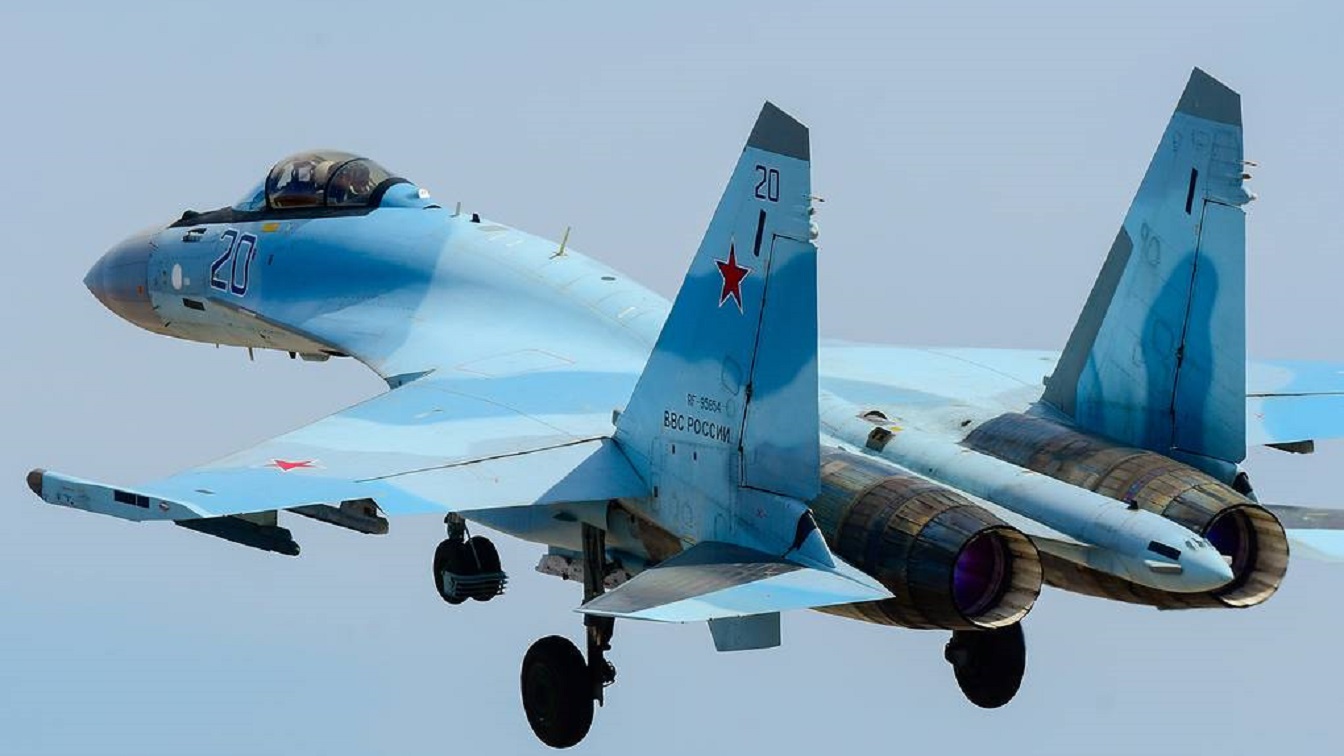
On the night of June 26-27, Ukraine’s Air Force confirmed the loss of a MiG-29 on a combat mission over Poltava Oblast, the Kyiv Independent reported. The pilot ejected and was recovered safely, and the official statement attributed the loss to nothing at all: causes and circumstances under investigation. Within hours, Russian military-linked channels and a handful of open-source analysts filled the silence, attributing the kill to a Su-35S that fired an R-37M missile from inside Russian airspace over Belgorod, at a range of roughly 190 kilometers. If that version were ever confirmed, it would rank among the longest fighter-versus-fighter kills in the history of air combat. It has not been confirmed, and it may never be.
One officially acknowledged loss, one unverifiable claim bolted onto it, and no way to close the gap between them: five days before this writing, the newest entry in the Su-35’s combat ledger arrived in exactly the form the previous four years taught observers to expect. The jet Russia sends to war more than any other modern fighter, fights at ranges where even its victories are hard to see.
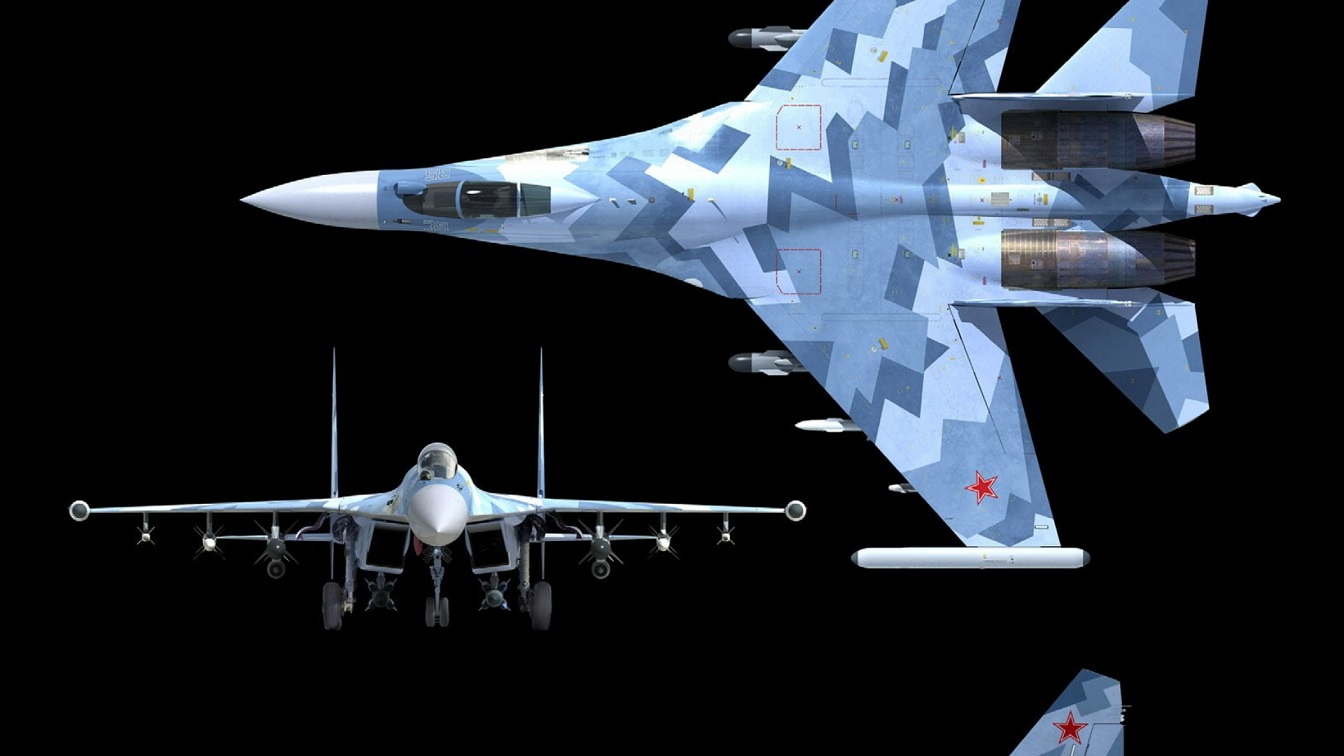
Su-35. Image Credit: Creative Commons.
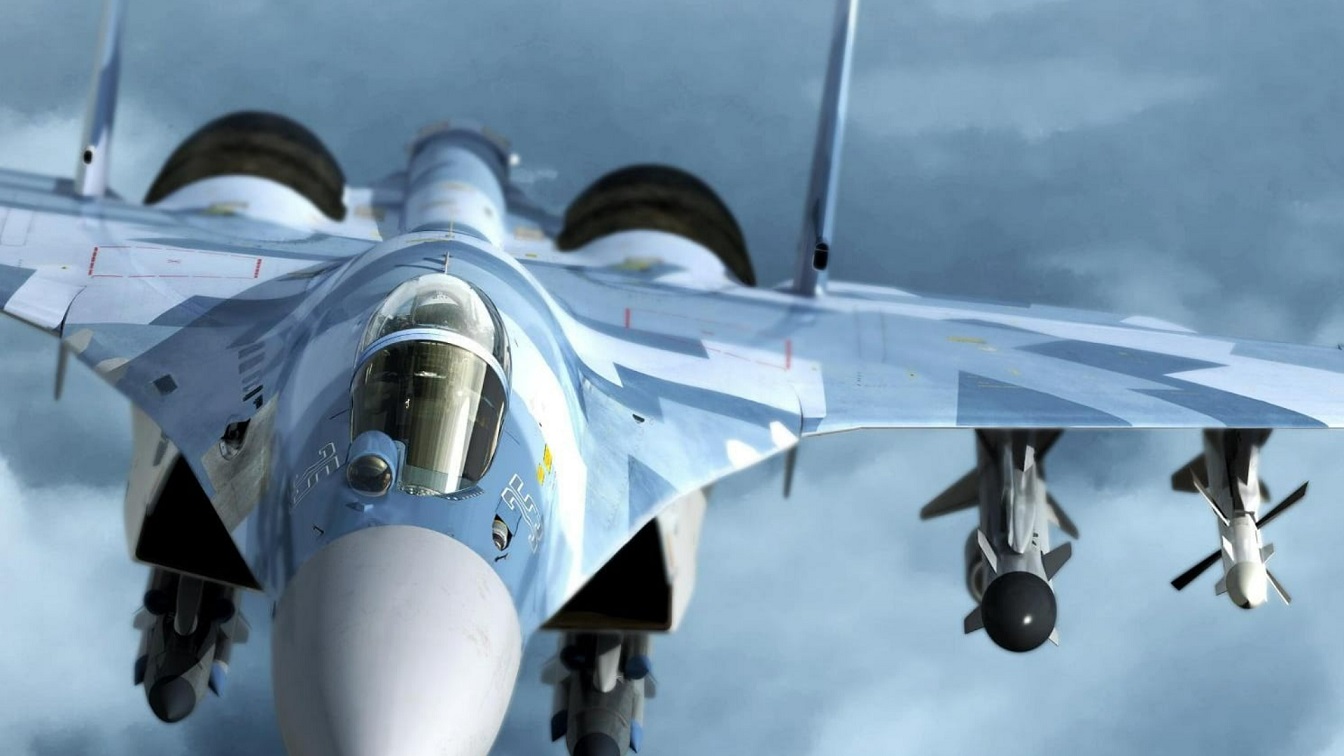
Su-35. Image Credit: Creative Commons.
Aerospace Origins: The Super Flanker Sukhoi Built to Beat the F-15 Up Close
The Su-35 descends from the Su-27M, a deep modernization of the Soviet Union’s premier air-superiority fighter whose first prototype flew back in 1988. The design that eventually emerged as the definitive Su-35S, first flown in May 2011 and in Russian service since 2014, was Sukhoi’s answer to a specific question: how to keep the Flanker family competitive against the F-15 and its successors without a clean-sheet stealth aircraft.
The answer was performance. The Su-35S carries AL-41F1S engines with thrust-vectoring nozzles, the feature behind the post-stall maneuvers that made the jet an airshow legend, a claimed top speed around Mach 2.25, and an airframe stressed for sustained hard turning. The Aviationist’s rundown of the type captures the rest of the package: the Irbis-E passive electronically scanned array radar, which its maker credits with detecting large targets out to roughly 400 kilometers, the Khibiny jamming suite, an infrared search-and-track system, and the ability to carry the very-long-range R-37M against high-value targets alongside Kh-31 anti-radiation missiles for hunting radars.
Fourteen hardpoints and more than 8,000 kilograms of ordnance round out a genuinely formidable machine, and its first combat deployment, to Syria in January 2016, cast it in the role the design implied: through the late 2010s, Su-35s repeatedly intercepted Turkish and Israeli jets over contested Syrian airspace, an intimidation mission built on presence and agility. Everything about the aircraft argued for getting close.
Then it got a real war, and the war never asked it to.
Air War Reality: What Four Years Over Ukraine Actually Asked the Su-35 to Do
In the opening days of the February 2022 invasion, the Su-35 did fly something like its designed mission. RUSI’s landmark November 2022 study of the air war found the Su-35S exacting a steady toll on Ukrainian aircraft near the front lines from the war’s first days, flying high-altitude combat air patrols above the strike packages pushing toward Kyiv and Kharkiv. The killing asymmetry was mechanical, and David Axe laid it out cleanly in Forbes that November: the Su-35’s R-77-1 missile is fire-and-forget, letting the shooter launch, go silent, and turn away, while the Ukrainian Su-27s and MiG-29s opposing it carried semi-active R-27s that force a pilot to keep his radar locked on the target, nose-on, all the way to impact. Open-source trackers credited the type with at least seven air-to-air victories over Ukrainian fighters by September 2022.
What the Su-35 could not do was survive over Ukraine itself. By March 2022, Ukraine’s dispersed, mobile surface-to-air missile force had made penetrating flights prohibitively costly, and Russian crewed aviation has not attempted them at any real scale since. The first Su-35 loss of the war made the point in person: on April 3, 2022, one went down near Izium, and its pilot was captured. So the fighter settled into the role that the rest of the war would cement, patrolling behind its own lines, escorting the Su-34s lofting glide bombs, firing Kh-31Ps at any Ukrainian radar that dared to emit, and, increasingly, sniping.
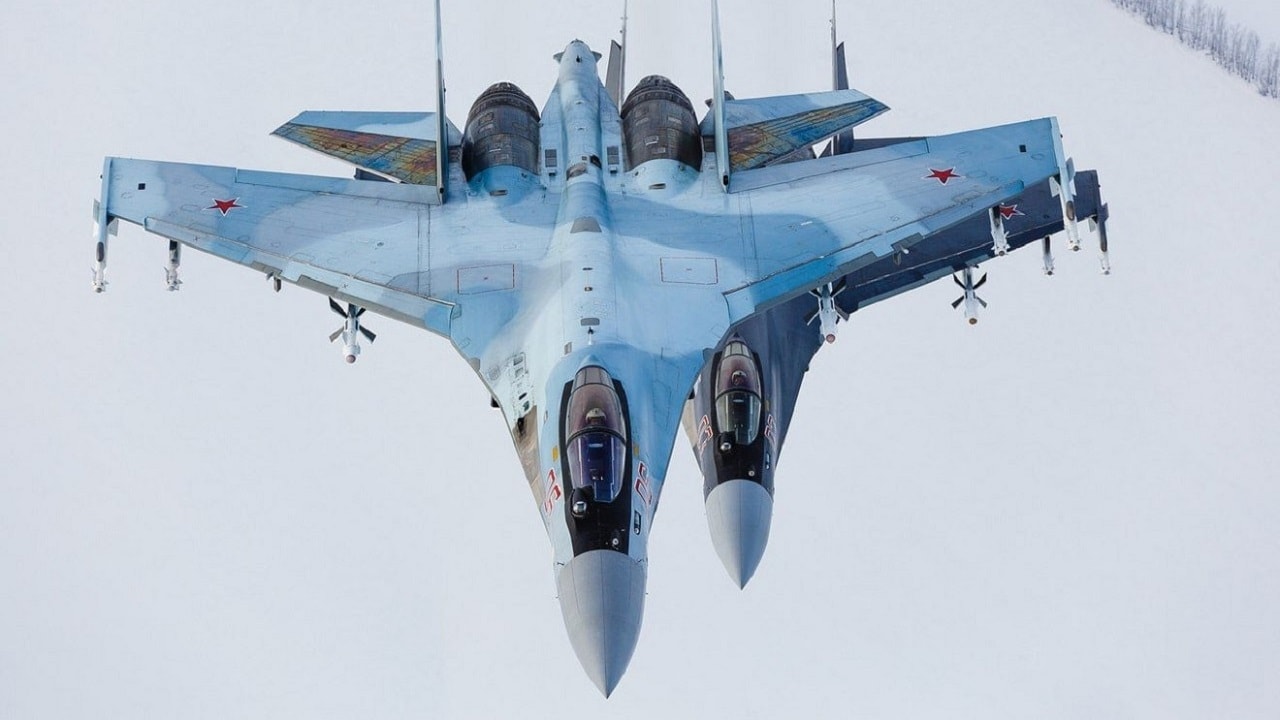
Russian Su-35 fighters. Image Credit: Creative Commons.
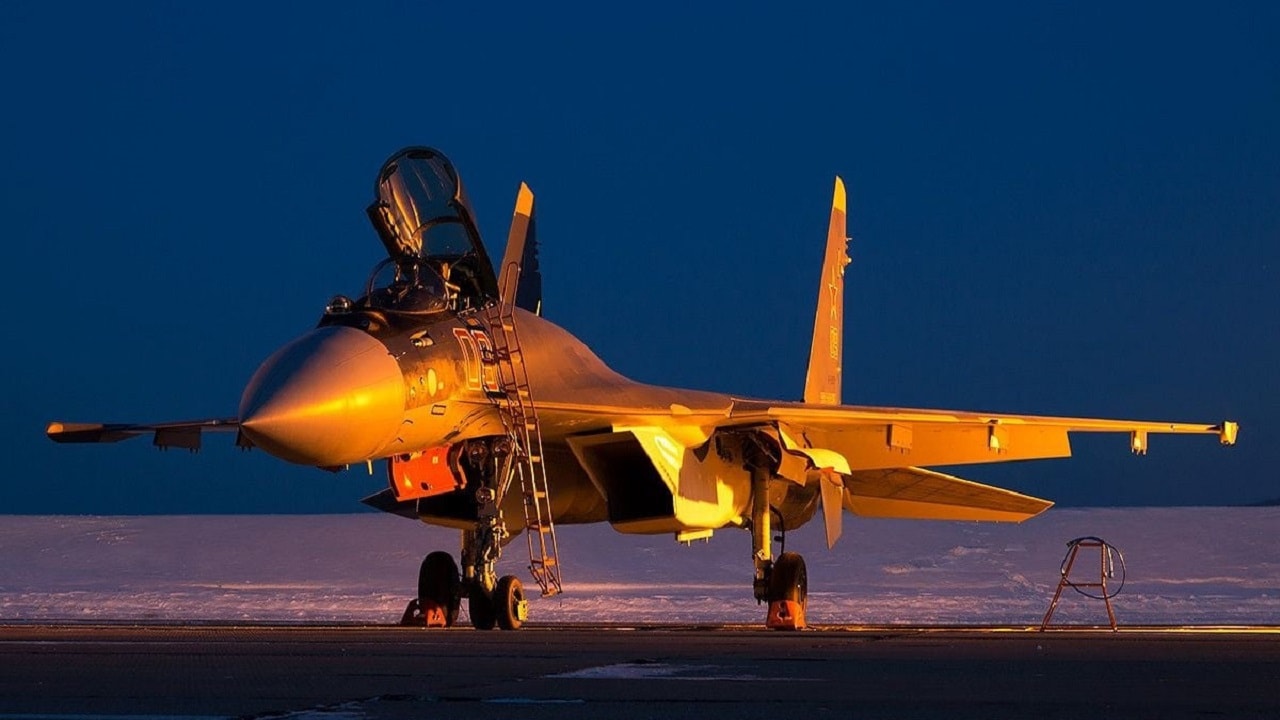
Russian Air Force Su-35. Image Credit: Creative Commons.
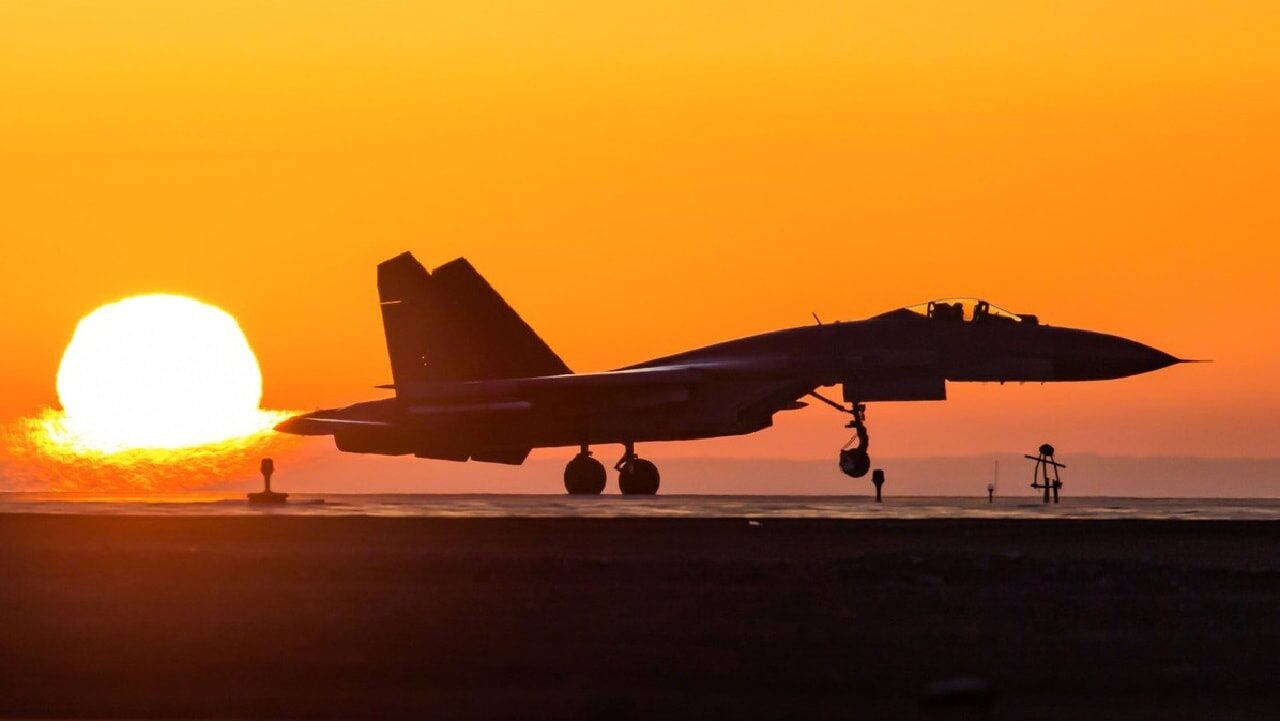
Su-35. Image Credit: Creative Commons.
The re-arming is the part RUSI’s January 2026 assessment flags as genuinely significant: the Su-35S fleet converted from the medium-range R-77-1 to rely primarily on the R-37M, a half-ton missile with a 60-kilogram warhead and an assessed reach in the 300-to-400-kilometer class, built in the Soviet era’s imagination to kill AWACS and tankers. Against Ukraine, it became a fighter-suppression weapon.
At the peak of the autumn 2022 air battles, RUSI’s researchers found the Russian air force “firing up to six R-37Ms per day,” a weapon whose speed and long reach made it exceptionally hard to evade. Ukrainian pilots learned to fly at treetop height, hide in ground clutter, and break off missions the moment launch warnings sounded. The missile’s real product was behavioral rather than physical: aborted missions, altitude ceilings, and a front-line air force that plans every sortie around the launch warning.
Ukraine has never pretended otherwise. “Unfortunately, today Russia has jets that see farther and missiles that fly farther,” Air Force spokesman Yuri Ignat said on June 3, 2025, conceding the point even against the American F-16s Kyiv had waited years to receive. Rostec chief executive Sergey Chemezov, whose conglomerate builds the jet and has every incentive to flatter it, claimed in November that “the Su-35S has driven enemy aircraft low” and into rear areas, and on this one point, the Ukrainian and Russian accounts broadly agree. Kyiv’s F-16s fly the war they are permitted: far behind the lines, hugging the terrain, superb at the air-defense mission. On one December night, per Ukrainska Pravda, F-16 pilots downed 34 of 35 incoming Russian cruise missiles. Against drones and cruise missiles, the Western jets excel. Against a Su-35 holding an R-37M at altitude, they do not get the chance to find out.
Business & Industrial Ledger: Eight Confirmed Losses, a “Handful” of Kills, and a Fleet That Grew Anyway
Both sides keep score, and both scores deserve suspicion. Start with the losses. The International Institute for Strategic Studies counted more than five Su-35s destroyed by May 2023. By the time one burned in a Kursk field on June 7, 2025, the visually confirmed count stood at eight, per The War Zone’s accounting of the open-source ledger. Ukrainian claims run to roughly 25. The confirmed entries are an unflattering list for a premier air-superiority fighter: two downed by Patriot batteries over Bryansk within eight days in May 2023, and one destroyed near Tokmak in September 2023 by Russia’s own S-300, a friendly-fire kill by a system that could not tell whose Flanker it was tracking.
The June 2025 Kursk shootdown doubles as a case study in how this war’s claims work. That Russia lost a Su-35S that morning is beyond doubt; wreckage footage circulated within hours. What killed it was never stated by Kyiv. The version that traveled the world, a Ukrainian F-16 guided by a Swedish Saab 340 radar plane scoring history’s first Viper kill of a Flanker, traces to the German tabloid Bild, and Newsweek’s contemporaneous report was careful to note the details had not been independently verified. A year later, they still have not been. Across four full years of war, in fact, not a single Su-35 loss has been independently confirmed as an air-to-air kill. The jet’s killers, so far as anyone can prove, have all fired from the ground, and one of them was Russian.
The kill column carries the same fog in mirror image. Rostec claims the type has destroyed more targets in air-to-air combat than any other fighter in Russian service, with estimates crediting it 20 or more Ukrainian aircraft. The independent read is colder. RUSI’s January 2026 paper on Russian and Chinese air power concluded that Russia’s fighter fleet, for all the R-37Ms it has expended against an opponent flying old jets with weak warning sensors, has managed “only a handful of air-to-air kills” in four years, and it drew the comparison Moscow’s marketers will hate: Chinese-built PL-15E missiles scored against modern fighters within days of their first combat use over South Asia in 2025, while the R-37M spent four years compiling a modest total against a smaller, older, half-blind opponent.
And yet the bluntest number in the ledger favors Moscow. RUSI assesses that only around 20 Su-35S and Su-30SM2 airframes combined have been lost or damaged beyond repair since February 2022, while deliveries from the Komsomolsk-on-Amur plant have continued every year of the war, including two reported batches this spring. By RUSI’s estimate, Russia ends the war’s fourth year with slightly more modern fighters than it started with. A war that has destroyed at least eight confirmed Su-35s has not shrunk the Su-35 force. Ukraine is attriting the jet more slowly than Russia is building it.
The May Claims: An F-16 Kill Russia Can’t Prove, and a Kursk Kill Ukraine Won’t Detail
The fog thickened in mid-May in both directions within roughly 24 hours. On May 15, Russian aviation channels claimed a Su-35S had shot down a Ukrainian F-16 at long range near the Sumy-Kursk frontier, with either an R-77M or an R-37M, which would be the first air-to-air F-16 loss of the entire war. Seven weeks on, there is no Ukrainian confirmation, no independent verification, and no detail even on which missile the claim involves. The skepticism is earned: Russia has announced dead F-16s repeatedly since the jets arrived in 2024, including an S-300 kill this January that Kyiv disputed, and the announcements have consistently run ahead of what independent evidence supports. Ukraine has lost several F-16s in the war, to drones, to debris, to causes still under investigation, and not one to a confirmed Russian fighter.
The very next day, May 16, the ledger flipped: Ukraine’s Air Force announced it had downed another Su-35 in the Kursk region, publishing drone footage of burning wreckage, with Russian aviation bloggers indirectly acknowledging the loss and reporting the pilot survived. Kyiv, as usual, declined to say who did the shooting. Two claims, two days, one war in which the most advanced fighter on either side scores and dies at ranges where proof rarely follows.
The Counterpoints: What the Su-35’s Critics Get Wrong
The case against the jet has a strong answer, and it deserves a deep look. Nothing flies uncontested over Ukraine; the war has built a layered, mobile surface-to-air environment that punishes any aircraft crossing the line, and standing off from it is what a rational air force does, not what a broken one does. American planners war-gaming a peer conflict lose sleep over exactly this problem. Second, the crews have improved: RUSI’s January assessment found Russian fighter pilots measurably more effective in air-to-air work than in 2022, with pilot attrition running far below airframe attrition and combat hours compounding across the force. Third, the narrow exchange rate flatters the jet.
A handful of kills against zero independently confirmed air-to-air losses is, read coldly, a winning record against enemy fighters. And fourth, the Su-35 has never fought the war it was built for. It was designed to contest air superiority against strike packages and their escorts, but Ukraine has instead offered it SAM ambushes and treetop MiGs.
All of that is true as far as it goes. It is also a list of reasons the brochure remains untested rather than evidence it was right, and an untested claim priced, by trade estimates, at roughly $100 million an airframe, is precisely what the export market has been evaluating.
Aerospace Market Verdict on Su-35: Algeria Buys, Iran Signs, China Stopped at 24
The buyers have rendered a split decision. Algeria became the type’s newest operator this year, with satellite imagery confirming ex-Egyptian Su-35s in Algerian markings at Oum el Bouaghi Air Base, drawn from the batch built for Cairo before American sanctions pressure collapsed that deal, and reportedly serving as a stopgap while Algiers waits on the Su-57. Iran, after years of hedging, publicly confirmed its purchase of Su-35s in January 2025. China, the first export customer, took 24 jets in the late 2010s and stopped, with Chinese commentary openly assessing that its domestic J-16 made further purchases pointless. The jet’s combat record now sells in both directions at once: the most battle-used Russian fighter of its generation, and the one whose battles keep happening a hundred kilometers from the nearest witness.
For now, the ledger stands where the war left it on June 27: one MiG-29 down over Poltava with the investigation open, one Russian claim attached to it that nobody outside Russia can check, and a production line at Komsomolsk-on-Amur that has already delivered twice this year. The Su-35 came to Ukraine as the fighter built to win the merge. Four years on, its entire war is fought, won, and occasionally lost from a hundred kilometers away.
About the Author: Harry J. Kazianis
Harry J. Kazianis (@Grecianformula) was the former Senior Director of National Security Affairs at the Center for the National Interest (CFTNI), a foreign policy think tank founded by Richard Nixon based in Washington, DC. Harry has over a decade of experience in think tanks and national security publishing. His ideas have been published in the NY Times, The Washington Post, The Wall Street Journal, CNN, and many other outlets worldwide. He has held positions at CSIS, the Heritage Foundation, the University of Nottingham, and several other institutions related to national security research and studies. He is the former Executive Editor of the National Interest and the Diplomat. He holds a Master’s degree focusing on international affairs from Harvard University.

