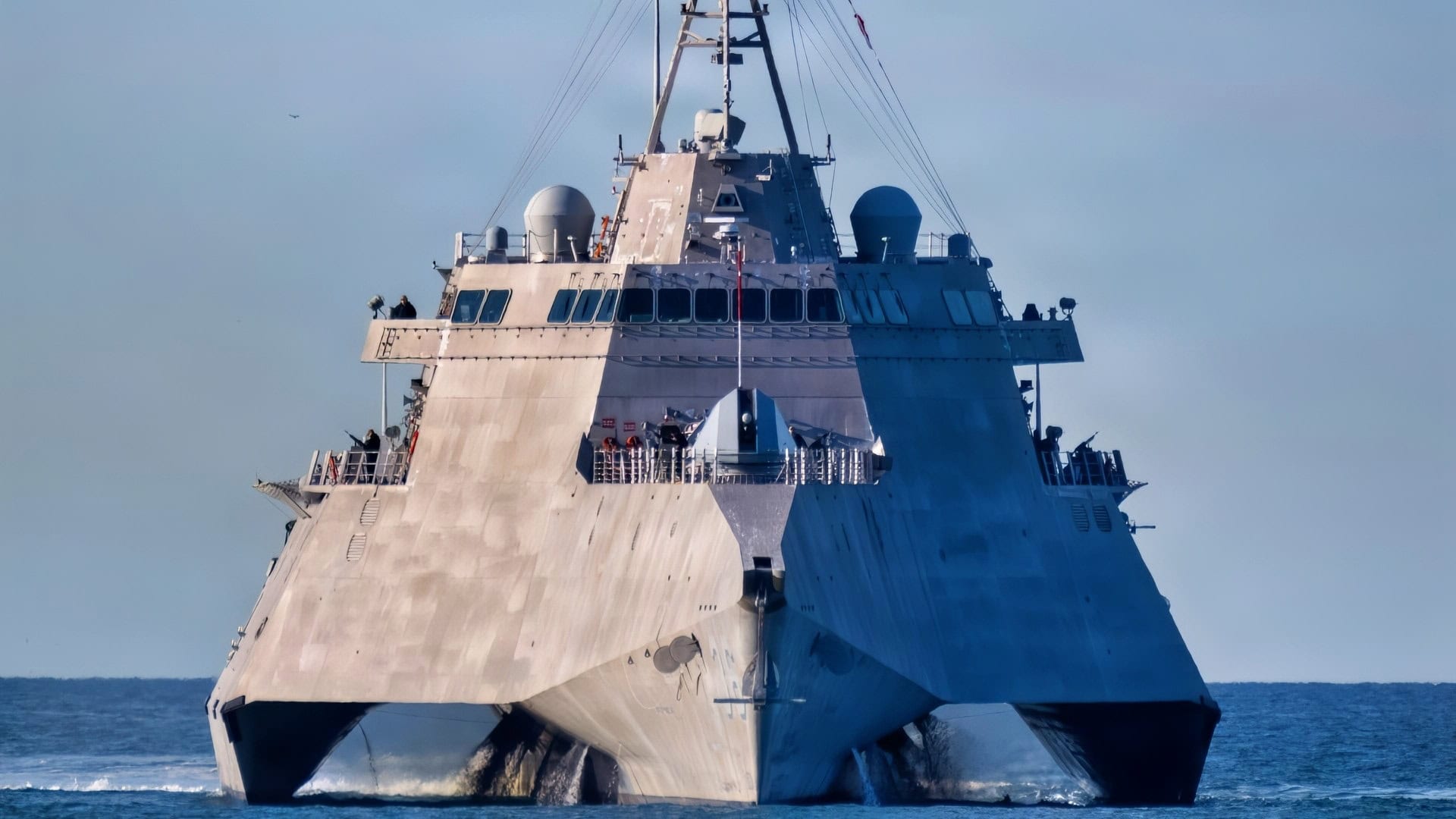
When the Littoral Combat Ship (LCS) was first pitched to Congress, it was sold as an inexpensive warship that could be adapted to any strategic situation in the post-Cold War era. You see, at that time, the United States was the sole remaining superpower.
America was a military, technological, economic, and cultural colossus bestriding the world.

Littoral Combat Ship from Fleet Week 2025. Image Credit: Stephen Silver/19FortyFive.com
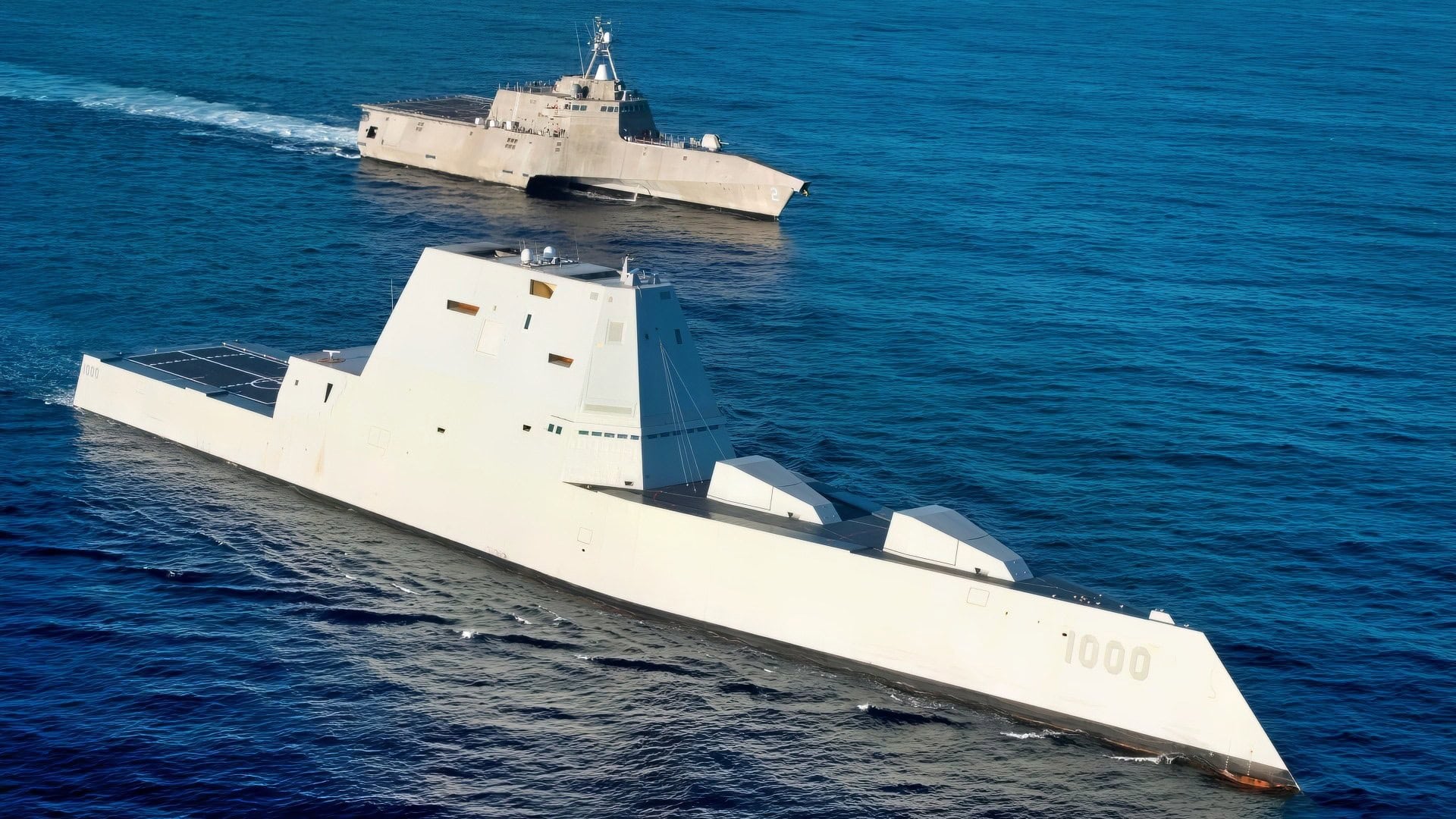
Dec. 8, 2016) The guided-missile destroyer USS Zumwalt (DDG 1000), left, the Navy’s most technologically advanced surface ship, is underway in formation with the littoral combat ship USS Independence (LCS 2) on the final leg of its three-month journey to its new homeport in San Diego. Upon arrival, Zumwalt will begin installation of its combat systems, testing and evaluation, and operation integration with the fleet. (U.S. Navy photo by Petty Officer 1st Class Ace Rheaume/Released)
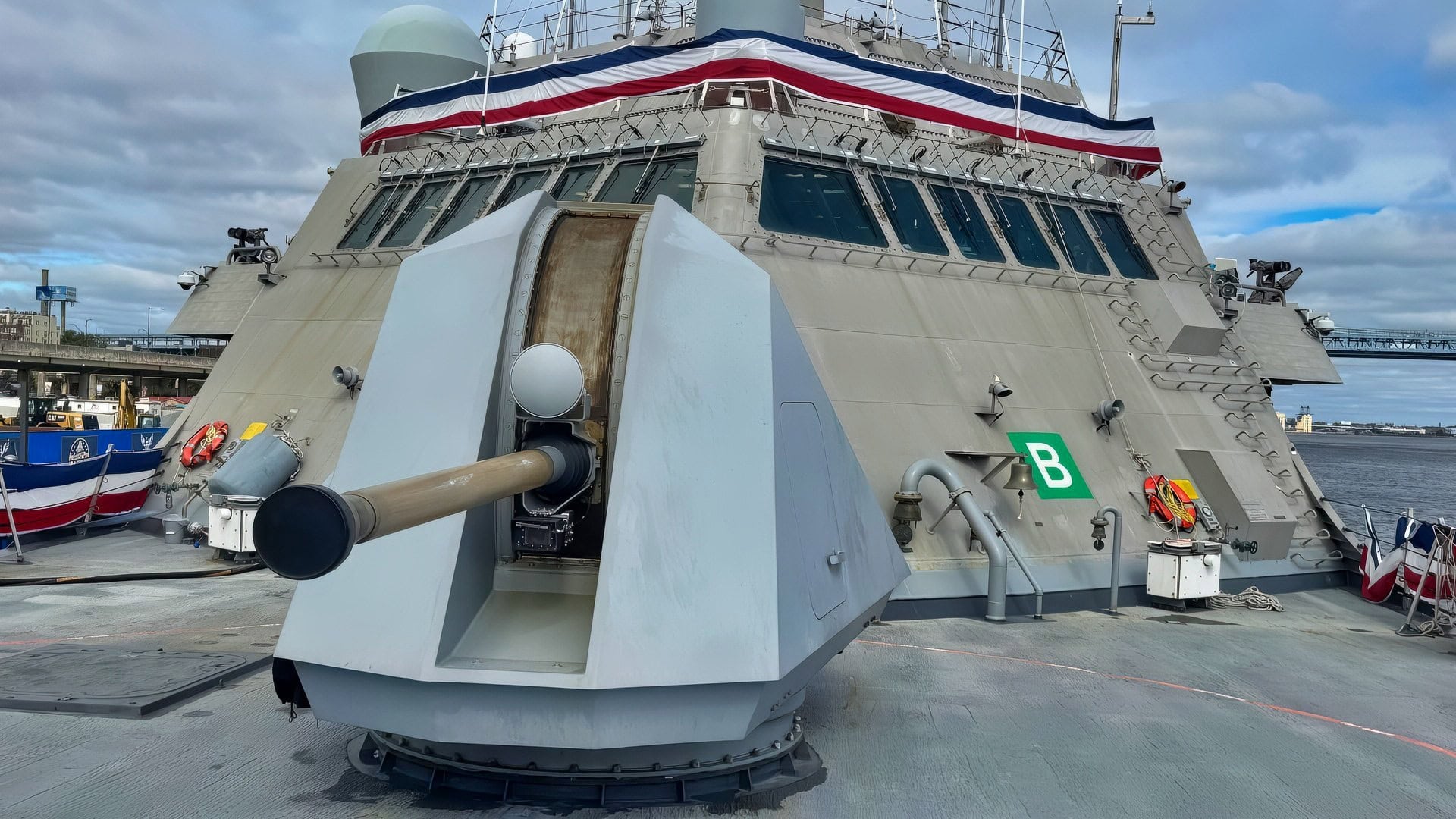
Littoral Combat Ship USS Cooperstown. Image Credit: 19FortyFive.com
The only real threats back then were from non-state actors and so-called “rogue states” in distant lands. The Navy believed it’d need combat power capable of sustaining a conflict involving ship-to-shore attacks, and it would require a warship that could move in close to the shores of Eurasia, the Middle East, and Africa.
The Cost of America’s “Affordable” Warship
The Navy believed it could build the LCS for $220 million per hull. Around 40 sailors would operate each ship.
Over time, the Navy converted these ships into mine-hunters and into ships for anti-submarine and anti-surface warfare missions. Yet, the Navy soon found that the LCS was a deeply problematic warship program. Over time, the LCS became a heavy burden on the maritime branch.
At first, the Navy learned that, rather than costing $220 million per hull, the LCS would cost $500 million each–and that was before counting mission packages, research, testing, shore infrastructure, repairs, and lifetime support.
The Government Accountability Office (GAO) found that the Navy’s planned 35-ship, 44-module program would cost more than $60 billion over its life cycle.
But some GAO officials quickly realized that the true costs of the LCS program over its life cycle would rise to more than $100 billion, far outstripping the estimate rather than the Navy’s official program figure.
What’s more, maintaining these ships became almost as problematic for the Navy as building them. Defense News, a popular online trade publication, assessed that the annual operating cost for the LCS was $70 million per ship.
But the Navy argued that the real figure was less–closer to $50 million per ship. Considering that the LCS is a 3,400-ton vessel with a tiny crew (compared to other Navy platforms).
For instance, an Arleigh Burke-class destroyer is nearly three times the displacement of an LCS. It is equipped with sophisticated air defense, cruise missiles, anti-submarine weapons, ballistic missile defense, and high-end sonar.
At the time of the LCS’s creation, the ship cost around $81 million to operate. The Navy was essentially telling Congress that it was acceptable to incur near-destroyer-level operating costs for a ship with barely a third of a destroyer’s combat power.
The Affordable Modular Fleet That Never Was
The LCS was a true Jack of all trades, master of none. Designers envisioned the LCS as a maritime equivalent of a Swiss Army Knife.
However, it never quite lived up to any of its main mission sets.
It was supposed to be a minesweeper, defend against submarines, interdict pirates, conduct overall maritime security, and other missions considered too routine or dangerous for large destroyers.
The way that the Navy achieved this multi-mission set was through ‘modularity.”
Rather than constructing separate classes for each of the aforementioned mission sets, the Navy attempted to make the LCS itself a base platform into which various mission modules could be installed for whatever mission it was assigned.
So, an LCS could conduct minesweeping missions, then return to port, have the minesweeping module removed and quickly swapped out for a module for, say, antisubmarine warfare.
That modular concept also depended on minimal planning. A core crew of around 40 sailors would operate the warship while contractors and shore-based personnel handled much of the maintenance.
Fewer sailors and interchangeable equipment were supposed to generate enormous savings.
Fundamentally, the modular concept–the core of the purported cost-saving approach that defined the LCS–failed.
Today, the LCS is kept around as a minesweeper. But that’s because many of the other modules designed for the LCS failed.
The Unbelievable Failure of Modularity
What the Navy discovered with its modularity approach was that changing a ship’s mission was more complicated in reality than on paper.
Personnel required specialized training, equipment had to be tested and integrated, and the ship schedule had to be coordinated with the availability of modules, personnel, and facilities.
The Navy quickly abandoned that fanciful notion of rapidly switching missions.
Ships were therefore assigned permanent specialization sets, thereby eliminating the justification for the LCS in the first place.
What’s more, the LCS was relatively small, far more expensive to maintain and operate than it should have been, and too lightly armed for its own good (especially when compared to other, older warships of specialized designs).
When Having Too Few Crew Was Too Much
The smaller crew also proved insufficient for the demands of operating the ship–especially under combat conditions. So, the Navy expanded the crew complement from 40 to 50 and, finally, 70.
With an embarked aviation detachment, the complement could approach 94. While that was still a smaller crew size than a standard US Navy frigate, it was much larger than what the original LCS concept called for.
Then there was the added complication that the Navy became far too reliant on outside contractors for maintaining the ship.
Because of its complexity, Navy technicians and engineers were forced to call upon engineers and technicians from the defense contractors who built the ships.
The GAO found that American contractors were sometimes flown overseas to conduct routine work because foreign personnel were legally restricted from performing certain maintenance.
Among 18 maintenance delivery orders the GAO examined, contractor travel costs ranged from a few thousand dollars to more than $1 million per order.
One would have thought that the Navy was operating the Starship Enterprise. In fact, they were struggling to maintain a costly system that those who served aboard the LCS derided as the “Little Crappy Ship.”
Further, the GAO found extensive unplanned work because the Navy often did not understand a ship’s physical condition before opening a maintenance period.
Due to this, the ships were often laid up in port far longer than anticipated, creating real capability gaps for the Navy–and exploding taxpayer costs.
Early Decommissioning
After all that, and so much more, such as range and endurance woes, the Navy finally opted to decommission the Little Crappy Ships earlier than they had planned; the ships cost around half a billion dollars per unit and served for less than a decade.
The Navy argued that keeping them would consume sailors, maintenance funding, spare parts, pier space, and training resources that could be directed toward more conventional systems.
Congress repeatedly resisted portions of the retirement plan due to concerns that fleet size and shipyard employment would be adversely affected.
In fact, these were merely arguments that fell under the “sunk cost” fallacy. Plus, Congress persisted in the erroneous belief that these boondoggles could still be used to perform lower-end missions.
No Resale Value
One of the first rules of purchasing a car or a home is to consider the resale value of those assets before signing on the dotted line.
Despite being a leading global arms exporter, the Pentagon and Congress rarely consider such factors when lavishly funding increasingly absurd, fantastical systems like the LCS.
Most naval experts believe that the LCS has extremely limited value in a post-retirement setting. And there is little real interest among America’s panoply of military partners in acquiring the Little Crappy Ship. These ships are way too expensive.
They require far too much specialization. These boats have a proven record of failure. And they are far too dependent on specialized American training and technical support (which will be time-consuming and expensive).
Meanwhile, some have proposed repurposing the LCS fleet into a group of training vessels and testbeds for advanced systems.
Yet each conversion, whether as trainers, Coast Guard cutters, or especially as testbeds, requires further investment.
So, the remaining alternatives–none of them cost-effective–are to let these boondoggles waste in reserve storage, cannibalize them, or scrap them.
Because of the complex nature of these boats, fully decommissioning them is likely to be a costly endeavor.
Yet in the end, mothballing these ships would likely yield massive savings for the Navy, allowing the maritime branch to reinvest that money in more useful systems.
When they procured the LCS, the Navy envisioned a joint force that was smaller, more technological, and faster.
The maritime branch assessed that the strategic “unipolar moment” would last for decades into the twenty-first century.
They abandoned decades–centuries–of maritime development in favor of an untested combined approach.
But by combining so many capabilities into a single platform, they created a ship that negated everything the Navy was trying to do.
It was too expensive, way too hard to maintain, difficult to keep at sea, and poorly armed for the conflicts the Navy actually fought.
Because of this, the taxpayers paid for a platform that could never be used, and we can only imagine the missed opportunities that would have arisen had that money been spent on simpler, traditional systems to maintain US fighting capabilities at sea.
About the Author: Brandon J. Weichert
Brandon J. Weichert is the Senior National Security Editor at 19FortyFive.com. He also manages The Weichert Brief on Substack. Weichert also hosts “National Security Talk” on Rumble. He is the author of four bestselling national security books, the most recent of which is A Disaster of Our Own Making: How the West Lost Ukraine (Encounter Books). Follow him via Twitter/X @WeTheBrandon.