
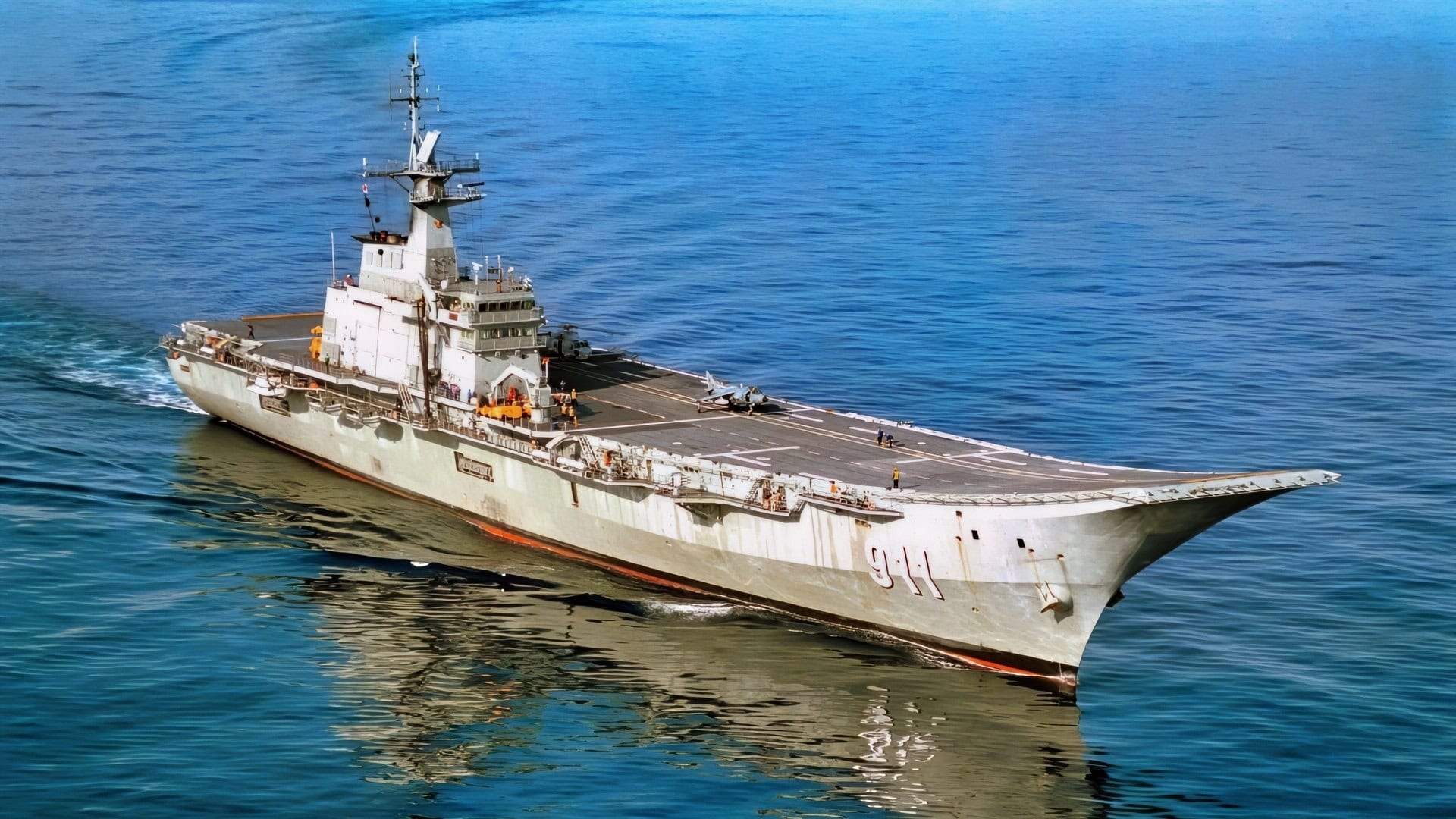
Thailand Owns the World’s Smallest Aircraft Carrier, and It Has Zero Aircraft — and It’s Still a $285 Million Lesson in Naval Power: The Royal Thai Navy’s flagship is an aircraft carrier that has not operated a fixed-wing aircraft in twenty years. HTMS Chakri Naruebet, the smallest carrier ever commissioned, spends most of her life at a pier, carries staterooms built for the Thai royal family, and wears a motto — “Rule the Sky, Rule the Sea” — that reality retired in 2006. She is easy to mock, and Thais themselves have done it best. But she is also the clearest demonstration afloat of the most expensive truth in naval power: a carrier is not a ship but an ecosystem, and buying the ship is only the down payment.
The Smallest Carrier Ever Built
The idea was born in a storm. When Typhoon Gay tore through the Gulf of Thailand in 1989, the Royal Thai Navy, the service responsible for search and rescue, found its ships could not operate in the conditions, and hundreds died. The answer, approved in 1992, was ambitious beyond anything in the region: a real aircraft carrier, ordered from Spain’s Bazán yard for roughly $285 million as a scaled-down version of Spain’s own Príncipe de Asturias, itself descended from a US “Sea Control Ship” concept. Commissioned in March 1997, she made Thailand the only carrier operator in Southeast Asia, a distinction it still holds. She is a genuine, if miniature, flat-top: 11,486 tons and about 600 feet, a 12-degree ski jump, a crew of some 600, and an air group of nine secondhand AV-8S Matador Harriers bought from Spain. King Bhumibol Adulyadej himself gave her the name, “Sovereign of the Chakri Dynasty,” and the design included apartments for the royal family, for whom she doubles as official transport. As a statement of national arrival, she was everything the Navy dreamed.
Delivered Into a Crash
The timing was the cruelest in modern procurement. The year she commissioned, 1997, was the year the Asian financial crisis detonated, in Thailand first, and the money to actually run a career evaporated before her paint was scuffed. Harrier flying withered on starved budgets and exhausted spare parts until the air unit was disbanded in 2006 and the jets retired outright, leaving an aircraft carrier with no aircraft, a condition she has now been in for two decades. The Navy itself reclassified her as an offshore patrol helicopter carrier. Even moving her is a budget event: a single short sortie costs one to two million baht, the fuel for a three-day exercise runs about a million on its own, and she has spent most of her career docked at Sattahip, where the Thai press nicknamed her the “Thai-tanic” and filed her under white elephant. The ski jump is still there. Nothing has left it under jet power since the second Bush administration.
The Ecosystem Lesson
It would be easy to leave it at the punchline, and that would miss why every naval planner on earth should study this ship. The Chakri Naruebet is the control experiment in carrier economics. Thailand did everything the brochure requires: it bought a real carrier, real jets, and trained real crews. What it could not buy, once the crash came, was the ecosystem that makes a carrier a weapon rather than a symbol — the air wing’s endless sustainment, the escorts, the fuel, the sea days, the pipeline of pilots who must fly constantly or lose the craft entirely. That system, not the hull, is where the money lives, which is why America’s newest carriers run past ten billion dollars before their aircraft show up and why the true measure of a carrier fleet is everything around the ship rather than the ship itself. Strip the ecosystem away, and what remains is exactly what sits at Sattahip: an immaculate, expensive, ceremonial building that floats. The lesson lands harder because the opposite case exists in the same history books: America once launched fifty cheap carriers in two years, and they mattered precisely because the aircraft, crews, and logistics came with them. Every rising navy now joining the carrier race is one recession away from owning a Chakri Naruebet, and most of them know it because she exists.
The Redemption Clause
And yet the strangest carrier in the world is not quite the useless one, because the mission she was originally sold on turned out to be the mission she actually performs. The very year she commissioned, she deployed for typhoon relief. After the 2004 Indian Ocean tsunami, she served as a floating shelter and hospital. And this past November, as southern Thailand suffered what the prime minister called the worst flooding in fifteen years, she sailed from Sattahip loaded with rescue helicopters, special-operations teams, and medical staff, serving as a floating command center, hospital, and a field kitchen turning out some 3,000 cooked meals a day for air delivery to stranded communities, with the navy’s newer landing ships readied behind her as a second wave.
Critics reasonably note that none of this required a carrier and that cheaper amphibious ships do the same work. True.
But it is also true that in her one real line of work, disaster relief, this much-mocked ship has done more measurable good for actual human beings than plenty of strike carriers ever manage.
The ship bought for a typhoon has spent nearly thirty years answering them.
The Verdict at the Pier
So there she sits: the world’s smallest aircraft carrier, twenty-nine years old, royal quarters aboard, motto gleaming, flight deck empty of jets since 2006, a national punchline that becomes a national lifeline whenever the water rises.
As a warship, she is a cautionary tale told in a single hull, the proof that the platform is the cheapest part of the platform.
As a lesson, she may be the best value in naval history, because every country debating its first carrier can study, for free, what $285 million buys without the other billion a year behind it.
And somewhere in southern Thailand, there are families who ate hot meals flown off her deck last November, which is more than most legends can say.
About the Author: Harry J. Kazianis
Harry J. Kazianis (@Grecianformula) was the former Senior Director of National Security Affairs at the Center for the National Interest (CFTNI), a foreign policy think tank founded by Richard Nixon based in Washington, DC. Harry has over a decade of experience in think tanks and national security publishing. His ideas have been published in the NY Times, The Washington Post, The Wall Street Journal, CNN, and many other outlets worldwide. He has held positions at CSIS, the Heritage Foundation, the University of Nottingham, and several other institutions related to national security research and studies. He is the former Executive Editor of the National Interest and the Diplomat. He holds a Master’s degree focusing on international affairs from Harvard University.

