
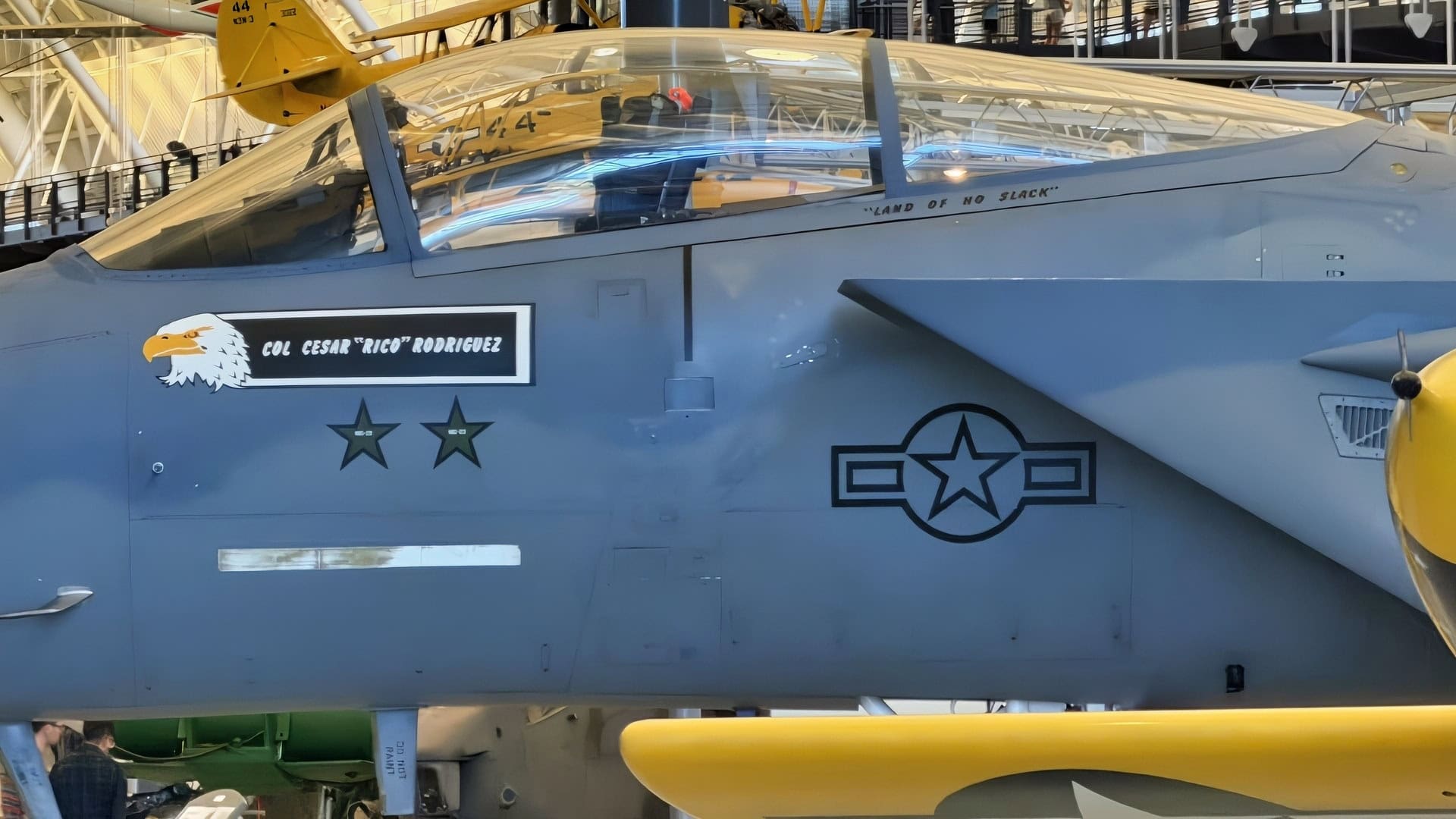
When the last F-15C Eagles leave the active force in the coming years, the Air Force will retire more than an airframe with an unbeaten record. It will retire an experience: the last American fighter designed around a single sentence, flown by a community that measured itself against that purity for nearly half a century. The record has been celebrated at length, including in these pages. This is about the other thing that goes away, what it was actually like to strap into the purest air-superiority machine America ever built.
The F-15: Built Around One Sentence
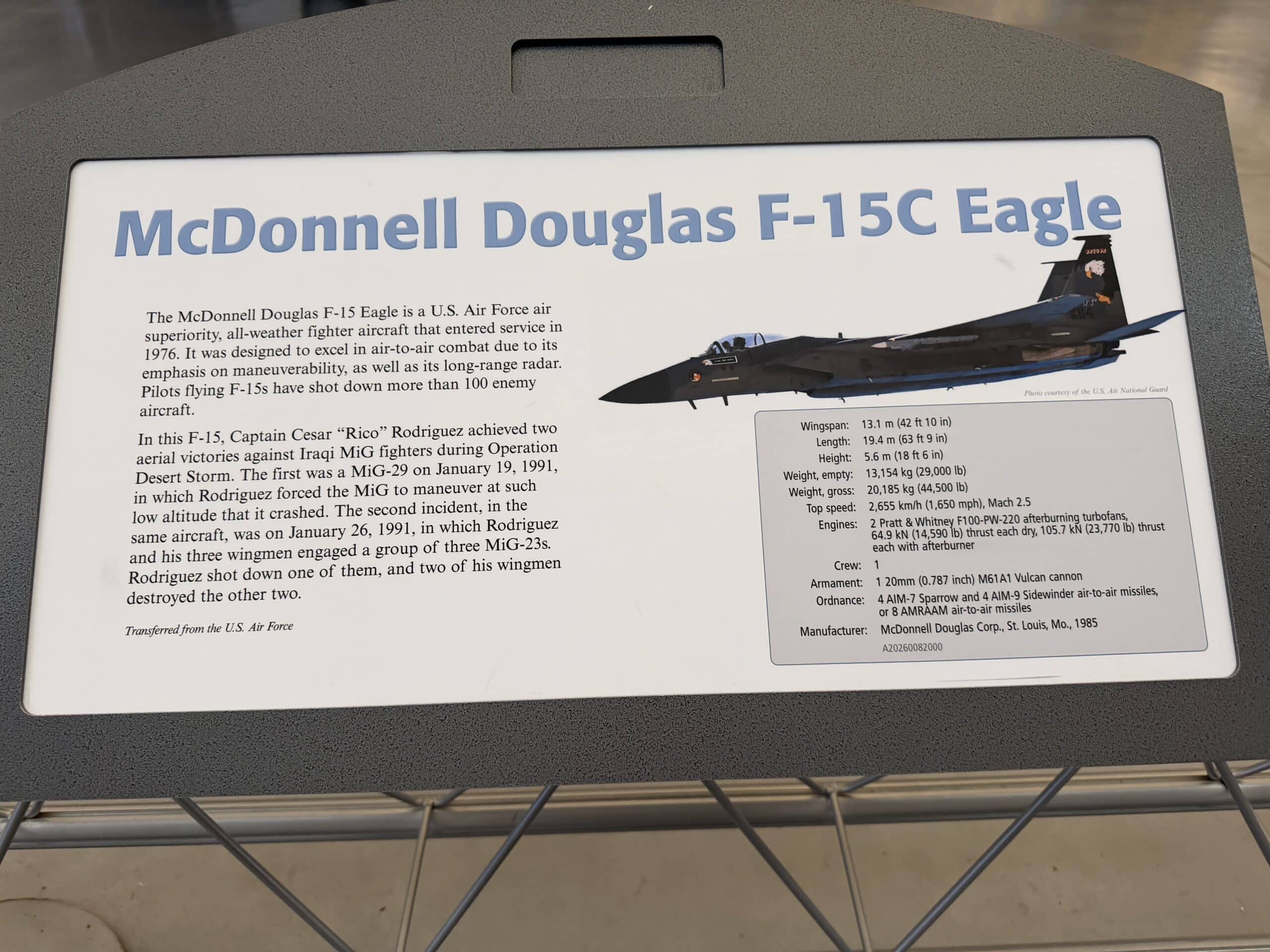
F-15C Smithsonian 19FortyFive Photo
The F-15 was born of fear. When the Soviet MiG-25 appeared in the late 1960s, its huge wing and blistering speed convinced Western intelligence that Moscow had built an unbeatable dogfighter, and the U.S. Air Force answered with a program governed by a creed that designers repeated like scripture: not a pound for air-to-ground. Nothing would hang on the jet, and nothing would be built into it, that did not serve to kill other airplanes.
The purity produced numbers no fighter had ever carried. Retired Air Force pilot Rich Martindell has recalled that the service wrote a thrust-to-weight ratio greater than one-to-one into the requirement itself, meaning the engines had to out-pull the airplane’s own weight so it could accelerate going straight up. The first jet rolled out of St. Louis just 30 months after McDonnell Douglas won the contract, flew in July 1972, and reached the operational force in January 1976, carrying two Pratt & Whitney F100s and a wing so large that its light loading gave the Eagle an instantaneous turn few aircraft could follow. To advertise the point, the Air Force stripped an early airframe of paint and radar, called it the Streak Eagle, and, in early 1975, broke eight time-to-climb records, several of which were taken directly from the MiG-25 that had started the panic.
What It Felt Like
The pilots’ accounts all begin the same way, with the push. A journalist who rode in the back seat out of Nellis described the jet straining against locked brakes at military power, lifting off in roughly 500 feet, and pegging the vertical-speed needle as it climbed away. Demonstration pilots made the thrust the whole show: retired Colonel William “Trapper” Carpenter, part of the early Eagle cadre, described pulling straight up after takeoff and climbing vertically to about 13,000 feet, dumping a puff of fuel so the crowd could find the dot. Tellingly, the first instructor pilots were Vietnam veterans of the F-4 and F-105, men who had fought MiGs with underpowered jets and bad missiles and knew precisely which failures the Eagle existed to erase.
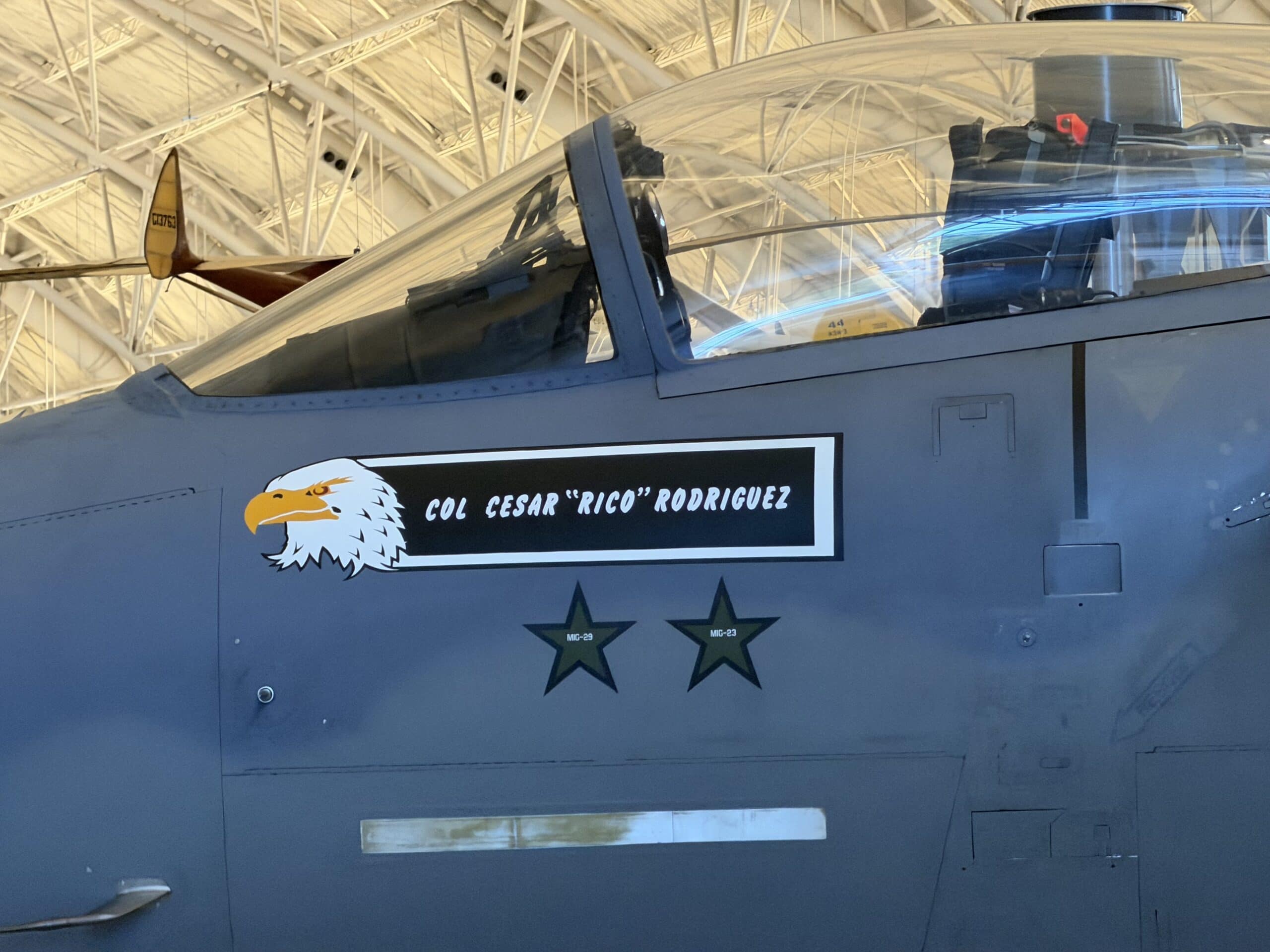
F-15C Smithsonian 19FortyFive Photo
The F-15C, which joined the force in 1979 with more internal fuel and the ability to carry conformal tanks, refined the formula without diluting it. From under that enormous bubble canopy, sitting high above the intakes, an Eagle driver saw everything, and with the big APG-63 radar, he usually saw it first. Visibility, thrust, and a radar that reached out beyond the merge: the jet was engineered so that its pilot would enter every fight already ahead.
Most of an Eagle driver’s career, though, was not war but watch. For decades, the Charlie sat armed alert from Iceland to Okinawa, and the scramble was its own ritual: the klaxon, the sprint to the jet, airborne in minutes to run down an unidentified radar return over cold ocean. Pilots trusted the machine’s margins on those long flights, because two engines meant an Eagle that lost one far from land could fly home on the other, a redundancy more than one crew cashed in.
How Eagle Drivers Fought
The community that grew up around the jet was defined less by swagger than by craft. In a long interview with the aviation site Hush-Kit, an F-15C pilot walked through fighting the smaller F-16: meet head-on, take the fight into a single circle, then get slow and live at high angles of attack where the Eagle could fly and the Viper’s flight-control limits could not follow. What he emphasized most was humility. He had watched Eagles get gunned in training by a Harrier, a T-38, and an A-4, and his summary of fifty years of dominance gave the machine only partial credit: “the plane is just a tool,” and the pilot’s skill decides the fight.
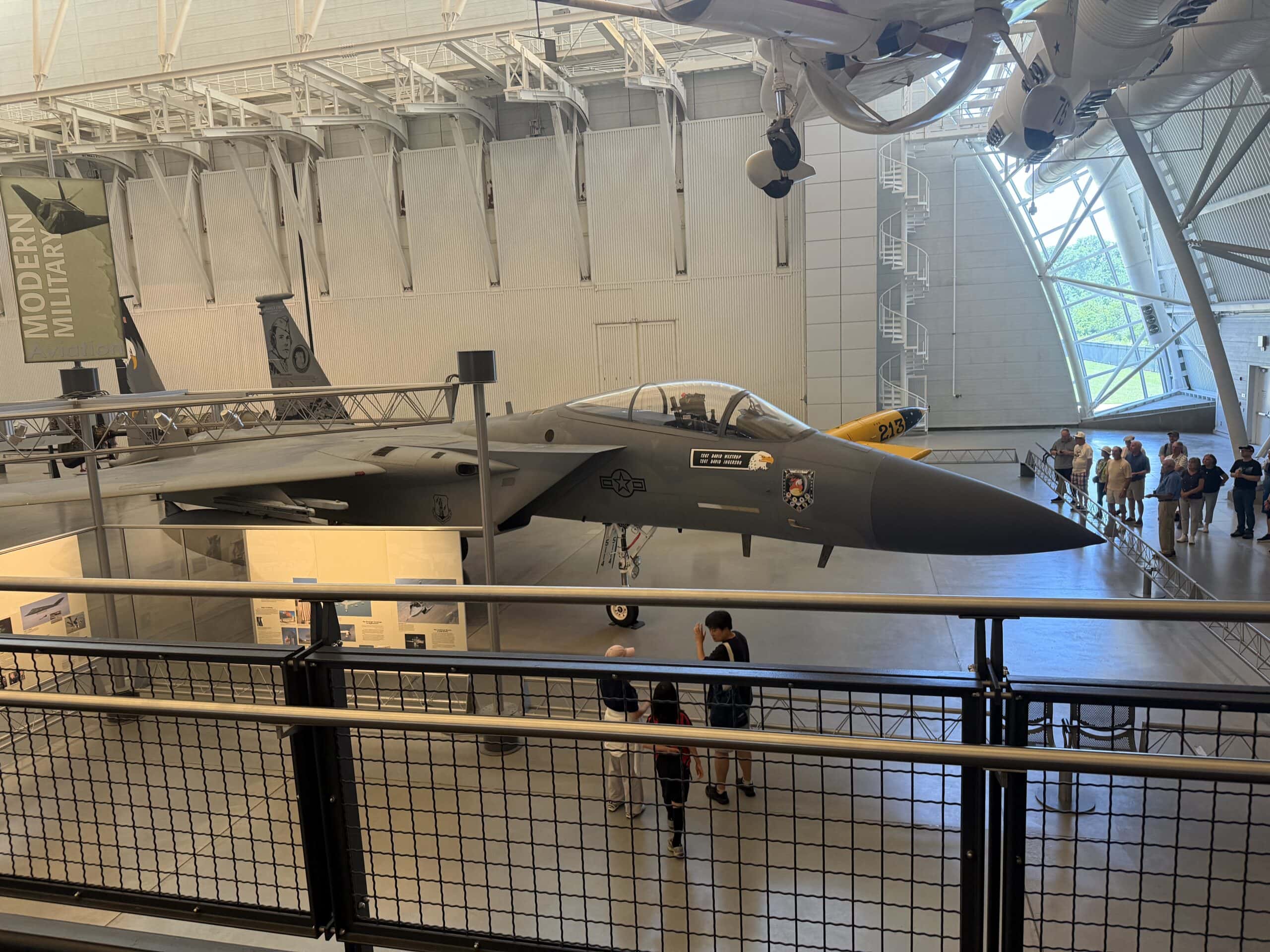
F-15C Smithsonian 19FortyFive Photo
The tools and the craft together built the ledger that made the Eagle famous, 104 air-to-air victories and zero defeats across every operator, a record no fighter in history approaches. As tallied previously in these pages, at least 41 of those kills belong to the Charlie model specifically, most of them scored by American pilots over Iraq in 1991, when F-15Cs flying marathon combat air patrols, hours on station between tankers with AWACS calling the picture, took the overwhelming share of coalition air-to-air kills, and the rest added by Israeli and Saudi Eagles across three decades of Middle Eastern skies.
The Day It Flew on One Wing
Every fighter community keeps one story as proof of what the machine could take, and the Eagle’s involves losing a wing. On May 1, 1983, over the Negev desert, an Israeli two-seat F-15D on a conversion flight, tail number 957, a jet already wearing five kill marks, collided with an A-4 Skyhawk during a mock dogfight. The student in front, Zivi Nedivi, with instructor Yehoar Gal behind him, recovered the spiraling jet by slamming both afterburners and flying it home to a landing at roughly twice normal speed, stopping just short of the arresting barrier. Only on the ground did the crew learn the collision had sheared the entire right wing off about two feet from the root. McDonnell Douglas initially refused to believe it and sent a team to see the jet, a story this site has told in full. The airplane was repaired, returned to service, and shot down a Syrian MiG-23 two years later. Eagle drivers did not need the legend embellished. The fuselage itself generated enough lift to stand in for a wing, which is simply what happens when engineers are ordered to waste nothing on any job but flying.
The Long Goodbye
Now the experience is ending in stages. Kadena Air Base in Japan, the Eagle’s Pacific fortress for more than four decades, sent its last F-15C/Ds home in late 2024, and the F-15EX squadrons taking their place arrive this year, with Guard wings in California, Louisiana, and beyond converting behind them. Most of the remaining Charlies, airframes now pushing four decades old and flying well past their original design lives, will be gone by around 2031, save for a small cadre of upgraded “Platinum Eagles” retained to guard American skies. It is fitting work. Interception was always the Charlie’s daily mission, with thousands of scrambles standing behind every kill on the ledger. The name and the airframe carry on in the two-seat, bomb-hauling F-15EX, a superb aircraft that is many things the C never was, multirole above all. That is precisely the difference. The F-15C was the last American fighter permitted to be only one thing, and the pilots who flew it spent their careers inside the purest expression of air superiority ever built. The jets are leaving for the boneyard and the museums, several already displaying their kill stars. What leaves with them is the one-sentence airplane.
About the Author: Harry J. Kazianis
Harry J. Kazianis (@Grecianformula) was the former Senior Director of National Security Affairs at the Center for the National Interest (CFTNI), a foreign policy think tank founded by Richard Nixon based in Washington, DC. Harry has over a decade of experience in think tanks and national security publishing. His ideas have been published in the NY Times, The Washington Post, The Wall Street Journal, CNN, and many other outlets. He has held positions at CSIS, the Heritage Foundation, the University of Nottingham, and several other institutions related to national security research and studies. He is the former Executive Editor of the National Interest and the Diplomat. He holds a Master’s degree focusing on international affairs from Harvard University.

