

On Friday, the Senate confirmed a general to run the most expensive defense project in American history, a missile shield meant to protect the homeland from weapons that do not fly like missiles at all. The strangest of those weapons is a Cold War ghost: the fractional orbital bombardment system (FOBS), a warhead that rides a partial orbit around the planet and comes at America from the direction its radars were never built to watch. The Soviets fielded it, then bargained it away at a negotiating table. China resurrected it in 2021 with a twist the Soviets never had. And the table where the first version died no longer exists.
A General Gets the Job
On July 17, the Senate confirmed Space Force Gen. Michael Guetlein by voice vote to lead Golden Dome, President Trump’s plan for a layered shield over the United States, a program whose ultimate cost estimates start north of $175 billion and climb from there. The quiet vote belied the size of the job: an architecture spanning every service, promising to stop ballistic, hypersonic, and cruise missiles aimed at the homeland, some before they finish launching. To understand why Washington is attempting something this hard and this expensive, it helps to study the weapon that best explains the ambition, because it is the one that makes the existing American warning system look like a fence with an open gate.
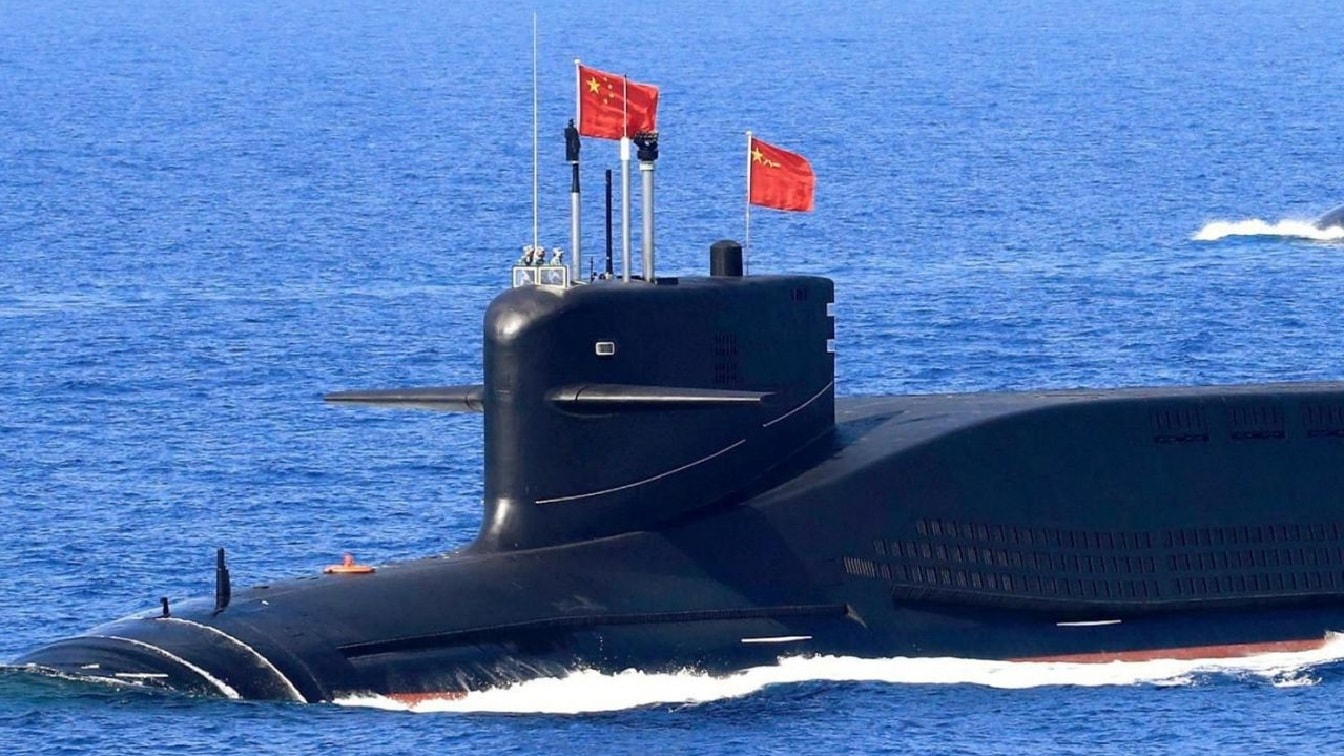
Chinese nuclear missile submarines. Image Credit: Creative Commons.
The Weapon That Comes From the South
A fractional orbital bombardment system does something no ordinary missile does. An intercontinental ballistic missile flies a predictable arc: within minutes of launch, radars can compute where it will land. A FOBS instead boosts its warhead into a partial orbit of the Earth, coasts along it like a satellite, and then fires a retrograde engine burn to drop out of orbit onto its target.
Until that deorbit burn, there is no ballistic trajectory to solve and no impact point to compute. Worse, the orbit can run in any direction, including south over Antarctica, entirely around the ballistic-missile early-warning radars that the United States built across the Arctic to face a Soviet attack coming over the North Pole. When confusion swirled after China’s test, the Space Force’s Lt. Gen. Chance Saltzman cut through it with a definitional scalpel, stressing that “a fractional orbit is different than suborbital” and different from a mere hypersonic missile: a separate class of weapon entirely. The category’s whole purpose is to arrive unannounced, from the wrong direction.
The Soviets Did It First — and Gave It Up
None of this is new, which is part of what makes it unsettling. The Soviet Union fielded the R-36O orbital bombardment missile in 1969, explicitly designed to fly via the South Pole and minimize the warning time of America’s early-warning radars. The trade-offs were understood even then: a fractional-orbit weapon was less accurate than an ICBM and carried a smaller warhead, which suited it to “time-urgent, soft targets” like bomber bases and command centers rather than hardened silos. In other words, it was a first-salvo weapon, valuable precisely for the surprise it bought.
The United States, for its part, studied the same physics in the 1960s with its X-20 space-bomber project and chose not to build the weapon. The Soviet system served in small numbers for about 14 years, and then the treaty era caught up with it: SALT II, signed in 1979, banned fractional orbital missiles by name, and Moscow deactivated the force by 1983. A destabilizing weapon was traded away at a table, which is how the first FOBS era ended. It is worth holding on to that detail because nothing like it is available today.
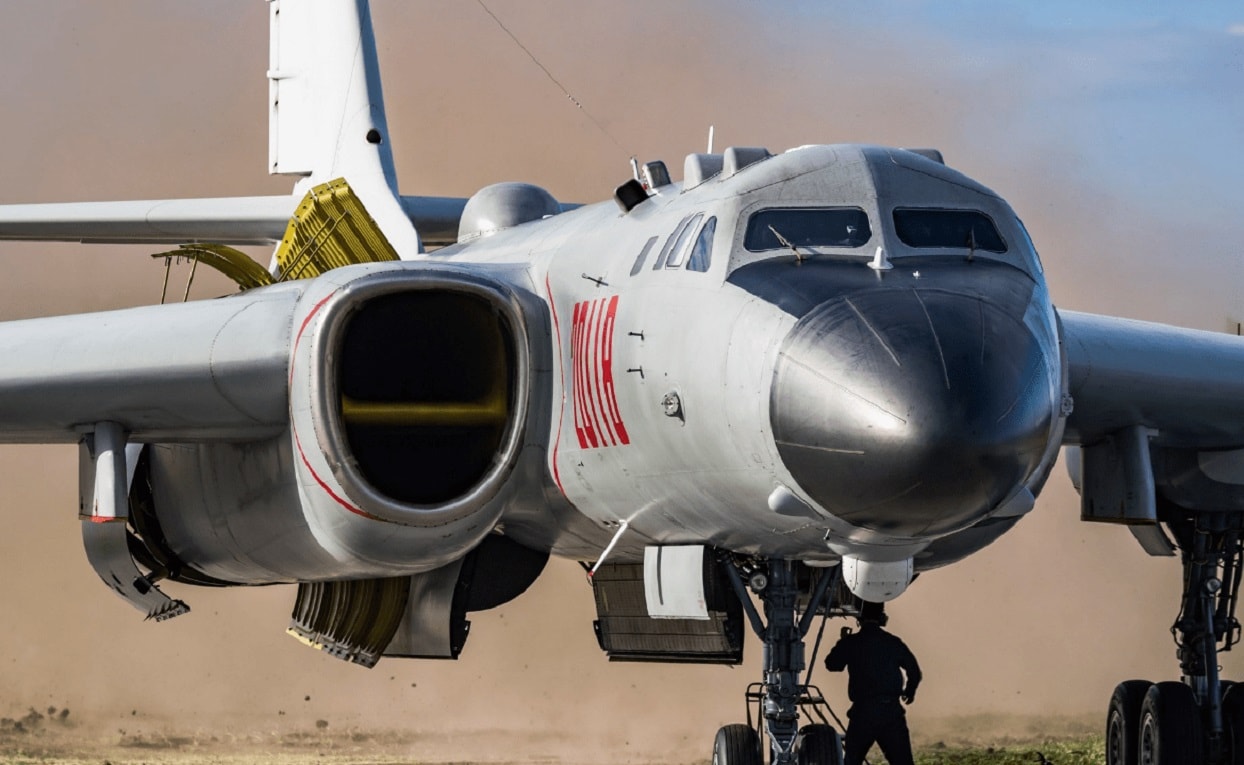
Chinese Bomber. Image: Creative Commons.
July 2021: The Resurrection
The second era began with a mystery. In October 2021, the Financial Times revealed that China had conducted two secretive tests that summer, in late July and mid-August, in which a rocket carried a weapon into a partial orbit of the Earth before it descended toward a target. The Pentagon’s own China Military Power Report later put the flight at nearly 25,000 miles, the longest of any Chinese land-attack weapon test, and by most accounts, the vehicle missed its target by roughly two dozen miles, a poor result for an ICBM and a startling one for a first-of-its-kind system.
What made the test genuinely novel was the payload. The Soviets had capped their orbital missile with an ordinary reentry vehicle; China paired the fractional orbit with a hypersonic glide vehicle, a maneuvering weapon that can fly low, evade interceptors, and disguise its destination after it leaves orbit. The combination marries the orbital trick that defeats early warning to the gliding trick that defeats missile defense, and no one had ever demonstrated it before. Gen. Mark Milley, then chairman of the Joint Chiefs, called it “a near-Sputnik moment.” Beijing insisted it had merely tested a routine reusable spacecraft, a denial it has never elaborated on, and the tests were never officially acknowledged as a weapons program at all.
Where It Stands in 2026
Five years on, the intelligence picture is careful and conditional, and it should be reported that way. The Defense Intelligence Agency assesses that if China chose to pursue the capability, it could field 60 operational FOBS by 2035, a projection, not a count of weapons in silos. The same agency’s threat assessment this spring projected the combined Chinese and Russian ICBM force growing from about 800 today to 1,200 within a decade, with rising numbers of those missiles expected to be fractional orbital systems alongside the hypersonic gliders both countries are fielding; the Pentagon’s reporting pairs the FOBS thread with China’s DF-27 glide-vehicle family. Nothing in the public record confirms an operational Chinese FOBS today.
What the record does show is a country that demonstrated the hardest part five years ago, has declined to foreswear it, and is expanding the nuclear arsenal behind it faster than any other state on earth.
The honest summary is that FOBS sits where many Chinese strategic programs sit: demonstrated, denied, and entirely unconstrained.
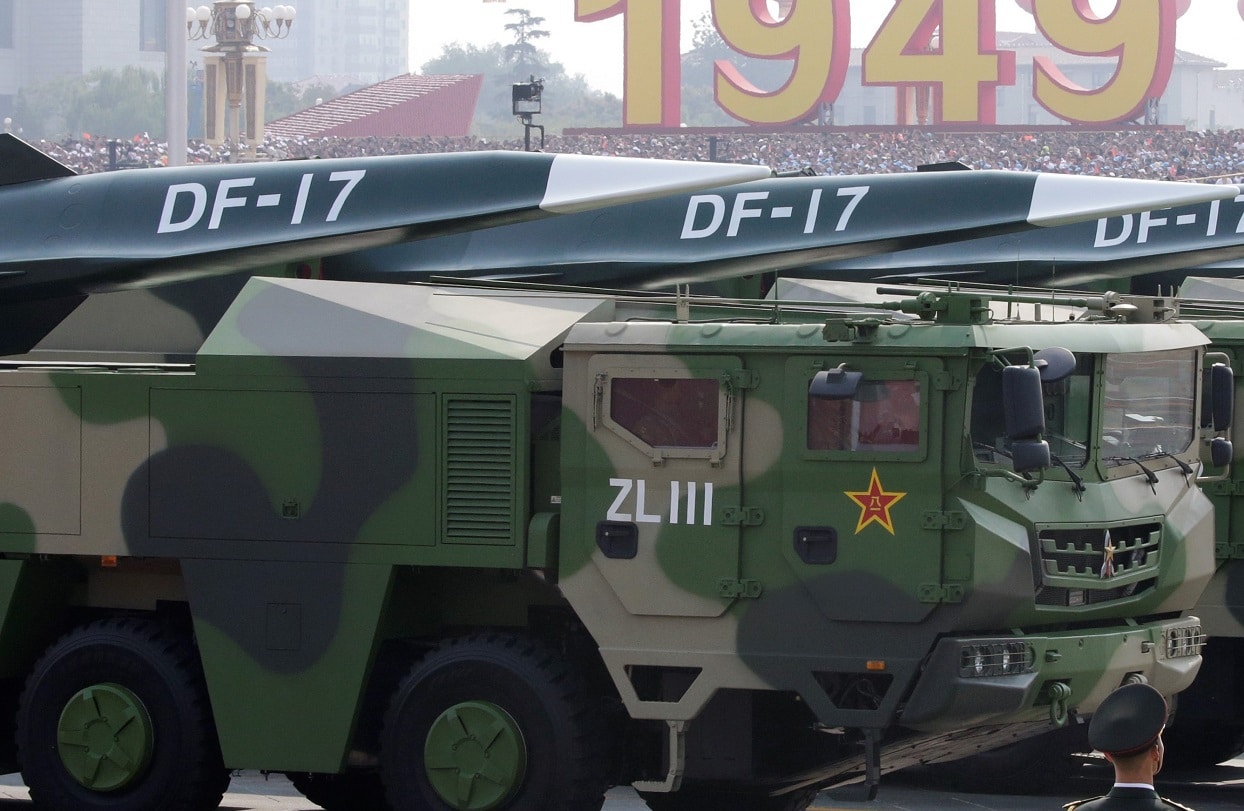
Image of DF-17 missile. Image: Creative Commons.
America’s Half-Trillion-Dollar Answer
Golden Dome is the institutional response, and FOBS is stamped through its justification, because a weapon that comes from the south is the clearest argument that the northern-facing architecture of the Cold War no longer suffices; advocates ground the case for space-based defenses explicitly in orbital-strike systems built to bypass those radars.
The program’s announced architecture projects $75 billion and full operation by 2029, with a $25 billion down payment already appropriated.
The Congressional Budget Office prices the space-based interceptor layer alone at $161 billion to $542 billion over two decades; Guetlein disputes that math, saying flatly, “They did not estimate the architecture that we’re building.” More striking is that the new director himself treats the layer FOBS most directly justifies as an open question: “If boost-phase from space is not affordable and scalable, we will not produce it,” he told Congress in April, conceding that scale and cost, not physics, are the unsolved problems. Congress is split accordingly: a group of senators warned the Pentagon the project could prove “prohibitively expensive, operationally ineffective” and risk igniting a nuclear arms race with Russia and China, and a separate Senate amendment would fence the money until the administration produces a full architecture plan, a presidential strategic-stability certification, and an independent technical review. The shield now has a confirmed general, a disputed price somewhere between $75 billion and half a trillion, and a Congress that has not decided how much of it to buy.
The Skeptics’ Case
The strongest argument against panic was made on this site within weeks of the original test, and it has aged well. As Michael Peck argued here in 2021, orbital gliders are far from superweapons: a fractional-orbit weapon is less accurate than an ICBM, carries less, and, counterintuitively, takes longer to arrive, closer to an hour partially circling the Earth against thirty minutes for a missile over the pole.
Above all, the surprise that made FOBS frightening in 1967 died in the 1970s, when America lofted launch-detection satellites that see the boost phase of any rocket from orbit, no matter which direction it flies afterward. The radars face north; the satellites face everywhere.
On this reading, China’s weapon is less a war-winner than a cost-imposition device, a way to frighten Washington into spending on continental defense, dollars that then cannot buy ships and aircraft for the Pacific fight China actually plans for.
The uncomfortable corollary is that a half-trillion-dollar Golden Dome layer is, on the skeptics’ math, exactly the prize the bluff was designed to win. That argument deserves to sit, unresolved, next to the DIA’s projections, because both can be true: a weapon can be militarily marginal and strategically corrosive at the same time.
This Time, No Treaty
Which brings the story to the part with no precedent. The first FOBS era ended because two superpowers, at the height of their rivalry, sat at a table and banned the weapon by name. Consider what surrounds the second one. New START, the last treaty limiting American and Russian strategic forces, expired on February 5 of this year, leaving the two arsenals without legally binding limits and without a successor under negotiation, for the first time since the early 1970s. Russia’s offer to observe the old ceilings informally for a year sits unanswered; President Trump’s own summary, in a January interview, was “If it expires, it expires,” though he has since called for a modernized treaty that includes China. Beijing has refused every invitation to trilateral arms control while running its arsenal from roughly 250 warheads a decade ago to 600 today, faster growth than any other nuclear power.
The Outer Space Treaty bans stationing nuclear weapons “in orbit,” but a fractional orbit, which never completes a revolution, slips through a loophole the drafters left open in 1967, the same loophole the Soviets exploited.
And the defensive answer is itself entangled in the spiral: Xi and Putin issued a joint statement in May of last year objecting to Golden Dome as a threat to strategic stability, the very argument Washington’s own treaty-minded senators make from the other direction.
SALT II killed the first orbital bomb because a table existed where such bargains could be struck.
As of this year, for the first time in half a century, there is no table, no treaty, no talks, and no limit, and the weapon that comes over the South Pole is being weighed again in a world that has dismantled every institution that stopped it the first time.
That, more than any single test, is what has changed.
About the Author: Harry J. Kazianis
Harry J. Kazianis (@Grecianformula) was the former Senior Director of National Security Affairs at the Center for the National Interest (CFTNI), a foreign policy think tank founded by Richard Nixon based in Washington, DC. Harry has over a decade of experience in think tanks and national security publishing. His ideas have been published in the NY Times, The Washington Post, The Wall Street Journal, CNN, and many other outlets worldwide. He has held positions at CSIS, the Heritage Foundation, the University of Nottingham, and several other institutions related to national security research and studies. He is the former Executive Editor of the National Interest and the Diplomat. He holds a Master’s degree focusing on international affairs from Harvard University.

