
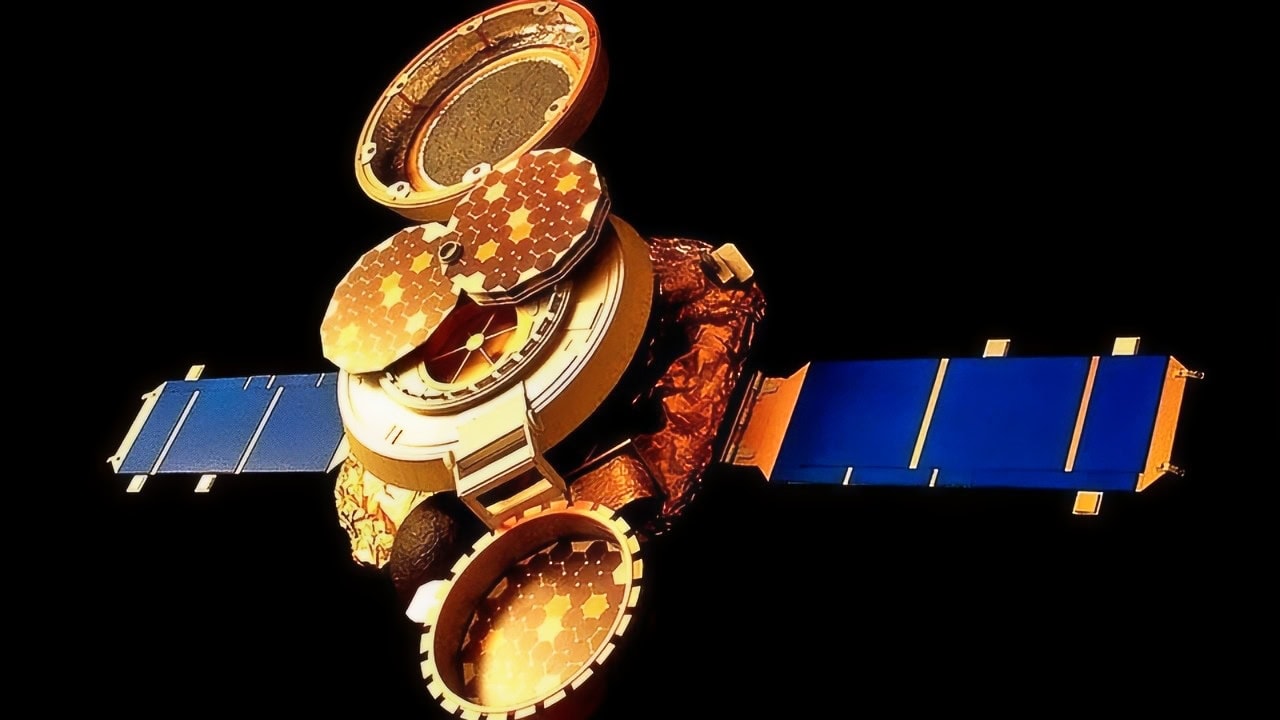
On 8 September 2004, two helicopters flown by Hollywood stunt pilots waited to catch NASA’s Genesis capsule in midair because its cargo was too fragile to touch the ground, but all four switches meant to sense the fall had been installed upside down, and the capsule hit the Utah desert at 193 miles per hour.
Genesis Meets the Sun
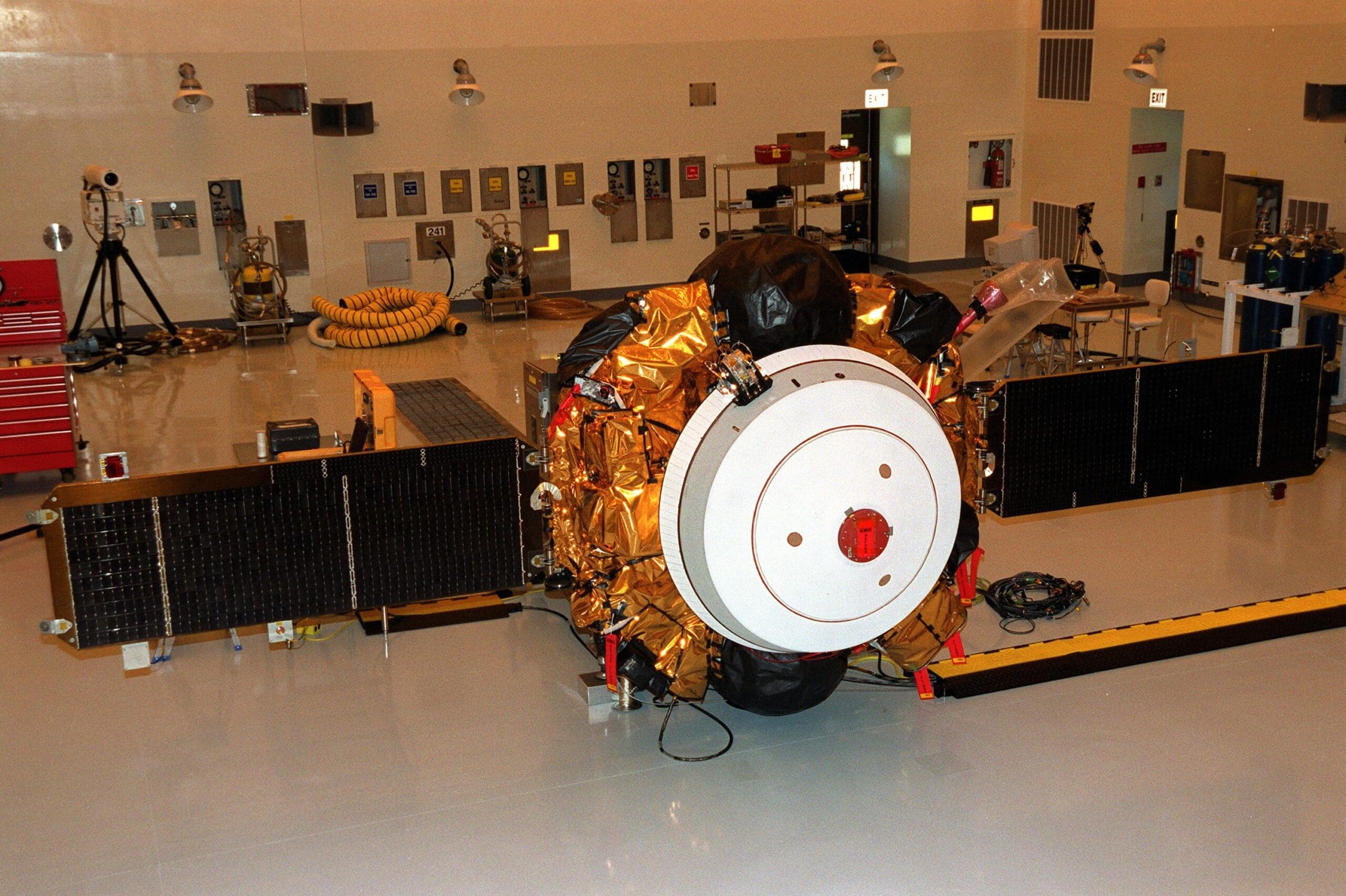
Genesis Capsule NASA Provided Photo
NASA had spent three years collecting atoms of the Sun and had no way to land them gently, so it hired the men who fly camera helicopters in action movies and gave them a hook on an eighteen-foot pole. They rehearsed eleven times without a miss. Then, a drawing error nobody caught in four years of reviews turned the most carefully planned helicopter flight in history into a recovery operation, and the mission’s answer had to be picked out of the desert with tweezers.
On the morning of 8 September 2004, two helicopters were circling over the Utah desert, waiting to go fishing.
What they were waiting for was a NASA capsule about five feet across, dropping out of the sky at the end of a three-year flight and carrying atoms of the Sun. Genesis was the first American mission to bring material home from space since Apollo, and its cargo was so fragile that a normal landing would have destroyed the science inside it. So the agency had hired Hollywood stunt pilots to snatch the capsule out of the air with a hook on a pole, and they had rehearsed the catch eleven times without a single miss.
They never got to try it. Four switches, each a small plunger on a spring, had been installed backward; the parachutes never opened, and the capsule went into the desert at 193 miles an hour. That is the part everyone remembers. The part worth knowing is that the mission succeeded anyway, seven years later, after its answer was recovered from the sand with tweezers.
The Fishing Rod on a Helicopter
Two helicopters would loiter over the Utah Test and Training Range, each carrying a crew of three. When the Genesis sample return capsule came down under its parafoil, the lead aircraft would move alongside it, close enough that the helicopter’s skids sat about eight feet above the top of the canopy, and extend an eighteen-and-a-half-foot pole tipped with what the man running the operation called an oversized, space-age fishing hook.
The hook would snag the parafoil, detach from the pole, and pay out roughly 400 feet of line from a winch to soften the jolt; the line was spun from Technora, the same aramid fiber that reinforced the parafoil itself. The recovery systems engineer described the entire apparatus, without irony, as a winch attached to a long fishing pole. If the lead helicopter missed, the second would take the pass.
The men flying were not test pilots. They were stunt pilots, drafted for the job because their trade is precisely this, flying with something awkward dangling from a long cable in tight airspace. Lead pilot Cliff Fleming had chased sky surfers through the air for the film XXX, towed Pierce Brosnan for Dante’s Peak, and had just come off Batman work. Backup pilot Dan Rudert, asked to rate the difficulty of the capture, put it between an 8 and a 9 out of 10.
They had earned the confidence. By August 2004 the team had run eleven simulated Genesis captures with a hundred percent success rate. Roy Haggard, chief of midair retrieval operations and chief executive of Vertigo Inc., the firm that had pioneered the parafoil-capture technique, offered the standing joke: there had never been a more highly planned helicopter flight in history.
Why Nobody Could Let It Land
The absurdity had a reason. The capsule’s cargo was a set of hexagonal wafers made of silicon, sapphire, gold, diamond, and other ultra-pure materials, chosen because their chemistry was clean enough that solar atoms buried in them could later be distinguished from everything else.
The atoms were buried shallow. Solar wind ions arriving at a few hundred kilometers per second typically embed themselves 40 to 100 nanometers beneath a polished surface, a depth measured in a few hundred atoms. A normal parachute landing, with its jolt and its dust, risked cracking the collectors and pressing terrestrial material into the very layer that held the science. So the mission’s designers concluded that the samples could not be allowed to touch the ground at all, and built an entire recovery architecture around that constraint. The parafoil existed so the capsule would glide forward rather than fall straight down, letting a helicopter fly in formation with it. The stunt pilots existed because someone had to catch it.
Three Years Parked in the Solar Wind
Genesis launched in August 2001 and flew to a gravitationally balanced point about a million miles sunward of Earth, outside the protection of the planet’s magnetic field, where it opened its collector arrays like a windshield in a cloud of insects and waited. It collected from 3 December 2001 to 1 April 2004, 850 days, gathering the thin stream of charged particles the Sun throws off in every direction.
The entire haul, by NASA’s own accounting, came to approximately ten to twenty micrograms of solar wind, which is why the mission’s scientists preferred to count it in atoms rather than weigh it. By that measure, the arrays caught roughly four hundred quadrillion of them.
The point was never the quantity but what those atoms encode. The Sun holds more than 99 percent of the mass of the solar system, so its composition is very nearly the composition of the original cloud that everything else condensed out of, including Earth. Measure the isotopes in the solar wind precisely enough and you have the baseline chemistry of the system as it stood 4.6 billion years ago, the number against which every rock, moon, and planet can be compared. Genesis was also the first American mission to bring material home from space since Apollo, and the first ever to return samples from beyond the Moon.
Nine Minutes
The capsule separated from its carrier and entered the atmosphere over northern Oregon at about 24,700 miles per hour, bright enough to be tracked as a fireball in daylight. Two minutes and seven seconds later, still supersonic and roughly 33 kilometers up, a drogue parachute was to deploy and stabilize the descent. Lower down, the parafoil would open and settle the capsule into a gentle glide, sinking at a few hundred feet per minute, slow enough for a helicopter to match it.
None of it happened. The drogue never came out. The capsule began to tumble and fell the rest of the way, slowed by nothing but air resistance, and it struck the ground at Dugway Proving Ground at about 193 miles an hour, burying itself roughly two feet into wet desert soil and splitting open on impact. The inner science canister breached. Unfired pyrotechnics from the parachute system and fumes from the capsule’s batteries kept the recovery crews at a distance while the wreck was made safe.
The helicopters, still airborne, had nothing to do. Don Burnett, the Caltech cosmochemist who had spent much of his career on the mission as its principal investigator, later recalled the moment the outcome became clear: when the altitude callout reached 2,700 feet with no parachute, he knew they were in trouble.
Four Switches, All Backward
The Mishap Investigation Board quickly found the cause, and it was almost too small to be believable. The capsule detected its own reentry with gravity switches, each one a tiny cylindrical plunger on a spring. Under the ferocious deceleration of atmospheric entry, the plunger was supposed to be forced onto an electrical contact, the way a seat belt tightens when a car brakes hard, and that contact would start the timer that fired the parachutes.
All four of them had been installed facing the wrong way. Because they were backward, the deceleration that should have closed the contact failed to do so, and the timer never started.
The redundancy is what turns the error from a mistake into an indictment. There were four switches, two in each of two separate electronics boxes, deliberately doubled so that a failure in one pair would be covered by the other. But the backups were not independent in the way that matters. All four had been built to the same Lockheed Martin design drawings, produced in 2001, and the drawings themselves showed the switches in the reversed orientation. Every pair inherited the identical defect from the identical piece of paper, so the redundancy protected nothing at all.
Nor did any inspection catch it, because at every stage the hardware faithfully matched the drawing it was built from. Investigators eventually had to X-ray the wreckage to confirm which way the plungers were pointing. Michael Ryschkewitsch, who chaired the Board, put the question plainly to reporters that October: how did we not catch this?
The Test Nobody Ran
The answer was that four separate processes failed in sequence. The Board found the fault in the design process that inverted the switch, and then in the design review, verification, and validation processes, each intended to catch exactly that kind of error, yet each missed it.
The design had been carried over from Stardust, a comet-sample mission built around the same general approach. But the Genesis version was not identical: the box holding the switches was a different shape, the electronics had to be rearranged to fit, and the orientation flipped somewhere in that rework. Because the team regarded the design as proven heritage hardware, a centrifuge test that would have spun the assembly and revealed the switches could not trigger was never performed, dropped partly on that assumption and partly to a schedule slip. The switches were tested to confirm they still flipped. They were not tested in a way that would show they were facing the wrong direction to flip when it counted.
Ryschkewitsch was blunt about what the lesson was not. It could not be reduced to don’t install the switches upside down, because the failure was never a technician’s error. It was a drawing that propagated cleanly through every review built to stop it, and the moment engineers hear that a test can be skipped because hardware is heritage is the dangerous one. The Board’s 231-page report also placed weight on the faster, better, cheaper culture that had thinned the team and its margins, tying Genesis to the same pattern that produced the Mars Climate Orbiter and Mars Polar Lander failures a few years earlier.
Stardust, meanwhile, flew home. Its drawings had the switches the right way round, its parachutes opened, and in January 2006, it delivered comet dust to the same Utah range without incident. Two nearly identical systems, two opposite outcomes, and the variable between them was a sheet of paper.
Picking the Sun Out of the Sand
By any conventional accounting, a $264 million spacecraft embedded in a desert is a write-off. Most of the roughly 300 glassy collector plates had shattered, and the fragments were lying in Utah dirt, which is the single worst thing that can happen to samples whose entire value lies in being uncontaminated. The losses were severe and uneven: taking three millimeters as the smallest useful fragment, the mission later calculated that it had lost roughly half its sapphire collectors and more than 99 percent of the germanium.
The science team rejected the verdict, and their reasoning was simple: the crash could not destroy atoms in the solar wind. The atoms were still there. They only had to be found. Fragments were gathered from the crater and shipped to the Johnson Space Center, and the work of separating the Sun from Utah began. The difficulty was one of scale in the wrong direction. Desert dust and spacecraft debris had settled on surfaces beneath which the solar atoms lay only tens of nanometers down, so every cleaning method had to strip contamination away without reaching the layer it was protecting. Techniques had to be invented for it, and the curation catalog of characterized fragments eventually ran past 1,850 entries.
The Answer, Seven Years Late
It took seven years and a great deal of picking through Utah sand with tweezers, and then, in June 2011, two teams published the mission’s central result in Science within the same week. A group led by Kevin McKeegan at UCLA reported the Sun’s oxygen isotope composition, finding that Earth, the Moon, Mars, and meteorites are all shifted toward the heavier isotopes relative to the Sun. A group led by Bernard Marty in France found the parallel story in nitrogen, with the Sun markedly poorer in nitrogen-15 than Earth’s air.
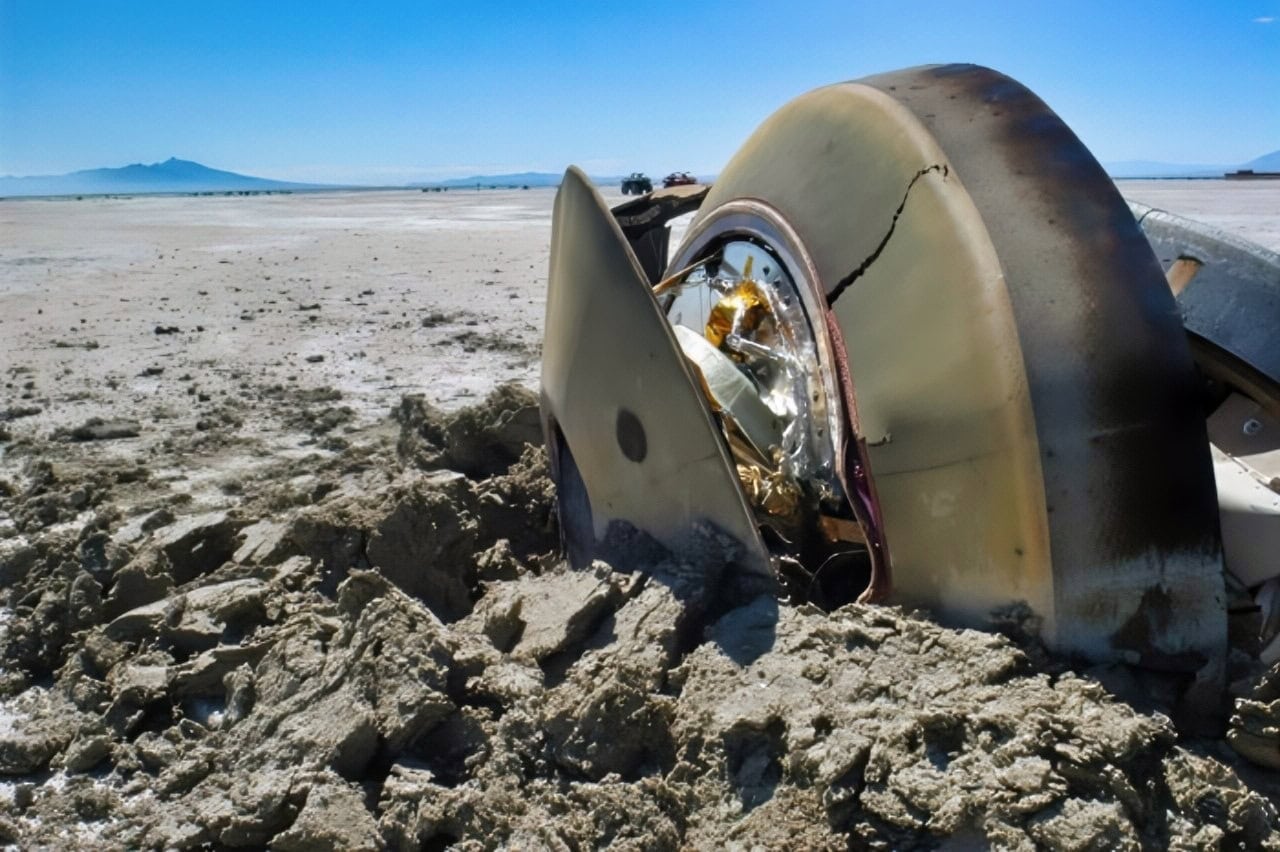
Genesis Wreck NASA Photo
Taken together, the two results say the planets are not simply small chemical copies of the star they orbit. Something rearranged the building blocks after the Sun formed and before the worlds assembled, most likely ultraviolet light from the young Sun breaking apart molecules at the edges of the nebula and sorting the isotopes as they recombined. Genesis had been built to ask exactly that question, and it answered it from inside a crater.
Burnett, who had watched the altitude callouts run out in 2004, gave the salvage its epitaph years later. If you must crash a spacecraft, he said, the best planet to crash it on is Earth, because there you can go and pick up the materials.
About the Author: Harry J. Kazianis
Harry J. Kazianis (@Grecianformula) was the former Senior Director of National Security Affairs at the Center for the National Interest (CFTNI), a foreign policy think tank founded by Richard Nixon based in Washington, DC. Harry has over a decade of experience in think tanks and national security publishing. His ideas have been published in the NY Times, The Washington Post, The Wall Street Journal, CNN, and many other outlets worldwide. He has held positions at CSIS, the Heritage Foundation, the University of Nottingham, and several other institutions related to national security research and studies. He is the former Executive Editor of the National Interest and the Diplomat. He holds a Master’s degree focusing on international affairs from Harvard University.

