
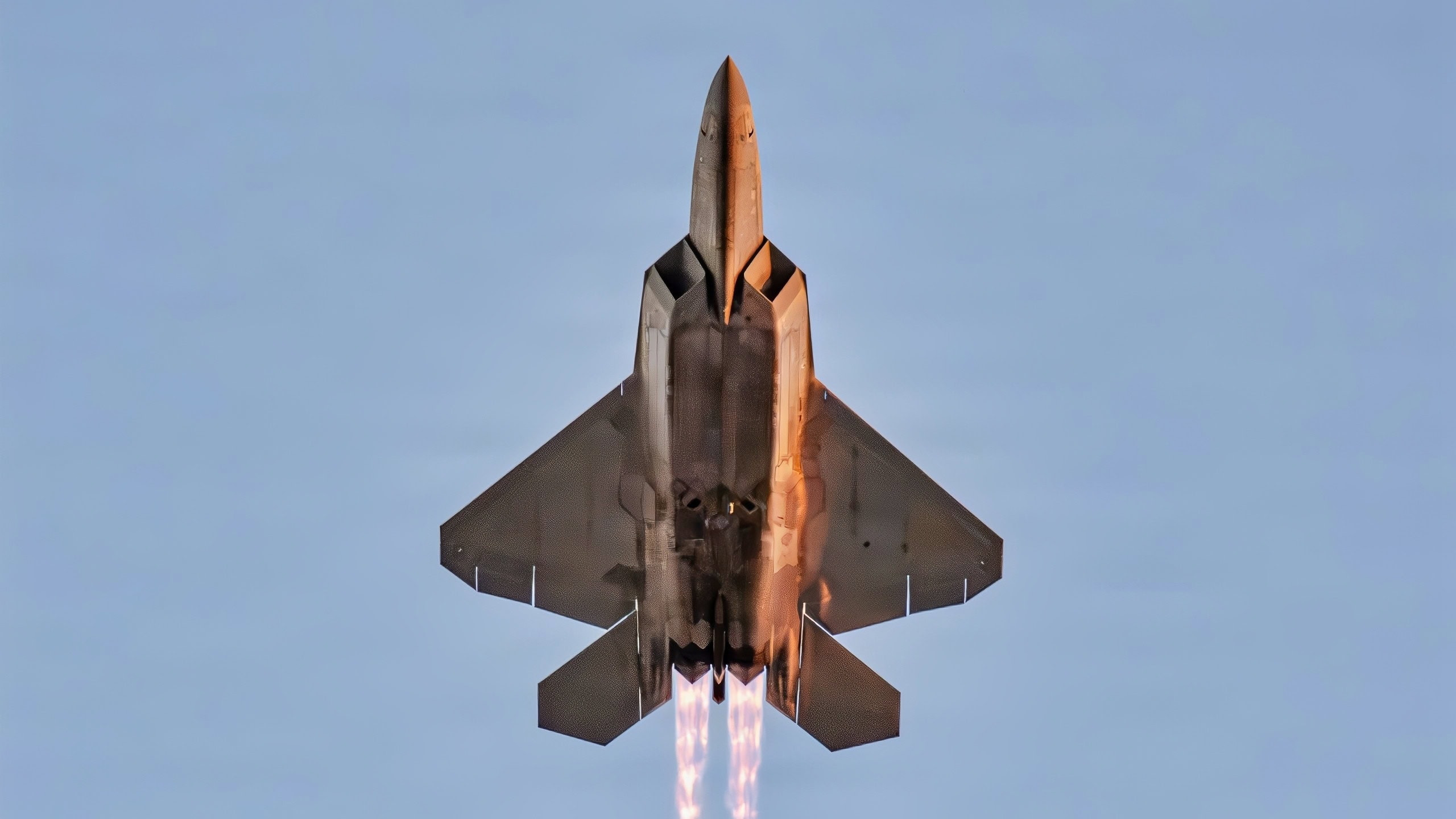
The US Air Force Planned 750 F-22 Raptors. It Stopped at 187: The U.S. Air Force planned 750 F-22 Raptors to defeat Soviet fighters and replace the F-15. It built 187 operational aircraft, 563 fewer than the original objective. Eight developmental jets brought total production to 195.
The missing 563 did not disappear in one vote. The planned buy fell to 648 in 1991, 442 after the 1993 Bottom-Up Review, 339 after the 1997 Quadrennial Defense Review, and finally 187 in 2009. Each reduction reflected a different mix of threat assessments, force cuts, cost growth and competing budget priorities.
The Advanced Tactical Fighter program began in the early 1980s as an answer to expected Soviet advances in combat aircraft and surface-to-air missiles. The Air Force wanted a stealthy F-15 successor with supercruise, advanced sensors and exceptional maneuverability, built in enough numbers to dominate a major air war in Europe.
By the time the Lockheed YF-22 won the competition in April 1991, the Soviet Union was months from collapse. Defense Secretary Dick Cheney had already delayed production by two years, citing budget constraints, a reduced European threat and the longer expected service life of the F-15. The Soviet Union collapsed during the opening months of full-scale development, a decade before low-rate production began.
The Soviet Union Disappeared Before the F-22 Entered Production
Washington then reduced the size of the armed forces and pursued a post-Cold War peace dividend. The F-22 survived because advanced Russian-designed fighters and air defenses were spreading beyond the former Soviet Union, but the rationale for 750 aircraft had vanished.
The 1993 review sized the program for four fighter wings; the 1997 review cut it to three. The history of the Raptor’s development became a story of preserving the capability while steadily reducing the quantity.
Smaller orders did not make the program cheap. Research, software, flight testing, tooling and other fixed expenses had to be divided across fewer aircraft. GAO reported in 2004 that development problems had delayed initial capability by 10 years and increased development costs by $16 billion.
An earlier review found that even a 333-aircraft production plan would exceed the congressionally imposed cost limit.
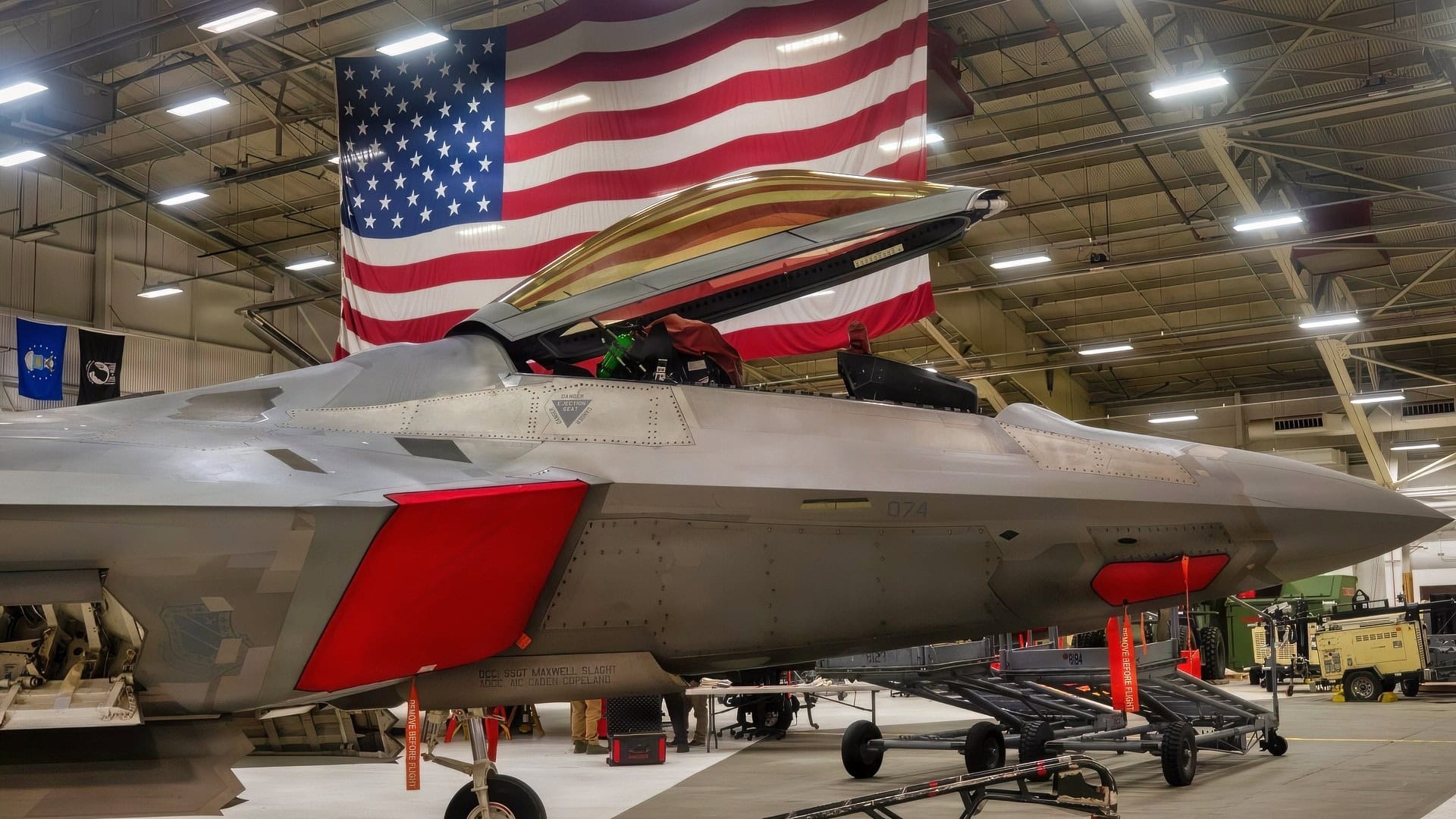
An F-22A Raptor sits in a hangar during a load competition on Joint Base Elmendorf-Richardson, Alaska, Jan. 23, 2026. Load competitions test Airmen’s ability to safely and efficiently build munitions, strengthening readiness for real-world taskings. (U.S. Air Force photo by Airman 1st Class Theodore Gowdy)

An F-35A Lightning II flown by a 65th Aggressor Squadron (AGRS) pilot takes off for its first flight with a new paint scheme at Nellis Air Force Base, Nevada, May 26, 2022. The mission of the 65 AGRS is to know, teach and replicate fifth-generation air adversaries tactics. (U.S. Air Force photo by Airman 1st Class Josey Blades)
Cost Growth Turned Every Quantity Cut Into Another Budget Fight
The Air Force listed the F-22’s unit price at $143 million. GAO estimated the completed program at $66.7 billion. Spread across 187 operational aircraft, that amounted to roughly $357 million per aircraft, though the larger figure includes decades of development and does not represent the price of building one additional Raptor.
Foreign orders never helped spread those costs. Congress adopted the Obey amendment in 1997, barring funds from being used to approve or license an F-22 export. Japan and Australia later showed interest, but the export prohibition remained. The program had one customer while the later F-35 drew orders from three U.S. services and numerous allies.
Iraq, Afghanistan and the F-35 Defined the 2009 Decision
The Raptor reached initial operational capability in December 2005, when U.S. forces were deeply committed in Iraq and Afghanistan. Neither opponent fielded an air force requiring hundreds of stealth air-superiority fighters. Defense Secretary Robert Gates redirected money toward troops, intelligence, surveillance, drones and equipment used in those wars. He described the F-22 as a “niche, silver-bullet solution” for a limited set of high-end conflicts.
The Obama administration proposed stopping at 187 while accelerating the F-35. Pentagon leaders argued that the smaller Raptor fleet would operate alongside unmanned aircraft, legacy fighters and more than 2,400 planned American F-35s. That calculation did not make the F-35 a direct replacement for the F-22’s air-superiority mission. It treated both aircraft as parts of a larger force.
The Air Force still wanted more Raptors. GAO found that service officials believed 381 aircraft would better meet combat requirements and reduce risk. The commander of Air Combat Command warned that ending at 187 placed execution of the national military strategy at high risk in the near to mid-term.
That disagreement mattered because the fleet also had to support training, testing, maintenance, homeland defense, overseas deployments and an attrition reserve. Gates, the Joint Chiefs and the White House chose the smaller force.
President Barack Obama threatened to veto a defense bill funding more Raptors. On July 21, 2009, the Senate voted 58-40 to remove $1.75 billion for seven additional aircraft. The final production F-22 rolled out in December 2011, and the Air Force accepted it in May 2012.
The 187-Aircraft Cap Became a Long-Term Strategic Bet
The decision assumed the United States would have enough time to field the F-35 in large numbers before a peer air threat became urgent. China later expanded its stealth-fighter production, long-range air defenses and electronic-warfare capabilities.
Reopening the Raptor line would require rebuilding suppliers, tooling and production knowledge, making new F-22 production an impractical near-term answer.
The Air Force is upgrading the surviving Raptors while Boeing develops the F-47 intended to replace them.
Congress bars the service from retiring an F-22 or reducing the inventory below 184 through September 30, 2027, except when an individual aircraft is no longer mission-capable and uneconomical to repair.
About the Author: Harry J. Kazianis
Harry J. Kazianis (@Grecianformula) was the former Senior Director of National Security Affairs at the Center for the National Interest (CFTNI), a foreign policy think tank founded by Richard Nixon based in Washington, DC. Harry has over a decade of experience in think tanks and national security publishing. His ideas have been published in the NY Times, The Washington Post, The Wall Street Journal, CNN, and many other outlets worldwide. He has held positions at CSIS, the Heritage Foundation, the University of Nottingham, and several other institutions related to national security research and studies. He is the former Executive Editor of the National Interest and the Diplomat. He holds a Master’s degree focusing on international affairs from Harvard University.

