
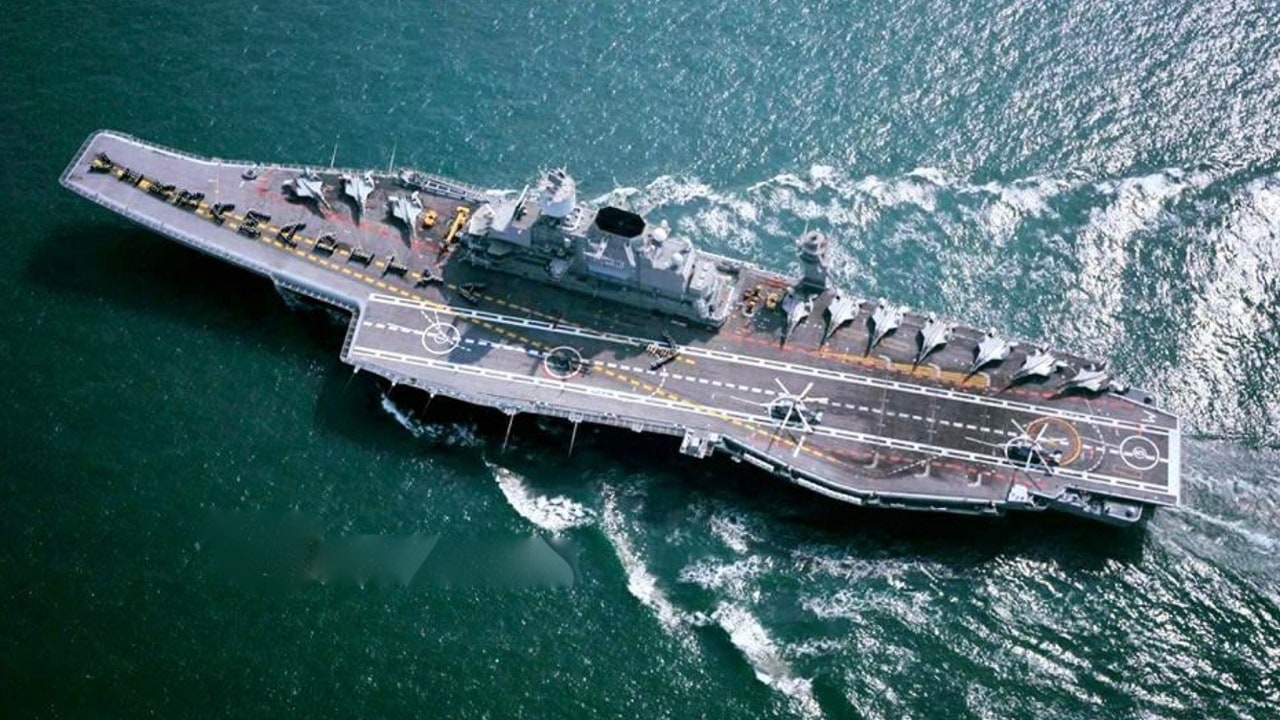
The Soviet Union Built Four Kiev-Class Carrier-Cruiser Hybrids. China Turned Two Into Attractions – The Soviet Union commissioned four Kiev-class warships between 1975 and 1987, and none resembled a conventional American aircraft carrier. An angled flight deck occupied the port side. The bow carried anti-ship missiles, surface-to-air weapons, guns and anti-submarine systems. The Soviet description, “heavy aircraft-carrying cruiser,” was unusually literal.
The first three ships displaced roughly 41,000 to 43,000 tons at full load and measured about 273 meters long. A normal air group combined 12 or 13 Yak-38 vertical-takeoff attack aircraft with 14 to 17 Ka-25 or Ka-27 helicopters. Kiev and Minsk also carried eight P-500 Bazalt anti-ship missile launchers.
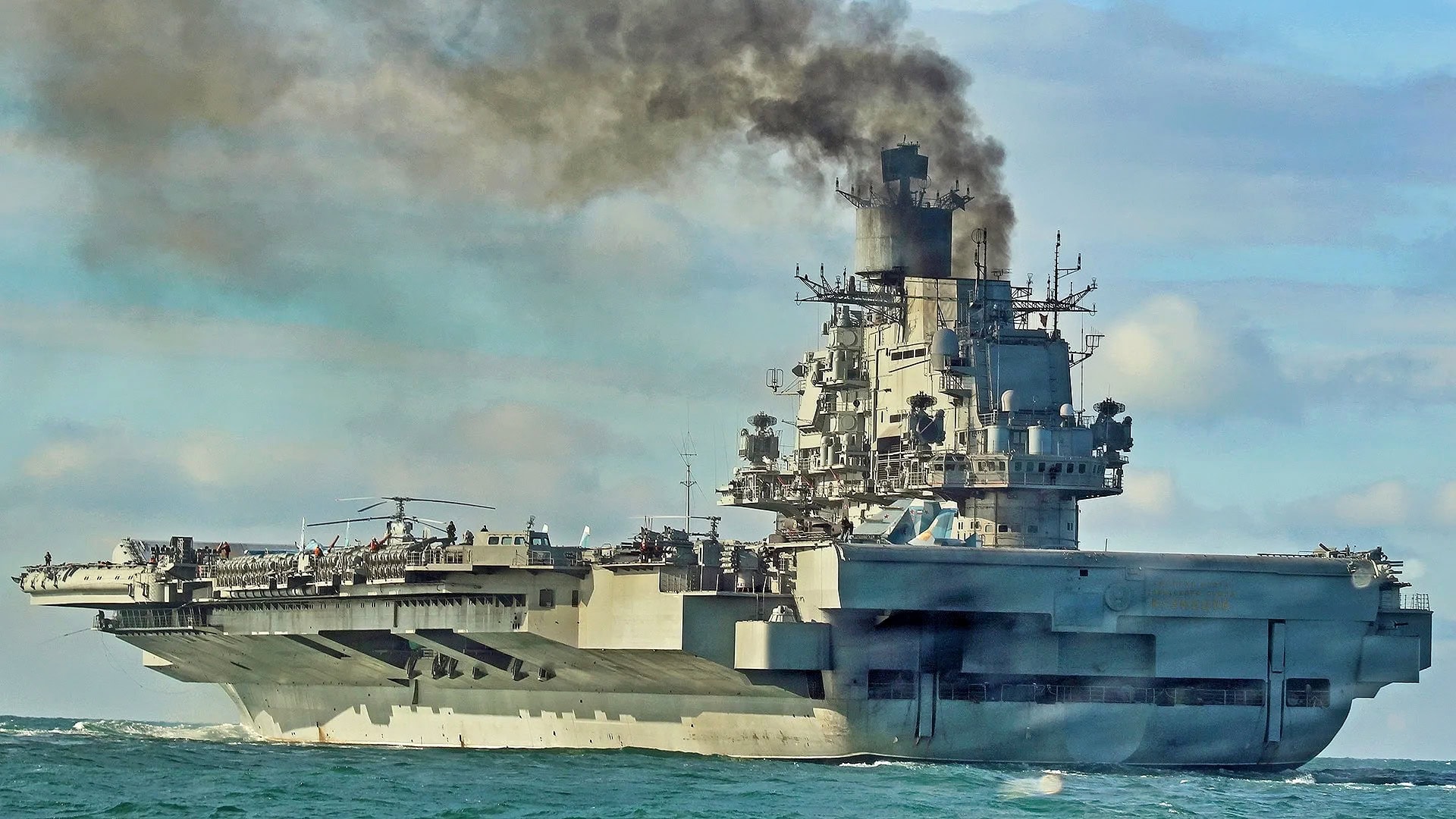
Aircraft Carrier Admiral Kuznetsov Russian Navy. Image Credit: Creative Commons.
That arrangement reflected Soviet doctrine. Moscow did not organize its fleet around carrier air wings built for sustained strikes ashore. The Kiev class was intended to hunt submarines, defend naval formations, support missile-armed surface ships and extend limited air cover beyond Soviet land bases. Its helicopters and ship-launched missiles mattered at least as much as its fixed-wing aircraft, a distinction contemporary Western analysts struggled to interpret.
The class later produced one ship scrapped in South Korea, two Chinese tourist attractions, and one carrier rebuilt for India. The famous story about a Soviet carrier sold to China as a casino concerns Varyag, a later Kuznetsov-class hull that became Liaoning. The casino company was a cover for acquiring Varyag. Kiev became a theme park and hotel; Minsk became the centerpiece of Minsk World.
The Soviet Navy Wanted Air Cover Without a U.S.-Style Supercarrier
The Kiev class grew from the smaller Moskva-class helicopter carriers. Soviet admirals wanted more aviation at sea, but a full carrier with catapults, arresting gear, and a large conventional air wing remained politically and technically difficult. Vertical-takeoff aircraft offered a path around those requirements and produced a radically different carrier design.
The hybrid carried substantial independent firepower. American carriers relied on aircraft for offensive strikes and escorts for much of their missile defense. Kiev carried long-range anti-ship missiles, layered air defenses, and anti-submarine weapons. Those systems reduced flight-deck and hangar space, but the trade matched a navy that expected missiles and submarines to do much of the work against NATO fleets. That philosophy shaped the Soviet Union’s entire carrier experiment.
Calling the ships cruisers also helped them transit the Turkish Straits from their Black Sea shipyard. Turkey accepted Kiev’s 1976 passage despite the Montreux Convention’s restrictions on aircraft carriers. The designation was not solely a legal device. Contemporary U.S. naval observers noted that the forward half looked and fought like a guided-missile cruiser.
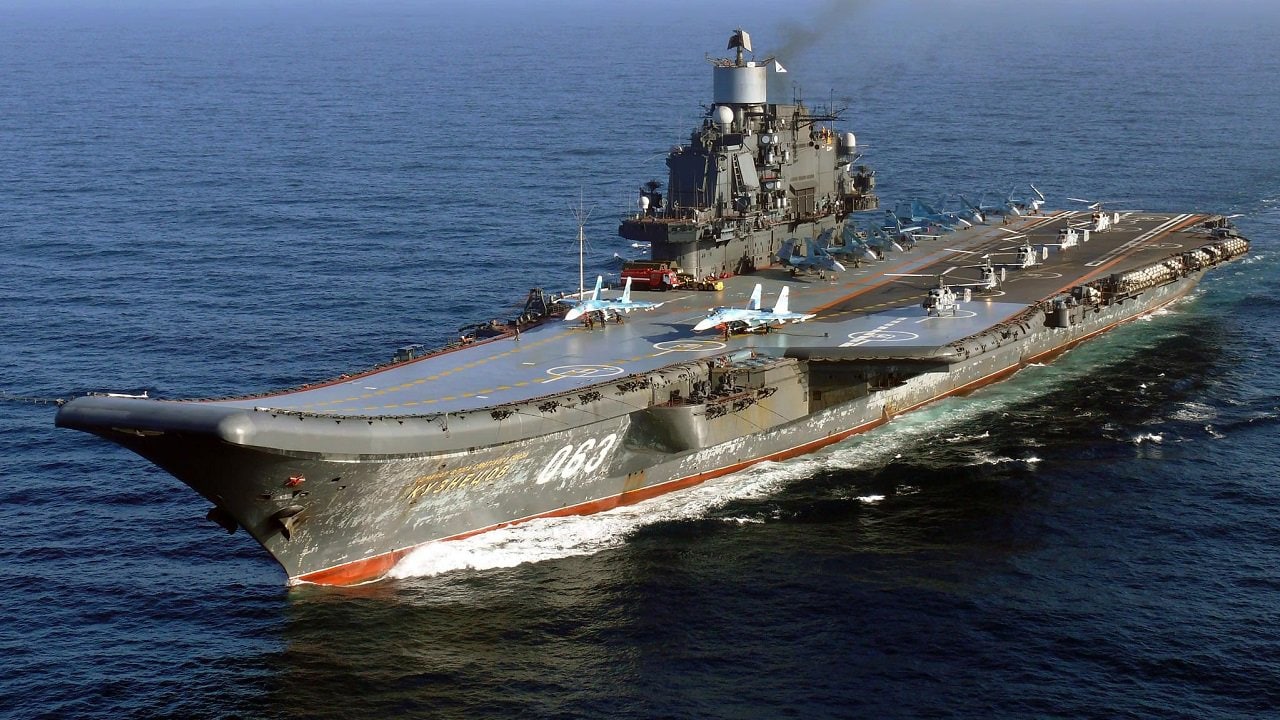
Admiral Kuznetsov. Image Credit: Creative Commons.
The Yak-38 Limited What the Flight Deck Could Deliver
The Yak-38 used one main engine for forward flight and two lift engines behind the cockpit for vertical operations. Those lift engines consumed space and weight while contributing nothing during normal flight. The result was short range, a modest weapons load and little fuel or payload margin.
The aircraft also lacked the radar, endurance and beyond-visual-range weapons needed to challenge American carrier fighters. Vertical takeoff reduced payload further, and the Kiev class had no catapults or arresting gear for conventional fighters or fixed-wing airborne early-warning aircraft. The Yak-38’s limitations placed it among the least successful operational fighter designs of its era.
The helicopters proved more useful. Ka-25s and Ka-27s searched for submarines, conducted rescue missions and helped locate targets for the ship’s anti-ship missiles. The Kievs were strongest as missile and anti-submarine ships with an aviation component, not as Soviet versions of a U.S. carrier strike group. That compromise continued to shape later Russian carrier development.
Baku Showed Where Soviet Carrier Design Was Heading
Kiev entered service in 1975, Minsk in 1978 and Novorossiysk in 1982. Baku, commissioned in 1987 and later renamed Admiral Gorshkov, was a substantially revised fourth ship with improved sensors, stronger air defenses and 12 Bazalt launchers rather than eight. It became the most heavily modified member of the family.
The Soviets expected the supersonic Yak-141 to replace the Yak-38 and provide credible fleet air defense. It never entered operational service before the Soviet collapse. Moscow had already moved toward Admiral Kuznetsov, which used a ski jump and arresting wires for conventional Su-33 fighters, followed by the unfinished nuclear-powered Ulyanovsk.
The Soviet Collapse Left Russia With Ships It Could Not Overhaul
A 1992 U.S. Naval Institute account described Kiev and Minsk as inactive and in need of major work best performed at the Black Sea shipyard, now located in independent Ukraine. Russia lacked the money, support network and useful Yak-38 force needed to keep the class operating.
Kiev, Minsk and Novorossiysk left service in 1993. Novorossiysk went to South Korea and was broken up. Baku survived long enough for Russia and India to agree on a radical reconstruction.
India commissioned the rebuilt ship as INS Vikramaditya in November 2013. The conversion removed the forward missile batteries, extended the flight deck and added a ski jump and arresting gear for MiG-29K fighters. The 44,500-ton carrier entered Indian service after losing the hybrid bow that defined the original design.
Two Kiev-Class Hulls Became Chinese Attractions
China bought Kiev in 1996. It opened as the centerpiece of a Tianjin military theme park in 2004 and later received hotel rooms, restaurants and performance spaces. The attraction remained active in May 2026, when Chinese state media photographed visitors touring the ship’s interior.
Minsk followed a rougher route. Sold first to a South Korean company and then to Chinese owners, it opened at Minsk World in Shenzhen in 2000. The park later went bankrupt, and the ship moved to Nantong in 2016 for another proposed attraction. A fire during dismantling and renovation work on August 16, 2024, damaged the old carrier. No injuries were reported.
MORE – China’s J-20 Stealth Fighter Is a Powerhouse
About the Author: Harry J. Kazianis
Harry J. Kazianis (@Grecianformula) was the former Senior Director of National Security Affairs at the Center for the National Interest (CFTNI), a foreign policy think tank founded by Richard Nixon based in Washington, DC. Harry has over a decade of experience in think tanks and national security publishing. His ideas have been published in the NY Times, The Washington Post, The Wall Street Journal, CNN, and many other outlets worldwide. He has held positions at CSIS, the Heritage Foundation, the University of Nottingham, and several other institutions related to national security research and studies. He is the former Executive Editor of the National Interest and the Diplomat. He holds a Master’s degree focusing on international affairs from Harvard University.

