
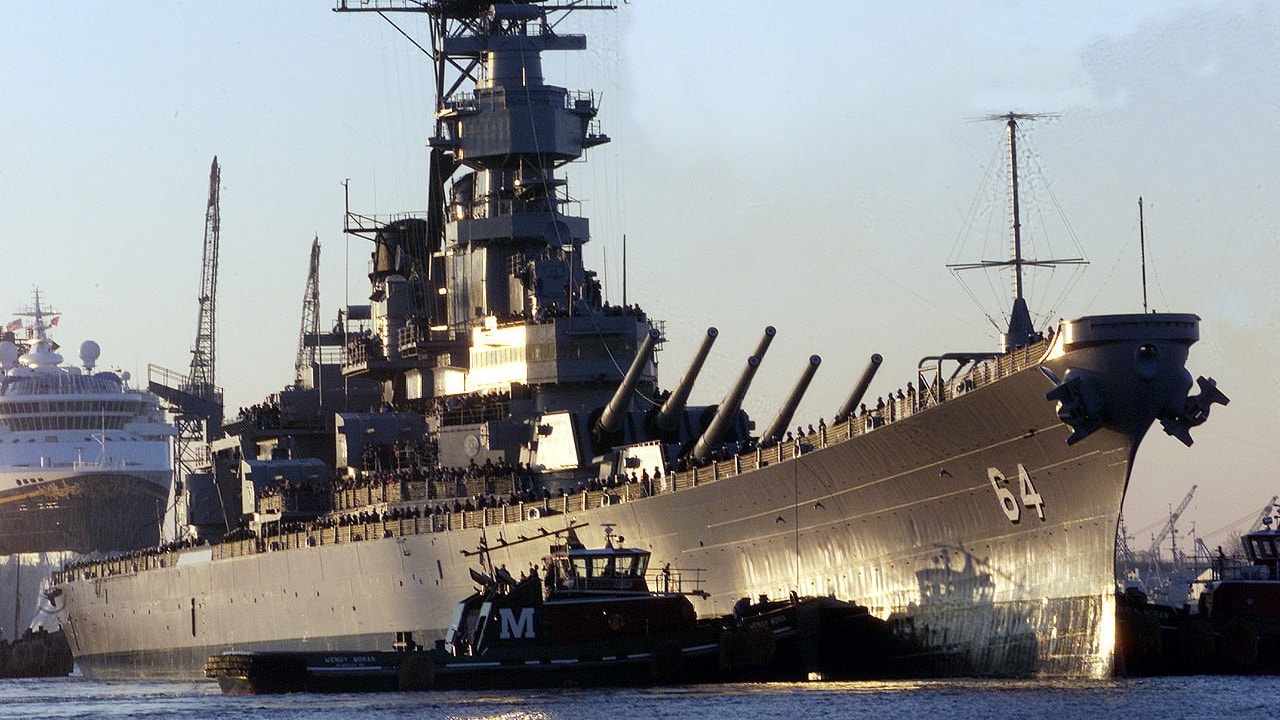
USS Kentucky by the Numbers: $55 Million Spent, 72 Percent Complete and Never Commissioned – Kentucky, hull number BB-66, is usually called USS Kentucky. Technically, the prefix never became official because the ship never entered commission. She never received a full crew, never carried an operational gun battery, and never moved under her own power. The Navy still completed more than 72 percent of the final Iowa-class battleship before abandoning the project.
A contemporary account preserved in the ship’s photographic construction record placed spending on Kentucky at $55 million before work ended. No finished purchase price exists because the Navy never completed the ship. Expensive work involving guns, radar, superstructure, fire-control equipment, testing, and final fitting-out still lay ahead. The stripped hull later sold for $1,176,666.
As designed, Kentucky belonged to the 45,000-long-ton standard Iowa class. A completed ship with wartime ammunition, fuel, stores, and crew would have displaced close to 58,000 tons. She would have measured 887 feet 3 inches long, 108 feet 2 inches across the beam, and roughly 38 feet in draft. Eight boilers and four geared turbines were intended to produce 212,000 shaft horsepower, driving four propellers at about 33 knots. Those figures matched the completed Iowa-class battleships.
Kentucky’s planned main battery consisted of nine 16-inch/50-caliber Mark 7 guns in three triple turrets. Each weapon fired a 2,700-pound armor-piercing projectile or a 1,900-pound high-capacity shell. Maximum reach exceeded 23 miles under favorable conditions. A full armor-piercing broadside would have placed 24,300 pounds of steel into the air, more than 12 tons. The Mark 7 gun combined high velocity with the super-heavy Mark 8 shell, giving it armor penetration close to Japan’s larger 18.1-inch naval gun.
USS Kentucky Was Ordered as the Sixth Iowa-Class Battleship
The Navy placed the order for BB-66 on Sept. 9, 1940. Kentucky and the preceding Illinois, BB-65, emerged during a period when planners were moving between two battleship ideas. One path produced the fast Iowa-class, capable of operating with aircraft carriers. The other produced the larger, slower, and more heavily armed Montana class, planned with twelve 16-inch guns.
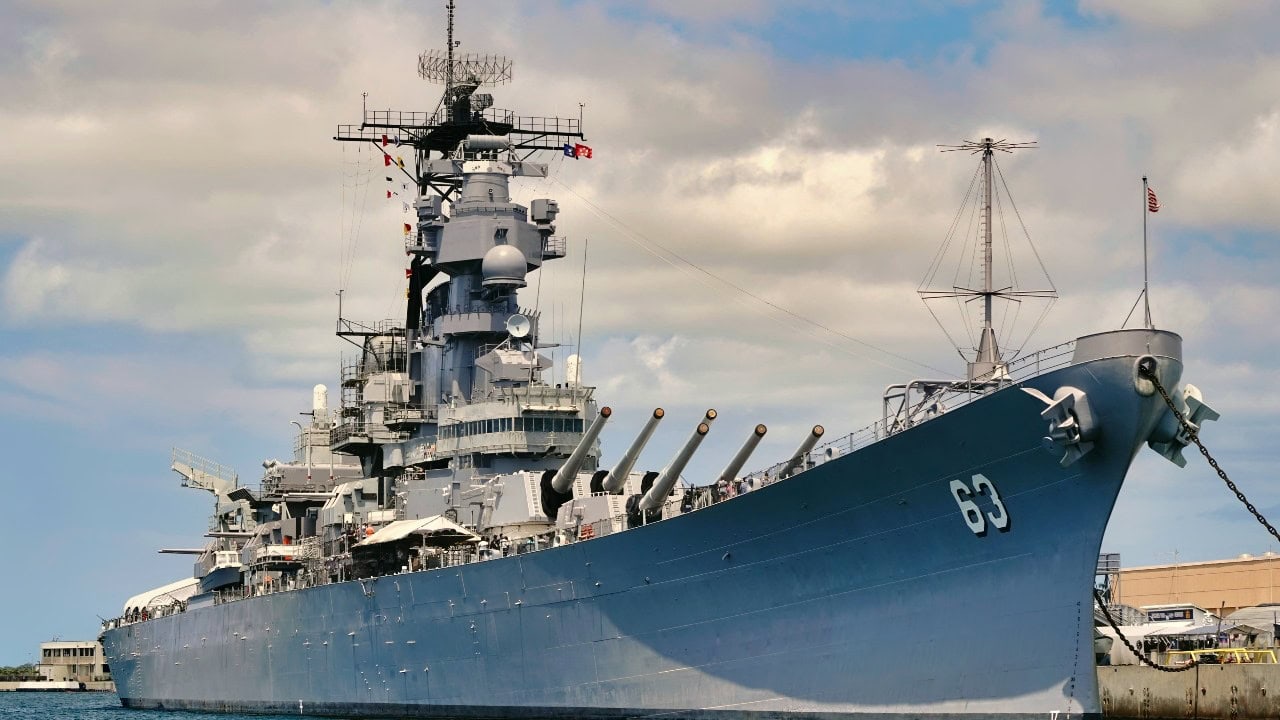
Iowa-Class Battleship at Port. Image Credit: Creative Commons.
Industrial mobilization favored another Iowa. The Navy already possessed the design, production drawings, and much of the required equipment. A 33-knot ship also fit the carrier-centered fleet taking shape far better than a 28-knot Montana. Kentucky therefore became the sixth state, following Iowa, New Jersey, Missouri, Wisconsin, and Illinois.
Norfolk Navy Yard in Portsmouth, Virginia, laid the keel on March 7, 1942. The yard had recently built the USS Alabama and was handling a rapidly expanding wartime workload. Three months after Kentucky’s keel went down, workers floated the completed bottom structure out of the building position. The space was needed for landing ships and other vessels able to enter combat sooner. Norfolk eventually built 20 LSTs during the war, according to the shipyard’s official construction history.
USS Kentucky’s Planned Weapons Made Her a Classic Iowa
Kentucky never carried her weapons in an operational sense. The round barbettes for the main turrets rose from the unfinished hull, and unused 5-inch gunhouses later sat on her deck, but the battleship never received a completed battery.
The planned armament matched the late-war Iowa configuration. Nine 16-inch guns formed the primary battery. Twenty 5-inch/38-caliber dual-purpose guns would have occupied 10 twin mounts, five on each side of the superstructure. Those weapons handled aircraft, destroyers, and shore targets. The intended lighter anti-aircraft fit included as many as eighty 40mm Bofors barrels and forty-nine 20mm Oerlikon guns.
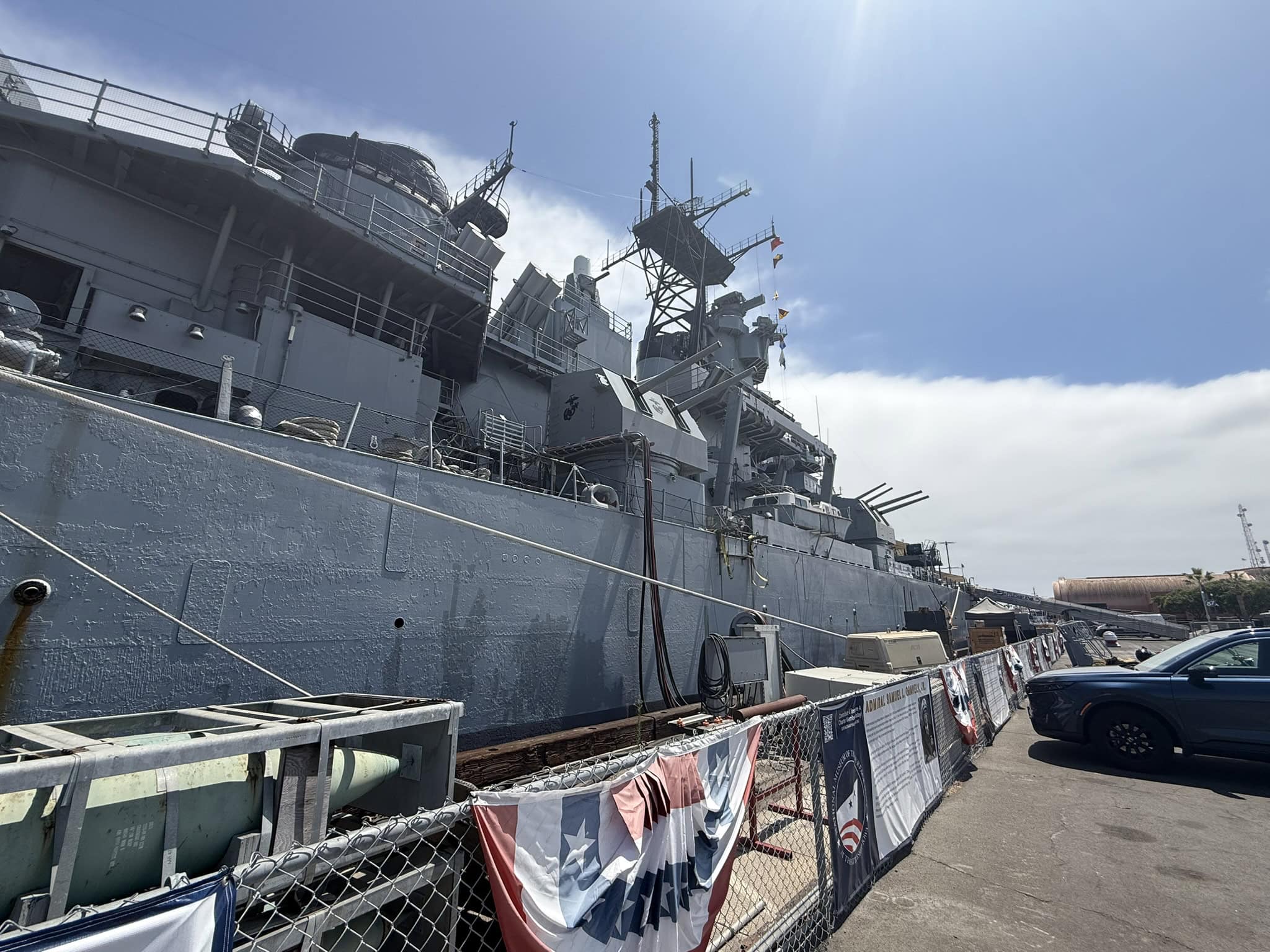
USS Iowa Visit by Harry Kazianis of 19FortyFive.com
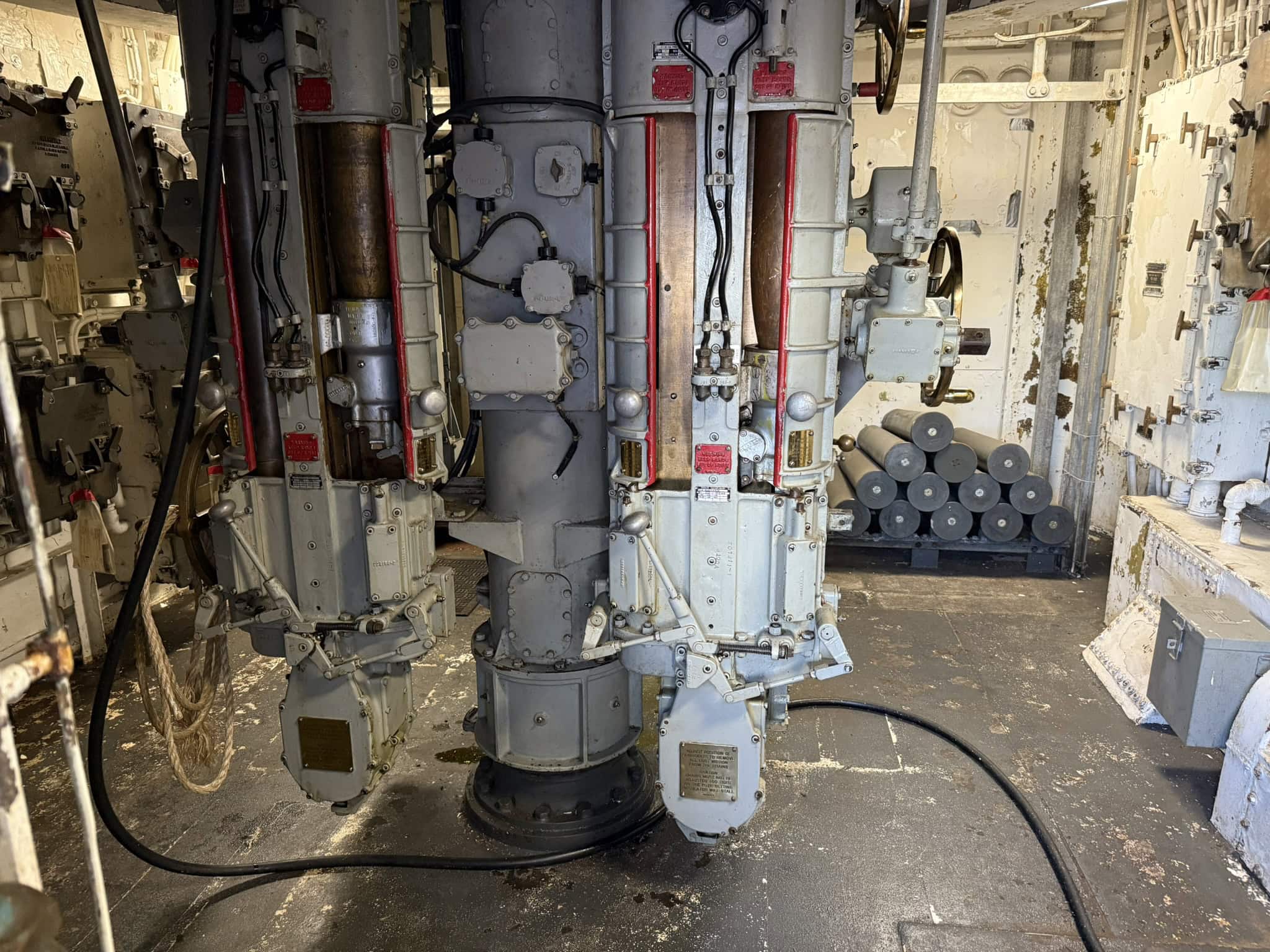
USS Iowa interior. 19FortyFive.com image.
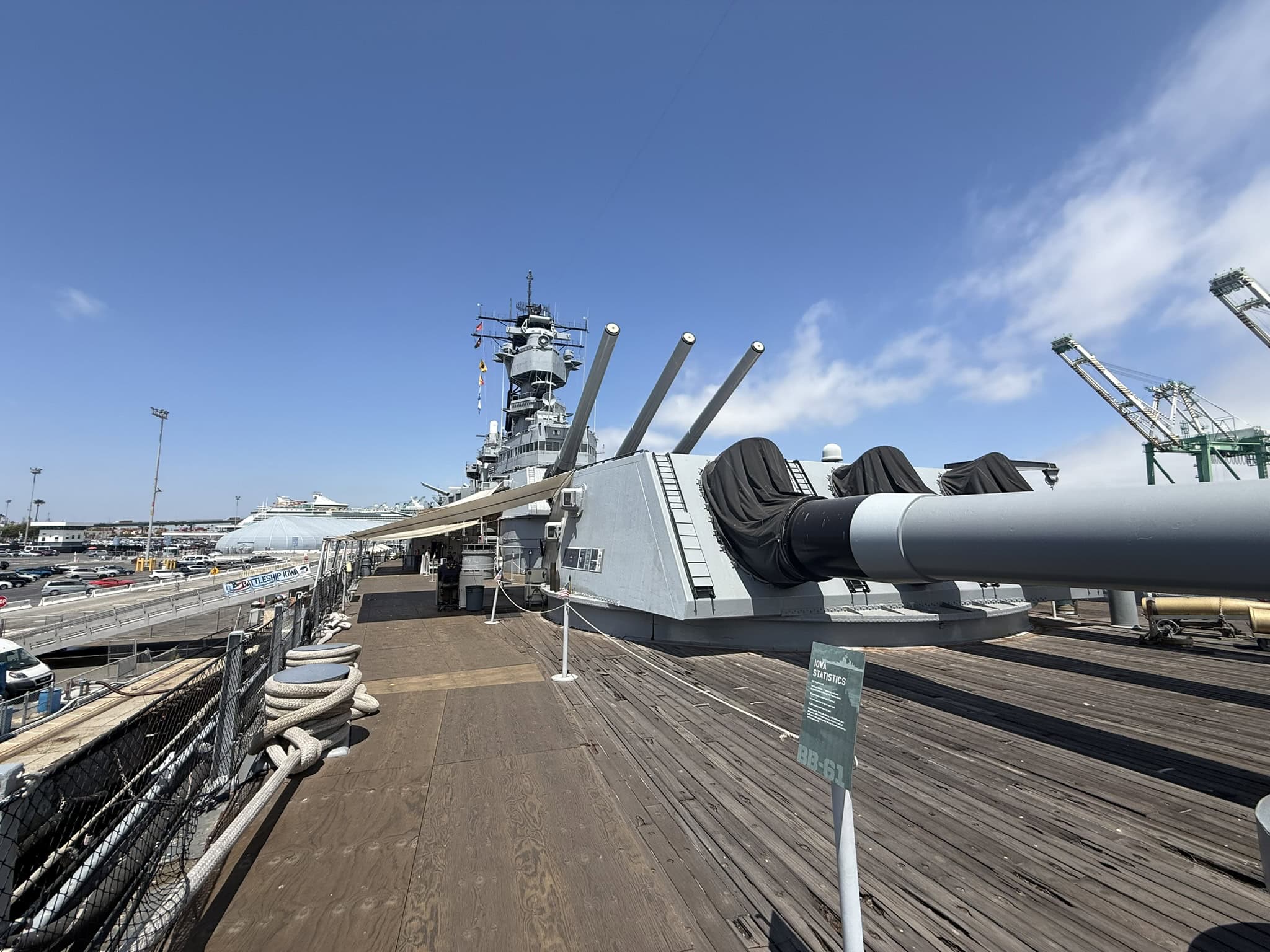
USS Iowa Visit by Harry Kazianis of 19FortyFive.com
Each Mark 7 main gun weighed about 120 tons without its breech. The barrel measured 66 feet. At the published maximum firing rate of two rounds per minute, Kentucky’s nine guns would have fired eighteen armor-piercing projectiles weighing 48,600 pounds in sixty seconds. The design behind the Iowa class’s 2,700-pound shell gave the ship immense firepower without the weight of Yamato’s main battery.
Three floatplanes were also planned for reconnaissance and gunfire spotting, launched from catapults at the stern and recovered by crane after landing on the water. Radar increasingly replaced part of the spotting mission as the war progressed, but the completed Iowa-class ships carried aircraft through World War II.
Construction Restarted When the Navy Expected a Longer War
Kentucky’s bottom structure remained tied up for almost 30 months. Work resumed in December 1944, when the hull sections returned to a dry dock. American forces were advancing across the Pacific, but no one knew how long it would take to defeat Japan. A completed battleship was projected for 1946.
Workers installed armor, framing, machinery foundations, barbettes, and large sections of the underwater protection system. Photographs from 1945 and 1946 show the lower belt armor running along the hull and the circular foundations for the forward turrets rising above the deck structure.
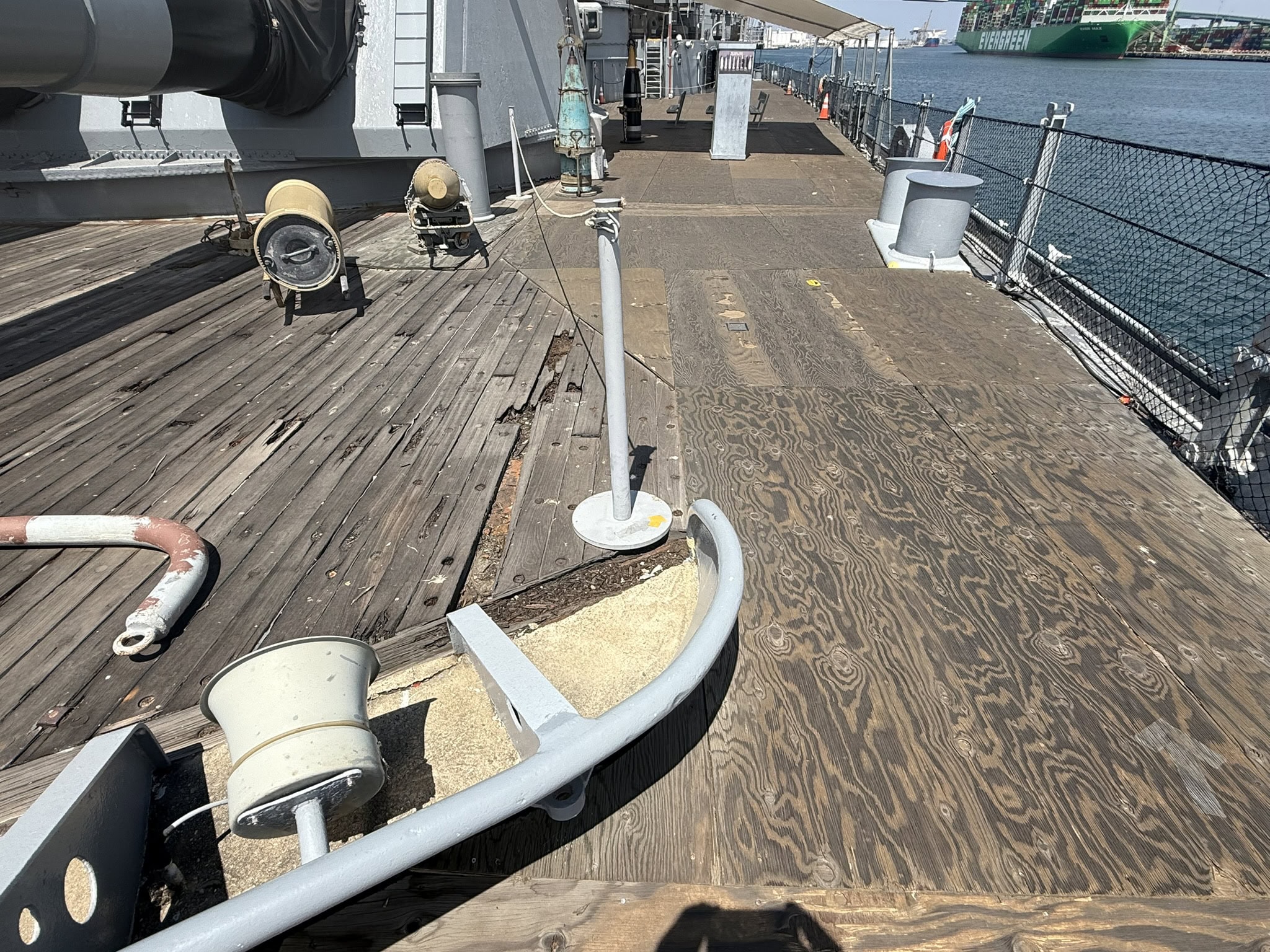
USS Iowa Battleship visit by Harry J. Kazianis for 19FortyFive.com. Taken back in August 15, 2025.
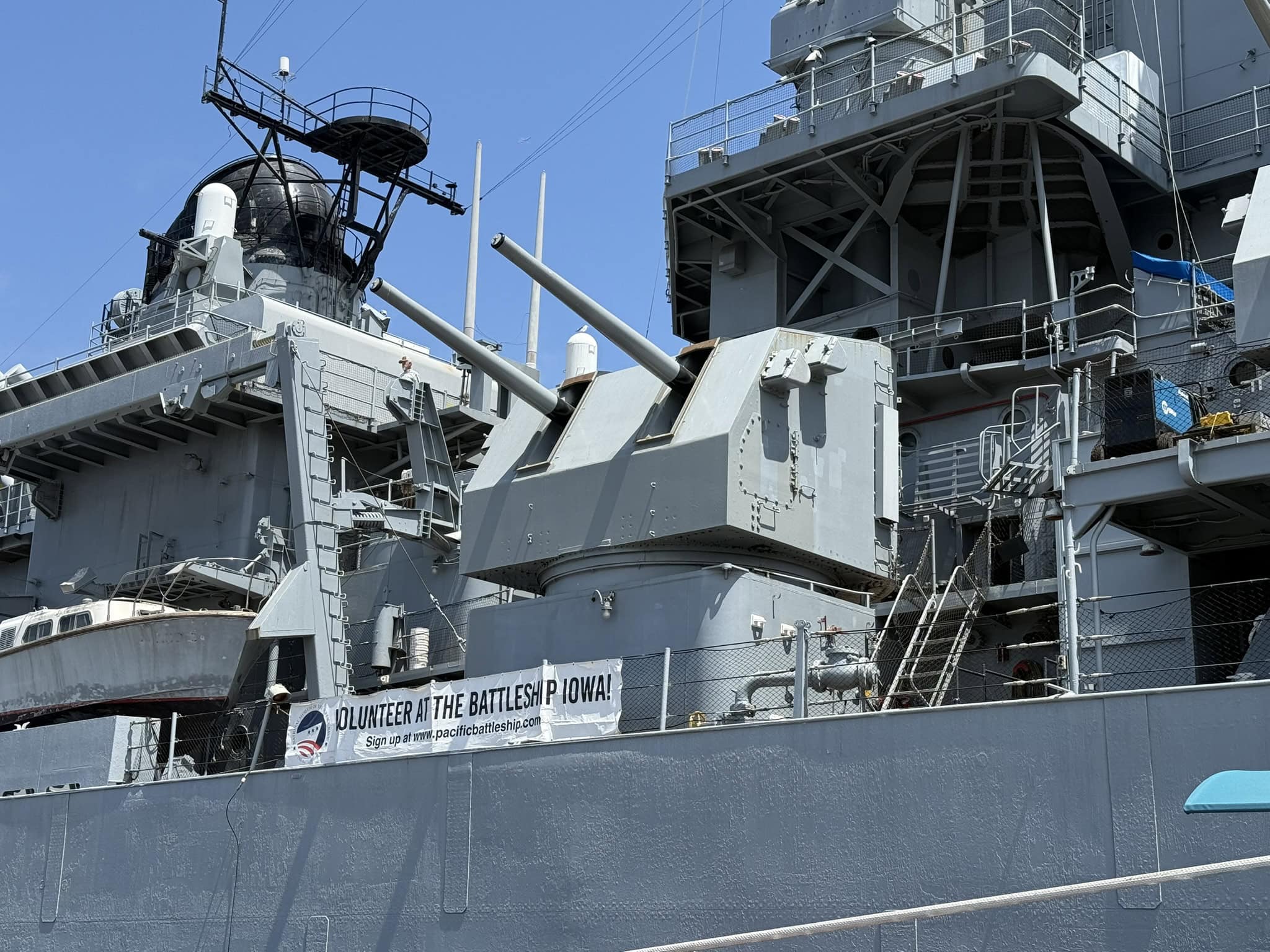
USS Iowa Battleship visit by Harry J. Kazianis for 19FortyFive.com. Taken back in August 15, 2025.
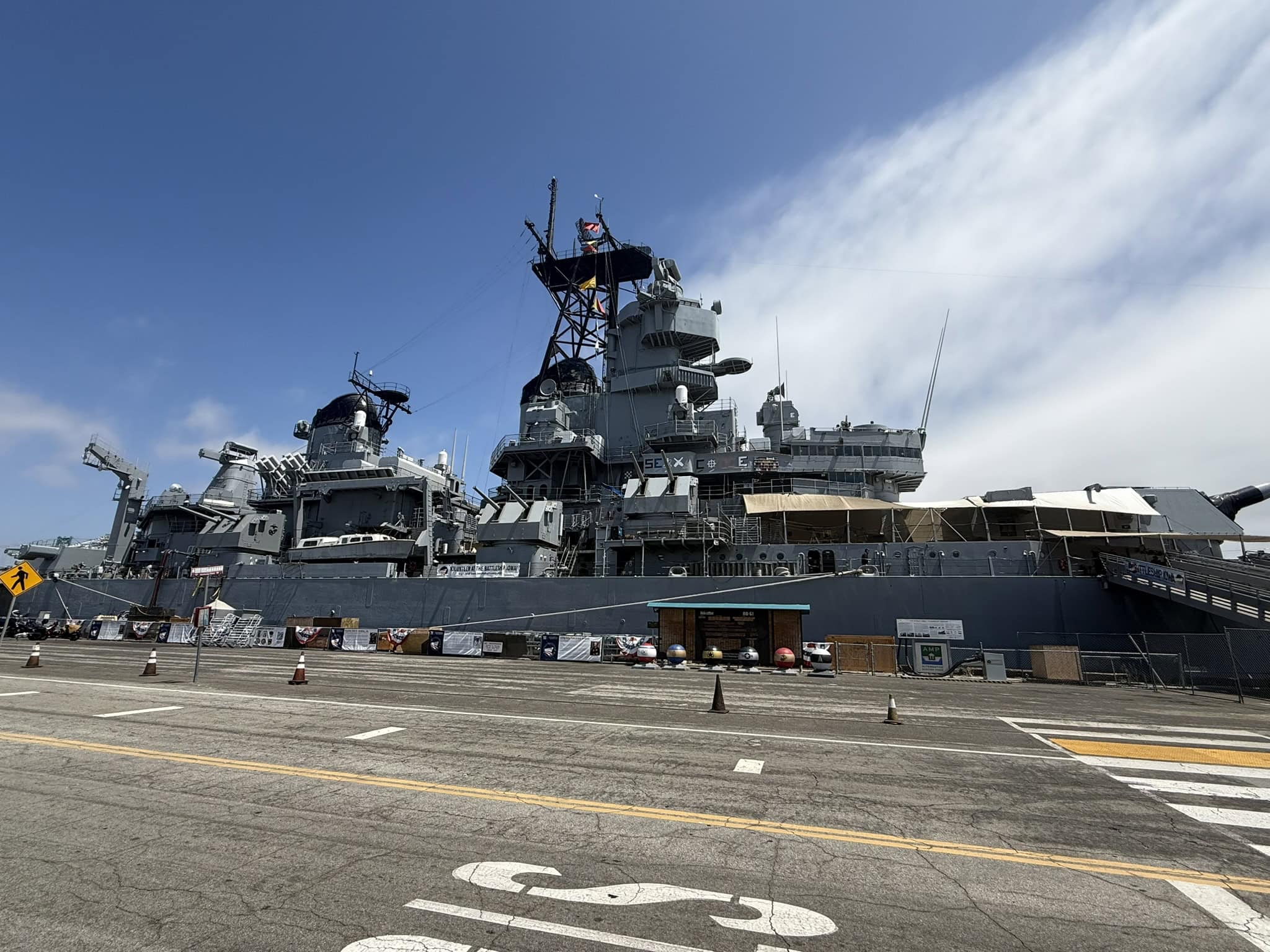
USS Iowa Battleship visit by Harry J. Kazianis for 19FortyFive.com. Taken back in August 15, 2025.
Japan surrendered in August 1945, before Kentucky was completed. The United States suddenly possessed a fleet built for a global war, including four completed Iowas, eight South Dakota- and North Carolina-class fast battleships, and numerous older ships. Finishing another battleship offered little immediate value during a postwar drawdown.
The Navy studied an anti-aircraft battleship version, reflecting lessons from Japanese kamikaze attacks. Other planners examined a carrier conversion. The proposed carrier would have received an 864-foot flight deck about 108 feet wide, but the design carried fewer aircraft than an Essex-class carrier and cost more than building another purpose-designed flattop. The Navy abandoned the idea, much as it walked away from Kentucky’s unfinished sister Illinois.
Construction stopped again with the hull slightly more than 72 percent complete. Limited work resumed later, but Kentucky never advanced beyond the second deck. She remained an armored hull without turrets, superstructure, or a completed propulsion plant.
USS Kentucky Was Floated Out but Never Finished
Kentucky’s Jan. 20, 1950, launch was not the usual beginning of a new warship’s life. No fitting-out program followed. The unfinished hull was floated from the building dock to release valuable shipyard space.
USS Missouri had run aground three days earlier in Chesapeake Bay and needed major repairs. Official photographs show tugs moving Kentucky’s bare hull from the dock with an unfinished upper bow section lying on the deck near the forward barbette. The operation allowed Missouri to enter the yard.
An Associated Press caption from December 1949 indicates a float-out had already been planned before Missouri grounded. The accident gave the yard an urgent use for the space. Either way, the event left Kentucky afloat but no closer to joining the fleet.
She lacked a bow completed to final form, main turrets, bridge, radar masts, and much of the machinery required for operation. Kentucky looked less like the four completed Iowa-class ships than an enormous armored barge carrying unfinished components.
The Last Two Iowa-Class Hulls Included Design Improvements
Kentucky was not intended as a larger or more heavily armed Iowa. Her dimensions, main guns, propulsion rating and expected speed remained broadly the same. The final pair did include construction changes unavailable when workers began Iowa and New Jersey.
Illinois and Kentucky were designed with greater use of welded construction, reducing reliance on thousands of rivets. Their armor-belt sections used pins rather than the keyway arrangement found on the first four ships. Engineers also revised parts of the underwater protection system to control flooding more effectively after tests exposed weaknesses in the original Iowa arrangement.
Kentucky’s forward armored bulkhead tapered from approximately 14.5 inches at the top to 11.7 inches near the bottom. Iowa and New Jersey had thinner protection in the same area, tapering from roughly 11.3 inches to 8.5 inches. Missouri and Wisconsin also benefited from later design adjustments, so every change was not unique to BB-66.
The final pair represented an improved production version rather than a separate subclass. Their all-gun combat power would have matched the completed ships: 212,000 horsepower, 33 knots, and nine 16-inch rifles designed for a surface battle the Iowas never fought.
A Guided-Missile USS Kentucky Reached the Planning Stage
The missile age gave Kentucky another chance. Early studies examined a guided-missile battleship carrying Terrier surface-to-air weapons alongside part of the traditional gun battery. Regulus cruise missiles also appeared in several concepts. The designation BBG-1 was associated with the program, although no ship entered service under the guided-missile battleship classification.
By 1956, a more ambitious design included ballistic and anti-aircraft missiles. One proposal placed Polaris launchers aboard the hull, together with Talos and Tartar surface-to-air batteries. Completion was tentatively scheduled for July 1961.
The estimated conversion price reached $178 million, according to the Naval Institute’s history of the BBG designation. The sum exceeded three times the money already spent on the hull. Missile technology was changing too quickly for a conversion expected to consume several years. Smaller cruiser hulls offered less expensive test beds, while nuclear submarines were becoming the preferred platform for Polaris.
The Navy built missile cruisers from existing Baltimore- and Cleveland-class ships and later constructed the nuclear-powered USS Long Beach. Kentucky offered space, armor, and speed, but she also demanded a large crew and extensive completion work before carrying one missile.
USS Kentucky Became a Parts Warehouse for the Fleet
Hurricane Hazel tore Kentucky from her moorings in October 1954 and pushed the hull aground. The Navy recovered her, but the incident underscored the cost of preserving an unfinished battleship with no approved mission.
Kentucky’s greatest contribution arrived after USS Wisconsin collided with destroyer USS Eaton on May 6, 1956. Wisconsin’s bow was crushed. Norfolk workers cut a 68-foot, 120-ton section from Kentucky, carried it across Hampton Roads by barge, and grafted it onto the damaged battleship. The repair took 16 days. Wisconsin returned to service with the bow built for her unfinished sister.
The propulsion machinery also found a second life. Kentucky’s four turbine sets went to the fast combat support ships USS Sacramento and USS Camden, two in each vessel. The Sacramento program used battleship turbines to produce 100,000 horsepower, enabling a replenishment ship to keep pace with carrier groups.
Other components disappeared into Navy inventories. By 1958, secondary gunhouses, bow pieces, and salvaged equipment covered parts of the deck. Kentucky had become more valuable as a source of machinery and fabricated steel than as a candidate for completion.
USS Kentucky Was Sold After 16 Years Without a Commission
The Navy struck Kentucky from the Naval Vessel Register on June 9, 1958. Boston Metals Company bought the remaining hull on Oct. 31 for $1,176,666. Workers removed more machinery before tugs moved the ship toward Baltimore.
Kentucky reached the scrapyard in February 1959. Cutting torches reduced the unfinished armor, barbettes, and hull sections into reusable metal. The ship had absorbed an estimated $55 million in construction spending, survived repeated redesigns, and waited through the first decade of the missile age without receiving a commission pennant.
Several ceremonial pieces survived. Mahogany doors donated by the state eventually returned to the Kentucky Historical Society. The largest surviving section sits in plain view on the Norfolk waterfront.
Visitors aboard USS Wisconsin at Nauticus still stand above the 68-foot section removed from BB-66 in 1956. Kentucky never sailed under her own power, but her bow crossed oceans, returned to combat service, and now rests at the front of a museum battleship.
MORE – The B-52 Bomber Is Getting a Massive Update
About the Author: Harry J. Kazianis
Harry J. Kazianis (@Grecianformula) was the former Senior Director of National Security Affairs at the Center for the National Interest, a foreign policy think tank founded by Richard Nixon in Washington, D.C. Harry has more than a decade of experience in think tanks and national security publishing. His ideas have been published in The New York Times, The Washington Post, The Wall Street Journal, CNN and many other outlets worldwide. He has held positions at CSIS, the Heritage Foundation, the University of Nottingham and several other institutions related to national security research and studies. He is the former Executive Editor of The National Interest and The Diplomat. He holds a master’s degree focusing on international affairs from Harvard University.

