
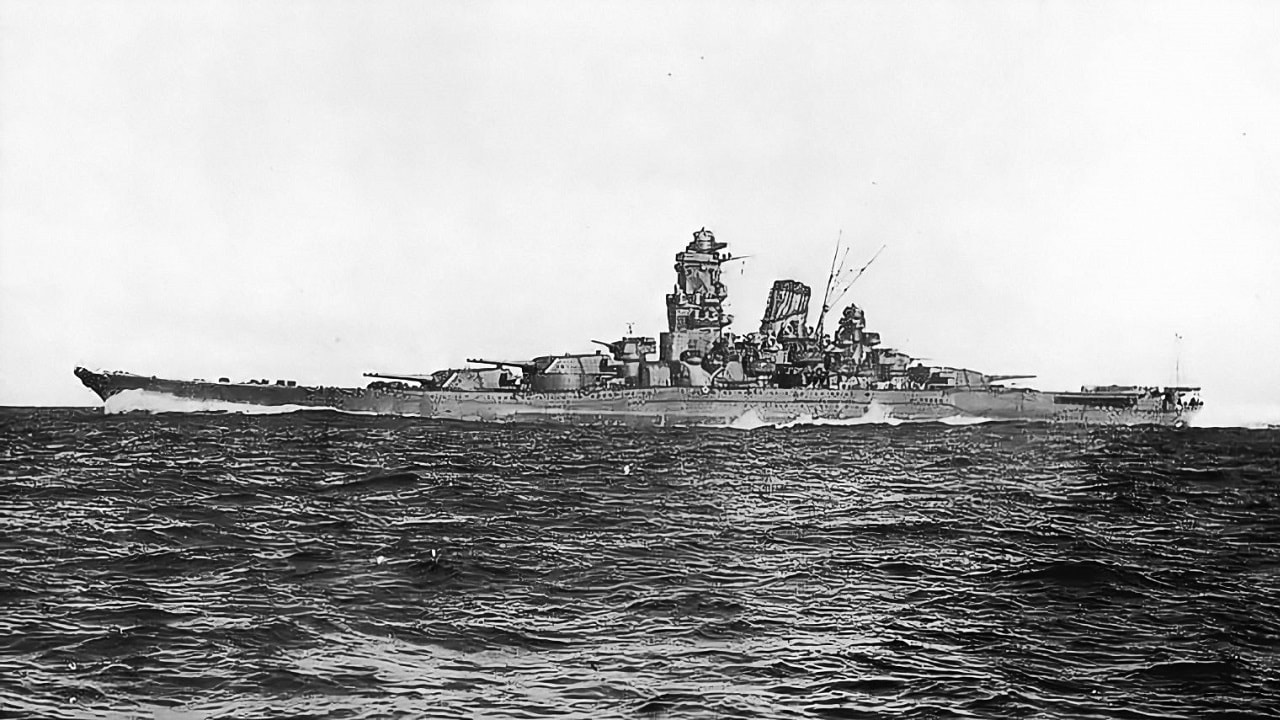
Musashi by the Numbers: 72,809 Tons, Nine 18.1-Inch Guns and 19 Torpedo Hits – Japan’s battleship Musashi displaced 72,809 metric tons at full load, carried nine 18.1-inch guns, and cost roughly ¥137.8 million under one widely cited construction estimate. She was one of the two largest battleships completed during World War II and the final battleship commissioned by the Imperial Japanese Navy.
Mitsubishi Heavy Industries laid down the ship at Nagasaki on March 29, 1938. Musashi was launched in secrecy on Nov. 1, 1940, and commissioned on Aug. 5, 1942. Her active career lasted only 811 days.
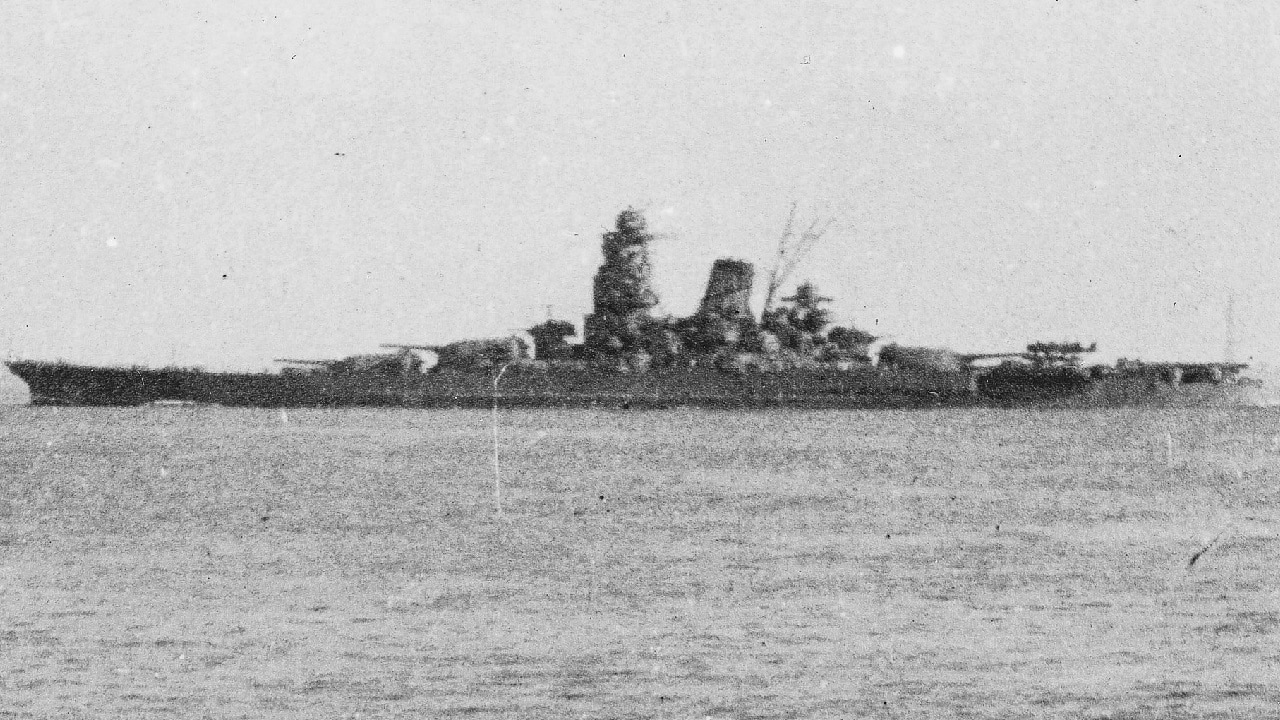
The Japanese battleship Musashi leaving Brunei, Borneo, in 1944, possibly on 22 October, when she departed to take part in the Battle of Leyte Gulf. Photographed by Japanese sailor Tobei Shiraishi from the destroyer Isokaze.
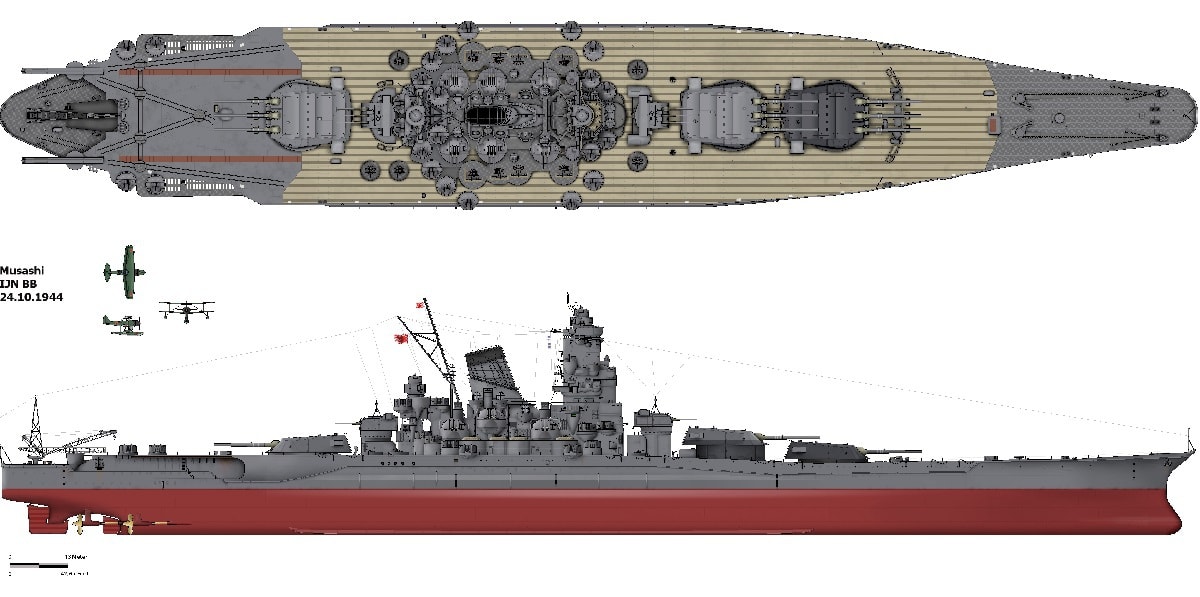
Musashi in 1944
The final design measured 263 meters, or about 862 feet 10 inches, overall. Maximum beam reached 38.9 meters, or roughly 127 feet 7 inches. Full-load draft approached 10.9 meters, or almost 36 feet. Twelve boilers supplied four geared steam turbines that produced 150,000 shaft horsepower through four propeller shafts, according to former Japanese naval engineers who described the design after the war.
The main battery used nine 460mm/45 Type 94 guns divided among three triple turrets. Each armor-piercing shell weighed approximately 3,219 pounds. A full broadside therefore launched 28,971 pounds of projectiles, almost 14.5 short tons, according to the surviving technical record of the weapon.
Musashi Cost About ¥137.8 Million, but the Accounting Is Complicated
The cost of Musashi is among the least stable figures associated with the ship. The Imperial Japanese Navy protected the Yamato program through intense secrecy, and different accounts include armor, guns, machinery, government-furnished equipment, and shipyard expansion in different ways.
A frequently cited direct construction estimate places Musashi at ¥137,802,000. Japanese budget histories put the two battleships authorized under the same program at ¥271.02 million combined, or an average of roughly ¥135.5 million per ship. The combined amount represented about 8.6 percent of Japan’s general-account spending when the program was approved.
Dividing that number equally gives each ship a budget impact of near 4.3 percent. A direct conversion into modern dollars would create false precision because Japan controlled exchange rates, wages, steel production, and military procurement differently from the modern economy.
The published ship price also fails to account for all supporting expenses. Japan expanded armor-production facilities, enlarged shipyards, built heavy cranes, and constructed a special transport vessel to carry the huge guns from Kure to Nagasaki. The Yamato class consumed resources far beyond the amount recorded against one hull.
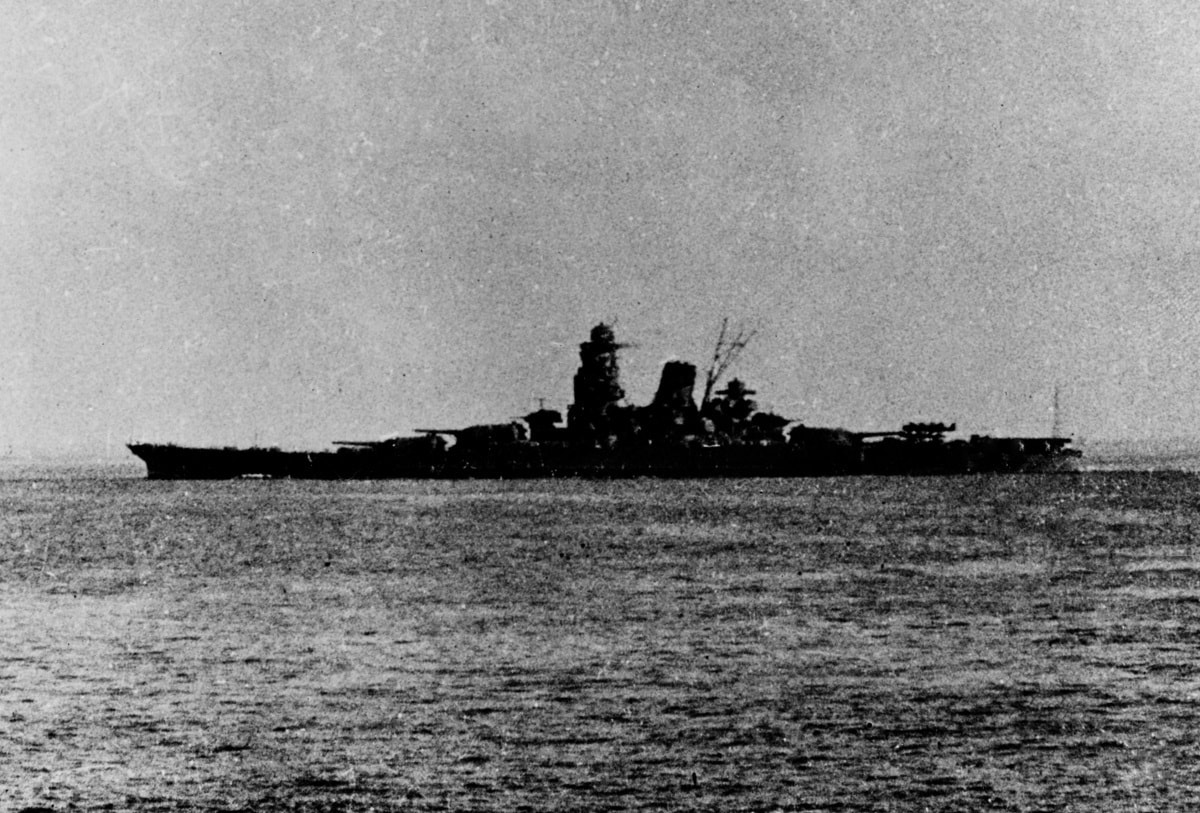
(Japanese battleship, 1942-1944) Leaving Brunei, Borneo, in 1944, possibly on 22 October, when she departed to take part in the Battle of Leyte Gulf. Courtesy of Lieutenant Tobei Shiraishi. U.S. Naval History and Heritage Command Photograph.
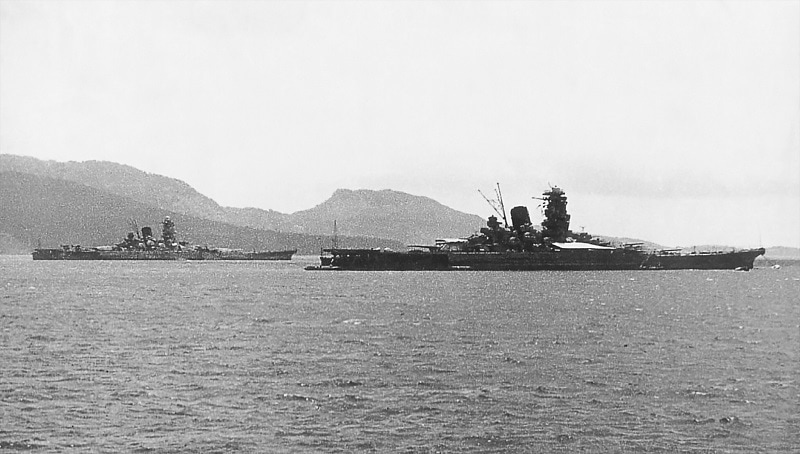
Yamato and Musashi anchored in the waters off of the Truk Islands in 1943.
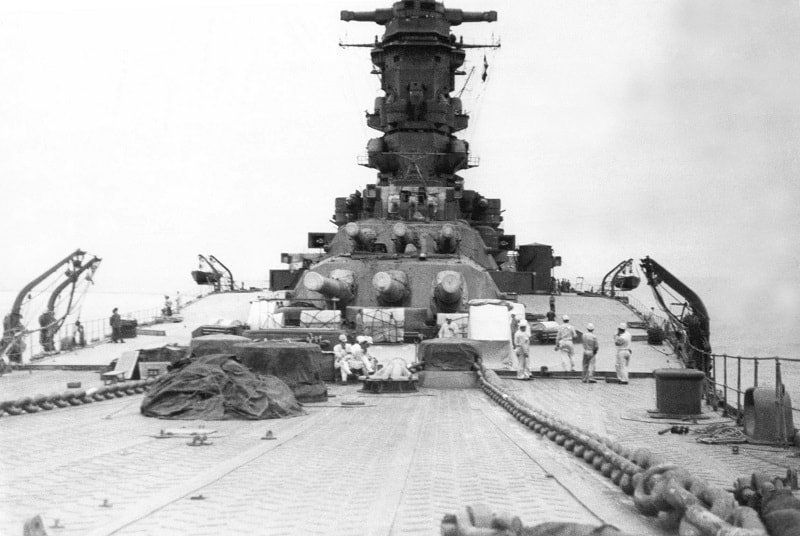
Battleship IJN Musashi, August 1942, taken from the bow.
That investment reflected the reasoning behind Japan’s plan for a small force of individually superior battleships. Tokyo knew it could not match American shipbuilding volume. It wanted each Japanese capital ship to outmatch any American opponent sent against it.
Musashi Required a Shipyard Rebuild and 2,710 Kilometers of Rope
Mitsubishi’s Nagasaki yard was not ready to build a battleship of this size without extensive changes. Workshops and supporting areas expanded by almost 240,000 square meters. The yard acquired floating cranes rated at 350 tons and 150 tons. The construction slipway needed reinforcement before it could support the hull.
Secrecy created another engineering requirement. A curtain weighing about 408 tons surrounded the building area. The material stretched for roughly 2,710 kilometers if laid end to end. Contemporary Japanese accounts identify it as rope made from Chinese windmill palm, although later histories often describe it as sisal or hemp.
The curtain contributed to a temporary shortage felt by local fishermen. Guards restricted access around the yard, and workers learned only shortly beforehand when the launch would occur.
Musashi entered the water with a launch weight of about 35,553 tons. The launch took place early in the morning without the public celebration normally associated with a major warship. Police and military personnel blocked observation points across Nagasaki Harbor.
The 18.1-inch guns posed another problem. Japan manufactured them at Kure Naval Arsenal, too far from Nagasaki for ordinary transport. The Navy built the ammunition and transport ship Kashino to move the barrels and turret components by sea. The guns reached Nagasaki, covered by canvas and under strict security.
The construction effort worked so well that American intelligence underestimated the class’s gun caliber long after the ships entered service.
Musashi Displaced More Than 72,000 Tons
Displacement figures depend on the condition being measured. The final design listed a trial displacement of 69,100 metric tons and a full-load figure of 72,809 metric tons. Converted into British long tons, the full-load number is about 71,660.
Standard displacement, which excludes some fuel, water, and consumable stores, is generally listed near 64,000 long tons. Every number is accurate within its own loading definition, which explains why histories describe Musashi as a 64,000-ton, 69,000-ton, 71,000-ton, or 73,000-ton ship.
The hull was shorter than an Iowa-class battleship but almost 20 feet wider. That breadth supported the armor, torpedo-defense system, four-row machinery arrangement, and enormous turret foundations.
The turbines were designed for 150,000 shaft horsepower. During a June 1942 trial, Musashi reportedly reached 28.05 knots while displacing 70,358 tons and producing 167,310 shaft horsepower. Normal rated speed remained about 27 to 27.5 knots.
Fuel capacity reached approximately 6,300 tons. Published range was 7,200 nautical miles at 16 knots. The ship carried about 2,500 officers and sailors when commissioned, although wartime anti-aircraft additions and staff personnel increased the number aboard.
Nine 18.1-Inch Guns Produced a 14.5-Ton Broadside
The Imperial Japanese Navy concealed the weapon’s true caliber by calling it the 40cm Type 94. Its bore measured 46 centimeters (18.1 inches).
Each gun weighed about 363,000 pounds with its breech mechanism and measured more than 69 feet long. A complete triple turret weighed roughly 2,774 tons, almost as much as a contemporary destroyer. The three turrets together accounted for more than 8,300 tons before the weight of ammunition, barbettes, and handling rooms was included.
The standard Type 1 armor-piercing projectile weighed 3,219 pounds and left the barrel at 2,559 feet per second. Calculated from the published mass and muzzle velocity, one shell carried approximately 444 megajoules of kinetic energy at the muzzle.
A nine-gun armor-piercing broadside weighed 28,971 pounds. A high-explosive broadside using 2,998-pound shells weighed 26,982 pounds.
Maximum range was just under 46,000 yards, more than 26 miles. Each gun received about 100 rounds, giving the three turrets a combined outfit of nearly 900 main-battery projectiles. The nominal rate of fire reached 1.5 to two rounds per minute, although loading at high elevation slowed the cycle.
A gun blast shaped the entire upper deck. Japanese designers calculated that firing all three guns in one turret created twice the blast pressure of two 16-inch guns at the same distance. Unprotected sailors near the muzzles faced severe injury. Boats had to be stored inside hangars, and anti-aircraft positions initially required blast shielding.
The guns gave Musashi the heaviest broadside mounted aboard any completed battleship. They never fired armor-piercing shells at another warship.
Musashi Carried 155mm Guns, Heavy Antiaircraft Weapons and Floatplanes
As completed, Musashi carried twelve 155mm guns in four triple turrets. The weapons had originally served as the main battery of Mogami-class cruisers before those ships were rearmed with 203mm guns.
Six twin mounts held twelve 127mm Type 89 dual-purpose guns. The original close-range defense included thirty-six 25mm Type 96 guns in twelve triple mounts and four 13.2mm machine guns in two twin mounts.
The anti-aircraft battery grew repeatedly. Repairs during April 1944 removed the two 155mm wing turrets and replaced them with 25mm mounts. More guns followed in July. By the Battle of Leyte Gulf, the commonly reconstructed battery included:
Nine 460mm guns, six 155mm guns, twelve 127mm guns, and 130 25 mm anti-aircraft guns.
The large number of 25mm barrels looked impressive on paper. The weapon suffered from excessive vibration, limited effective range, small 15-round magazines, and inadequate fire-control support. American aircraft encountered heavy fire around the ship, but Japanese gunners struggled to stop coordinated dive-bomber and torpedo attacks.
Musashi also carried as many as six or seven floatplanes, normally Aichi E13A reconnaissance aircraft and Mitsubishi F1M observation aircraft. Two catapults at the stern launched them, while a crane recovered the aircraft after water landings.
Musashi Carried Armor More Than Two Feet Thick
The main waterline belt measured 410mm, or 16.1 inches. The armored deck over vital spaces reached approximately 200mm, with thicker sections approaching 230mm. The main turret faces measured about 650mm, or 25.6 inches.
Barbette armor reached 560mm in the most exposed areas. The conning tower carried protection approaching 500mm. Roughly one-third of the ship’s weight went into armor and protective structure.
Japanese designers intended the belt to resist an 18.1-inch shell at battle ranges above 20,000 meters. The armored deck was designed around plunging shellfire and heavy aerial bombs. Internal subdivision included more than 1,100 watertight compartments.
The protection was immense, but not uniform. The bow and stern outside the armored citadel had a lighter structure. Repeated torpedo hits eventually flooded the spaces beneath the forward magazines and alongside the protected section. The armored core survived long after the ship’s ability to remain level and move through the water had disappeared.
Musashi vs. Iowa Class by the Numbers
A direct comparison between Musashi and the American Iowa class starts with size. Musashi measured about 862 feet 10 inches. An Iowa measured 887 feet 3 inches, making the American ship roughly 24 feet longer.
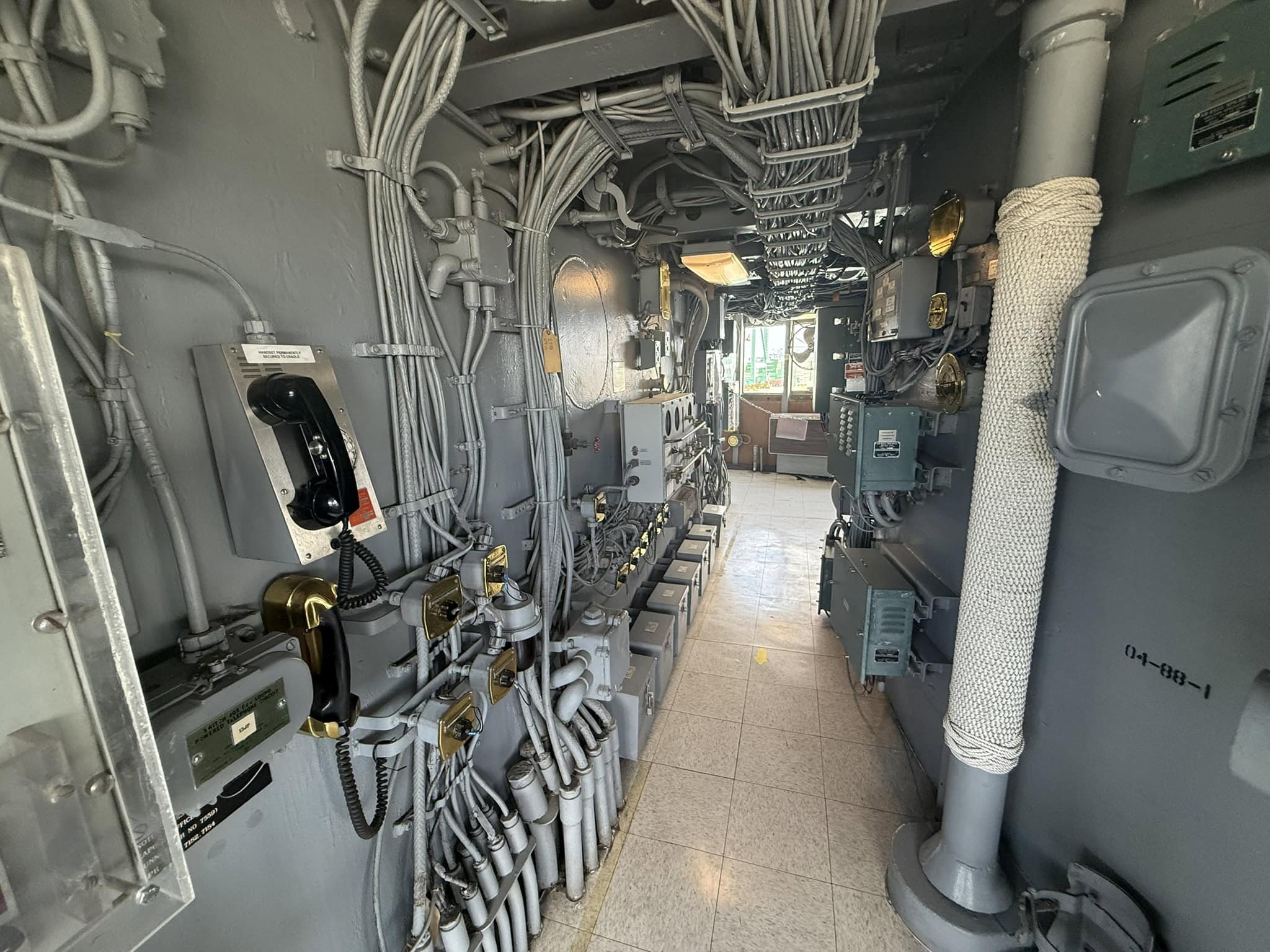
USS Iowa. 19FortyFive.com Image Taken Back in July of 2025.
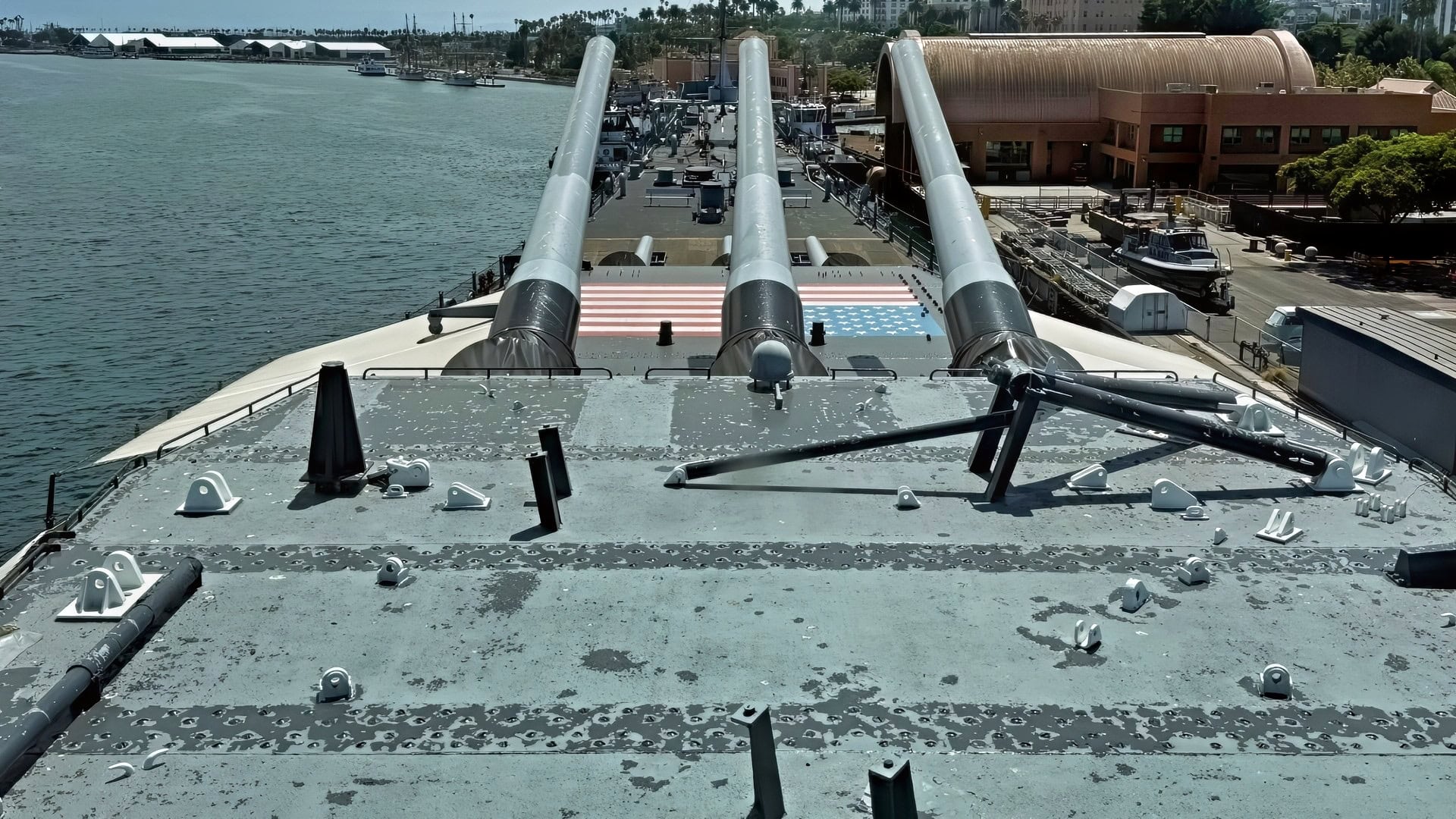
16-Inch Iowa-Class Guns USS Iowa. 19FortyFive.com Image.
Musashi was far wider. Her beam reached about 127 feet 7 inches, compared with 108 feet 3 inches for USS Missouri. The narrow American beam reflected the requirement to pass through the Panama Canal.
Loaded displacement favored the Japanese ship by a wide margin. Musashi approached 71,700 long tons at full load. An Iowa displaced about 58,000 tons when loaded. The Japanese battleship carried roughly 14,000 more tons.
Speed reversed the advantage. Musashi had 150,000 rated shaft horsepower and a speed near 27.5 knots. The Iowa class produced 212,000 shaft horsepower and exceeded 30 knots, with trial and operational figures commonly placed near 33 knots.
Both ships carried nine main guns. Musashi fired 3,219-pound 18.1-inch armor-piercing shells. The Iowa fired 2,700-pound 16-inch Mark 8 projectiles. The Japanese broadside was about 19 percent heavier.
The difference was smaller than the caliber numbers suggested. America’s 16-inch/50 Mark 7 gun launched its 2,700-pound shell at about 2,500 feet per second. The weapon combined a long barrel with the heavy Mark 8 projectile, explaining why the Iowa’s smaller gun remained close in practical striking power.
Musashi possessed thicker armor. Its 16.1-inch belt exceeded Iowa’s approximately 13.5 inches. The 25.6-inch Japanese turret faces were far thicker than the Iowa’s 17-inch faces. Armor quality, angle, internal structure, and shell design complicate any simple comparison based on thickness alone.
The Iowa held the stronger advantage in radar, speed, anti-aircraft fire control, and integration with carrier task forces. American Mk 8 fire-control radar allowed accurate gunnery in darkness and poor visibility. Japanese Type 22 radar had limited fire-control capability and never approached the maturity of the American system.
On paper, Musashi offered the heavier broadside and thicker protection. Iowa offered higher speed, more horsepower, better radar, and a far stronger supporting fleet. That is why a hypothetical Yamato-versus-Iowa battle cannot be settled by shell diameter alone.
No such battle took place. The four completed Iowa-class ships never fired their main guns at an enemy battleship. Musashi never fired at an enemy surface ship of any type.
Musashi Entered Service After Carriers Had Changed the War
Musashi was commissioned two months after Japan lost four fleet carriers at Midway. The battle the ship had been designed to fight was already becoming harder to arrange.
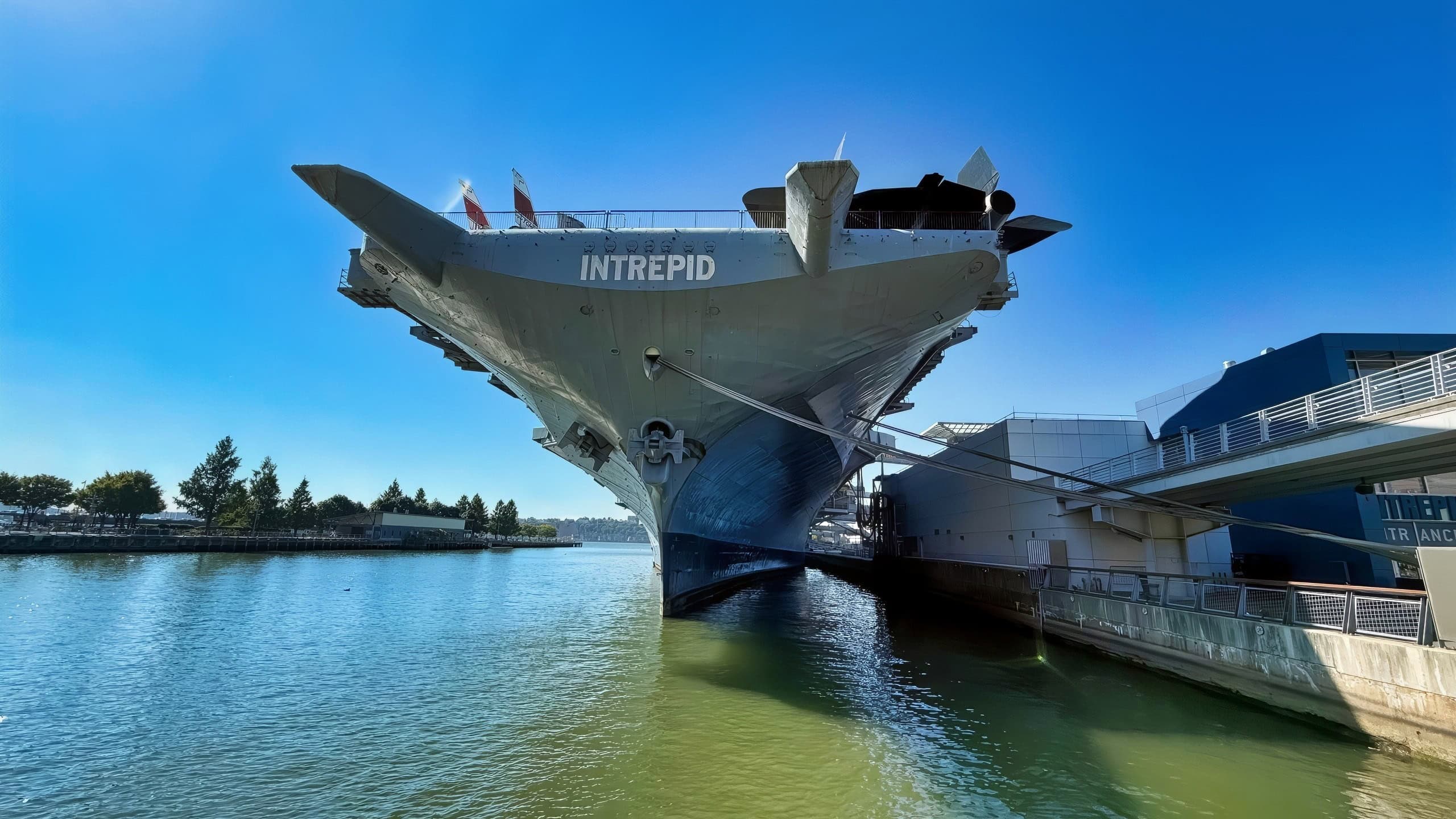
USS Intrepid Essex-Class Aircraft Carrier 19FortyFive.com Photo.
She replaced Yamato as flagship of the Combined Fleet in February 1943 and spent much of the year at Truk. Admiral Isoroku Yamamoto used the ship as his headquarters before his death in April 1943. Musashi later carried his ashes back to Japan.
The battleship sortied several times in response to reports of American fleet activity but made no contact. Fuel shortages, the growing American submarine threat, and the need to preserve the battle line kept Japan’s largest ships away from combat.
The Navy eventually used Musashi as a heavily protected transport. In February 1944, she carried trucks, bombs, torpedoes, ammunition, troops, and thousands of mines to Palau. A battleship designed to destroy American capital ships was moving garrison supplies.
This mismatch between investment and employment shaped the short career described in Musashi’s wider operational history. Japan possessed enormous guns but struggled to bring them within range of an American fleet increasingly organized around aircraft carriers.
USS Tunny Put a Torpedo Into Musashi
American submarine USS Tunny found Musashi leaving Palau on March 29, 1944. One torpedo struck the port bow about 20 feet below the waterline.
The explosion opened a hole approximately 19 feet across, flooded the forward windlass room and hydrophone compartment, and killed seven sailors. Eighteen men became casualties. The battleship took aboard about 2,630 tons of water.
The hit did not stop her. Damage-control teams shored the flooded area, and Musashi cleared the region at 24 knots. She reached Kure for repairs on April 3.
The survival demonstrated the hull’s strength and the depth of reserve buoyancy. The repair period also revealed Japan’s changing priorities. Workers removed two 155mm turrets and filled the space with more anti-aircraft guns.
Musashi Fired Her 18.1-Inch Guns at Aircraft
Musashi joined the Japanese Mobile Fleet during the Battle of the Philippine Sea in June 1944. The main action occurred between carrier air groups rather than battleships.
On June 20, the battleship fired Type 3 incendiary anti-aircraft shells from its main battery at American dive bombers. Each shell weighed almost 3,000 pounds and carried hundreds of incendiary elements intended to create a burning cone ahead of attacking aircraft.
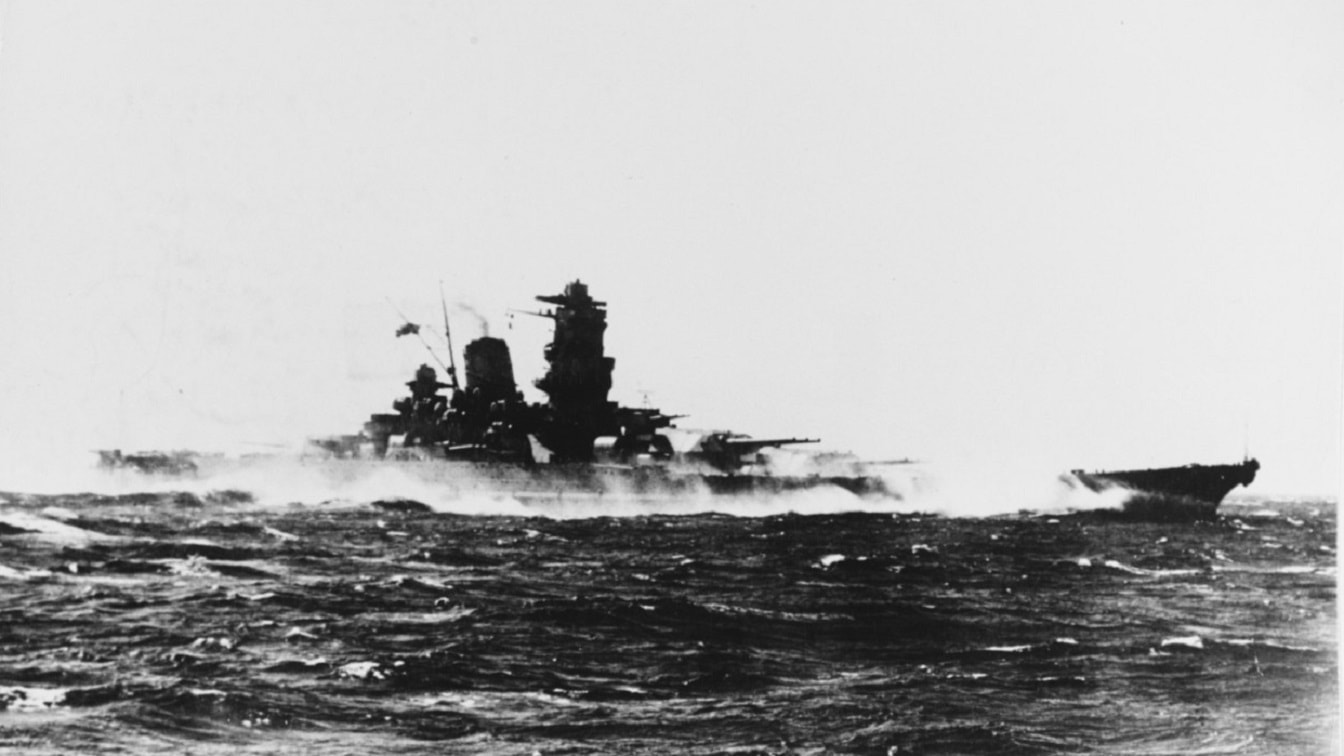
Battleship Yamato-Class. Image Credit: Creative Commons.
The spectacle was more impressive than the effect. American pilots described the huge bursts but did not regard the weapon as an efficient defense. During the same engagement, Musashi’s 25mm gunners mistakenly shot down a Japanese Zero.
The Battle of the Philippine Sea destroyed much of Japan’s remaining carrier aviation. Musashi survived without firing at an American ship.
Musashi Sailed for Leyte Gulf With Kurita’s Center Force
Japan committed its remaining surface fleet after American forces landed in the Philippines in October 1944. Vice Adm. Takeo Kurita’s Center Force included Yamato, Musashi, Nagato, Kongō, Haruna, 10 heavy cruisers, two light cruisers, and destroyers.
The mission required the force to pass through the Sibuyan Sea and San Bernardino Strait, then attack American transports and escort carriers off Leyte. If the plan worked, Musashi’s main guns would finally reach the kind of surface targets for which they had been built.
The force left Brunei on Oct. 22. Musashi carried a ship’s company of 2,399, along with several staff and liaison personnel. American submarines attacked the following morning in the Palawan Passage. USS Darter sank Kurita’s flagship Atago, while USS Dace sank the heavy cruiser Maya.
Musashi took 769 survivors aboard from Maya, placing more than 3,000 people aboard before the fleet entered the Sibuyan Sea.
259 American Carrier Sorties Concentrated on Musashi
American reconnaissance aircraft located Center Force on the morning of Oct. 24. Aircraft from six carriers attacked for more than five hours. The participating flight decks included Intrepid, Cabot, Essex, Lexington, Enterprise, and Franklin.
The attacks totaled 259 sorties against Kurita’s force. Musashi attracted repeated attention because of her size, position, and the damage visible after early strikes.
The first torpedo hit the starboard side near a boiler room shortly after 10:30 a.m. About 3,000 tons of water entered the ship, creating a 5.5-degree list. Counterflooding reduced it to about one degree, and speed remained unchanged.
The next attack brought bomb hits and three more torpedoes. Flooding reached spaces forward of the armored citadel and damaged machinery. One shaft went out of service. Speed fell to 22 knots, and the bow settled about six feet deeper.
Musashi fired Type 3 shells from the main battery as aircraft approached. During one firing sequence, a shell problem disabled the forward turret. Accounts differ over whether a projectile exploded or rebounded during loading. The crew evacuated the turret and flooded its magazines as a precaution.
Further torpedo hits reached both sides. Counterflooding repeatedly corrected the list, but every correction added more water. The battleship dropped to 20 knots, then eight, and finally about six.
The final large wave struck at roughly 3 p.m. Dive bombers hit the forecastle, communications spaces, bridge areas, sickbay, and machinery rooms. Torpedo bombers opened additional sections of the underwater hull. One cluster of explosions tore a 30-foot section from the side near an engine room.
The most accepted modern total is 17 direct bomb hits, 19 torpedo hits, and about 20 damaging near misses. Ten torpedoes hit the port side, and nine struck starboard. The precise locations of several hits remain disputed, but no disagreement changes the scale of the attack.
Musashi’s Armor Survived Longer Than Her Buoyancy
The early attacks did not penetrate the entire armored citadel or detonate the main magazines. Japanese engineers later noted that the protected core remained largely intact after the first nine torpedo hits and seven bomb hits.
The ship sank because flooding spread through the forward hull, machinery spaces, shaft tunnels, and compartments surrounding the protected section. Bulkheads bent, rivets loosened, and water moved into spaces not designed to absorb repeated explosions.
Counterflooding prevented an early capsize, but it also reduced reserve buoyancy. By late afternoon, the bow was more than 26 feet lower than normal, and the forecastle was awash. Sailors moved rice, timber, and other material to starboard in another attempt to control the list. They dropped the port anchor and flooded additional starboard spaces.
Rear Adm. Toshihira Inoguchi tried to beach the battleship, but the remaining engines stopped before she reached shallow water. Kurita detached cruisers and destroyers to assist while the main force moved away.
At 7:15 p.m., with the list reaching 12 degrees, the crew received orders to prepare to abandon ship. Inoguchi remained aboard. The battle flag came down, and the Emperor’s portrait was removed.
At 7:36 p.m., Musashi rolled to port and sank by the bow. The aft 18.1-inch turret fell from its barbette as the stern rose. Two heavy underwater explosions followed.
Of the 2,399 members of Musashi’s crew, 1,023 died. Another 117 survivors from Maya were killed during the attacks or sinking. Japanese destroyers rescued 1,423 members of the battleship’s crew. The United States lost 18 aircraft during the day’s attacks.
The Wreck of Musashi Was Found in 2015
Paul Allen’s research team located the wreck in March 2015 after years of work in the Sibuyan Sea. A remotely operated vehicle found the remains at a depth of roughly 910 meters (about 3,000 feet).
The ship had broken into several major sections. The bow rested upright. The stern lay upside down. The forward superstructure had separated, and much of the central hull had been destroyed by explosions after the ship disappeared beneath the surface.
The immense turrets no longer sat inside their barbettes. The guns Japan built to dominate a surface engagement had never fired at an enemy ship. Their mountings now rested apart from the hull on the floor of the Sibuyan Sea.
About the Author: Harry J. Kazianis
Harry J. Kazianis (@Grecianformula) was the former Senior Director of National Security Affairs at the Center for the National Interest, a foreign policy think tank founded by Richard Nixon in Washington, D.C. Harry has more than a decade of experience in think tanks and national security publishing. His ideas have been published in The New York Times, The Washington Post, The Wall Street Journal, CNN and many other outlets worldwide. He has held positions at CSIS, the Heritage Foundation, the University of Nottingham and several other institutions related to national security research and studies. He is the former Executive Editor of The National Interest and The Diplomat. He holds a master’s degree focusing on international affairs from Harvard University.

