
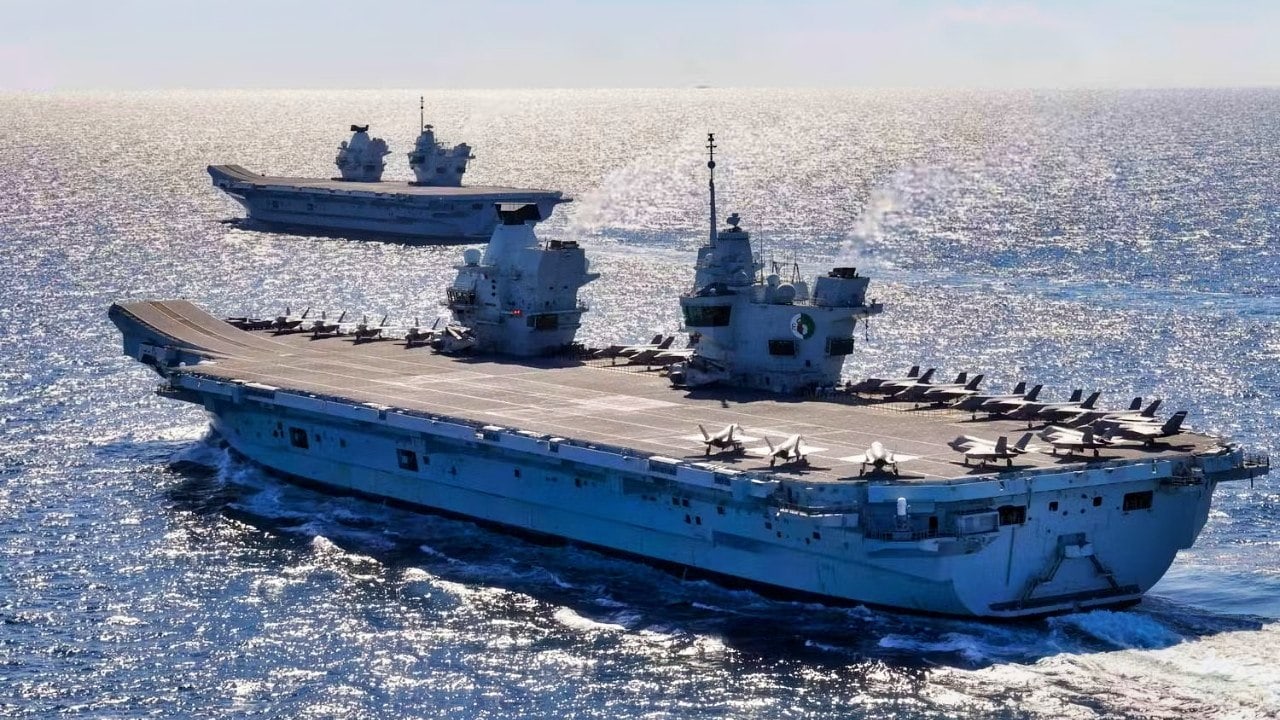
Britain No Longer Needs a 1945 Navy. Its Modern Fleet Is Still Too Small – In August 1945, the Royal Navy had 990 major combat units, defined as frigates and larger warships, including submarines. Fewer than 300 remained active as wartime demobilization began. The figure describes a mobilized force built to fight Germany, Italy, and Japan across several oceans, not a normal peacetime fleet.
By August 2026, the surface escort force had fallen to six Type 45 destroyers and five Type 23 frigates. Britain began the year with seven frigates in service, including one in deep maintenance. The retirement of HMS Iron Duke and HMS Richmond removed two more before a Type 26 or Type 31 replacement had entered service.
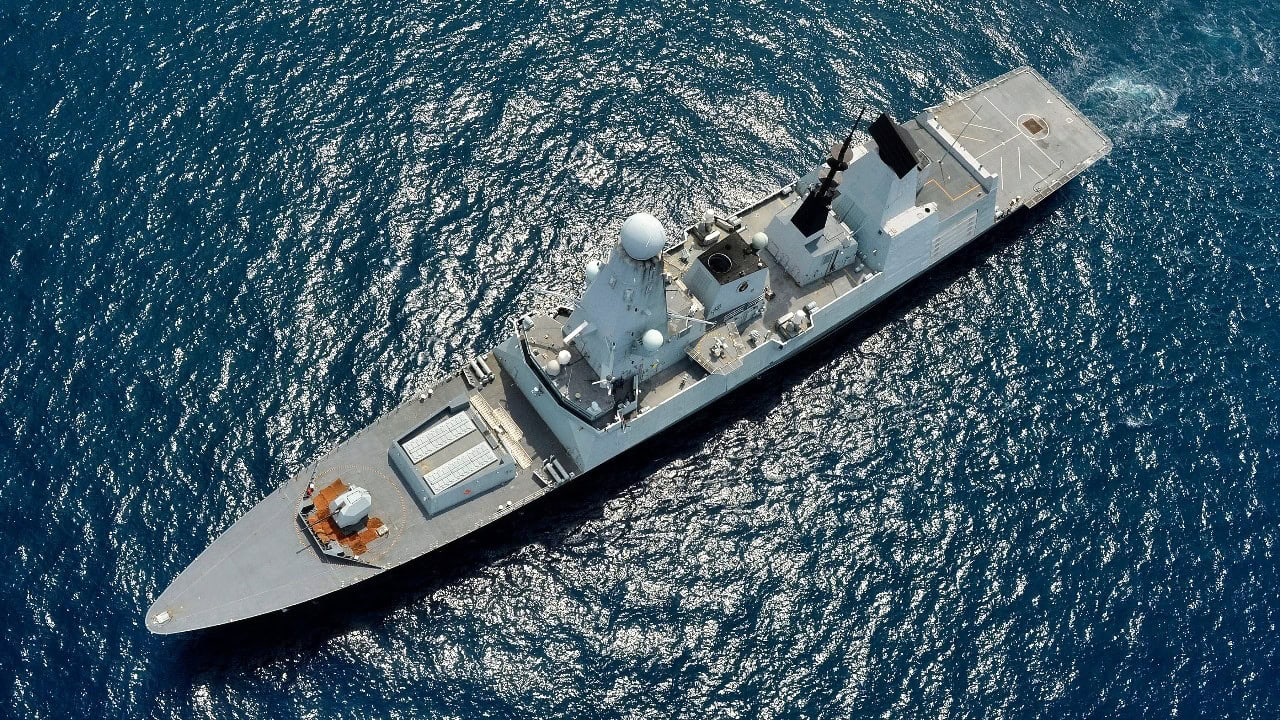
HMS Daring Type 45 Destroyer Royal Navy.
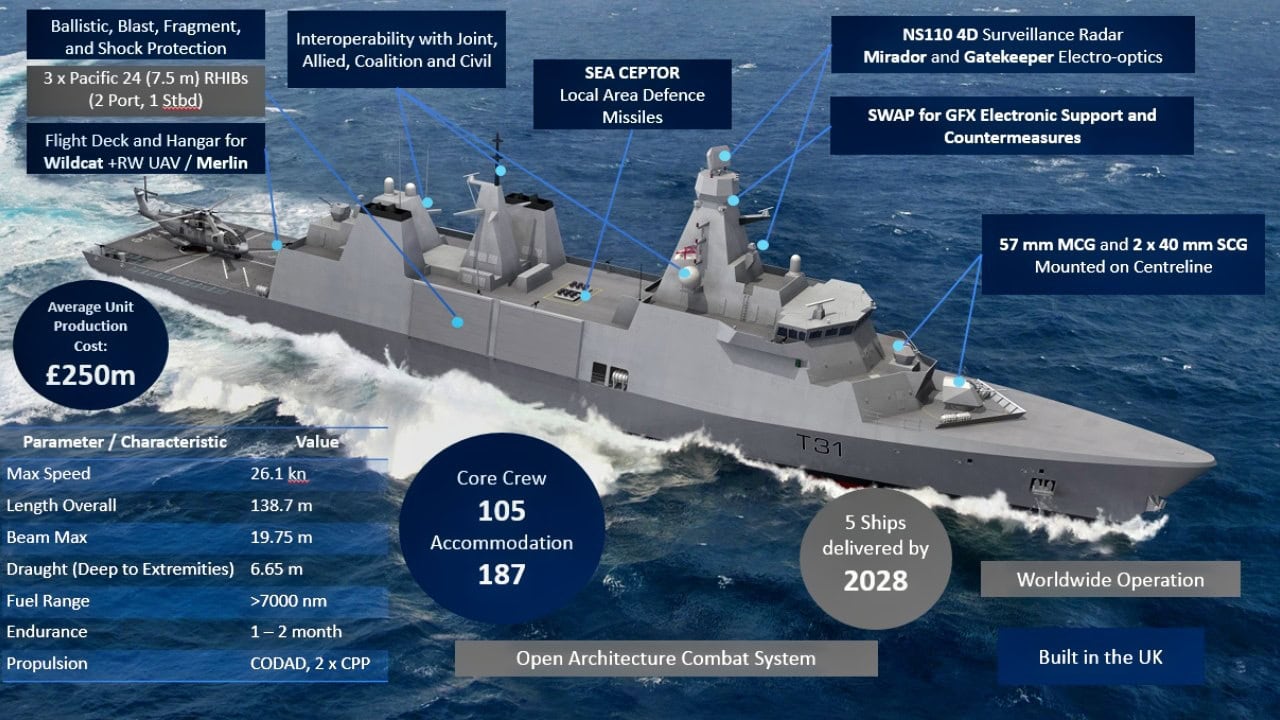
Type 31 Frigate. Image Credit: Royal Navy.
Much of the postwar contraction was unavoidable. Britain emerged from World War II economically exhausted; its empire was breaking apart; the United States had become the leading Western naval power, and guided missiles, nuclear submarines, and jet aircraft made many wartime ships obsolete.
The harder question is where necessary demobilization ended and structural weakness began. The modern fleet still operates two large aircraft carriers, maintains the nuclear deterrent, hunts submarines in the North Atlantic, and supports British commitments from the Falklands to the Indo-Pacific.
Those missions now rest on a much thinner margin of ships and crews.
The 1945 Fleet Began Shrinking Before the War Ended
Britain had already started paying off ships when Japan surrendered. By the winter of 1947, total active strength had fallen to 80. The Home Fleet contained one cruiser, two destroyers, six frigates, and 20 submarines, while manpower and fuel shortages immobilized other vessels.
The Navy briefly rebuilt during the early Cold War. Active strength reached a postwar peak of 123 major units and 145,000 personnel in 1952–1953. In 1959, Parliament recorded an operational fleet of three aircraft carriers, six cruisers, 23 destroyers, and 30 frigates, in addition to submarines and smaller vessels.
That force no longer had to police every route of the British Empire, but it still protected Atlantic shipping, supported NATO, maintained forces east of Suez, and responded to crises from Korea to the Mediterranean. Its size was already a fraction of the 1945 inventory, yet it retained several carrier groups and enough escorts to distribute across separate commands.
The Falklands War Showed What Fleet Depth Still Bought
An Associated Press analysis placed the Royal Navy at 166 vessels in 1975 and 66 in 2025. The categories are more comparable than the 990-unit wartime figure, although changes in ship roles and counting methods still require caution. The numbers help explain why warnings about a Royal Navy shrinking to only a few dozen commissioned hulls carry weight.
Britain assembled a 127-ship task force after Argentina invaded the Falkland Islands in 1982. That total included warships, Royal Fleet Auxiliary vessels, and requisitioned merchant ships rather than 127 combatants. It still demonstrated the depth available to move troops, aircraft, ammunition, fuel, and repair support 8,000 miles from Britain.
The task force lost the destroyers Sheffield and Coventry and the frigates Ardent and Antelope. Other ships suffered damage, yet the force continued fighting. A British-only deployment on the same scale is no longer available. The two Queen Elizabeth-class carriers preserve a major strike capability, but every deployment draws heavily on a small pool of escorts and support ships. Britain once operated far more carrier decks than its current two-ship force.
The Peace Dividend Cut Escorts Faster Than Replacements Arrived
The escort fleet provides the clearest long-term measure. Britain had 50 destroyers and frigates in 1990. The total fell to 23 by 2010 and 19 by 2015. A parliamentary committee warned that the 19-ship plan contained little redundancy for breakdowns, unexpected deployments, or combat losses.
Reuters reported that the Navy had about 62,000 personnel, three carriers, and roughly 50 destroyers and frigates in 1991. By April 2026, it had about 38,000 personnel, two carriers, and 13 escorts. The retirement of Iron Duke and Richmond then reduced the formal destroyer-frigate total to 11.
The Type 45 program captured the pattern. The Navy originally expected 12 air-defense destroyers. The planned buy fell to eight and then six, even though the requirement to keep five ships available at sea remained unchanged. The six completed destroyers are far more capable than the Type 42s they replaced, but one prolonged refit or machinery problem removes a much larger share of the class.
Modern quality matters. It does not erase geography. A destroyer protecting a carrier cannot simultaneously escort shipping in the Red Sea, monitor Russian vessels near Britain, and reinforce the eastern Mediterranean. The 2015 parliamentary warning was blunt: numbers matter because a ship cannot be in two places at once.
The Modern Royal Navy Still Holds High-End Capabilities
The fleet is not a hollow collection of old hulls. HMS Queen Elizabeth and HMS Prince of Wales each displace 65,000 tonnes and operate F-35B fighters. Six Type 45s provide sophisticated area air defense. Five Astute-class attack submarines are listed in active service, a sixth has been commissioned and a seventh is under construction. Four Vanguard-class submarines maintain the continuous nuclear deterrent.
In 2026, HMS Prince of Wales led a carrier group into the North Atlantic and High North with HMS Duncan, tanker RFA Tidespring, F-35Bs, helicopters, and uncrewed systems.
Frigate HMS Somerset and a French destroyer later joined, while British aircraft used the Royal Air Force and Italian tankers for long-range sorties. The deployment demonstrated real carrier power and the degree to which Britain now generates it through NATO integration.
A modern destroyer has radar, missiles, data links, and defensive systems that no 1945 escort possessed. One Astute performs missions once assigned to several conventional submarines
The smaller force therefore delivers more capability per hull, but the cost and complexity concentrated in a few ships lengthen repairs and make every unavailable vessel more consequential.
A carrier also requires escorts, aircraft, tankers and trained personnel before its size becomes usable combat power.
The Replacement Fleet Is Arriving After the Old One Leaves
Britain plans eight Type 26 anti-submarine frigates and five Type 31 general-purpose frigates.
The government also intends to buy at least six Common Combat Vessels from the early 2030s to take over the Type 45 air-defense role and coordinate uncrewed systems.
Those programs give the Royal Navy a route back toward greater numbers, but the transition has produced the present gap. Four of the five Type 31s were under construction by February 2026, while the Type 26 program remained in build.
When the Navy announced the retirement of Iron Duke and Richmond on July 13, neither replacement class had entered service.
About the Author: Harry J. Kazianis
Harry J. Kazianis (@Grecianformula) was the former Senior Director of National Security Affairs at the Center for the National Interest (CFTNI), a foreign policy think tank founded by Richard Nixon based in Washington, DC. Harry has over a decade of experience in think tanks and national security publishing. His ideas have been published in the NY Times, The Washington Post, The Wall Street Journal, CNN, and many other outlets worldwide. He has held positions at CSIS, the Heritage Foundation, the University of Nottingham, and several other institutions related to national security research and studies. He is the former Executive Editor of the National Interest and the Diplomat. He holds a Master’s degree focusing on international affairs from Harvard University.

