
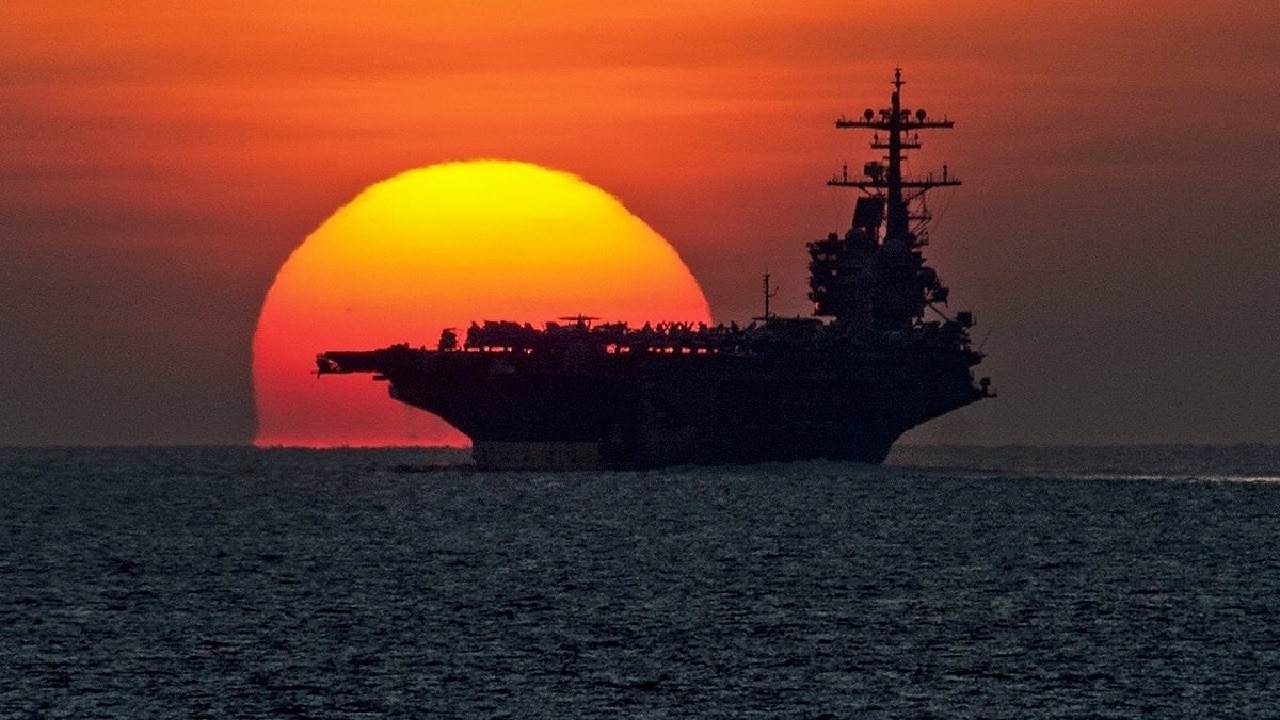
Operation Epic Fury provided US Navy aircraft carrier strike groups (CSGs) with a major test, requiring the platforms to sustain high-tempo operations against an adversary deploying asymmetric threats such as missiles and drones. US Navy aircraft carriers performed well enough—at least in isolation—but questions were raised about how long that performance could be sustained.
While carriers provide something land-based aviation cannot—namely, a mobile, sovereign airfield that can reposition without host-nation permission and generate repeated fighter strikes—Epic Fury also demonstrated what critics have warned about: carriers are increasingly vulnerable to inexpensive missiles and drones. This vulnerability forces the CSG to expend weapons and fuel, pushes the carrier farther offshore, and generally makes participation in the fight harder to sustain.
Aircraft Carrier Contributions
What US aircraft carriers contributed to Epic Fury was persistent tactical aviation close to the theater. CSG air wings can generate F/A-18 Super Hornet strikes and defensive sorties, EA-18G Growler electronic warfare, F-35C stealth operations, E-2D Hawkeye airborne early warning and battle management, and helicopters for logistics, surveillance, and rescue.
This makes the carrier much more than a platform launching bombs. It functions as an integrated aviation ecosystem, capable of detecting threats, coordinating engagements, suppressing defenses, and attacking targets.
And during Epic Fury, aircraft carrier assets were called upon to defend US naval forces against Iranian drones and missiles.
Extensive Support
Of course, the carrier itself doesn’t operate as an isolated vessel. Its survival and function depend upon the surrounding CSG, especially the Arleigh Burke-class destroyer equipped with the Aegis Combat System.
The CSG’s defensive architecture is layered, with fighters intercepting threats at long range, Aegis ships detecting and engaging missiles farther out, Standard Missiles providing multiple defensive engagement options, ESSM and other shorter-range weapons offering a close-in layer, and CIWS serving as a last-ditch defensive capability.
Therefore, the carrier’s operational success depends heavily on aircraft, radar networks, electronic warfare, and escort ships that can operate as a unified defensive system.
The Cost of Business
Iran imposes a cost—even without sinking an aircraft carrier.
Anti-ship ballistic missiles, cruise missiles, drones, and submarines can potentially force commanders to operate the carrier from farther away. The mere threat of penetrating a carrier’s defensive shield affects a commander’s decision-making, as the $10 billion-plus carrier is arguably the most concentrated and valuable military asset in human history. Loaded with thousands of personnel and dozens of aircraft, the carrier simply cannot be lost. So any viable threat will force operational trade-offs.
In Epic Fury, that threat forced carriers to operate several hundred miles farther away. While this may seem trivial, it causes significant, cascading operational complications.
Sortie duration increases, which causes increased reliance on tankers, which increases fuel consumption, while pilot fatigue increases and aircraft flight hours increase, which spikes the aircraft’s maintenance burden.
Everything compounds, increasing costs, reducing effectiveness, and accelerating wear.
The air wing’s efficiency can be degraded without the enemy ever hitting the ship itself. And while the carrier is nuclear-powered and can operate for years without refueling, the air wing is more conventionally limited. F/A-18s, for example, still consume enormous quantities of JP-5 aviation fuel; every sortie consumes spare parts, weapons, and maintenance hours.
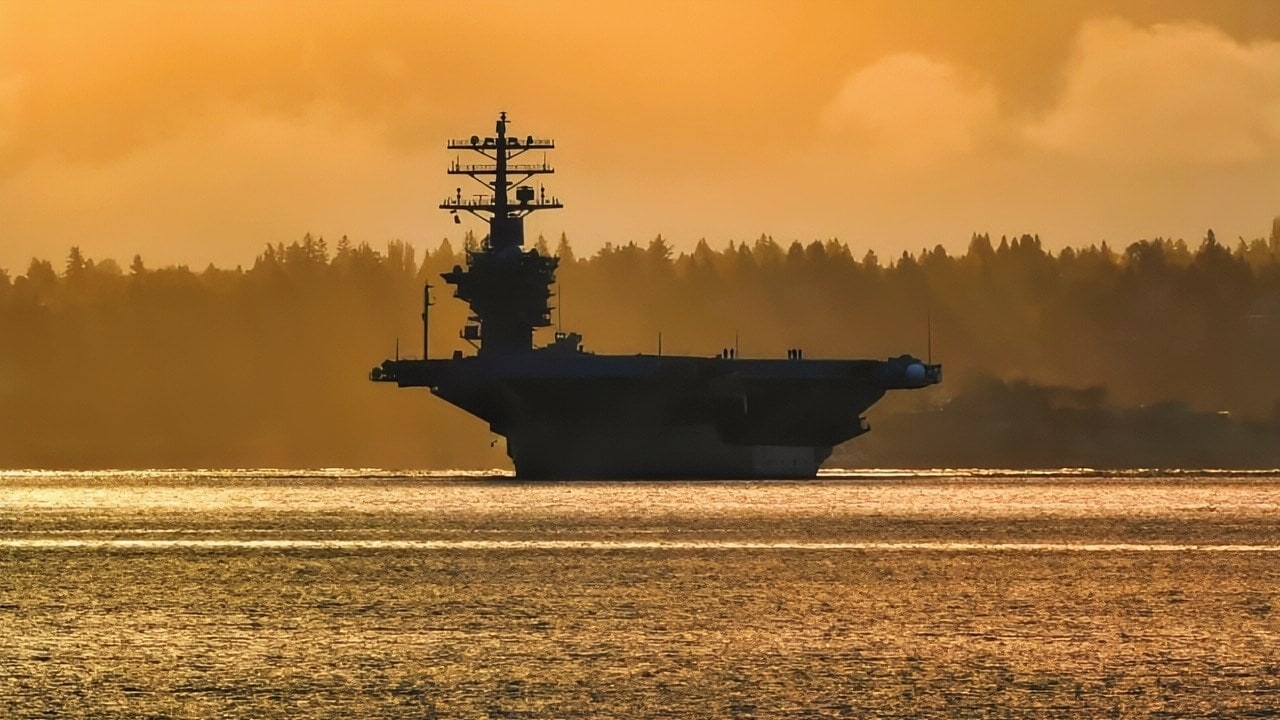
MANCHESTER, Wash. (April 28, 2017) USS Nimitz (CVN 68) transits Puget Sound, past the Seattle skyline enroute to its homeport, Naval Base Kitsap-Bremerton. The return to homeport marks the end of an underway along with its Carrier Strike Group 11, having successfully completed its final pre-deployment assessment, Composite Training Unit Exercise, April 21, and is now fully certified to deploy later this year. (U.S. Navy photo by Mass Communication Specialist 2nd Class Vaughan Dill/Released
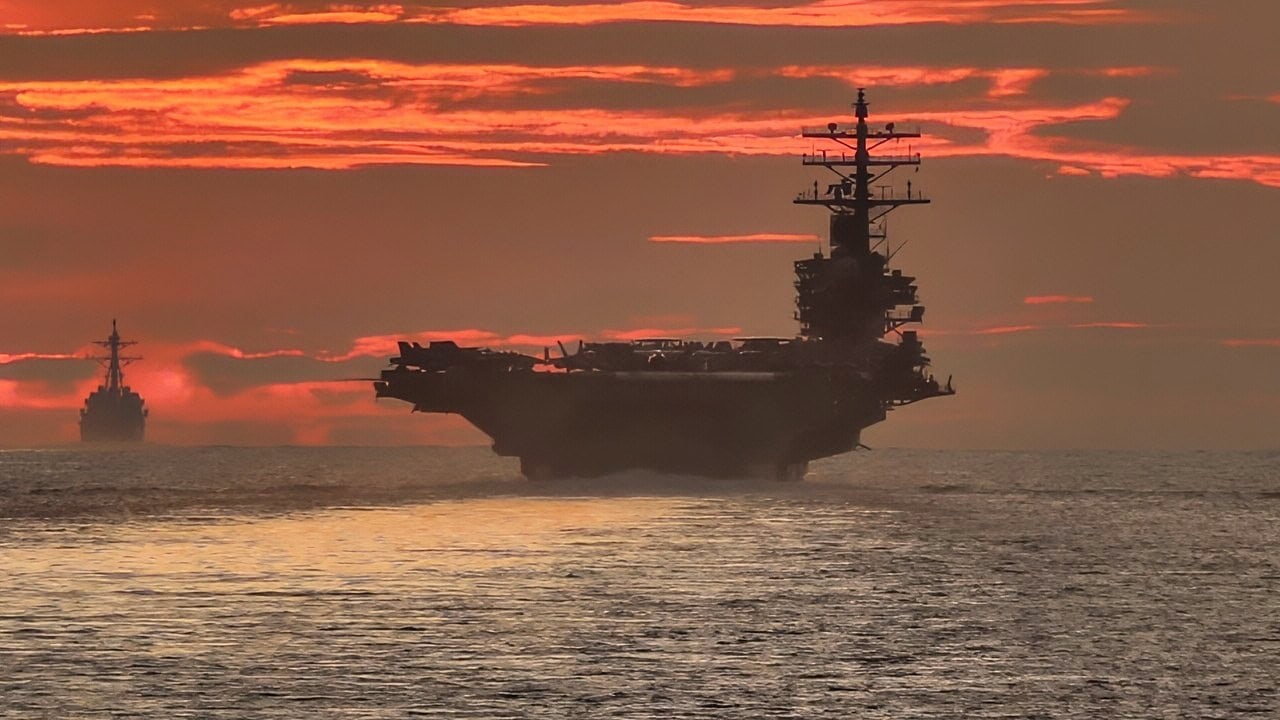
210618-N-JW440-2165 STRAIT OF MALACCA (June 18, 2021) As seen from the Ticonderoga-class guided-missile cruiser USS Shiloh (CG 67), the Navy’s only forward-deployed aircraft carrier USS Ronald Reagan (CVN 76) transits the South China Sea with the Arleigh Burke-class guided missile destroyer USS Halsey (DDG 97). The ships are part of Task Force 70/Carrier Strike Group 5, conducting underway operations in support of a free and open Indo-Pacific. (U.S. Navy Photo by Mass Communication Specialist 1st Class Rawad Madanat)
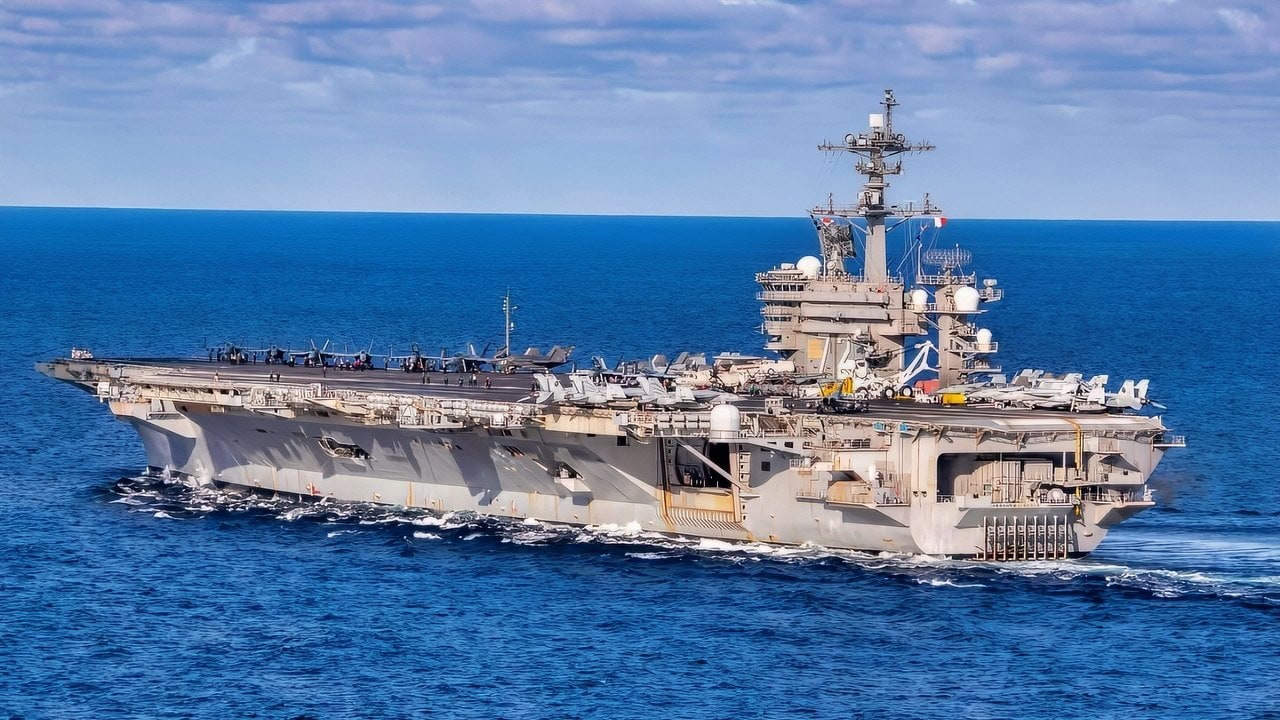
Nimitz-Class Aircraft Carrier At Sea. Image Credit: Creative Commons.
Operating from greater distances from targets also creates complications. Aerial refueling becomes more important because fighters operate from so far away. This means the carrier and its aircraft are increasingly forced to depend on a much larger logistical network—in the case of aerial refueling, relying upon another branch of the military (the Air Force).
Thinning Fleet
The US was also confronted with the fact that carriers are scarce. Despite operating the world’s largest carrier fleet, America’s global commitments stretch the fleet thin. Between Indo-Pacific, European, and Middle Eastern (and lately Caribbean) commitments, and between maintenance, refueling, and upgrade cycles, the hulls available to participate in Epic Fury were limited relative to the theater’s demands.
This led to prolonged deployments, which led to their own set of problems.
For a limited campaign, US carriers performed well enough, showing that they remain relevant in modern conflict.
Nothing can provide tactical aviation to an inconvenient location like a carrier. But global commitments, paired with emerging asymmetric threats and constraints on the larger support network, have called into question the US carrier fleet’s ability to sustain a high-intensity conflict.
MORE – Iran Would Love the Su-57 Felon Stealth Fighter
About the Author: Harrison Kass
Harrison Kass is a writer and attorney focused on national security, technology, and political culture. His work has appeared in Tablet, City Journal, The Hill, The Spectator, and The Cipher Brief. He holds a JD from the University of Oregon and a master’s in Global & Joint Program Studies from NYU. More at harrisonkass.com.